タグ: Figma

  • The Best Bleach Figures for Collectors: A Buying Guide by Character and Type

    The Best Bleach Figures for Collectors: A Buying Guide by Character and Type

    Affiliate Disclosure: This post contains affiliate links. If you buy through one of them, I may earn a small commission at no extra cost to you. I only recommend stores I’ve actually ordered from or researched thoroughly — my opinions are my own.

    The Problem: A Franchise That Went Quiet, Then Came Roaring Back

    Bleach is a genuinely interesting case study in how anime merchandise timing works: the manga wrapped up years ago, and figure releases slowed to match. Then the Thousand-Year Blood War anime adaptation brought the franchise back into the spotlight, and the figure catalog picked up dramatically — new sculpts, new lines, and a level of manufacturer attention the franchise hadn’t seen in years.

    Following the same approach I’ve used for Dragon Ball this guide applies my general figure-buying framework specifically to Bleach’s catalog.

    Who This Article Is NOT For

    • If you haven’t read my Nendoroid vs Figma vs Scale Figure guide yet, start there first.
    • If you’re specifically hunting original-series (pre-Thousand-Year Blood War) figures from the franchise’s first anime run, expect more secondhand searching, since current manufacturer attention is concentrated heavily on Thousand-Year Blood War designs.
    • If you’re not familiar with the “revival” pattern in anime merchandising, it’s worth knowing this is genuinely common — a completed or dormant manga getting a new anime adaptation frequently restarts figure production, and Bleach is one of the clearer recent examples.

    The Manufacturers Actively Producing Bleach Figures

    ManufacturerLine(s)Style
    Bandai Spirits / Tamashii NationsS.H.FiguartsHighly articulated figures with extensive effect-part sets, built specifically to recreate signature techniques like Getsuga Tensho
    Bandai Spirits / Tamashii NationsFiguarts ZERODynamic static sculpts with built-in battle effects
    BanprestoIchibansho/Masterlise, Solid and SoulsLarge-format premium prize statues (some standing nearly 10 inches) alongside standard prize lines
    MegaHouseLook Up (Rukappu), G.E.M. Series, Mega Cat ProjectA distinctive sitting-figure format shared with other popular franchises, plus a precision-sculpted premium prize-adjacent line and a chibi cat-themed novelty line

    Bleach also has an active Ichiban Kuji presence (the ongoing “Stirring Souls” series, for example), regularly introducing new character designs tied to the Thousand-Year Blood War storyline.

    Matching Character to Format

    Ichigo Kurosaki, as the franchise’s central character, has by far the deepest catalog — S.H.Figuarts alone has released multiple versions covering different forms (Bankai, Dual Zangetsu, and others), each with extensive interchangeable parts for recreating specific signature moves.

    Signature techniques and Bankai forms are where S.H.Figuarts’ effect-part sets genuinely matter — these releases are specifically engineered with swappable hands, expressions, and technique-effect pieces (Getsuga Tensho energy effects, multiple sword configurations) rather than a single static pose.

    Major antagonists and supporting cast from the Thousand-Year Blood War arc are seeing particularly strong support right now, reflecting the anime adaptation’s current storyline focus — a good area to watch if you’re after recent, arc-accurate designs.

    If you want something outside the standard articulated/scale format lineup, MegaHouse’s Look Up series offers the same charming sitting-figure format that’s proven popular across several franchises, as a lower-footprint alternative.

    A Note on the Revival Effect

    Bleach is a genuinely useful example of the pattern I’ve covered in my guide to catching figure announcements for new and airing content — merchandise attention tracks demonstrated current popularity, and an anime adaptation of previously-completed source material can meaningfully reignite a figure catalog. If you’re a fan of a franchise that’s gone quiet on merchandise, a new adaptation announcement is worth watching closely.

    Where to Actually Buy Bleach Figures

    Given the renewed release schedule tied to Thousand-Year Blood War, it’s worth checking your preferred trusted retailer directly for current stock. Solaris Japan maintains a dedicated Bleach collection, worth checking directly for current stock. CDJapan is also worth checking for broader searches and preorders on recent announcements.

    Which Should You Buy First? (By Priority)

    “I want an affordable entry point.” A Banpresto prize figure of Ichigo or a favorite character — accessible pricing with the franchise’s renewed release attention keeping the catalog fresh.

    “I want something that captures a signature technique.” An S.H.Figuarts release with included effect parts — this line exists specifically to recreate the franchise’s most iconic combat moments.

    “I want a large, imposing display piece.” Banpresto’s Ichibansho/Masterlise line, which favors larger-format premium statues over standard prize sizing.

    “I want something different from the usual formats.” MegaHouse’s Look Up series or Mega Cat Project offer distinctive, lower-footprint alternatives to a standard figure.

    Frequently Asked Questions

    Why does Bleach’s figure catalog feel more active recently than a few years ago? The Thousand-Year Blood War anime adaptation significantly revived manufacturer attention on the franchise, following a period of relatively quiet merchandise output after the original manga concluded — a good example of how adaptations can restart a dormant catalog.

    Is it hard to find original-series (pre-TYBW) Bleach figures? Generally yes, relative to current Thousand-Year Blood War-focused releases — current manufacturer attention is concentrated on the newer arc, so older designs often require more secondhand searching. My guide to buying secondhand safely is worth pairing with that search.

    Is Bleach merchandise at meaningful bootleg risk? Any popular, high-demand franchise carries elevated counterfeiting risk — see my general bootleg guide for the checks that apply here as much as anywhere else.

    What’s the difference between S.H.Figuarts and Figuarts ZERO for this franchise? S.H.Figuarts is fully articulated, built for hands-on posing and technique recreation with swappable parts; Figuarts ZERO is a static sculpt with built-in dynamic effects baked directly into the piece — similar tradeoff to what I’ve covered for other action-focused franchises on this site.

    Final Thoughts

    Bleach’s figure catalog is a genuinely good illustration of how anime merchandising responds to renewed popularity — the Thousand-Year Blood War adaptation turned a relatively quiet catalog back into an actively supported one, with S.H.Figuarts’ technique-focused releases and Banpresto’s large-format prize statues leading the current wave. Whether you’re chasing a signature Bankai moment or just want an accessible entry point, matching format to what draws you to the franchise is the right starting approach.

    If you haven’t already, my Nendoroid vs Figma vs Scale Figure guide and comparison of trusted retailers are the foundational reads before diving further into this catalog.
  • The Best Dragon Ball Figures for Collectors: A Buying Guide by Character and Type

    The Best Dragon Ball Figures for Collectors: A Buying Guide by Character and Type

    Affiliate Disclosure: This post contains affiliate links. If you buy through one of them, I may earn a small commission at no extra cost to you. I only recommend stores I’ve actually ordered from or researched thoroughly — my opinions are my own.

    The Problem: The Same Character Has Been Redesigned Across Four Different Eras

    Dragon Ball’s figure catalog carries a specific complication most other franchises don’t have to the same degree: the franchise spans Dragon Ball Z, Dragon Ball Super, Dragon Ball GT, and the newer Dragon Ball Daima, and the same character can look meaningfully different across each era — before you even get into the dozens of power-up forms within a single series. Picking “a Goku figure” isn’t really one decision; it’s several.

    Following the same approach I’ve used for One Piece, and Naruto, this guide applies my general figure-buying framework specifically to Dragon Ball’s catalog.

    Who This Article Is NOT For

    • If you haven’t read my Nendoroid vs Figma vs Scale Figure guide yet, start there first.
    • If you only want US-market, domestically available figures without importing, note that Bandai’s Dragon Stars line (a separate American toy line) may suit you better than the Japan-focused imports covered here.
    • If you’re not sure which series era you’re actually a fan of, it’s worth figuring that out before buying — Z, Super, GT, and Daima each have meaningfully different visual styles for the same characters.

    The Manufacturers and Lines Actively Producing Dragon Ball Figures

    ManufacturerLine(s)Style
    Bandai Spirits / Tamashii NationsS.H.FiguartsThe franchise’s largest and longest-running articulated line — over 200 releases since 2009, covering nearly every major character, form, and era
    Bandai Spirits / Tamashii NationsFiguarts ZERO / EXTRA BATTLEDynamic static sculpts with built-in energy and battle effects
    BanprestoIchibansho/Masterlise, Grandista, Match Makers, Blood of Saiyans, History BoxA wide spread of budget-to-mid-tier prize figures, spanning different sculptural styles and price points
    MegaHouseDesktop Real McCoySmaller, charming diorama-style petit figures, often featuring character pairs
    Various (HQS Plus)Ultra-premium 1/6 scale limited statuesThe franchise’s top-tier collector statues — comparable in positioning to Naruto’s Tsume Art HQS line

    A note for US-based buyers: Bandai also produces a separate domestic toy line called Dragon Stars, sold through normal US retail channels rather than imported from Japan — worth knowing about if you’d rather avoid international shipping for a more toy-oriented (rather than premium collector-oriented) figure.

    Matching Character, Form, and Era to Format

    Central characters across every era (Goku and Vegeta especially) have by far the deepest catalog, spanning every manufacturer, era, and price tier — if you’re not sure where to start, either character is a safe bet for availability.

    Specific transformation forms (Super Saiyan levels, Super Saiyan God, Ultra Instinct, and similar) are where S.H.Figuarts and Figuarts ZERO’s effect parts genuinely matter — these lines are built specifically to distinguish between forms visually, often through included aura or energy-effect accessories, rather than requiring you to imagine the power-up yourself.

    Villains and major antagonists (Frieza, Cell, Majin Buu, and similar) show up across nearly every line, from budget Banpresto prize figures to premium HQS Plus statues — a good franchise for building out a villain-focused display if that’s your preference.

    If you’re specifically loyal to one era’s art style (Z vs. Super vs. GT vs. Daima), check the listing carefully before buying — the same character name can refer to meaningfully different character designs depending on which era a specific figure is sculpted after.

    A Note on Ultra-Premium Statues

    Similar to Naruto’s Tsume Art tier, Dragon Ball has its own ultra-premium collector statue category through lines like HQS Plus — limited-edition 1/6 scale pieces built for serious, dedicated collectors rather than casual buyers. Treat this as a tier to grow into once you have a clear sense of your favorite characters and moments, not a typical starting point.

    Where to Actually Buy Dragon Ball Figures

    Given the franchise’s long history and huge catalog, it’s worth checking your preferred trusted retailer directly, since availability spans both current releases and older, harder-to-find pieces from earlier eras. Solaris Japan maintains a dedicated Dragon Ball collection, worth checking directly for current stock. CDJapan is also worth checking for broader searches and preorders on recent announcements.

    Which Should You Buy First? (By Priority)

    “I want an affordable entry point.” A Banpresto prize figure (Ichibansho, Match Makers, or similar) of Goku or your favorite character — accessible pricing with a wide selection to choose from.

    “I want something that captures a specific transformation.” An S.H.Figuarts or Figuarts ZERO piece with included effect parts for the specific power-up form you’re after.

    “I want a smaller, charming display piece.” MegaHouse’s Desktop Real McCoy line offers character-pair dioramas at a more modest size and price than premium scale statues.

    “I’m a dedicated collector chasing the definitive version of a favorite character.” Research the HQS Plus line, understanding this is a genuine investment-tier purchase rather than a casual one.

    Frequently Asked Questions

    Why does the same character look different across different Dragon Ball figures? The franchise spans multiple distinct eras (Z, Super, GT, Daima) with genuinely different character designs for the same characters, plus dozens of transformation forms within each era — always check which specific era and form a figure represents before buying.

    What’s the difference between S.H.Figuarts and Dragon Stars? S.H.Figuarts is a premium, Japan-produced articulated line aimed at serious collectors; Dragon Stars is a separate, more toy-oriented domestic US line sold through normal retail channels. They serve different collecting goals and budgets.

    Is Dragon Ball merchandise at meaningful bootleg risk? Given the franchise’s decades-long popularity and huge catalog with many discontinued pieces, yes — the same caution from my general bootleg guide applies strongly here.

    Should I collect figures from one specific era, or mix eras on my shelf? This is entirely personal preference — some collectors focus on a single era’s art style for visual consistency, while others enjoy mixing designs across eras to show the character’s full history. Neither approach is more “correct” than the other.

    Final Thoughts

    Dragon Ball’s figure catalog rewards knowing which era, form, and price tier you’re actually after before you start browsing — the franchise’s decades-long history means “a Goku figure” can mean dozens of meaningfully different things. Start with an accessible tier and a specific era or form you’re genuinely drawn to, and treat the ultra-premium HQS Plus tier as something to grow into.

    If you haven’t already, my Nendoroid vs Figma vs Scale Figure guide and budgeting guide are useful companion reads before diving further into this catalog.
  • The Best Naruto Figures for Collectors: A Buying Guide by Character and Type

    The Best Naruto Figures for Collectors: A Buying Guide by Character and Type

    Affiliate Disclosure: This post contains affiliate links. If you buy through one of them, I may earn a small commission at no extra cost to you. I only recommend stores I’ve actually ordered from or researched thoroughly — my opinions are my own.

    The Problem: Naruto’s Catalog Spans a Wider Price Range Than Almost Any Other Franchise

    Naruto has been running long enough, and popular enough, that its figure catalog stretches from budget lottery prizes worth a few dollars all the way up to museum-grade resin statues that cost more than most people’s entire monthly figure budget. Understanding where you actually want to land on that spectrum matters more here than for most franchises.

    Following the same approach I’ve used for Frieren this guide applies my general figure-buying framework specifically to Naruto’s catalog.

    Who This Article Is NOT For

    • If you haven’t read my Nendoroid vs Figma vs Scale Figure guide yet, start there first.
    • If a five- or six-figure yen budget for a single statue sounds absurd to you, that’s a completely reasonable reaction — the ultra-premium tier covered below is a genuine niche within a niche, not a typical starting point.
    • If you’re specifically hunting original-series (pre-Shippuden) merchandise, availability skews heavily toward Shippuden-era releases in the current catalog — expect more secondhand hunting for earlier-series pieces.

    The Price Tiers of Naruto Figures

    Naruto’s catalog is genuinely useful to think about in tiers, since the price range is unusually wide even by anime figure standards:

    TierExamplesRough Price Range
    Budget prize figuresBanpresto Ichibansho, World Collectable FigureRoughly ¥3,500–7,000 in Japan — a genuine bargain compared to marked-up Western retail pricing
    Mid-tier dynamic/statue linesGrandista, Masterlise, Figuarts ZERO / EXTRA BATTLEModerate pricing, larger and more detailed than standard prize figures
    Premium articulated action figuresS.H.Figuarts, Medicom’s MAFEXRoughly ¥8,000–12,000+, built for serious posability and accessory sets
    Ultra-premium resin statuesTsume Art’s HQS lineRoughly ¥80,000–180,000 depending on character — genuinely museum-tier pieces aimed at the most dedicated collectors

    Matching Character to Format

    Naruto and other central protagonists have the deepest catalog across every tier, from budget Ichibansho prizes to premium S.H.Figuarts releases with extensive accessory sets (multiple interchangeable hands, facial expressions, and technique-effect parts).

    Combat techniques and transformation forms (Sage Mode, Kurama Link Mode, and similar) are where S.H.Figuarts and Figuarts ZERO’s built-in effect parts genuinely pay off — these figures are specifically engineered around recreating iconic technique moments, not just standing poses.

    Antagonists and dramatic character moments (Madara, Itachi, and similar) show up frequently in the Grandista and Masterlise lines, which favor imposing, large-scale sculptural presentation over articulation.

    If you’re a genuinely dedicated collector chasing the absolute best version of a specific character, Tsume Art’s HQS line is worth knowing about even if you never buy one — pieces like their Minato Namikaze statue are consistently cited as some of the finest Naruto figures ever produced, and command real secondhand premiums as a result.

    A Note on Arc-Tied Ichiban Kuji

    Naruto has a long history of Ichiban Kuji releases tied to specific story arcs (the Kazekage Rescue Arc, for example), each with its own tiered prize lineup. If you’re after a figure of a specific character in a specific arc-accurate design, checking Ichiban Kuji history for that arc is often more fruitful than searching standard figure lines alone.

    Where to Actually Buy Naruto Figures

    Given the franchise’s decades-long catalog, it’s worth checking your preferred trusted retailer directly, since availability spans both current releases and older, harder-to-find pieces. Solaris Japan maintains a dedicated Naruto collection, worth checking directly for current stock. CDJapan is also worth checking for broader searches and preorders on recent announcements.

    Which Should You Buy First? (By Priority)

    “I want an affordable entry point.” A Banpresto Ichibansho prize figure — genuinely good value, especially compared to marked-up Western retail pricing on the same pieces.

    “I want something that captures a signature jutsu or technique.” An S.H.Figuarts piece with technique-effect parts included, or Figuarts ZERO/EXTRA BATTLE for built-in dynamic effects without full articulation.

    “I want an imposing, large-scale display piece.” Grandista or Masterlise — favored for their large, dramatic sculptural presentation.

    “I’m a serious collector chasing the best possible version of my favorite character.” Research Tsume Art’s HQS line — understand this is a genuine investment-tier purchase, not a casual one, and budget accordingly.

    Frequently Asked Questions

    Why is there such a big price gap between Naruto figure tiers? The franchise’s long history and broad popularity support manufacturers targeting very different collector budgets simultaneously — from mass-produced lottery prizes to hand-finished premium resin statues aimed at serious, dedicated collectors.

    Are Ichibansho prize figures actually worth buying for this franchise? Yes, generally — Naruto’s Ichibansho pricing in Japan is notably reasonable, and buying through a trusted Japan-based retailer avoids the substantial markup these pieces often see through Western resellers.

    Is Tsume Art’s HQS line worth the price for a casual fan? Probably not — this tier is built for serious, dedicated collectors chasing the definitive version of a specific character, not a typical entry point. If you’re newer to collecting this franchise, start with a more accessible tier first.

    Should I expect to find original-series (pre-Shippuden) merchandise easily? Not as easily as Shippuden-era pieces — current catalogs skew heavily toward Shippuden and later content, so original-series hunting often means more secondhand searching. My guide to buying secondhand safely is worth pairing with that search.

    Final Thoughts

    Naruto’s figure catalog rewards knowing which price tier actually fits your goals — a budget Ichibansho prize figure and a Tsume Art HQS statue are both legitimately “Naruto figures,” but they serve completely different collecting purposes and budgets. Start with an accessible tier, and treat the ultra-premium end of the catalog as something to grow into rather than a typical starting point.

    If you haven’t already, my Nendoroid vs Figma vs Scale Figure guide and budgeting guide are useful companion reads before diving into a catalog with this much price range.

  • The Best One Piece Figures for Collectors: A Buying Guide by Character and Type

    The Best One Piece Figures for Collectors: A Buying Guide by Character and Type

    Affiliate Disclosure: This post contains affiliate links. If you buy through one of them, I may earn a small commission at no extra cost to you. I only recommend stores I’ve actually ordered from or researched thoroughly — my opinions are my own.

    The Problem: One Piece’s Merchandise Pipeline Is Bigger Than Almost Any Other Franchise

    One Piece is the best-selling manga series of all time, and its figure catalog reflects a scale most franchises simply can’t match — decades of releases, multiple competing premium lines from the same manufacturer, and a genuinely dizzying number of sub-lines for popular characters like Luffy alone. This isn’t a franchise where you’re short on options; it’s one where the options themselves need a map.

    Following the same approach I used for Demon Slayer, this guide applies my general figure-buying framework specifically to One Piece’s catalog.

    Who This Article Is NOT For

    • If you haven’t read my Nendoroid vs Figma vs Scale Figure guide yet, start there first.
    • If you’re only interested in a single specific character, you may want to search that character directly rather than reading the full manufacturer breakdown below.
    • If you’re chasing vintage, out-of-print figures from earlier in the series’ decades-long run, that’s a more specialized secondhand-hunting situation — see my guide to buying secondhand safely alongside this one.

    The Manufacturers Actively Producing One Piece Figures

    ManufacturerLine(s)Style
    MegaHousePortrait of Pirates (P.O.P)The premium scale line — larger, highly detailed, static display pieces, generally the top choice for serious collectors
    Bandai Spirits / Tamashii NationsS.H.FiguartsFully articulated figures built for dynamic combat posing
    Bandai Spirits / Tamashii NationsFiguarts ZERODynamic static sculpts with built-in battle effects (flames, lightning, haki energy) — a strong middle ground between P.O.P’s premium presentation and S.H.Figuarts’ full articulation
    BanprestoIchibansho, DXF, World Collectable FigureBudget-friendly prize figures — quality has improved enough in recent years that some Ichibansho pieces genuinely compete with pricier lines

    Understanding Portrait of Pirates’ Sub-Lines

    This is worth its own section, since P.O.P alone has enough internal variation to confuse new collectors:

    • Neo — earlier, pre-timeskip character designs
    • Sailing Again — post-timeskip designs
    • MAX — larger-scale releases, generally for bigger-statured characters
    • SOC (Sitting On Chair) — male characters in seated poses
    • BB (Bathing Beauties) — female characters in swimsuit-themed releases
    • Evolutionary History — recent-arc releases tied to the Egghead arc and beyond
    • Limited Edition — restricted releases, worth checking against my guide to identifying genuine limited editions before assuming a piece is genuinely scarce

    Scale isn’t fully consistent across every sub-line either — a Neo-era release of a character may be noticeably smaller than a Sailing Again version of the same character, so check the specific listed height rather than assuming uniformity across the line.

    Matching Character to Format

    Luffy, Zoro, and other central Straw Hats have by far the deepest catalog across every manufacturer and line — if you’re not sure where to start, one of these characters is a safe bet for availability.

    Gear transformations and major combat moments (Luffy’s various Gear forms in particular) are where Figuarts ZERO’s built-in battle effects or S.H.Figuarts’ articulation genuinely earn their price — a static, effect-free figure undersells these moments significantly.

    A single favorite character as a premium centerpiece is exactly what Portrait of Pirates exists for — larger, more detailed, and priced accordingly compared to the mid-tier lines.

    Budget-conscious collecting across a wide cast is where Banpresto’s prize lines make the most sense, letting you build out a broader Straw Hat crew display without the per-figure cost of premium lines.

    A Word on Bootleg Risk

    One Piece’s massive popularity and decades-long merchandise history make it a genuinely significant target for counterfeiters — this is a franchise where the combination of high demand, long out-of-production runs, and complex sub-line variations creates real opportunities for bootleg sellers to blend in. My general guide to spotting bootlegs applies especially strongly here — buying from an established retailer matters more for this franchise than almost any other on this site.

    Where to Actually Buy One Piece Figures

    Solaris Japan explicitly stocks a dedicated One Piece collection spanning MegaHouse, Banpresto, and Bandai releases, from accessible everyday pieces to premium display figures — a solid starting point given the franchise’s scale. CDJapan are also worth checking for preorders and broader catalog searches.

    Which Should You Buy First? (By Priority)

    “I want an affordable, broadly appealing entry point.” A Banpresto Ichibansho or DXF prize figure of Luffy or Zoro — accessible pricing with surprisingly solid quality on many recent releases.

    “I want something that captures a signature combat moment.” A Figuarts ZERO piece with built-in battle effects, or S.H.Figuarts if you specifically want posability.

    “I want one premium showpiece of my favorite character.” A Portrait of Pirates release — just double-check which sub-line (Neo vs. Sailing Again vs. MAX, etc.) matches the specific design era you want.

    “I want to build out the whole crew without breaking the budget.” Lean on Banpresto’s prize lines across multiple characters rather than committing to P.O.P for the entire cast.

    Frequently Asked Questions

    What’s the difference between Portrait of Pirates and Figuarts ZERO? P.O.P is MegaHouse’s premium, larger-scale static line aimed at serious collectors; Figuarts ZERO is Bandai’s mid-tier line that emphasizes dynamic combat effects (flames, lightning, energy) at a more accessible price and size. Many collectors own both, using them for different purposes.

    Why does the same character look different sizes across different P.O.P releases? Scale isn’t fully standardized across P.O.P’s sub-lines (Neo, Sailing Again, MAX, etc.) — always check the specific listed height for the release you’re considering rather than assuming consistency.

    Is One Piece merchandise at higher bootleg risk than other franchises? Given its scale, popularity, and decades-long catalog with many discontinued pieces, yes — this is one of the franchises where authenticity checks matter most. See my bootleg-spotting guide for details.

    Are Banpresto’s budget prize figures actually worth buying for this franchise? Increasingly yes — quality on recent Ichibansho releases in particular has improved enough that some pieces genuinely compete with pricier mid-tier lines, making them a reasonable way to build out a broader collection affordably.

    Final Thoughts

    One Piece’s figure catalog rewards a bit of homework before buying — knowing which manufacturer and sub-line fits your priorities (premium showpiece vs. combat-effect display vs. budget-friendly crew-building) makes a genuinely overwhelming catalog much easier to navigate. Given the franchise’s scale and popularity, sticking with an established retailer matters more here than almost anywhere else on this site.

    If you haven’t already, my Nendoroid vs Figma vs Scale Figure guide and manufacturer comparison guide are useful companion reads before diving further into this catalog.
  • The Best Frieren Figures for Collectors: A Buying Guide by Character and Type

    The Best Frieren Figures for Collectors: A Buying Guide by Character and Type

    Affiliate Disclosure: This post contains affiliate links. If you buy through one of them, I may earn a small commission at no extra cost to you. I only recommend stores I’ve actually ordered from or researched thoroughly — my opinions are my own.

    The Problem: Frieren’s Figure Catalog Has a Very Different Personality Than Most Action-Heavy Franchises

    Frieren: Beyond Journey’s End is a quieter, more reflective series than most heavily merchandised anime, and its figure catalog actually reflects that tone in a genuinely distinctive way — alongside the usual Nendoroid and scale figure lines, you’ll find formats built specifically around the show’s contemplative, melancholic atmosphere rather than dynamic combat poses. If you’re used to shopping for action-focused franchises, Frieren’s catalog rewards a slightly different approach.

    Following the same framework I’ve used for Demon Slayer and Jujutsu Kaisen, this guide applies my general figure-buying approach specifically to Frieren’s catalog.

    Who This Article Is NOT For

    • If you haven’t read my Nendoroid vs Figma vs Scale Figure guide yet, start there first.
    • If you’re specifically looking for dynamic, combat-posed figures, Frieren’s catalog leans much more toward contemplative and static formats than franchises like Demon Slayer or Jujutsu Kaisen — worth knowing before you start browsing.
    • If you already collect from one specific line for this series, the manufacturer breakdown below is likely already familiar.

    The Manufacturers Actively Producing Frieren Figures

    ManufacturerLine(s)Style
    Good Smile CompanyNendoroid, Nendoroid Surprise, POP UP PARADE, figmaChibi entry point, a distinctive blind-box mini format, and simplified scale-style pieces
    KotobukiyaARTFX JDetailed scale statues
    SEGALuminasta, PM Perching Figure, TenitolBudget-to-mid-range prize figures, including sitting/perching-pose pieces that suit the show’s quieter character moments
    FuRyuNoodle Stoppers and other prize linesBudget-friendly, officially licensed
    Various (Glasscape line)Diorama-style figures with glass backdrop settingsA distinctly atmospheric format built around recreating specific quiet, reflective scenes from the series

    A Format Unique to This Franchise: Nendoroid Surprise

    Worth calling out specifically: Good Smile Company has released Frieren-specific “Nendoroid Surprise” figures — smaller, blind-box style mini Nendoroids (roughly 70mm) sold in sets, where the specific character and included accessory parts are randomized. This is a genuinely different collecting experience than a standard Nendoroid purchase, closer in spirit to prize figures or Ichiban Kuji in that you don’t fully control which specific outcome you get. If you want a guaranteed specific character, a standard Nendoroid release is the more predictable choice.

    Matching Character to Format

    Frieren and Fern, as the show’s central figures, have by far the deepest catalog support — standard Nendoroids, POP UP PARADE pieces, ARTFX J statues, and multiple prize figure variants across different outfits and moods.

    Quieter, reflective character moments suit the “Perching Figure” and “Glasscape” style formats particularly well — these are built specifically to capture the show’s contemplative tone rather than a dynamic action pose, which is a genuinely different display experience than what you’d look for in a more action-oriented franchise.

    Himmel, Heiter, and Eisen (the original hero party) tend to appear in figures and Ichiban Kuji sets that lean into nostalgia and memory, fitting their narrative role in the series — worth prioritizing if you’re specifically drawn to the show’s themes around legacy and time passing.

    Aura the Guillotine and other antagonists get comparatively fewer figure releases than the protagonists, which tracks with the show’s narrative balance — don’t expect the same villain-focused catalog depth you’d see in a more combat-centric franchise.

    Where to Actually Buy Frieren Figures

    Given Frieren’s strong international popularity, it’s worth checking your preferred trusted retailer for current stock, since the catalog spans several manufacturers and formats. Solaris Japan maintains a dedicated Frieren collection, worth checking directly for current stock. CDJapan is also worth checking for broader searches and preorders on recent announcements.

    Which Should You Buy First? (By Priority)

    “I want the most iconic, broadly appealing entry point.” A standard Nendoroid of Frieren or Fern — both represent the series’ core visual identity and have the deepest catalog support.

    “I want something that captures the show’s quieter, reflective tone.” Look at the Perching Figure or Glasscape-style releases rather than a standard action-posed figure — these formats exist specifically to capture that atmosphere.

    “I like the idea of a surprise/collectible element.” Nendoroid Surprise sets offer a lower-cost, randomized alternative to committing to one specific full-size Nendoroid — just go in knowing you won’t control exactly which character or parts you receive.

    “I want a premium showpiece.” Check Kotobukiya’s ARTFX J line for detailed scale statue treatment of the main cast.

    Frequently Asked Questions

    Why does Frieren’s figure catalog feel different from more action-focused franchises? The figure formats genuinely reflect the show’s tone — alongside standard Nendoroid and scale lines, you’ll find contemplative, sitting-pose, and diorama-style figures built specifically to match the series’ quieter, more reflective atmosphere, rather than the dynamic combat poses common in action-heavy franchises.

    What’s the difference between a standard Nendoroid and Nendoroid Surprise? A standard Nendoroid is a specific, guaranteed character you choose directly. Nendoroid Surprise is a smaller (roughly 70mm), blind-box style format where the character and included parts are randomized within a set — closer in spirit to a prize figure or kuji purchase than a typical Nendoroid order.

    Does Frieren have as much merchandise as bigger action franchises like Demon Slayer or Jujutsu Kaisen? The catalog is genuinely deep and actively growing given the show’s popularity, though the balance leans more toward the main cast and atmospheric formats than the broad villain-heavy lineups you’d see in more combat-focused franchises.

    Is Frieren merchandise at meaningful bootleg risk? Any popular, high-demand franchise carries elevated counterfeiting risk for the reasons covered in my general bootleg guide — buying from an established retailer is worth prioritizing given the show’s strong international following.

    Final Thoughts

    Frieren’s figure catalog is a good reminder that not every franchise’s merchandise should be approached the same way — this series rewards paying attention to formats built around its contemplative tone (Perching Figures, Glasscape dioramas) alongside the more standard Nendoroid and scale options. Whether you want the guaranteed familiarity of a standard Nendoroid or the surprise element of a blind-box release, matching the format to what actually draws you to the show is the right starting point.

    If you haven’t already, my Nendoroid vs Figma vs Scale Figure guide and comparison of trusted retailers are the foundational reads before exploring this catalog further.

  • The Best Jujutsu Kaisen Figures for Collectors: A Buying Guide by Character and Type

    The Best Jujutsu Kaisen Figures for Collectors: A Buying Guide by Character and Type

    Affiliate Disclosure: This post contains affiliate links. If you buy through one of them, I may earn a small commission at no extra cost to you. I only recommend stores I’ve actually ordered from or researched thoroughly — my opinions are my own.

    The Problem: Jujutsu Kaisen’s Catalog Spans Everything From Chibi to Premium Showpieces

    Jujutsu Kaisen has become one of the most heavily merchandised franchises in the current anime landscape, and the figure catalog reflects that — a dozen-plus manufacturers, dynamic combat-focused action lines, and even a viral sitting-figure format that doesn’t really exist for most other franchises. If you’re trying to figure out where to start, the sheer variety is the actual obstacle.

    Following the same approach I used for my Demon Slayer figure guide, this article applies the general figure-buying framework I’ve built out across this site specifically to Jujutsu Kaisen’s catalog.

    Who This Article Is NOT For

    • If you haven’t read my Nendoroid vs Figma vs Scale Figure guide yet, start there — this article builds on those format fundamentals.
    • If you’re looking for non-figure merchandise (apparel, plushies tied to the “Fuwa Kororin” line, or trading goods), that’s outside this guide’s scope.
    • If you already know exactly which line you collect for this series, the manufacturer breakdown below is likely familiar territory already.

    The Manufacturers Actively Producing Jujutsu Kaisen Figures

    ManufacturerLine(s)Style
    Good Smile CompanyNendoroid, POP UP PARADEChibi entry point and simplified scale-style pieces
    Bandai SpiritsS.H.FiguartsHighly articulated figures built specifically for recreating cursed technique poses and Domain Expansion moments
    KotobukiyaARTFX JDynamic-pose scale figures
    MegaHouseLook Up (sometimes called “Rukappu”)A distinctive sitting-figure format that’s become genuinely viral for this franchise specifically — worth knowing about as a format outside the usual Nendoroid/Figma/scale categories
    FuRyuF:Nex and other premium linesPremium scale pieces, including notably detailed villain releases
    Prize manufacturers (Banpresto, SEGA/Luminasta, Taito)VariousBudget-friendly, officially licensed, more variable quality — see my prize figures guide

    Jujutsu Kaisen also has an unusually deep Ichiban Kuji presence, with releases regularly tied to specific story arcs like the Culling Game — worth watching if you’re after a specific arc-tied character design.

    Matching Character to Format

    Gojo, Itadori, and other central protagonists have the deepest Nendoroid and POP UP PARADE support, making them the most accessible entry point regardless of your budget.

    Combat-heavy characters and Domain Expansion moments are where S.H.Figuarts-style articulation genuinely matters — this franchise’s biggest visual moments are built around specific techniques and poses, and a static figure of, say, Gojo’s Infinity technique undersells the character in a way an articulated figure doesn’t. S.H.Figuarts has built a lineup specifically designed around recreating these iconic combat poses, often with optional hands and parts for exactly this purpose.

    Sukuna and other major antagonists tend to get the most premium scale treatment — FuRyu’s premium lines in particular have produced notably detailed, higher-priced Sukuna pieces that lean into the character’s dramatic visual design.

    If you want something different from the usual format lineup, MegaHouse’s Look Up series is worth a look — the sitting-figure format has developed a genuine following specifically within this fanbase, and it’s a fun, lower-footprint alternative to a full-size Nendoroid or scale figure.

    A Note on Arc-Tied and Kuji Releases

    Given how frequently Jujutsu Kaisen merchandise ties into specific story arcs, my guide to catching figure announcements for new and airing content is especially relevant here — arc-specific figures and Ichiban Kuji sets tend to follow the broadcast/adaptation schedule closely, and popular arc tie-ins can move fast once announced.

    Where to Actually Buy Jujutsu Kaisen Figures

    Given the franchise’s popularity, it’s worth checking your preferred trusted retailer directly for current Jujutsu Kaisen stock, Solaris Japan maintains a dedicated Jujutsu Kaisen collection, worth checking directly for current stock. CDJapan is also worth checking for broader searches and preorders on recent announcements.

    Which Should You Buy First? (By Priority)

    “I want an affordable, broadly appealing entry point.” A Nendoroid of Gojo or Itadori — both have extensive Nendoroid support and represent the franchise’s core visual identity.

    “I want something dynamic that captures a signature technique.” An S.H.Figuarts piece of your favorite sorcerer — this line exists specifically to recreate the franchise’s most iconic combat moments.

    “I want a premium showpiece of a major villain.” Check FuRyu’s premium lines for Sukuna, or Kotobukiya’s ARTFX J for dynamic antagonist poses.

    “I want something different from the usual figure formats.” MegaHouse’s Look Up series offers a genuinely distinct, lower-footprint alternative worth trying.

    Frequently Asked Questions

    Which Jujutsu Kaisen character has the deepest figure catalog? Gojo Satoru and Itadori Yuji consistently have the broadest support across nearly every manufacturer and format, reflecting their status as the franchise’s most central characters.

    What is the “Look Up” series, and is it worth collecting? It’s a MegaHouse line of sitting-pose figures that’s become particularly popular within the Jujutsu Kaisen fanbase specifically — a fun, distinctive alternative if you want something outside the standard Nendoroid/Figma/scale format lineup.

    Is Jujutsu Kaisen merchandise at elevated bootleg risk given its popularity? Yes, generally — high-demand franchises attract more counterfeiting for the reasons covered in my general bootleg guide. Buying from an established retailer matters even more for a franchise this in-demand.

    Should I chase Ichiban Kuji prizes tied to specific arcs? This depends on whether you want a specific arc’s version of a character — my Ichiban Kuji guide covers how the lottery system works and what to expect if you’re chasing a specific tier secondhand.

    Final Thoughts

    Jujutsu Kaisen’s figure catalog rewards knowing what you’re actually looking for before you start browsing — Nendoroids for accessible, expressive entries; S.H.Figuarts for the franchise’s combat-defining moments; premium scale pieces for a standout villain centerpiece; and the Look Up series if you want something genuinely different from the usual format lineup..

  • The Best Demon Slayer Figures for Collectors: A Buying Guide by Character and Type

    The Best Demon Slayer Figures for Collectors: A Buying Guide by Character and Type

    Affiliate Disclosure: This post contains affiliate links. If you buy through one of them, I may earn a small commission at no extra cost to you. I only recommend stores I’ve actually ordered from or researched thoroughly — my opinions are my own.

    The Problem: Demon Slayer Has One of the Deepest Figure Catalogs in the Hobby, and That’s Overwhelming

    Demon Slayer is one of those franchises where the merchandise problem isn’t scarcity — it’s abundance. Between Good Smile Company, Bandai Spirits, Kotobukiya, Aniplex, and several prize figure manufacturers all producing figures of the same characters in different styles, price points, and formats, picking a starting point can feel harder than it should.

    In my experience, the trick isn’t finding a Demon Slayer figure — it’s matching the right manufacturer and format to the specific character and moment you actually want on your shelf. This guide applies the general framework I’ve covered elsewhere on this site specifically to Demon Slayer’s catalog.

    Who This Article Is NOT For

    • If you haven’t read my Nendoroid vs Figma vs Scale Figure guide yet, it’s worth reading first — this article builds directly on those format basics rather than re-explaining them.
    • If you’re looking for merchandise beyond figures (apparel, plushies, prop replicas), that’s outside the scope of this guide, which focuses specifically on collectible figures.
    • If you only collect from one specific manufacturer already, you probably don’t need the manufacturer breakdown below — feel free to skip to the character-specific section instead.

    The Manufacturers Actively Producing Demon Slayer Figures

    ManufacturerLine(s)Style
    Good Smile CompanyNendoroid, POP UP PARADEChibi-style entry point and simplified scale-style pieces
    Bandai SpiritsS.H.Figuarts, Figuarts Zero, Figuarts miniHighly articulated action figures built for dynamic combat poses, plus smaller chibi-proportioned pieces
    KotobukiyaARTFX JDynamic-pose scale figures
    AniplexConoFig and other linesOfficially licensed figures tied closely to the anime’s own visual style
    Prize figure manufacturers (SEGA, Banpresto, and others)Various (e.g., Luminasta)Budget-friendly, officially licensed, more variable quality — see my prize figures guide for what to expect

    Matching Character to Format

    Protagonists and emotionally central characters (Tanjiro, Nezuko, Zenitsu, Inosuke) tend to work exceptionally well as Nendoroids — the series’ expressive character designs translate naturally into the chibi style, and Good Smile Company has consistently supported these characters across multiple Nendoroid releases and variants.

    Hashira and other combat-heavy characters are where Figma-style articulation or Bandai Spirits’ S.H.Figuarts line genuinely earn their price premium — these characters are defined by their breathing-style combat techniques, and a static figure undersells that in a way an articulated one doesn’t. S.H.Figuarts in particular has built out an extensive lineup covering most major Hashira and antagonists in dynamic, combat-ready poses.

    Villains and Upper/Lower Moon demons tend to suit both articulated figures (for combat poses) and premium scale pieces (for a single dramatic showpiece), depending on whether you want posability or maximum sculpted detail for a specific character’s most iconic moment.

    A Note on Movie and Arc-Tied Releases

    Demon Slayer’s ongoing film releases (including the Infinity Castle arc adaptation) have historically driven waves of new figure announcements tied to specific story arcs and key scenes. If you’re tracking a character tied to a currently adapting arc, my guide to catching figure announcements for new and airing content applies directly here — arc-specific merchandise around major film or season releases tends to follow the same “demonstrated popularity drives announcements” pattern covered there, and can move fast once revealed.

    Where to Actually Buy Demon Slayer Figures

    Demon Slayer is popular enough that it’s explicitly stocked as its own category by multiple retailers I already recommend. Solaris Japan in particular lists Demon Slayer as one of its featured franchises, alongside fixed-pose figures, scale figures, Nendoroid, and Figma options — worth checking directly if you’re hunting for a specific character or format. For preorders on upcoming releases, CDJapan are also worth checking given the franchise’s consistently active release schedule.

    Which Should You Buy First? (By Priority)

    “I want an affordable entry point with broad appeal.” A Nendoroid of Tanjiro or Nezuko — both have deep Nendoroid support and represent the series’ iconic visual identity well at an accessible price.

    “I want something dynamic that captures a signature combat move.” An S.H.Figuarts or Figuarts Zero piece of your favorite Hashira — this is where the line’s articulation and combat-focused sculpting pays off most.

    “I want one premium showpiece figure of my absolute favorite character.” A Kotobukiya ARTFX J or premium scale release — check my manufacturer comparison guide for how these companies’ styles differ before choosing.

    “I want to test the waters on a budget before committing.” A prize figure of a favorite character is a reasonable low-cost starting point, with the understanding that quality varies more than premium lines — see my prize figure guide for what to expect.

    Frequently Asked Questions

    Which Demon Slayer character has the most figure options? Tanjiro and Nezuko consistently have the deepest catalogs across nearly every manufacturer and format, given their status as the series’ central characters — a reasonable default if you’re not sure where to start.

    Is Demon Slayer merchandise at higher risk of bootlegging given its popularity? Popular, high-demand franchises do tend to attract more counterfeiting, for the same reasons covered in my general guide to spotting bootlegs — buying from an established retailer matters even more for a franchise this popular.

    Should I wait for Infinity Castle arc-specific figures instead of buying earlier-series releases now? This depends on whether you’re after a specific arc’s version of a character or are happy with earlier designs — earlier releases are already available and won’t disappear, while arc-tied announcements follow their own release timeline covered in my new-anime tracking guide.

    Do all Demon Slayer figures come from Japan-based manufacturers? The core lines (Good Smile Company, Bandai Spirits, Kotobukiya, Aniplex) are all Japan-based, though Western retailers do stock and import their releases — buying through a Japan-focused retailer directly is generally the most reliable path to authentic stock.

    Final Thoughts

    Demon Slayer’s figure catalog is deep enough that the real decision isn’t “should I buy a figure” — it’s matching the right manufacturer and format to the specific character and moment you want on your shelf. Nendoroids suit the series’ expressive protagonists beautifully, articulated lines like S.H.Figuarts do justice to the Hashira’s combat techniques, and premium scale pieces make sense for a single character you love most.

  • Best Anime Figures for Beginners: Where to Actually Start Your Collection

    Best Anime Figures for Beginners: Where to Actually Start Your Collection

    Affiliate Disclosure: This post contains affiliate links. If you buy through one of them, I may earn a small commission at no extra cost to you. I only recommend stores I’ve actually ordered from or researched thoroughly — my opinions are my own.

    The Problem: Too Many Options Makes It Hard to Just Start

    If you’ve decided you want to start collecting anime figures, the sheer number of options can be genuinely paralyzing — Nendoroid or Figma or scale figure, which manufacturer, which character, how much to spend, where to even buy it from. It’s a lot to figure out before you’ve even made your first purchase.

    In my experience, the collectors who get stuck the longest aren’t the ones who don’t know what they like — they’re the ones trying to make the “perfect” first decision instead of just making a reasonable one. This guide is meant to cut through that: a straightforward starting point based on what actually works well for a first purchase, without needing to have every preference figured out in advance.

    Who This Article Is NOT For

    • If you’ve already made your first purchase and are past this stage, this is more useful to share with someone else just getting started than for yourself at this point.
    • If you already know exactly what you want, there’s no need to overthink it with a “beginner framework” — go buy it.
    • If budget genuinely isn’t a factor for your first purchase, some of the cost-based reasoning here matters less — buy whatever excites you most.

    What Actually Makes a Good First Figure

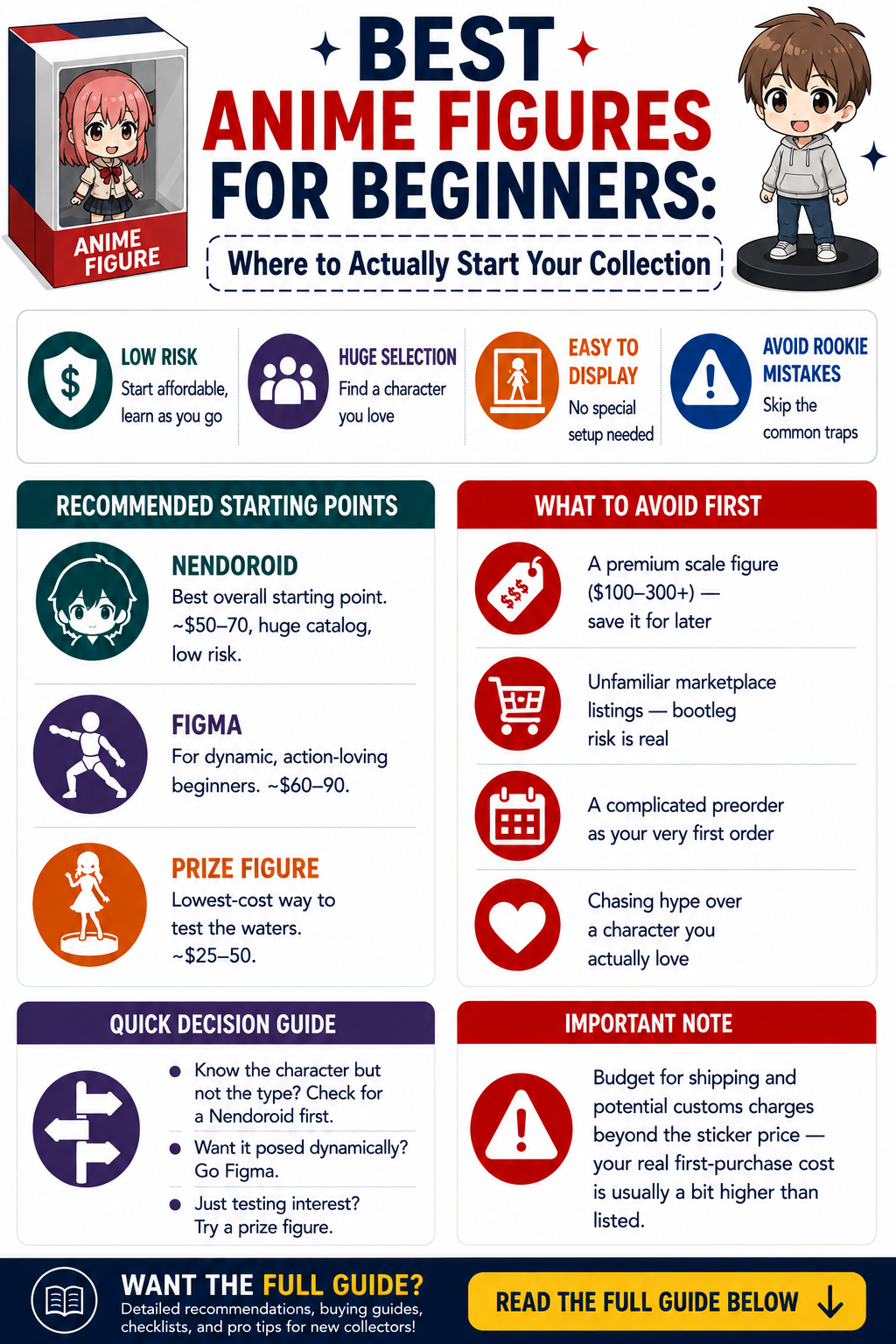
    1. Low financial risk. Your first purchase is also your first chance to learn how a store’s shipping, packaging, and process actually works — you want that learning experience to come from something affordable, not your most expensive purchase.

    2. Broad appeal and availability. A figure type with a huge catalog gives you the best chance of finding a character you already love, rather than compromising on your first purchase.

    3. Manageable commitment. Something that doesn’t require special display considerations, extensive posing skill, or a big shelf investment right away.

    The Recommended Starting Point: Nendoroid

    If you only take one piece of advice from this article, it’s this: for almost every new collector, a Nendoroid is the right first purchase.

    • Price is low-risk. Generally in the $50–70 range, which means a purchase that doesn’t go perfectly (wrong character choice, wanting something different next time) doesn’t sting financially.
    • The catalog is enormous. If a character has merchandise at all, there’s a strong chance a Nendoroid exists for them, which means you’re very likely to find one of a character you already love rather than settling.
    • They’re genuinely fun, not just a “starter” compromise. Interchangeable face plates and small accessories make them engaging to own, not just a stepping stone to something else.
    • They’re forgiving to display. Small footprint, no special lighting or case requirements to get started, and durable enough for a first-time buyer still learning how to handle and store figures carefully.

    If You Want Something More Dynamic: Figma

    If you already know you’re drawn to action-heavy series and want your first figure posed dynamically rather than sitting still, Figma is a reasonable alternative starting point — slightly pricier than a Nendoroid (roughly $60–90), but still well within low-risk territory for a first purchase.

    If You Want to Test the Waters Before Spending Much at All

    Prize figures are a genuinely reasonable way to dip a toe in before committing to a full-price figure — officially licensed, generally in the $25–50 range, with the tradeoff of more variable quality between manufacturers and sub-lines. This is a fine way to see whether collecting appeals to you at all before spending more.

    What to Avoid for Your First Purchase

    • A premium scale figure, however tempting. The price (often $100–300+) and lack of forgiveness if you’re not sure about display space or long-term interest make this a riskier first move — save it for once you know you’re genuinely committed to the hobby.
    • Buying from an unfamiliar marketplace listing to save a few dollars. Your first purchase is the worst time to accidentally receive a bootleg — stick with a trusted retailer for your first order, even if it costs slightly more.
    • A complicated preorder as your very first order. Preorders involve payment timing quirks and release delays that are easier to navigate once you already understand how a store’s process works — an in-stock item is a gentler introduction. My first-time buyer’s guide covers both paths in detail once you’re ready.
    • Chasing hype over genuine interest. A popular figure you don’t actually care about tends to be a less satisfying first purchase than a less-hyped figure of a character you genuinely love.

    A Simple Decision Framework

    “I know exactly which character I want, but not which figure type.” Check whether a Nendoroid exists for that character first — it’s the lowest-risk way to start, and you can always add a Figma or scale figure of the same character later once you know you’re committed.

    “I’m not sure which character I even want yet.” Take some time browsing a trusted retailer’s Nendoroid catalog specifically — the format’s broad coverage makes it a good way to browse without narrowing yourself to one figure type’s limited selection first.

    “I want to spend as little as possible to see if I even like collecting.” Start with a prize figure rather than a full-price Nendoroid — lower stakes, though expect more variability in quality.

    “I already know I want something dynamic and posed.” Go with Figma over a static scale figure for your first purchase — you get the posability you’re after without the price and space commitment of a premium scale piece.

    Frequently Asked Questions

    Is a Nendoroid really the best choice for every beginner? It’s the best choice for most beginners specifically because of the combination of low price, huge catalog, and low display commitment — but if you already know you want something more dynamic or detailed, that’s a completely valid reason to start elsewhere.

    Should my first figure be a character I already love, or whatever looks good? A character you already love, if possible. First purchases you’re genuinely attached to tend to hold up better as a positive first experience than ones chosen purely because they were available or discounted.

    Is it a mistake to start with a scale figure if that’s genuinely what I want most? Not necessarily a mistake, but it does raise the stakes on your first purchase before you’ve learned how shipping, condition, and display actually work in practice. If you’re confident and prepared for that, it’s a personal choice rather than an objective error.

    How much should I expect to spend on my first figure, all in? Beyond the figure’s sticker price, factor in shipping and potential customs charges, which vary by country — budgeting for a total somewhat above the listed price avoids an unpleasant surprise at checkout or delivery.

    Final Thoughts

    The “right” first figure isn’t a single universal answer, but a Nendoroid of a character you genuinely love is the starting point that works well for the vast majority of new collectors — affordable enough that a less-than-perfect first choice doesn’t sting, broad enough in catalog that you’re likely to find exactly what you want, and forgiving enough to display without any special setup.

    Once you’ve made that first purchase and have a feel for the process, my Nendoroid vs Figma vs Scale Figure guide and comparison of trusted retailers are the natural next steps for figuring out where your collection goes from here.

  • The Complete Anime Figure Collector’s Glossary (Every Term Explained)

    The Complete Anime Figure Collector’s Glossary (Every Term Explained)

    Affiliate Disclosure: This post contains affiliate links. If you buy through one of them, I may earn a small commission at no extra cost to you. I only recommend stores I’ve actually ordered from or researched thoroughly — my opinions are my own.

    The Problem: Every Listing Assumes You Already Know the Jargon

    If you’re new to collecting, figure listings can read like a different language — “1/7 PVC scale figure, exclusive, limited, preorder, GK, recast warning” — and most sites assume you already know what all of that means. In my experience, this jargon barrier is one of the quieter reasons new collectors hesitate to buy their first figure: not because they don’t want one, but because they’re not entirely sure what they’re actually looking at.

    This glossary exists to fix that. Every term below is one you’ll genuinely run into while shopping, organized by category so you can find what you need quickly — and linked to a full guide wherever I’ve covered a topic in more depth elsewhere on the site.

    Who This Article Is NOT For

    • If you’ve been collecting for years, you probably know most of this already — feel free to use it as a quick reference rather than reading start to finish.
    • If you’re looking for buying advice rather than definitions, start with my comparison of trusted retailers or first-time buyer’s guide instead.

    Figure Types and Formats

    TermWhat It Means
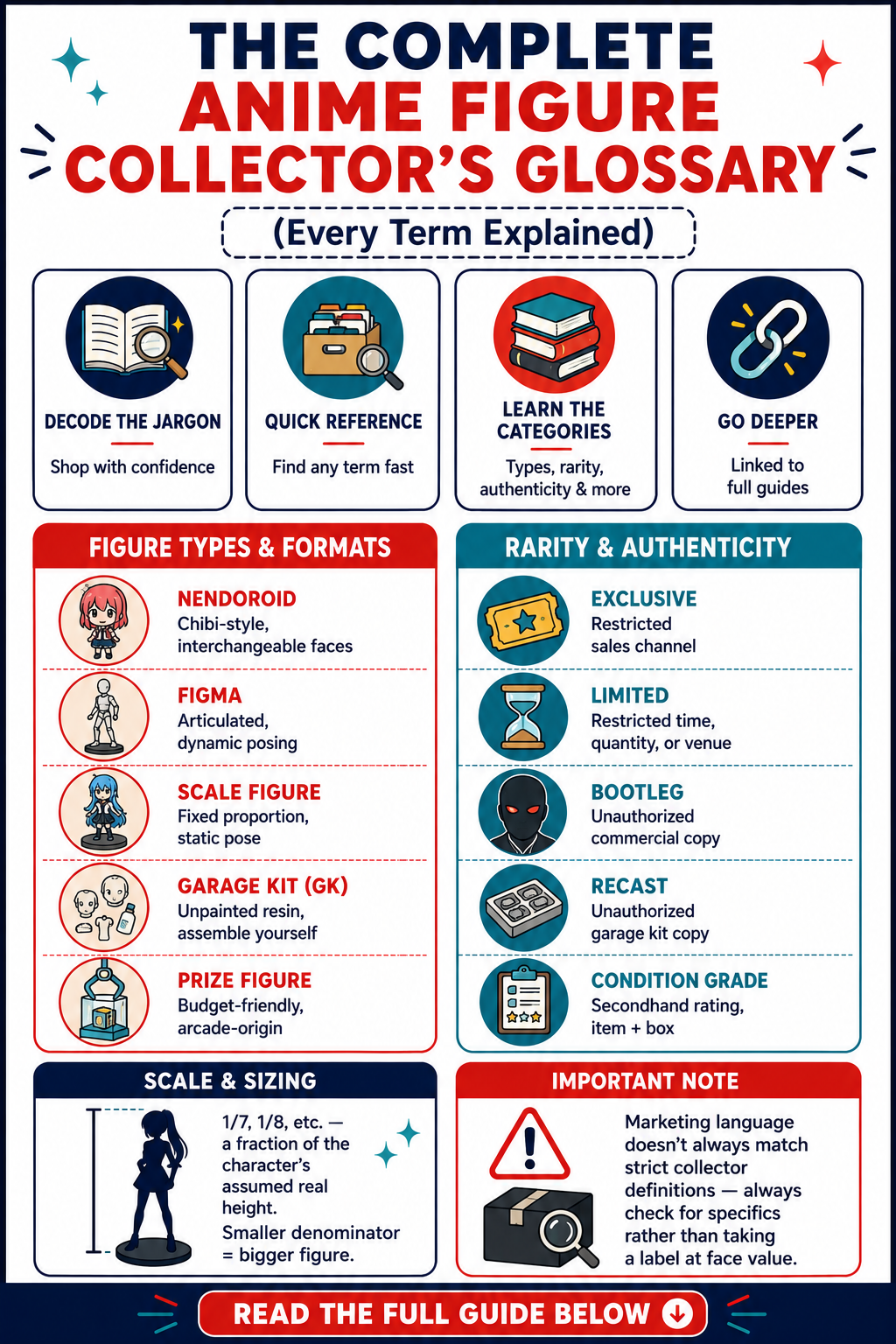
    NendoroidGood Smile Company’s chibi-style figure line — big head, small body, interchangeable face plates. The most affordable common format. Full breakdown
    FigmaMax Factory’s articulated, realistically proportioned figure line, built for dynamic posing. Full breakdown
    Scale FigureA figure sculpted at a fixed proportion of the character’s assumed real-life height (e.g., 1/7), static pose, no articulation. Full breakdown
    POP UP PARADEGood Smile Company’s simplified, more affordable scale-style line — less detail than a full scale figure, priced accordingly
    S.H.FiguartsBandai Spirits’ highly articulated action-figure-style line, known for strong posability
    Garage Kit (GK)An unpainted, unassembled resin kit, typically made independently and requiring assembly and painting by the buyer. Full guide
    Prize FigureA budget-friendly, officially licensed figure originally distributed through arcade crane games, from brands like Banpresto, SEGA, and Taito. Full guide
    Ichiban KujiBandai’s lottery-ticket figure system, with tiered prizes (A through E, plus a “Last One” prize). Full guide
    Non-ScaleA figure line (like Nendoroid or Figma) that doesn’t follow strict proportional scale to the character’s real height, prioritizing consistent display size instead

    Materials and Construction

    TermWhat It Means
    PVCPolyvinyl chloride — the standard plastic used for most pre-painted commercial figures
    ABSA more rigid plastic often used for jointed or load-bearing parts, sometimes combined with PVC in the same figure
    ResinThe material used for garage kits — typically polyurethane resin, allowing for finer sculpted detail than mass-production plastics
    ArticulationA figure’s range of joint movement and posability, most relevant to Figma and S.H.Figuarts-style lines
    Seam LineA visible line where two mold halves meet during manufacturing — more common on budget-tier figures like prize figures

    Scale and Sizing

    TermWhat It Means
    Scale Ratio (1/7, 1/8, etc.)A fraction describing how much a figure is shrunk down from the character’s assumed real-life height — smaller denominator means a bigger figure. Full guide
    1/1 Scale / Life-SizeA figure or bust produced at actual real-world size — rare and typically very expensive
    BustA figure depicting only the head, shoulders, and upper torso, rather than a full-body sculpt

    Availability and Rarity

    TermWhat It Means
    MSRPManufacturer’s suggested retail price — the baseline price before any store discount or markup
    PreorderOrdering a figure before it’s been produced or shipped, based on an estimated future release date. Full guide on tracking these
    ExclusiveSold only through a specific store, bundle, or mail-order channel — doesn’t necessarily mean a capped total quantity
    LimitedRestricted by time, quantity, or venue — the exact meaning varies significantly, so it’s worth checking which kind of “limited” applies. Full breakdown
    Small Lot / Large LotInformal terms describing whether a production run was genuinely small (verifiably scarce) or larger than the “limited” label might suggest
    CancelledProduction was stopped, either before release or after a partial run — sometimes genuinely rare, sometimes reflecting low original demand
    RestockA store receiving additional inventory of a previously sold-out item
    Reissue / RereleaseA manufacturer producing a figure again after its original run, sometimes as a color variant of the same sculpt

    Authenticity and Condition

    TermWhat It Means
    BootlegAn unauthorized, unlicensed copy of a commercial figure, sold to deceive buyers into thinking it’s genuine. Full guide
    RecastWithin the garage kit hobby specifically, an unauthorized copy of an independent sculptor’s original kit — a related but distinct issue from commercial bootlegging. Full explanation
    Authentication Sticker / Hologram SealA manufacturer’s holographic or metallic seal on packaging, used to help verify authenticity — a missing or non-holographic seal is a red flag
    Condition GradeA rating (numeric or letter-based) describing a secondhand figure’s physical condition, often scored separately for the item and the box. Full guide
    MIB (Mint in Box)A figure that remains unopened and in original packaging, in as-new condition

    Manufacturers and Production Culture

    TermWhat It Means
    Good Smile Company (GSC)Major manufacturer behind Nendoroid, POP UP PARADE, and a broad scale figure catalog. Manufacturer comparison
    Max FactoryThe manufacturer behind the Figma line specifically, closely associated with Good Smile Company
    AlterA manufacturer known for premium, highly detailed scale figures at a higher price tier
    KotobukiyaA manufacturer known for dynamic-pose scale figures (ARTFX/ARTFX J lines) and plastic model kits
    CircleThe hobbyist term for a small, independent group of creators producing garage kits, often under a shared name
    Wonder Festival (Wonfes)A convention held in Japan roughly twice a year, where independent sculptors and circles sell original garage kits directly to attendees

    Shopping and Logistics

    TermWhat It Means
    De MinimisThe value threshold below which imported goods aren’t subject to duty or tax — varies significantly by country and can change with trade policy. Full country-by-country breakdown
    Consolidation / Private WarehouseA service that holds multiple orders and ships them together in one package to reduce total shipping cost
    Proxy Shopping ServiceA third-party service that purchases items from Japan-only stores or listings on your behalf and forwards them internationally
    EMSA common express international shipping method from Japan, generally faster and pricier than economy alternatives

    VTuber-Specific Terms

    TermWhat It Means
    VTuberA virtual, animated on-screen persona used by a streamer or performer for content, backed by an agency that produces official merchandise
    hololive productionA major VTuber agency operated by Cover Corporation. VTuber figures guide
    NijisanjiA major VTuber agency operated by Anycolor. VTuber figures guide

    Frequently Asked Questions

    What’s the difference between “exclusive” and “limited”? “Exclusive” typically refers to a restricted sales channel (a specific store or bundle), while “limited” can mean either a restricted time window or an actual capped production quantity. They’re related concepts but not interchangeable.

    Is a recast the same thing as a bootleg? They’re closely related — both involve unauthorized copying — but “recast” is specifically used within the garage kit hobby to describe unauthorized copies of an independent creator’s original kit, while “bootleg” more broadly describes unauthorized copies of commercial, licensed figures.

    What does “non-scale” mean if Nendoroid and Figma still have a size? It means the figure’s size isn’t calculated as a strict proportion of the character’s real-life height the way scale figures are — a very tall character and a very short character end up roughly similar sizes in these lines, prioritizing a consistent display format over proportional accuracy.

    Why do some terms (like “limited”) get used so loosely? Marketing language doesn’t always match strict collector definitions — this is exactly why it’s worth checking for specifics (a stated production number, a defined ordering window) rather than taking a label at face value.

    Final Thoughts

    Jargon shouldn’t be the thing standing between you and your first figure. Bookmark this page as a reference, and whenever a listing uses a term you’re not sure about, it’s probably covered here — with a link to a full guide if you want to go deeper on any specific topic.

    If you’re ready to put this vocabulary to use, my comparison of trusted Japan-based retailers and first-time buyer’s guide are the natural next steps.

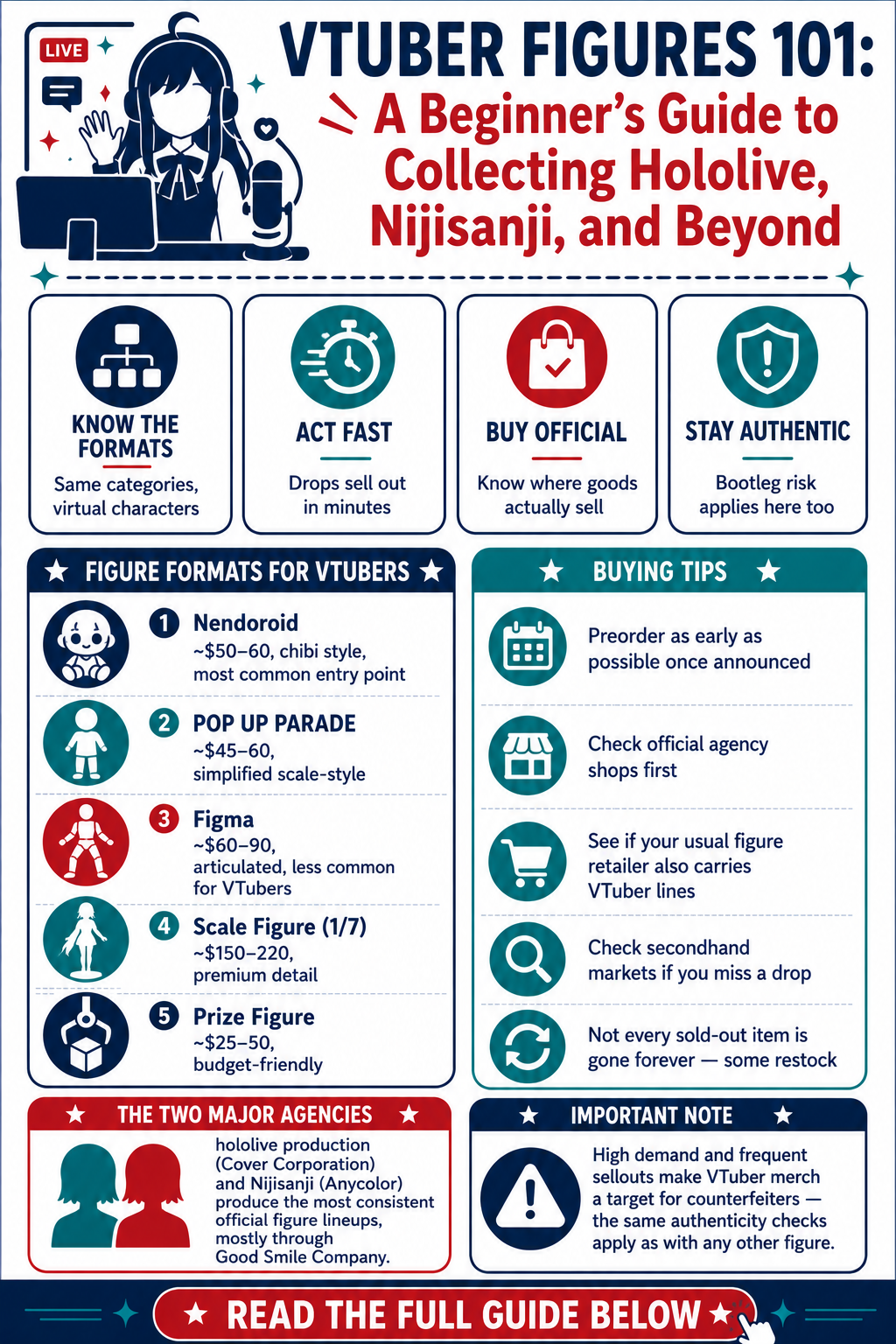
  • VTuber Figures 101: A Beginner’s Guide to Collecting Hololive, Nijisanji, and Beyond

    VTuber Figures 101: A Beginner’s Guide to Collecting Hololive, Nijisanji, and Beyond

    Affiliate Disclosure: This post contains affiliate links. If you buy through one of them, I may earn a small commission at no extra cost to you. I only recommend stores I’ve actually ordered from or researched thoroughly — my opinions are my own.

    The Problem: VTuber Merch Follows Different Rules Than Standard Anime Figures

    If you’ve made the jump from anime figures into VTuber collecting, you’ve probably noticed the buying process feels a bit different — drops that sell out in minutes, region-restricted official shops, and event-exclusive goods that only ever get sold at a single physical pop-up in Japan. None of this means VTuber figures are riskier or harder to collect well, but it does mean the playbook that works for standard anime figures needs a few adjustments.

    In my experience, most of the frustration collectors run into here comes from not knowing the category exists separately from general anime merch, rather than the buying process itself being genuinely difficult. This guide covers the basics: who the major players are, what figure types you’ll actually encounter, and how to buy without getting caught out by a sold-out drop.

    Who This Article Is NOT For

    • If you’re not familiar with VTubers at all, this guide assumes some basic familiarity with the concept — a VTuber is a virtual, animated on-screen persona used by a streamer/performer for content, backed by an agency that produces official merchandise for that persona.
    • If you already collect VTuber merch regularly, most of this will be familiar — feel free to skip to the “Dealing with Sold-Out Drops” section for the parts most likely to still be useful.
    • If you haven’t read my Nendoroid vs Figma vs Scale Figure guide yet, it’s worth reading first — VTuber figures use the exact same format categories, just applied to a different kind of character.

    The Two Major Agencies You’ll Run Into Most

    hololive production, operated by Cover Corporation, is one of the largest VTuber agencies, and its talents get consistent figure support across Nendoroid, Figma, POP UP PARADE, and scale figure lines, mostly through Good Smile Company.

    Nijisanji, operated by Anycolor, is the other major name you’ll encounter constantly, with its own steady stream of scale figures and merchandise, including collaborations with figure retailers running region-specific preorders.

    There are smaller and independent VTuber talents and agencies as well, though official figure support tends to concentrate most heavily around these two larger agencies simply due to scale and demand.

    Figure Categories for VTubers (Same Formats, Different Characters)

    VTuber figures use the same category system as standard anime figures — the format decision is the same, just applied to a virtual streamer persona instead of an anime character:

    FormatWhat to ExpectTypical Price
    NendoroidChibi-style, interchangeable face plates, the most common entry point~$50–60
    POP UP PARADEGood Smile Company’s mid-tier, simplified scale-style line — less detailed than a full scale figure but more affordable~$45–60
    FigmaArticulated, posable — less common for VTubers than Nendoroid, but does exist for some popular talents~$60–90
    Scale Figures (typically 1/7)Full detail, static pose, the premium option~$150–220
    Prize FiguresBudget-friendly, licensed but more variable quality — same category I’ve covered for general anime figures~$25–50

    If you’ve already read my guides on figure types and prize figures, you already understand the tradeoffs here — VTuber collecting doesn’t introduce new format logic, just a new category of character.

    Where Official VTuber Goods Actually Sell

    • Official agency shops (hololive’s official shop, for example) sell merchandise directly, though a meaningful portion of drops and campaigns are structured primarily for Japan-based buyers, which can limit direct access for overseas fans on certain items
    • General figure retailers increasingly carry VTuber figures alongside their standard anime catalog — it’s worth checking whether your preferred retailer stocks this category, since several mainstream import-friendly shops do carry Good Smile Company’s VTuber lines
    • Event-exclusive goods are sometimes only available at physical conventions or pop-up stores in Japan, similar in spirit to the convention-exclusive garage kits I’ve covered elsewhere — these are the hardest category to access without being in Japan in person

    Dealing With Sold-Out Drops

    This is genuinely the biggest adjustment coming from standard anime figure collecting — VTuber merch, especially limited or event-tied goods, can sell out dramatically faster than a typical figure preorder, sometimes within minutes of going live.

    • Preorder as early as possible once an item is announced, rather than waiting to see if you’re still interested — popular talent merchandise in particular can disappear from official stock quickly
    • Check secondhand marketplaces if you miss a drop. Sold-out VTuber goods do turn up on Japanese secondhand platforms afterward, though usually at a premium over the original price
    • Apply the same scarcity-checking logic I’ve covered for limited editions here — not every sold-out item stays permanently unavailable, and some do get restocked or reprinted, so it’s worth checking back rather than assuming a missed drop is gone forever

    Authenticity Still Matters Here Too

    Don’t assume the bootleg risk that applies to standard anime figures somehow doesn’t apply to VTuber merchandise — if anything, the combination of high demand and frequent sold-out drops makes VTuber figures an attractive target for counterfeiters for exactly the same reasons limited editions attract more bootlegging in general. The same checks — official packaging, authentication stickers, seller reputation — apply just as much here as with any other figure purchase.

    Frequently Asked Questions

    Do VTuber figures use different formats than regular anime figures? No — they use the same category system (Nendoroid, Figma, POP UP PARADE, scale figures, prize figures). The only real difference is the character being represented, not the format logic itself.

    Why do some VTuber goods sell out so much faster than typical anime figures? A combination of large, highly engaged fanbases and genuinely limited production runs on certain items, particularly event-exclusive or campaign-tied merchandise, creates faster sellouts than you’d typically see with standard figure preorders.

    Can I buy VTuber figures from the same stores I already use for anime figures? Often yes — it’s worth checking whether your regular retailer carries this category, since several mainstream import-friendly shops now stock official VTuber merchandise from Good Smile Company alongside their standard catalog.

    Is it worth buying VTuber merch secondhand if I miss a drop? It can be a reasonable option, with the same caution that applies to any secondhand figure purchase — check my guide to buying secondhand safely and stay alert for bootleg risk on especially hyped, sold-out items.

    Final Thoughts

    VTuber figure collecting isn’t a fundamentally different hobby from standard anime figure collecting — it’s the same format categories and the same authenticity concerns, layered with a faster-moving, higher-demand buying environment. The biggest adjustment is speed: preorder early, know where official and secondhand markets exist for a specific talent, and don’t assume a sold-out item is gone forever without checking back.

    If you’re new to this side of the hobby entirely, it’s worth starting with my breakdown of figure types and comparison of trusted retailers before diving into VTuber-specific drops — the fundamentals carry over directly.