Affiliate Disclosure: This post contains affiliate links. If you buy through one of them, I may earn a small commission at no extra cost to you. I only recommend stores I’ve actually ordered from or researched thoroughly — my opinions are my own.
The Problem: “Garage Kit” Sounds Like a Red Flag, But It Isn’t (Usually)
If you’ve spent any time browsing figure marketplaces, you’ve probably come across a listing for a “garage kit” and felt a little suspicious of it — an unpainted, unassembled resin figure, sold outside the usual retailers, sometimes at a price that seems too good to be true for the detail shown in the photos. After everything I’ve covered about spotting bootlegs, that instinct to be cautious is a good one.
But garage kits are a completely different, legitimate category of the hobby — they’re just built differently, sold differently, and require a different kind of buyer than the pre-painted figures I usually cover on this site. This guide explains what they actually are, how to tell a legitimate one from a piracy problem specific to this corner of the hobby, and whether they’re worth getting into.
Who This Article Is NOT For
- If you want a figure that arrives ready to display straight out of the box, garage kits are not for you — by definition, they require assembly and painting. Stick with Nendoroid, Figma, or pre-painted scale figures instead.
- If you don’t have any interest in a hands-on hobby beyond collecting, that’s a completely reasonable preference, and garage kits genuinely aren’t for everyone — there’s no shame in preferring finished figures.
- If you’re specifically looking for character variety and guaranteed availability, garage kits are often small-run, sometimes one-off releases sold at a single convention — this isn’t a category where you can reliably find any character you want on demand.
What Actually Defines a Garage Kit
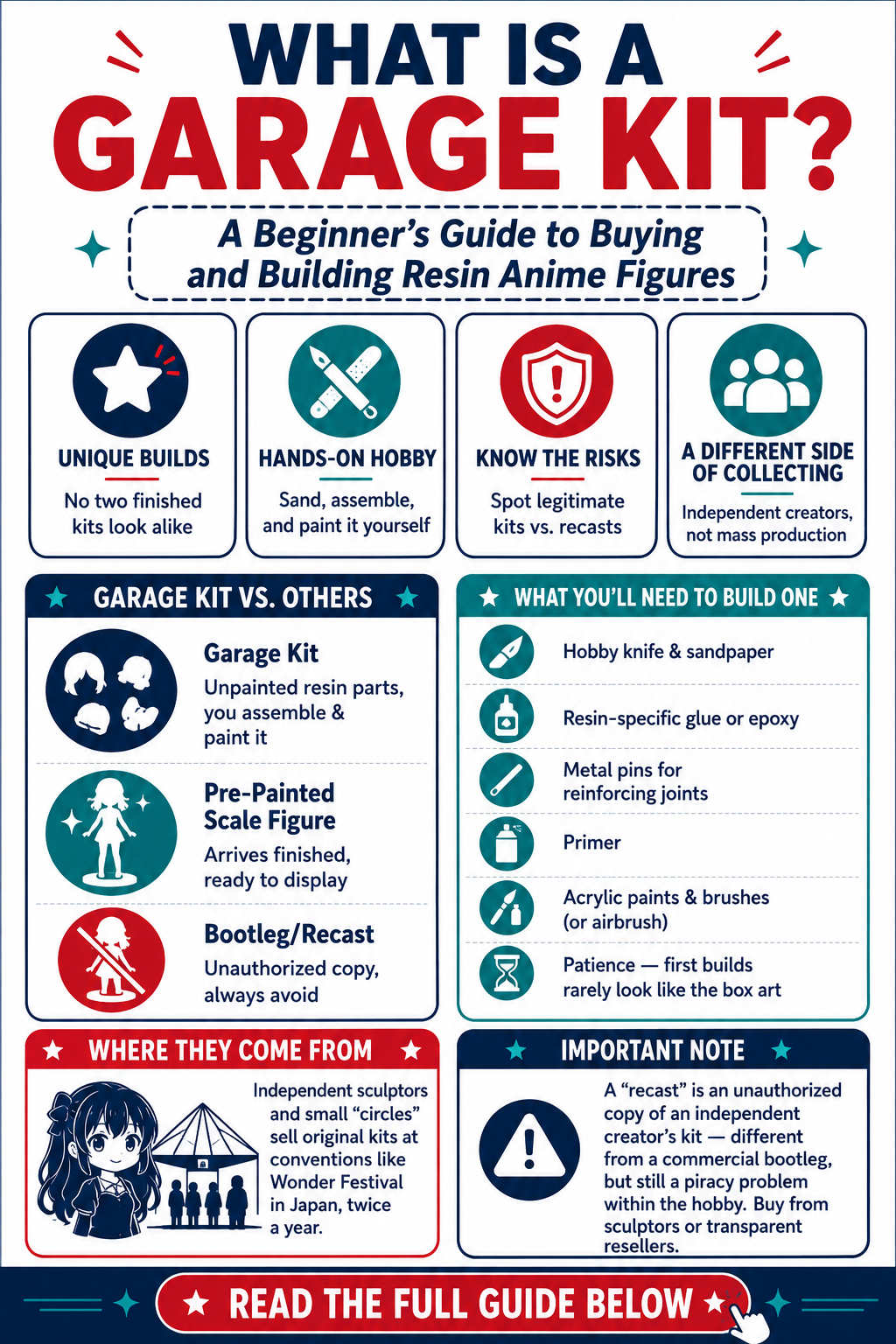
1. It’s unpainted and unassembled. This is the core, defining trait — you receive separate resin parts, not a finished figure.
2. It’s typically made in polyurethane resin, not the PVC/ABS plastic used in mass-produced commercial figures, which is part of why the sculpting can achieve extremely fine detail.
3. It’s usually produced independently, by an individual sculptor or small “circle” (the hobbyist term for a small creative group), rather than by a major manufacturer like Good Smile Company or Kotobukiya.
Garage Kit vs. Pre-Painted Figure vs. Bootleg: What’s the Difference?
| Garage Kit | Pre-Painted Scale Figure | Bootleg / Recast | |
|---|---|---|---|
| Condition on arrival | Unpainted, unassembled resin parts | Fully assembled and painted | Fully assembled and painted (imitation) |
| Who makes it | Independent sculptor or small “circle” | Major manufacturer (Alter, Kotobukiya, etc.) | Unauthorized copier |
| Official/licensed? | Often unlicensed fan work, though some are licensed | Licensed by the IP holder | Never licensed — always unauthorized |
| Where it’s sold | Conventions (Wonder Festival), secondhand marketplaces, specialty importers | Authorized retailers | Marketplace listings, often disguised as genuine |
| Buyer’s effort required | Significant — sanding, gluing, priming, painting | None | None |
| Legitimacy concern | Generally accepted as part of dojin (fan-creator) culture, though a real piracy problem exists within the hobby (see below) | None, if bought from an authorized source | Always illegitimate |
Where Garage Kits Actually Come From
Garage kits trace back to hobbyists in Japan in the early 1980s producing small-batch resin models — often of characters or subjects that official manufacturers weren’t making at the time — literally out of home workshops, which is where the name comes from. Over time, this grew into an organized part of hobby culture, most visibly through Wonder Festival (often shortened to “Wonfes”), a convention held roughly twice a year in Japan where independent sculptors and small circles sell their original resin kits directly to attendees.
This is genuinely a different world from the manufacturer-driven side of the hobby I usually cover — it’s closer to independent/fan-creator culture than to retail shopping, and a lot of kits are produced in very limited quantities, sometimes only for a single event.
The Piracy Problem Within the Garage Kit Hobby Itself
Here’s a nuance that catches people off guard: garage kit collectors use the term “recast” specifically to describe something that happens within their own hobby — someone taking an independent sculptor’s original kit, copying the mold without permission, and selling unauthorized reproductions. This is a real, ongoing issue in the garage kit community and is generally looked down upon, since it directly undercuts small, independent creators who often aren’t making much money from their work to begin with.
This is a related but distinct issue from the commercial bootlegs I cover elsewhere on this site — there, the concern is unauthorized copies of a major manufacturer’s licensed, mass-produced figure. Here, it’s unauthorized copies of an independent creator’s original, often small-batch resin sculpt. The underlying problem (unauthorized mold-copying) is the same concept, just applied to a different part of the hobby.
If you’re buying a garage kit, a few practical signs of a legitimate “original” kit:
- It’s sold directly by the sculptor/circle, or by a retailer who’s transparent about sourcing from the original creator
- Pricing is in a reasonable range for hand-produced small-batch resin work, not suspiciously cheap for the apparent detail level
- The listing doesn’t use official commercial product photography that doesn’t match what’s actually being sold
What You’ll Actually Need to Build One
This is the part that surprises first-timers most: a garage kit is genuinely a hands-on craft project, not a quick assembly.
- Basic modeling tools: hobby knife, sandpaper (various grits), files for cleaning up resin parts
- Adhesive: typically a resin-specific glue or two-part epoxy, since standard plastic model cement doesn’t always work well on resin
- Pinning materials: small metal rods (often brass) used to reinforce joints between parts, since resin is more brittle than injection-molded plastic
- Painting supplies: at minimum, acrylic paints and brushes; most serious builders eventually use an airbrush for smoother results, especially on larger surface areas
- Primer: resin surfaces generally need priming before paint will adhere properly and evenly
- Patience and realistic expectations for your first kit — the learning curve is real, and a first build rarely looks like the box art
Should You Actually Get Into Garage Kits?
If you enjoy modeling, painting, or hands-on craft hobbies already, garage kits are a genuinely rewarding extension of figure collecting — you end up with something no mass-produced figure can replicate, since your specific paint job and assembly choices are unique to your build.
If you just want to grow a display collection without a big time investment, this probably isn’t the right path — stick with pre-painted figures from trusted retailers, where the entire appeal is that someone else already did the hard part.
If you’re curious but not ready to commit, a lower-cost, smaller kit is a reasonable way to test whether you enjoy the process before investing in an expensive, detailed piece.
Frequently Asked Questions
Are garage kits legal? This exists in a genuinely gray area. Many garage kits are unlicensed fan works, which technically involves IP rights that haven’t been formally licensed — historically, this has been tolerated to varying degrees within Japan’s dojin (independent creator) culture, though the situation isn’t uniform across every franchise or rights holder. This is different from a bootleg or recast, which is a clear-cut piracy issue even within the hobby’s own norms.
Can beginners realistically build a garage kit? Yes, though it’s genuinely more difficult than assembling a standard plastic model kit — resin requires different adhesives, careful sanding, and priming before painting. Starting with a smaller, simpler kit rather than an ambitious first project is the more realistic path in.
Where can I find garage kits if I can’t attend Wonder Festival in person? Secondhand marketplaces and specialty resellers are the most realistic option for overseas buyers, since a lot of kits are sold in person at Japanese conventions first. Mandarake, which I’ve mentioned elsewhere as a source for rare and discontinued figures, is also a reasonable starting point for browsing secondhand garage kits, though selection varies.
Is a garage kit the same thing as a bootleg? No — a legitimate garage kit is an independently produced, often unlicensed fan creation sold transparently as such. A bootleg is an unauthorized copy of someone else’s commercial or independent work, sold in a way that misrepresents what it actually is. The distinction matters even though both involve unlicensed production.
Final Thoughts
Garage kits are one of the more misunderstood corners of figure collecting — easy to mistake for something shady if you’ve only ever bought pre-painted figures, but really just a different, more hands-on branch of the same hobby with its own culture and history. Whether they’re worth getting into really comes down to whether you want figures, or whether you want a craft project that happens to result in one.
If the hands-on side doesn’t appeal to you, that’s completely fine — most of what I cover on this site focuses on the pre-painted side of collecting, starting with my guide to choosing between Nendoroid, Figma, and scale figures and where to buy them safely.
コメントを残す