Affiliate Disclosure: This post contains affiliate links. If you buy through one of them, I may earn a small commission at no extra cost to you. I only recommend stores I’ve actually ordered from or researched thoroughly — my opinions are my own.
The Problem: “Limited Edition” Gets Used Loosely, and It’s Not Always Meaningful
Here’s something that trips up a lot of collectors, myself included when I was newer to this: the word “limited” shows up on a huge percentage of figure listings, and it doesn’t always mean what you’d assume. Sometimes it genuinely means a few hundred pieces ever produced, never to be made again. Other times it means “available for a restricted ordering window” on a figure the manufacturer might reprint again in a year or two anyway.
In my experience, understanding what these terms actually mean matters most in two situations: deciding whether to rush a purchase because something really won’t come back, and not overpaying on the secondary market for something that turns out not to be as scarce as it looked. This guide breaks down the terminology so you can tell the difference.
Who This Article Is NOT For
- If you buy figures purely because you love the character, regardless of production numbers, none of this changes your decision much — buy what you love. This matters most if scarcity or long-term value factors into your choice.
- If you’re treating figure collecting primarily as a financial investment, it’s worth resetting expectations here: most figures depreciate over time, and genuine appreciation is the exception, not the rule, even among figures marketed as limited.
- If you haven’t figured out where to buy safely yet, start with my comparison of trusted Japan-based figure stores — the terminology below matters most once you’re actually navigating real listings.
How These Terms Actually Break Down
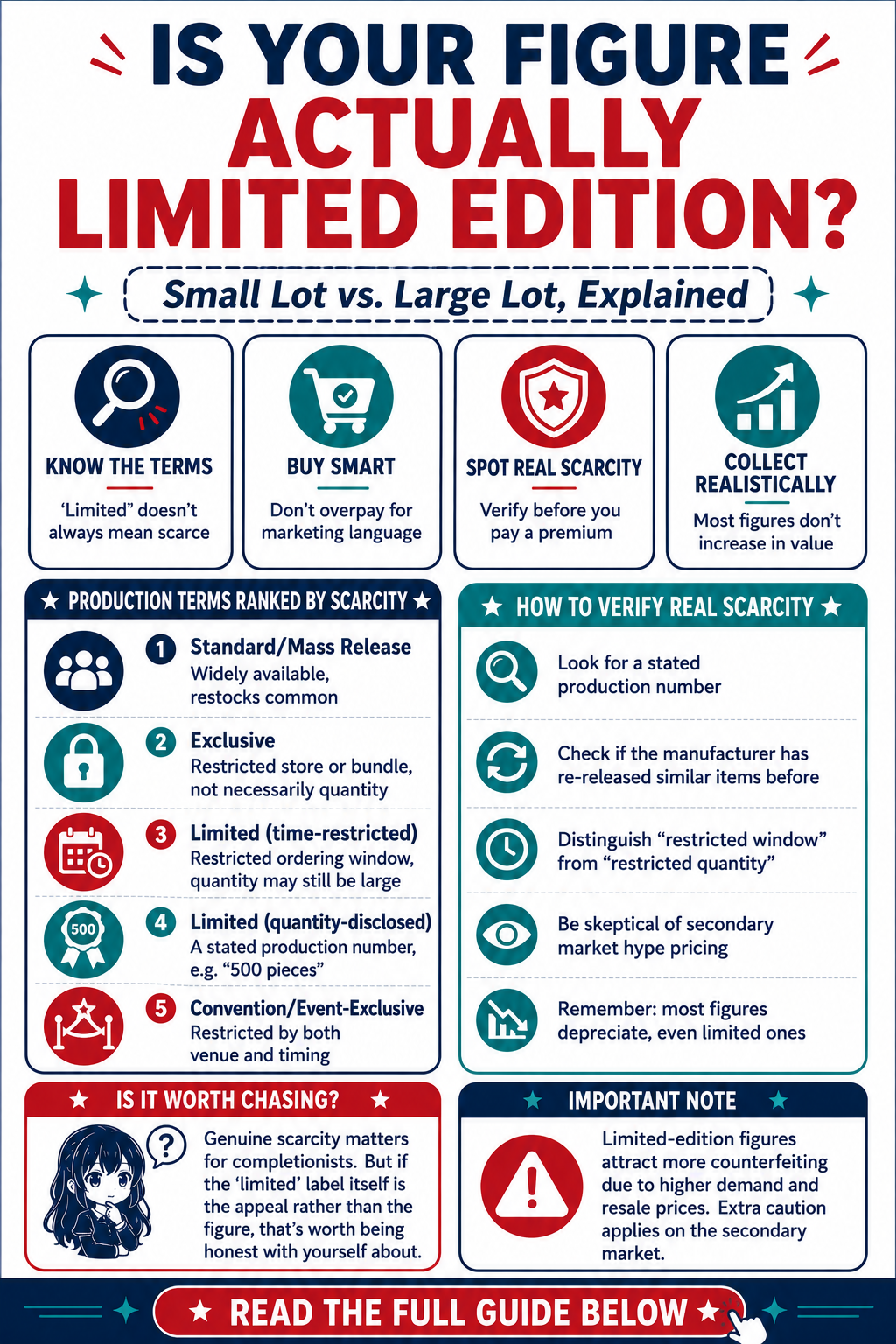
1. Whether a specific production number is disclosed. A genuine small-lot limited release usually states or strongly implies a specific quantity — vague “limited” language without any numbers is a weaker signal.
2. Whether it’s restricted by time, by retailer, or by actual unit count. These are three different kinds of “limited,” and they don’t all carry the same scarcity.
3. Whether the manufacturer has a track record of re-releasing similar items. Some companies have reprinted or re-released figures previously marketed as exclusive — worth knowing before you pay a premium purely for scarcity.
Figure Production Terminology, Explained
| Term | What It Actually Means | Scarcity Level |
|---|---|---|
| Standard / Mass Release | Ongoing production, widely available through normal retail channels | Low — restocks are common |
| Exclusive | Bundled with another item, or only sold through a specific store or mail order | Moderate — availability is restricted by channel, not necessarily by total quantity |
| Limited (time-restricted) | Available only during a specific ordering window | Moderate — the order period is limited, but the total quantity produced may still be fairly large |
| Limited (quantity-disclosed) | A specific, stated production number (e.g., “500 pieces worldwide”) | High — this is the strongest, most verifiable form of “limited” |
| Convention-only / Event-exclusive | Sold only at a specific event, sometimes a single day | High — genuinely restricted by both venue and timing |
| Kuji / Prize figures | Mass-produced, won through lottery-style sales (kuji) or arcade claw machines | Low individually, though specific prizes within a set can be scarcer than others |
| Cancelled | Production was stopped and the item was never released, or discontinued after a run | Varies — sometimes genuinely rare, sometimes reflects low original demand |
How to Verify Real Scarcity Before Paying a Premium
- Look for a stated production number. This is the clearest, most verifiable signal. “Limited” without any number attached is a much weaker claim than “limited to 300 units.”
- Check whether the manufacturer has re-released similar items before. Some companies have brought back figures originally marketed as one-time exclusives, sometimes as a color variant of the same sculpt. This doesn’t happen with every limited release, but it’s common enough to be worth a quick search on the specific figure and manufacturer before assuming true, permanent scarcity.
- Distinguish “restricted ordering window” from “restricted total quantity.” A figure that was only orderable for two weeks might still have had a fairly large total production run within that window — time-limited isn’t automatically the same as scarce.
- Be skeptical of secondary market hype pricing. Resale prices climbing well above retail reflect current demand and FOMO as much as genuine long-term scarcity. A figure trading at a premium today doesn’t guarantee it’ll hold that value — most figures depreciate over time, and even rare pieces from well-known series are the exception rather than the rule when it comes to appreciating in value.
Should Scarcity Actually Influence Your Buying Decision?
If you’re a completionist collector of a specific character or series, genuine limited availability is a real reason to prioritize a purchase — a figure you can never get again is a different situation from one you can pick up next month.
If you’re chasing figures specifically because they’re marketed as limited, it’s worth pausing to ask whether you actually want the figure, or whether the scarcity framing itself is driving the appeal. Both are valid reasons to buy something, but it’s worth being honest with yourself about which one it is.
If you’re considering figures as a long-term investment, treat that as a secondary consideration at best. The honest reality is that most figures — including many marketed as limited — depreciate rather than appreciate, and predicting which ones will hold or gain value is genuinely difficult even for experienced collectors.
A Word of Caution on the Secondary Market
Figures marketed as scarce or limited are also disproportionately likely to attract counterfeiting, simply because higher demand and higher resale prices make bootlegging more profitable. If you’ve missed a genuinely limited release and are considering a secondary market purchase, it’s worth revisiting my guide to spotting bootleg figures before paying a premium for something that might not be authentic.
If you’d rather avoid the missed-preorder situation entirely, building a habit of tracking preorders and release announcements is the more reliable long-term solution than relying on the secondary market later.
Frequently Asked Questions
Does “limited edition” always mean a figure will increase in value? No. Most figures, limited or not, depreciate over time rather than appreciate. Genuine long-term value increases happen, but they’re the exception rather than something you should count on when buying.
Can a company re-release a figure that was originally marketed as limited? Yes, this does happen — sometimes as a direct reprint, sometimes as a color variant or slightly modified re-release of the same sculpt. It’s not universal, but it’s common enough that “limited” shouldn’t automatically be read as “permanently unavailable again in any form.”
What’s the difference between an exclusive and a limited figure? “Exclusive” typically refers to restricted sales channels (a specific store or bundle), while “limited” can refer to either a restricted time window or an actual capped production quantity. They’re related but not interchangeable terms.
Are kuji and prize figures considered “limited”? Not usually in the collector sense — these are typically mass-produced, even though individual prizes within a specific kuji set or lottery campaign can be harder to obtain than others due to the randomized distribution.
Final Thoughts
“Limited edition” is a spectrum, not a single guarantee — everything from a two-week ordering window on a fairly large production run to a genuinely one-time, numbered release at a single convention gets described with the same word. Learning to tell the difference helps you make better calls about when a purchase is genuinely time-sensitive and when the “limited” label is doing more marketing work than actual scarcity work.
If you’re building a collection with an eye toward pieces that are genuinely hard to find again, it’s worth pairing this knowledge with a solid preorder tracking habit and buying from retailers you already trust — that combination will serve you better than chasing marketing language alone.
コメントを残す