タグ: Figma

  • The Best Type of Figure for Your Favorite Anime Genre (Battle, Slice-of-Life, and More)

    The Best Type of Figure for Your Favorite Anime Genre (Battle, Slice-of-Life, and More)

    Affiliate Disclosure: This post contains affiliate links. If you buy through one of them, I may earn a small commission at no extra cost to you. I only recommend stores I’ve actually ordered from or researched thoroughly — my opinions are my own.

    The Problem: The “Right” Figure Type Depends on What You Actually Watch

    I’ve written before about the practical differences between Nendoroid, Figma, and scale figures — price, posability, size. But there’s a layer on top of that practical comparison that matters just as much: what kind of anime you actually love changes which figure type tends to suit it best.

    In my experience, this is genuinely one of those “it depends” situations, but not in a frustrating way — once you know your favorite genre’s general personality, the right figure type becomes a lot more obvious. A static, cute chibi figure does something completely different for a slice-of-life character than it does for someone mid-battle in a shonen series, and neither is wrong — they’re just suited to different kinds of shows.

    Who This Article Is NOT For

    • If you only care about one specific character, regardless of genre, buy the figure of that character in whatever type suits your budget and taste — genre patterns are a helpful starting point, not a rule.
    • If you haven’t read my Nendoroid vs Figma vs Scale Figure breakdown yet, it’s worth reading that first — this article builds on those basics rather than repeating them.
    • If you collect across every genre equally, that’s genuinely one of the best positions to be in as a collector (mine included) — feel free to treat this as a buffet rather than a strict guide.

    How Genre Actually Influences Figure Choice

    1. How dynamic the source material is. Shows built around movement, combat, or dramatic poses tend to translate better into posable figures — static pieces can feel like they’re missing the point.

    2. The visual tone of the character designs. Some genres lean into exaggerated, expressive character designs that suit chibi styles beautifully; others rely on grounded, detailed designs that shine more in realistic scale sculpts.

    3. How you’re likely to actually display it. A genre built around big emotional or dramatic moments often benefits from a scale figure capturing one iconic scene; a genre built around everyday charm often benefits from a rotating cast of smaller figures instead.

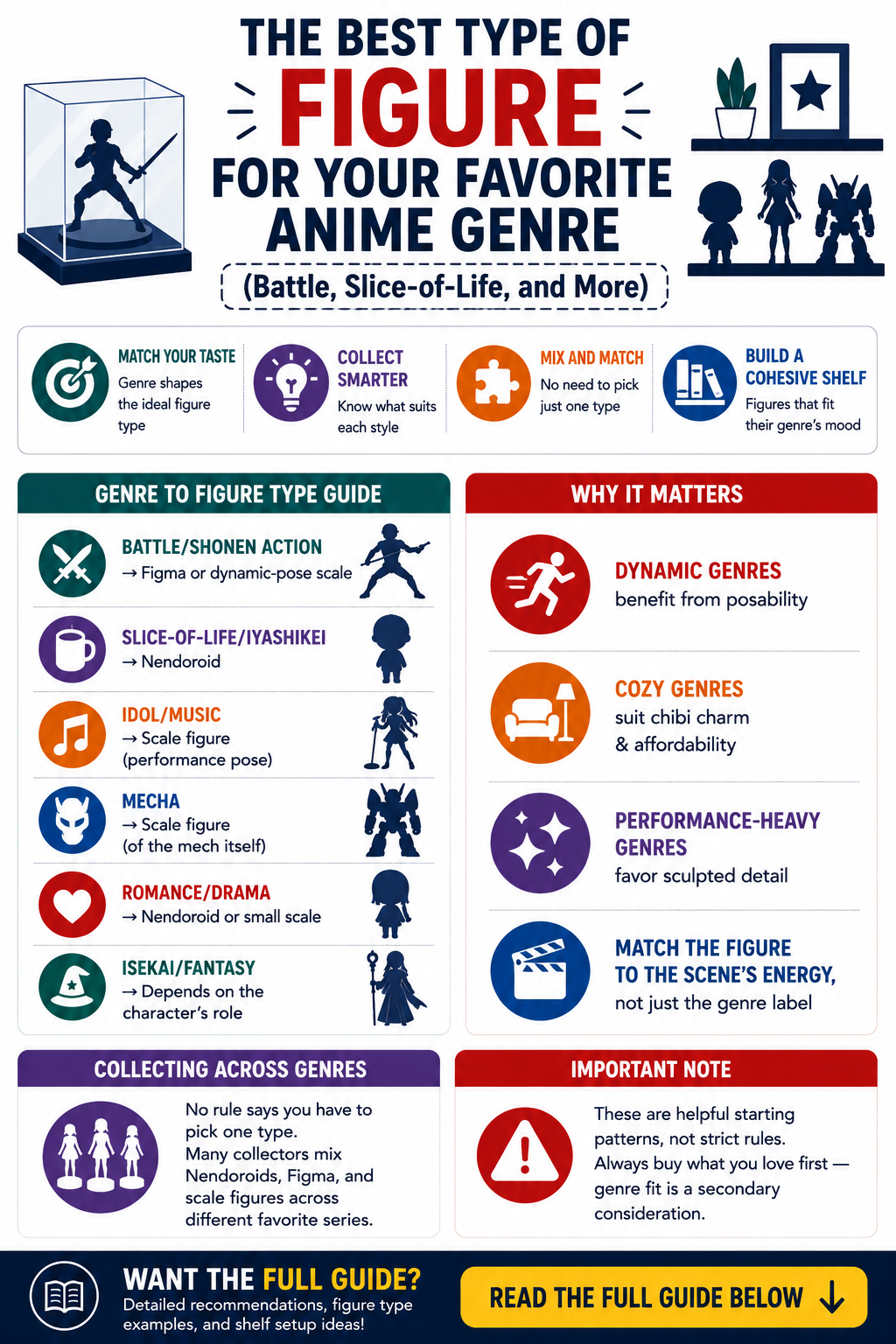
    Quick Reference: Genre to Figure Type

    GenreBest FitWhy
    Battle / Shonen ActionFigma, or dynamic-pose scale figuresPosability and dramatic sculpted poses do justice to combat-heavy characters
    Slice-of-Life / IyashikeiNendoroidChibi charm suits the genre’s cozy, low-stakes tone; affordable enough to collect a whole cast
    Idol / MusicScale figures, often in performance posesThese series are built around visually striking stage moments that scale figures capture well
    MechaScale figures (often of the mecha itself, not just the pilot)Mechanical detail work is a major part of the appeal, and static display suits large, complex models
    Romance / DramaNendoroid or smaller scale figuresCharacter-focused, emotionally driven shows often suit a more intimate, expressive figure style
    Isekai / Fantasy AdventureMix of Figma and scale, depending on the specific character’s roleWide variance within the genre — action-heavy protagonists suit Figma, iconic “hero shot” moments suit scale

    Battle and Action Series: Lean Into Posability

    If your favorite shows are built around fight scenes, tournaments, or big dramatic confrontations, a static figure genuinely underdelivers on what made you love the character in the first place. This is where Figma earns its reputation — the articulation exists specifically to let you recreate the kind of dynamic moment that defines these characters.

    That said, don’t rule out scale figures entirely here. A lot of manufacturers specifically sculpt action-series scale figures in a dynamic mid-combat pose rather than a neutral stance — you lose posability, but gain a level of sculpted detail (flowing capes, motion lines, impact effects) that a Figma’s engineered joints can’t fully replicate. If you have a single defining character you love, a well-sculpted dynamic-pose scale figure can be a genuine showpiece.

    Slice-of-Life and Iyashikei: Lean Into Charm and Collectability

    Shows built around everyday moments, gentle humor, and cozy atmospheres tend to suit Nendoroids remarkably well. The chibi style matches the genre’s general visual warmth, and because these shows are often ensemble-focused, Nendoroids’ relative affordability makes it realistic to actually collect the whole main cast rather than picking just one favorite.

    This is also a genre where interchangeable face plates genuinely add value — a lot of slice-of-life charm comes from small expressive moments, and being able to swap a figure’s expression to match your mood (or the scene you’re recreating) fits the tone of these shows particularly well.

    Idol and Music Series: Lean Into Performance Moments

    These series are usually built around visually spectacular stage performances, elaborate costumes, and specific iconic scenes — exactly the kind of thing a scale figure, sculpted in a single striking pose, captures better than an articulated alternative. Costume and hair detail tend to be a big part of what makes these characters visually distinctive, and that level of sculpted and painted detail is squarely a scale figure’s strength.

    Mecha: Lean Into the Machine, Not Just the Pilot

    If mecha is your genre, don’t overlook figures of the mechs themselves, not just their pilots. This is a genre where the machine design is often as central to the appeal as any individual character, and scale model kits or figures of the mecha itself can be some of the most satisfying pieces to display — particularly for anyone who also enjoys the more hands-on side of the hobby covered in my garage kit guide.

    Romance and Character Drama: Lean Into Intimacy

    Shows centered on close character relationships and emotional nuance tend to suit smaller, more personal figure formats — Nendoroids for a warmer, approachable feel, or smaller scale figures for something a bit more detailed without going to a large, imposing showpiece size. These genres are less about dramatic action poses and more about capturing a character’s personality, which smaller formats tend to do well.

    Isekai and Fantasy Adventure: It Depends on the Specific Character

    This genre spans a wide range — some isekai leans heavily into action and power fantasy (suiting Figma or dynamic scale figures), while other entries lean more into worldbuilding, comedy, or slower-paced adventure (suiting Nendoroid or standard-pose scale figures). Rather than a single genre-wide recommendation, it’s worth thinking about which specific character or moment you’re drawn to and matching the figure type to that scene’s energy rather than the genre label alone.

    Building a Collection Across Multiple Genres

    If, like a lot of collectors (myself included), your taste spans several genres, there’s no need to pick one figure type and stick with it exclusively. A shelf mixing a couple of Nendoroids from a slice-of-life favorite, a dynamic Figma from a battle series, and one standout scale figure as a centerpiece is a completely normal, and honestly pretty common, way to collect. The genre-to-type patterns above are a useful starting point for a specific purchase decision, not a rule about how your whole collection needs to look.

    If you’re building out a mixed collection like this, it’s worth revisiting my storage and display guide for tips on protecting a varied shelf that includes both posable and static pieces, since they have slightly different care considerations.

    Frequently Asked Questions

    Is it “wrong” to buy a Nendoroid of a serious battle series character? Not at all — plenty of intense action series also get Nendoroid releases, and the contrast between the character’s serious source material and their chibi figure can be part of the appeal. These are general patterns based on what tends to suit a genre well, not hard rules.

    Which genre tends to have the most figure variety to choose from? Popular, long-running battle/shonen series tend to have the largest catalogs across all figure types, simply due to how much merchandise gets produced for major franchises. Niche or newer series in any genre may have more limited options regardless of genre fit.

    Should I buy based on genre fit or just what I love most? What you love most, always — genre patterns are meant to help you decide which type of figure to get for a character you already want, not to talk you out of a figure that doesn’t fit the “expected” mold for its genre.

    Final Thoughts

    There’s no strict rulebook here — plenty of great figures break these patterns entirely, and the best figure for you is ultimately the one of a character and moment you actually love. But if you’re stuck deciding between a Nendoroid, Figma, or scale figure for a specific character, thinking about your favorite genre’s general personality — dynamic and action-driven, or cozy and character-focused — is a genuinely useful starting point.

    If you haven’t already, my full breakdown of Nendoroid vs Figma vs scale figures and comparison of trusted Japan-based figure stores are the natural next steps once you’ve settled on a direction.
  • How to Store and Display Anime Figures the Right Way (Without Ruining Them)

    How to Store and Display Anime Figures the Right Way (Without Ruining Them)

    Affiliate Disclosure: This post contains affiliate links. If you buy through one of them, I may earn a small commission at no extra cost to you. I only recommend stores I’ve actually ordered from or researched thoroughly — my opinions are my own.

    The Problem: The Damage Happens So Slowly You Don’t Notice Until It’s Done

    Here’s what makes figure damage particularly frustrating: it’s almost never sudden. Nobody drops a figure and shatters it on day one — instead, it sits on a sunny shelf for a year, and one day you notice the white parts have gone slightly yellow, or a color that used to look vivid now looks faded. By the time you notice, the damage is already done and generally can’t be reversed.

    In my experience, most collectors don’t lose figures to accidents — they lose them slowly to sunlight, dust, and humidity, simply because nobody told them these were actual threats worth planning around. This guide covers what’s actually causing that slow decline and what to do about it, without requiring you to build a museum-grade archive for a $60 Nendoroid.

    Who This Article Is NOT For

    • If you keep your figures sealed in the box and never display them, most of this doesn’t apply to you — an unopened box already provides a lot of natural protection. This guide is for collectors who actually want to display their figures.
    • If you’re looking for repair advice for a figure that’s already yellowed or faded, unfortunately this kind of damage is largely permanent — this guide is about prevention going forward, not restoration.
    • If you only own one or two figures and keep them somewhere naturally dim and stable, you probably don’t need to overhaul your setup. This matters most as your collection grows and stays displayed long-term.

    What Actually Damages Figures (and Why)

    1. UV light causes yellowing and fading — and it’s irreversible. This is the single biggest threat to a displayed figure, and it’s also the one most collectors underestimate.

    2. Dust is more than cosmetic. It settles into fine detail work and, combined with humidity, can contribute to surface degradation over time.

    3. Humidity and temperature swings affect materials over the long term. PVC and joint materials react to their environment more than most people expect.

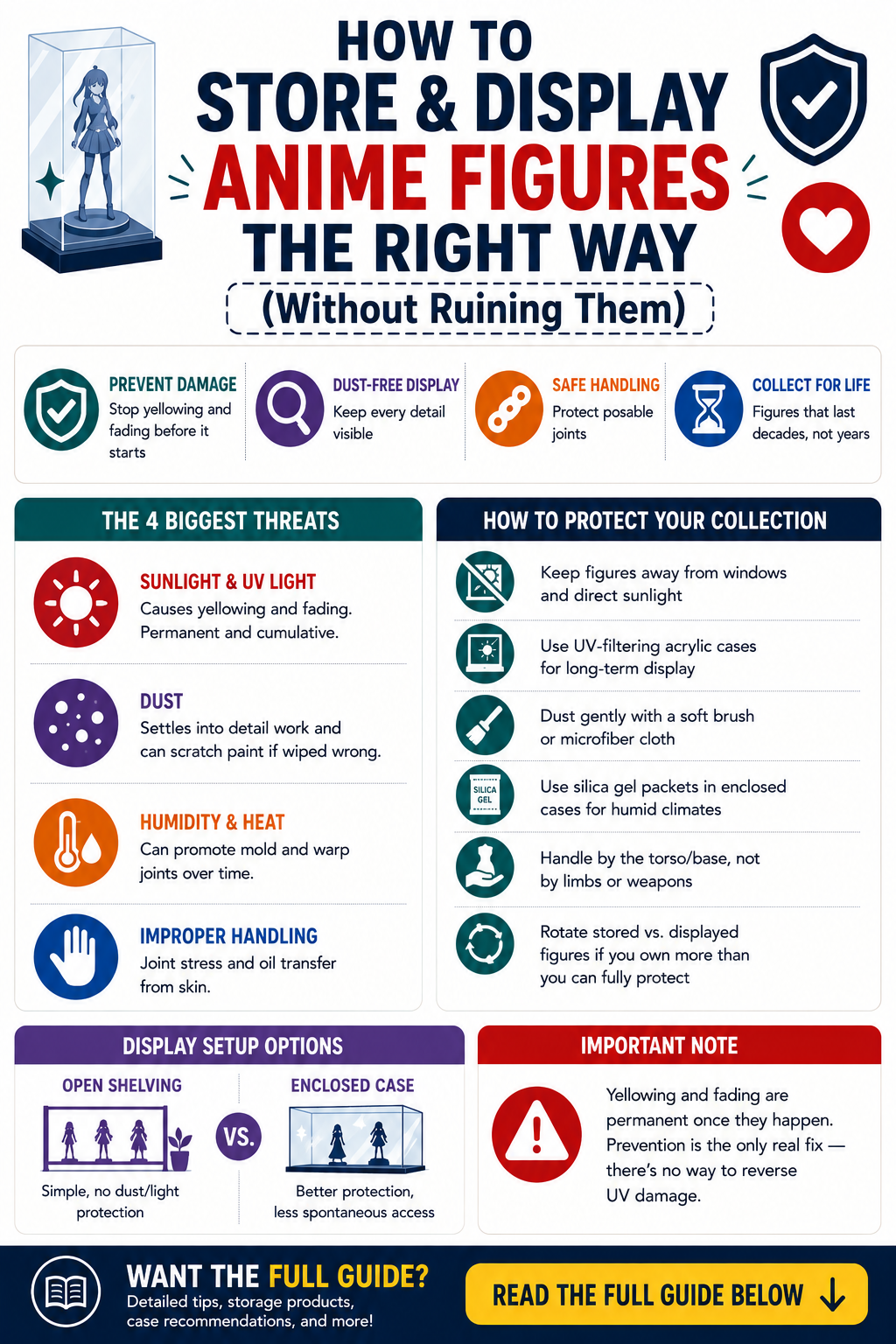
    Quick Reference: Threats and Fixes

    ThreatWhat It DoesHow to Prevent It
    Direct or indirect sunlightCauses yellowing and uneven color fading, especially on white/light parts — cumulative and permanentKeep figures away from windows; use UV-filtering acrylic cases if displaying near any natural light
    Artificial light (some LEDs, fluorescent)Lower-level version of the same UV damage over long exposureUse “UV-free” or high-CRI LED lighting, positioned a reasonable distance from the figure
    DustSettles into detail work, can scratch paint if wiped incorrectly, contributes to grime buildupRegular gentle dusting with a soft brush or microfiber cloth; enclosed cases for long-term display
    High humidityCan promote mold on painted surfaces and affect adhesives over timeKeep relative humidity in a moderate range; use silica gel packets in enclosed cases, particularly in humid climates
    Heat / temperature swingsAccelerates plastic aging and can warp or loosen jointsAvoid placing figures near vents, radiators, or direct heat sources
    Improper handlingOils from skin, accidental drops, joint stress on posable figuresHandle by the base/torso rather than limbs; consider light gloves for particularly valuable pieces

    Light: The Threat That Does the Most Damage

    If you only fix one thing after reading this article, make it light exposure. UV radiation breaks down the plastic polymers used in most figures, which shows up as yellowing (especially on white or light-colored parts) and uneven color fading over time — and once it happens, it doesn’t reverse.

    The tricky part is that this isn’t limited to figures sitting in direct sunlight. Indirect daylight through a window still carries enough UV to cause gradual damage, just more slowly. A figure that looks fine after a few months on a sunlit shelf can show noticeable fading within a year or two.

    Practical steps:

    • Keep figures away from windows, and especially away from direct sun exposure at any point in the day
    • If you’re using a display case, UV-filtering acrylic panels meaningfully reduce this risk compared to plain glass or open shelving
    • For artificial lighting, look for LED lighting specifically labeled low-UV or UV-free, and avoid older fluorescent bulbs
    • If you’re storing figures long-term rather than displaying them, darkness is genuinely the safest option

    Dust: Small Particles, Real Consequences

    Dust isn’t just an aesthetic annoyance. It settles into fine sculpted details — hair strands, fabric texture, small accessories — and over time can dull the finish and make cleaning harder without risking damage. Combined with humidity, accumulated dust can also contribute to mold growth in genuinely humid environments.

    Practical steps:

    • Dust regularly with a soft brush or microfiber cloth rather than letting it build up — it’s much easier to remove lightly and often than to clean off a thick layer later
    • Avoid wiping dust off with a rough cloth or paper towel, which can scratch paint on close inspection
    • Enclosed display cases dramatically reduce dust accumulation compared to open shelving, at the cost of being slightly less convenient to interact with

    Humidity and Temperature: The Slower-Moving Threats

    These matter more for long-term collections than for a single figure sitting out for a few months, but they’re worth knowing about as your collection grows.

    • Moderate, stable humidity is the goal. Excessive humidity can promote mold on painted surfaces and affect glue or adhesive points over time; excessively dry conditions can increase static buildup, which in turn attracts more dust.
    • Avoid placing figures near heat sources — radiators, direct sun-warmed surfaces, or vents — since heat accelerates the same aging processes as UV exposure.
    • A stable environment matters more than a “perfect” one. You don’t need lab-grade climate control for a normal collection; the goal is just avoiding extremes and big swings, not hitting an exact number.

    Handling: Don’t Let Posability Work Against You

    This one’s specific to articulated figures — Figma in particular, given how much of its appeal is built around posing.

    • Support joints properly when posing, rather than forcing a limb past its natural range of motion
    • Handle by the torso or base, not by grabbing an extended limb or weapon, which puts unnecessary stress on the joint or a thin sculpted part
    • Avoid repositioning too frequently. Repeated posing does put gradual wear on joints over time — it’s fine to enjoy displaying your figure dynamically, just be mindful that constant repositioning isn’t free
    • Consider light cotton gloves for particularly valuable pieces, since skin oils can transfer to certain finishes over repeated handling

    Choosing a Display Setup That Fits Your Collection

    Open shelving is the simplest and most accessible option — you can rearrange and interact with figures easily — but it offers no protection from dust or light on its own. This works best in a room that’s already naturally dim and away from windows.

    Enclosed display cases (glass or acrylic) meaningfully reduce dust exposure and, if UV-filtering, reduce light damage as well. The tradeoff is cost and slightly less spontaneous access to your collection.

    Rotating your collection — keeping some figures on display and others stored safely — is a practical middle ground if you own more figures than you can properly protect all at once. This also has the side benefit of evenly distributing light exposure if you periodically swap which figures are up front.

    Frequently Asked Questions

    Can yellowing be reversed once it happens? Generally no. Yellowing results from a chemical change in the plastic itself, not just surface discoloration, so it’s not something you can simply clean or polish away. Prevention is genuinely the only reliable strategy here.

    Is it safe to display figures on an open shelf, or do I need an enclosed case? Open shelving is fine as long as the location is reasonably protected from direct and indirect sunlight and isn’t in a high-dust environment. Enclosed cases become more valuable as your collection grows in both size and value, or if your display space gets any natural light.

    Do I need to worry about this for a single Nendoroid on my desk? Realistically, the risk scales with time and light exposure, not just figure count. A single figure kept away from a window for a year or two isn’t at serious risk — the concerns in this guide matter most for larger, longer-term, or sunlit displays.

    Does the original box protect the figure if I keep it stored away? Yes, generally — original packaging offers a reasonable degree of protection against light and dust for figures you’re not actively displaying, which is part of why some collectors keep a portion of their collection boxed rather than out on shelves.

    Final Thoughts

    None of this requires turning your home into a museum. The core principles are simple: keep figures out of direct and indirect sunlight, dust them gently and regularly, avoid extreme humidity or heat, and handle articulated figures with a bit of care around the joints. Do those four things consistently, and most of the damage that quietly ruins collections over the years simply won’t happen to yours.

    If you’re still building your collection, it’s worth revisiting my guides on choosing between Nendoroid, Figma, and scale figures and buying from trusted Japan-based retailers — starting with an authentic figure from a reliable source is the first step toward a collection that’s actually worth protecting long-term.

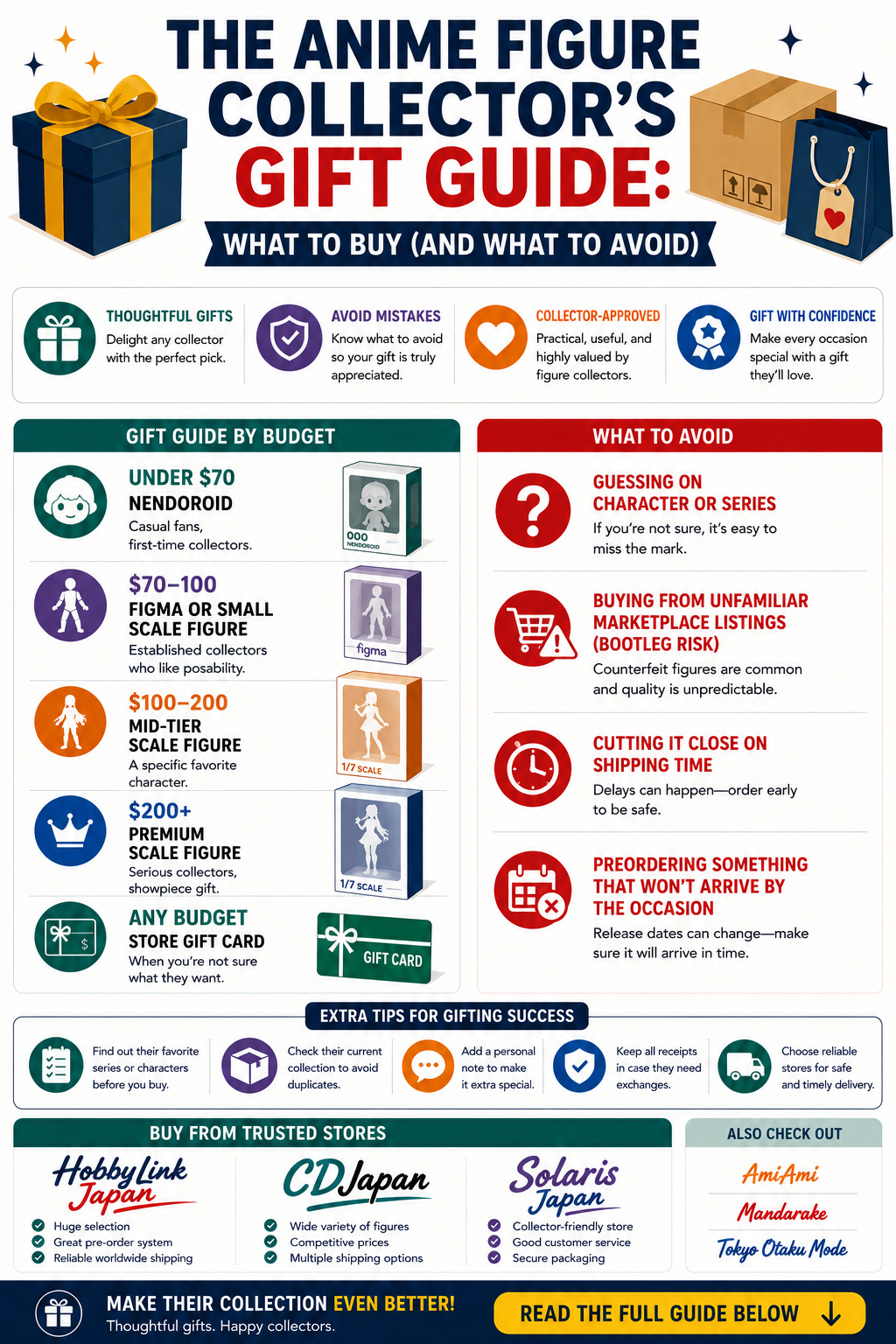
  • The Anime Figure Collector’s Gift Guide: What to Buy (and What to Avoid)

    The Anime Figure Collector’s Gift Guide: What to Buy (and What to Avoid)

    Affiliate Disclosure: This post contains affiliate links. If you buy through one of them, I may earn a small commission at no extra cost to you. I only recommend stores I’ve actually ordered from or researched thoroughly — my opinions are my own.

    The Problem: Buying a Figure for Someone Else Is Riskier Than It Looks

    If you’re not a collector yourself, buying an anime figure as a gift can feel like a minefield. Get the wrong character, the wrong version, or the wrong type of figure, and you’ve spent real money on something that’s going to sit unopened in a closet. Even collectors buying for other collectors run into this — everyone’s taste and display space is different, and “I got you a figure” doesn’t automatically mean “I got you a figure you’ll actually want.”

    In my experience, the gift guides that work best don’t try to recommend a single specific figure — because I don’t know your recipient’s exact favorite character — they instead help you make good decisions about type, price, and what to actually check before buying. That’s what this guide does.

    Who This Article Is NOT For

    • If you already know exactly which figure they want, you don’t need a gift guide — just go buy it, ideally from a trusted retailer so you’re not accidentally gifting a bootleg.
    • If you’re buying for someone who doesn’t currently collect figures, a figure might not be the right gift at all — jumping straight to a $150 scale figure for someone who’s never expressed interest in collecting is a common and expensive mistake.
    • If you’re the collector yourself and just want to know what to ask for, skip to the “How to Make This Easy on Your Gift-Giver” section near the end.

    How to Actually Choose the Right Gift

    1. Match the gift to how deep they already are into collecting. A casual fan and a serious collector need very different gifts, and getting this wrong is the single most common mistake.

    2. Confirm the character before anything else. Never guess on this one — a wrong character is a much bigger miss than a wrong figure type.

    3. Buy from a source you trust. A gift is a bad moment to accidentally receive a bootleg — see my guide to spotting fakes if you’re buying somewhere you’re not fully sure about.

    Quick Gift Guide by Budget and Relationship

    BudgetBest Gift TypeGood For
    Under $70NendoroidCasual fans, first-time collectors, “testing the waters” gifts
    $70–100Figma, or a smaller scale figureSomeone with an established collection who appreciates posability
    $100–200Mid-tier scale figureA specific favorite character, a meaningful milestone gift
    $200+Premium scale figure from a manufacturer like AlterSerious collectors, a “this is the one” showpiece gift
    Any budget, zero character riskStore gift cardWhen you genuinely don’t know what they want, or don’t want to risk getting the wrong character/version

    Gift Ideas by Type of Collector

    For the Casual Fan Who’s Never Collected Before

    Start small. A Nendoroid of a character from a show they’ve mentioned loving is close to the ideal entry gift — it’s affordable enough that a mismatch isn’t a disaster, and the chibi style tends to have broad appeal even for people who aren’t deep into figure collecting specifically. If you’re genuinely unsure of the character, a gift card to a trusted retailer is a completely reasonable choice; a lot of collectors actually prefer picking their own figure rather than receiving a guessed-wrong one.

    For the Collector Who’s Into Action/Battle Series

    If you know they collect figures from shows with a lot of combat or dynamic action, a Figma of a relevant character tends to land better than a static option — the posability actually matters for characters known for their fight scenes, and it shows you put some thought into what suits their specific taste.

    For the Serious, Established Collector

    This is where scale figures come in. If you know their favorite character (and ideally, whether they already own other figures of that character, so you’re not duplicating something they have), a scale figure is a genuine showpiece gift. This is also the price range where it’s worth double-checking you’re buying an authorized, in-production version rather than an older release that’s since been quietly replaced by bootleg reproductions on secondary marketplaces.

    For Someone You’re Not Sure Is Still Into Collecting

    Interests change, and figure collecting is a hobby people sometimes step back from. If you’re not certain the interest is still active, a smaller, lower-commitment gift (or a gift card) is a safer bet than a large investment in a scale figure they may not want to display anymore.

    What to Avoid

    • Guessing on character or series if you’re not confident. This is the single biggest way a figure gift goes wrong — better to ask a mutual friend, check their existing collection for clues, or fall back on a gift card.
    • Buying from an unfamiliar marketplace listing to save money. A gift is exactly the wrong moment to risk a bootleg — stick to retailers with a track record.
    • Cutting it close on shipping time. Import shipping from Japan can take anywhere from about a week to over a month depending on the method — order well ahead of the occasion, and check my shipping cost and timing breakdown if you’re cutting it close to a specific date.
    • Preordering something that won’t arrive in time. Preorders are exciting, but release dates shift — if the gift needs to arrive by a specific day, an in-stock item is the safer choice.

    How to Make This Easy on Your Gift-Giver (If You’re the Collector)

    If you’re the one hoping to receive a figure as a gift, the kindest thing you can do for whoever’s buying it is remove the guesswork:

    • Share a direct product link rather than just a character name — there are often multiple versions of the same character, and the specific one matters
    • Mention whether you already own other figures of that character, so they’re not duplicating something you have
    • If you genuinely don’t have a specific figure in mind, say so directly and suggest a gift card instead — it’s a completely normal and appreciated option, not a “lesser” gift

    Frequently Asked Questions

    Is a gift card a “lazy” gift for a figure collector? Not at all — most collectors have very specific taste in characters and figure versions, and a gift card removes the real risk of buying something that doesn’t match what they actually want. Many collectors genuinely prefer it.

    How far in advance should I order a figure as a gift? For an in-stock item, ordering at least a few weeks ahead gives a reasonable buffer for international shipping and any customs processing. For a preorder, don’t count on a specific arrival date at all — treat preorders as gifts for “sometime in the future,” not for a fixed occasion.

    What if I don’t know if they’d prefer a Nendoroid, Figma, or scale figure? When in doubt, a Nendoroid is the safest default — it’s the most affordable of the three, has broad appeal, and a mismatch there stings a lot less than a mismatch on a $200 scale figure. My full breakdown of the differences can help if you want to make a more informed guess.

    Final Thoughts

    The best figure gifts aren’t necessarily the most expensive ones — they’re the ones that actually match what the person collects, arrive on time, and come from a source you can trust. When in doubt, lean toward the safer choice: a smaller figure of a confirmed favorite character, or a gift card that lets them make the final call themselves.

    Whichever direction you go, buying from a trusted Japan-based retailer — HobbyLink Japan, CDJapan, or Solaris Japan — is the safest way to make sure the gift you send is the real thing.

  • How to Spot a Bootleg Anime Figure Before You Buy (And What to Do If You Already Did)

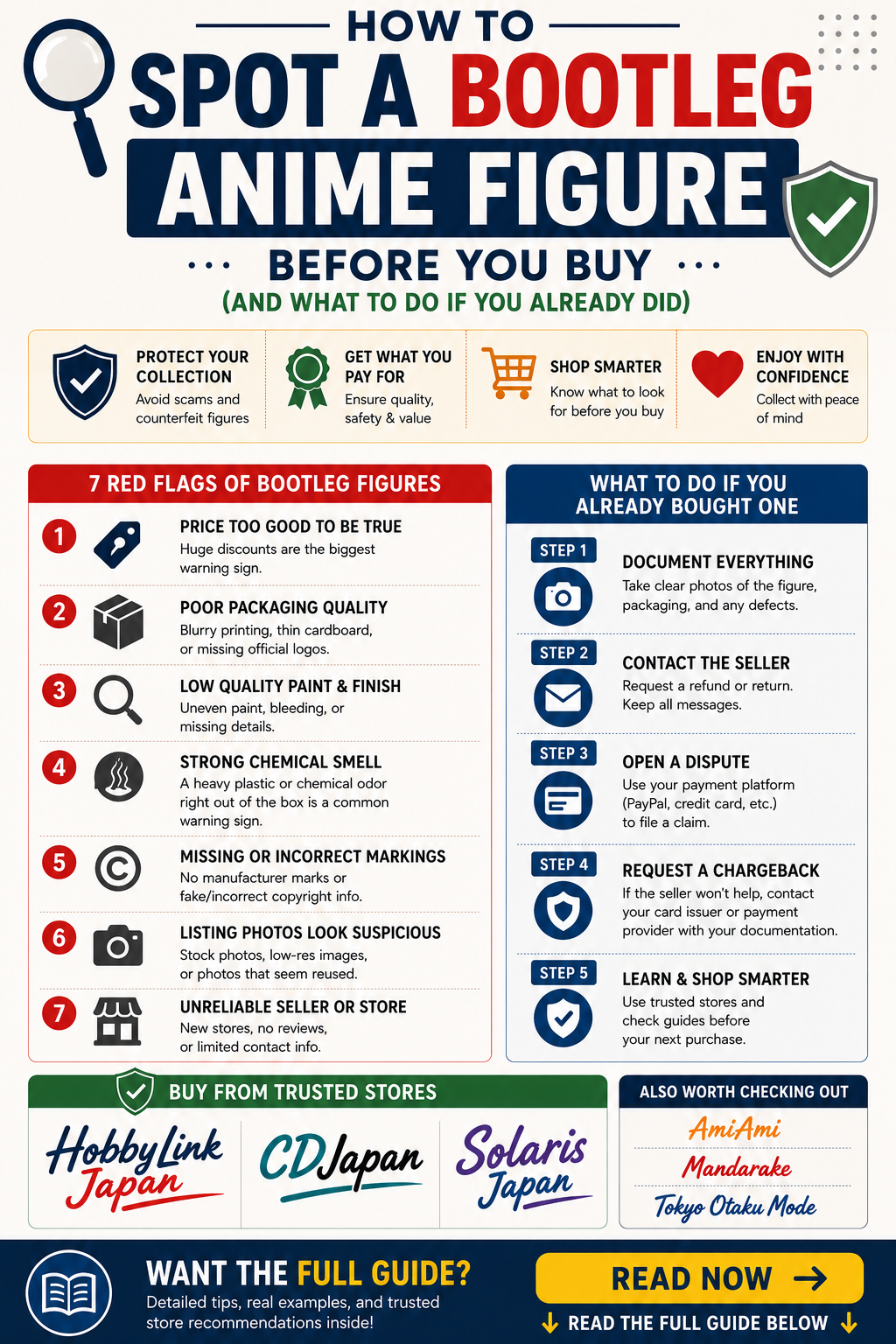
    How to Spot a Bootleg Anime Figure Before You Buy (And What to Do If You Already Did)

    Affiliate Disclosure: This post contains affiliate links. If you buy through one of them, I may earn a small commission at no extra cost to you. I only recommend stores I’ve actually ordered from or researched thoroughly — my opinions are my own.

    The Problem: That “Great Deal” Might Not Be a Figure At All — It Might Be a Recast

    Here’s an uncomfortable truth about figure collecting: bootlegs (often called “recasts” in the hobby, because they’re literally cast from a mold copied off an official figure) have gotten a lot better at looking real. A few years ago, spotting a fake was almost trivial — bad paint, obviously wrong packaging, a price that was suspiciously low. Today, some of these knockoffs are convincing enough to fool collectors who’ve been in the hobby for years, let alone someone buying their first figure.

    In my experience, the moment this actually stings isn’t when you first suspect something’s off — it’s weeks later, when you finally compare your figure side-by-side against official photos and realize the hair is subtly wrong, the paint has bled slightly outside the lines, or the box just feels cheap in a way you can’t quite explain until you’ve held a real one.

    This guide walks through exactly what to check, in the order I’d actually check it, so you can catch a fake before you buy — or at least before your return window closes.

    Who This Article Is NOT For

    • If you’re only buying from stores I’ve already vetted — HobbyLink Japan, CDJapan, and Solaris Japan all source directly from official distributors, so bootlegs essentially aren’t a risk there. This guide matters most if you’re buying from marketplaces, resellers, or anywhere outside a trusted specialist retailer.
    • If you’re deliberately buying garage kits (GKs) or fan-made resin kits that are openly sold as unofficial, unlicensed pieces — that’s a different (and legal, as long as it’s disclosed) category from a bootleg being passed off as authentic.
    • If you haven’t picked a figure type yet, back up to my Nendoroid vs Figma vs Scale Figure guide first — it’s easier to spot something wrong once you know what the real thing is supposed to look like.

    How This Checklist Is Built

    1. Check the packaging before the figure itself. Bootleggers often nail the sculpt reasonably well but cut corners hard on the box, since that’s the part original manufacturers actually spend real money protecting.

    2. Check the details real manufacturers can’t afford to get wrong. Paint bleed, seam lines, and material quality are expensive to get right — legitimate companies invest in it, and copies almost always show the strain somewhere.

    3. Check the context of the sale. Price, seller reputation, and where the listing lives tell you a lot before the figure even arrives.

    Quick Red-Flag Checklist

    CategoryAuthentic FigureBootleg / Recast
    PriceMatches typical retail or preorder pricingNoticeably below market price, “too good to be true”
    Box printingCrisp, high-resolution art and textBlurry, pixelated, or slightly off-color printing
    Authentication stickerHolographic or metallic manufacturer seal presentMissing, or a flat sticker with no holographic effect
    Hair/sculpt tipsSharp, pointed detail matching official rendersRounded, softened, or slightly misshapen edges
    Paint applicationClean lines, no bleed between colorsSmearing, bleeding outside lines, uneven coverage
    Smell (fresh from box)Little to no odor, or mild plastic smellStrong chemical or “heavy plastic” smell
    Seller/listingAuthorized retailer or manufacturer-recognized shopMarketplace listing using stolen official photos, vague seller history

    What to Actually Check, Step by Step

    1. Start With the Box, Not the Figure

    Before you even touch the figure itself, the box tells you most of what you need to know. Legitimate manufacturers like Good Smile Company, Bandai, and Kotobukiya spend real money on packaging because it’s part of protecting a premium product — bootleggers are usually working from scanned images of the original box art, which shows up as blurry or slightly pixelated printing once you look closely.

    The single most reliable box-level check is the authentication sticker. Most major manufacturers place a holographic or metallic seal somewhere on the box — tilt it under a light and you should see a multi-layered, shifting logo effect. If that sticker is missing entirely, or present but completely flat with no holographic shimmer, that’s one of the strongest single signals you’re looking at a fake.

    Watch out for sellers who explain away a missing sticker or box with phrases like “factory reject” or “unboxed unofficial stock.” Manufacturers don’t sell damaged or rejected stock through unofficial channels — that explanation is a workaround bootleg sellers use, not a real category of product.

    2. Look at the Fine Detail Work

    Once you’re looking at the actual figure, focus on the parts that are genuinely expensive to get right: hair tips, fabric texture, and small painted details like eyes or emblem work.

    Hair and sculpted edges are a surprisingly reliable tell. Authentic figures tend to have sharp, defined tips wherever the sculpt calls for it. Recasts are made from a mold taken off an existing figure, and that process tends to soften and round out fine points — so hair that should end in a crisp tip often looks slightly melted or blunt on a bootleg.

    Paint application is another strong indicator. Look at the most visually complex areas of the figure — eyes, patterned clothing, small emblems — since that’s where a rushed paint job shows the most. Bleeding between colors, visible smearing, or paint that looks either too thin or oddly caked on are all signs of a lower-quality reproduction rather than an official production run.

    3. Trust Your Nose (Seriously)

    This sounds strange, but it’s a genuinely useful check: authentic figures typically have little to no smell straight out of the box, or at most a very mild plastic scent. Bootlegs are frequently made with cheaper, non-regulated materials, and a strong chemical or “heavy plastic” odor right after unboxing is a real warning sign — not proof on its own, but worth combining with the other checks above.

    One caveat: older figures, or ones that have sat in a hot or sun-exposed environment, can develop an odor or slightly degraded paint from age rather than being fake. Use smell as one data point among several, not a standalone verdict.

    4. Investigate the Listing Itself, Before You Even Buy

    A lot of this can be checked before the figure ever ships:

    • Price that’s dramatically below typical retail is the single biggest predictor of a bootleg. Authentic figures cost what they cost because of material quality and licensing — a steep discount almost always means something’s off.
    • Stock photos vs. seller photos. If a listing only uses official promotional images and never shows an actual photo of the item the seller has in hand, be cautious — this is a common tactic for disguising a bootleg.
    • Seller history and reviews. Check whether other buyers have specifically mentioned receiving a bootleg from that seller. On larger marketplaces, this is often searchable directly in the reviews.
    • Where the listing lives. Marketplace listings (eBay, general marketplace apps, social media shops) carry meaningfully more bootleg risk than a dedicated, specialist retailer that sources directly from manufacturers or authorized distributors.

    If You Think You Already Bought a Bootleg

    • Compare against official reference photos from the manufacturer’s own product page, focusing on the checkpoints above (hair tips, paint bleed, box printing).
    • If you bought through a major marketplace (eBay, Amazon, similar platforms), most have explicit buyer protection policies for counterfeit or “significantly not as described” items — file a claim through the platform rather than trying to negotiate directly with the seller.
    • If you bought from a private seller or an unfamiliar site, a chargeback through your card issuer or payment provider is usually your strongest option once you have comparison photos ready.

    The Simplest Long-Term Fix

    Realistically, the checklist above is useful for marketplace purchases, secondhand buys, or anywhere you’re not 100% sure of the source. But the easiest way to avoid ever needing it is to buy from retailers that source directly from official distributors in the first place. That’s the whole reason I put together my comparison of trusted Japan-based figure stores — HobbyLink Japan, CDJapan, and Solaris Japan all source through legitimate channels, so this entire checklist becomes unnecessary if you’re ordering from them.

    Frequently Asked Questions

    What does “recast” mean in figure collecting? A recast is a bootleg figure made by taking a mold directly off an existing official figure, then producing unauthorized copies from that mold. The term is used somewhat interchangeably with “bootleg” in the collecting community, though recast specifically refers to this mold-copying process.

    Are bootleg figures illegal? Yes — bootlegs are unlicensed reproductions that infringe on the original manufacturer’s and copyright holder’s rights. Beyond the legal issue, they’re also frequently made with lower-quality, non-regulated materials.

    Can a bootleg figure look identical to the real thing in photos? Increasingly, yes. Some high-quality bootlegs are convincing enough in online listing photos that the differences only become clear once you inspect the packaging, paint, and sculpt details in person — which is why checking seller reputation and price before buying matters as much as inspecting the item after it arrives.

    Is it safe to buy secondhand anime figures? It can be, but the bootleg risk is higher than buying new from an authorized retailer, since you’re relying entirely on the seller’s honesty and your own inspection. Apply the checklist above, and be especially cautious of secondhand listings priced well below typical resale value.

  • Nendoroid vs Figma vs Scale Figure: Which One Should You Actually Buy?

    Nendoroid vs Figma vs Scale Figure: Which One Should You Actually Buy?

    Affiliate Disclosure: This post contains affiliate links. If you buy through one of them, I may earn a small commission at no extra cost to you. I only recommend stores I’ve actually ordered from or researched thoroughly — my opinions are my own.

    The Problem: You Found a Character You Love, and Now There Are Five Different Figures of Them

    Here’s the moment that trips up almost every new collector: you finally decide to buy your first figure, you search the character’s name, and suddenly you’re staring at a Nendoroid, a Figma, and two or three scale figures — all of the same character, all wildly different prices, and nothing on the product page actually explains why.

    In my experience, this is where a lot of people either panic-buy the cheapest option and end up disappointed, or overspend on something way more detailed than they actually wanted for their first purchase. Neither outcome feels great.

    The truth is, “Nendoroid,” “Figma,” and “scale figure” aren’t just brand names — they’re entirely different categories of product, built for different purposes, at different price points, with different tradeoffs. Once you understand what separates them, picking the right one becomes obvious. That’s what this guide is for.

    Who This Article Is NOT For

    • If you already know exactly what you want and just need to know where to buy it safely, skip ahead to my comparison of trusted Japan-based figure stores instead.
    • If you’re specifically hunting for prize figures (the cheaper figures you’d win from a claw machine or crane game in Japan, or their retail equivalents), that’s a different category entirely with its own quality expectations — this guide focuses on the three main collector-grade categories.
    • If budget isn’t a concern and you just want “the best one, whatever it costs”, the short answer is a premium scale figure from a manufacturer like Alter — but keep reading anyway, because “best” really does depend on what you’re going to do with it.

    How I’m Comparing These (Selection Criteria)

    1. What the figure is actually built for. Some figures are designed to be posed and played with. Others are designed to sit still and look as detailed as possible. That single distinction drives almost every other difference between the three categories.

    2. Realistic price-to-value expectations. I’m not just listing sticker prices — I’m looking at what you’re actually getting for that money, so you can judge whether a category fits your budget before you fall in love with a specific figure.

    3. Practical collecting factors. Display space, durability, assembly requirements, and how forgiving each type is for a first-time buyer.

    Quick Comparison Table

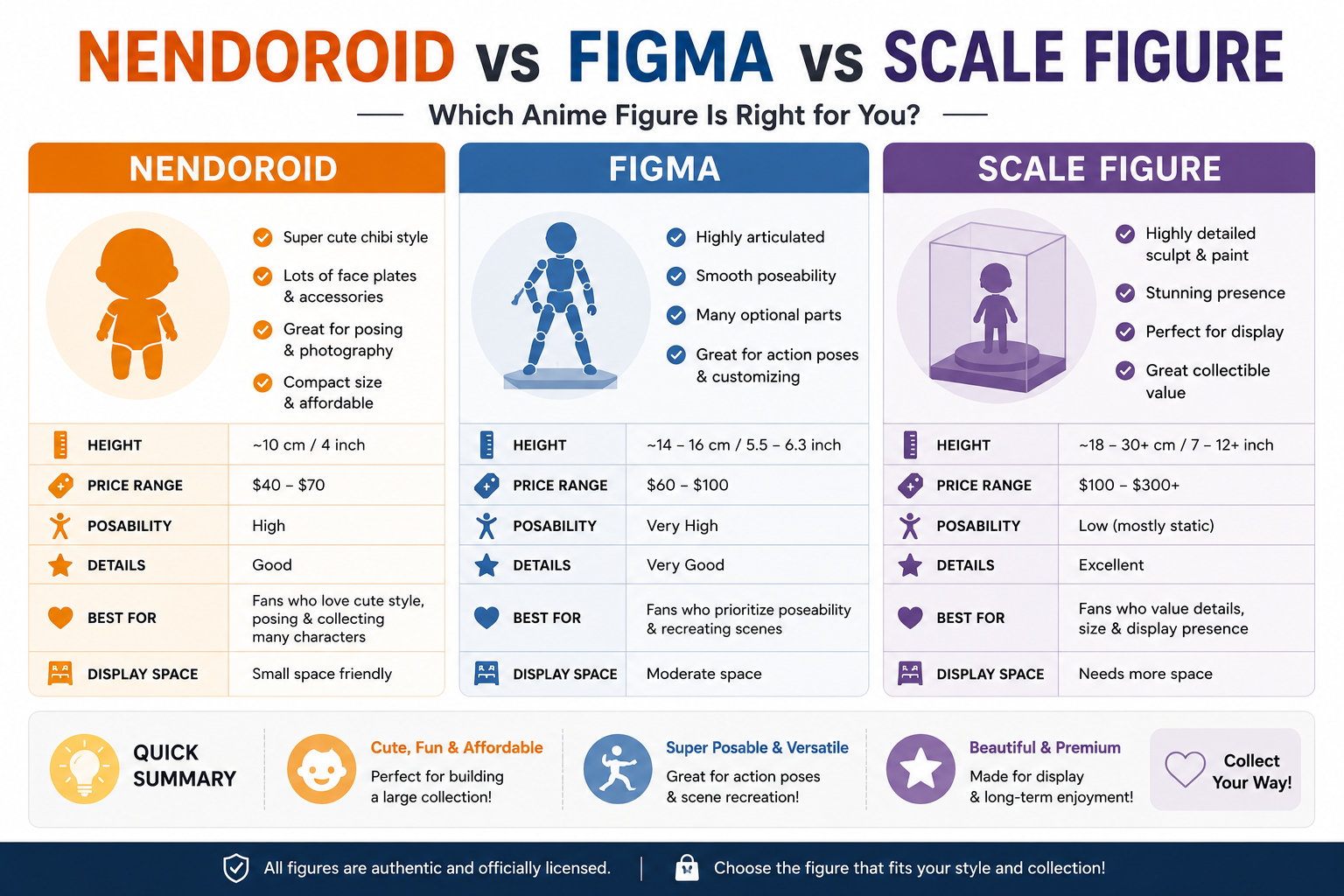
    NendoroidFigmaScale Figure
    Made byGood Smile CompanyMax Factory (distributed by Good Smile Company)Alter, Kotobukiya, Freeing, Yamato, Good Smile Company, and others
    StyleChibi / super-deformed, exaggerated proportionsRealistic proportions, action-figure-likeRealistic proportions, often dynamic sculpted poses
    Typical heightAround 10cmAround 12–15cmVaries by scale (1/7, 1/8 common), often 20cm+
    Posable?Some articulation, limited by chibi designHighly articulated, built for posingNo — sculpted in a fixed pose
    Typical price rangeRoughly $50–70Roughly $60–90Roughly $80–300+
    Best forCute displays, photography, casual collectingDynamic scenes, action poses, versatilitySerious detail, showpiece collecting

    The Three Categories, Explained

    Nendoroid — The Cute, Customizable Desk Companion

    Nendoroids are Good Smile Company’s chibi-style line — big heads, small bodies, and an emphasis on charm over realism. What makes them special isn’t just the look, though; it’s the sheer number of interchangeable parts. Most Nendoroids ship with multiple face plates for different expressions, swappable hands, and small props that let you recreate specific scenes or just give the figure some personality.

    Pros:

    • Generally the most affordable of the three main categories
    • Interchangeable face plates make them genuinely fun to photograph and display differently over time
    • Small footprint, so you can fit a lot of them on one shelf
    • Huge catalog — if a character has any figure at all, there’s a good chance it’s a Nendoroid

    Cons:

    • Articulation is real but limited compared to a Figma — the chibi proportions restrict how dynamic a pose can look
    • Some collectors find the exaggerated style doesn’t suit “serious” characters from darker or more mature series
    • Small accessories are easy to lose, and swapping parts too often can loosen the joints over time

    In my experience, Nendoroids are the best entry point for someone who isn’t sure yet how deep into collecting they want to go. They’re cheap enough that a bad purchase doesn’t sting, and versatile enough to stay fun long after the first unboxing.

    Figma — Built for Motion

    Figma is Max Factory’s line (distributed through Good Smile Company), and the entire design philosophy is different from Nendoroid: realistic proportions, engineered joints, and a level of articulation that lets you recreate almost any pose from the source material. Where a Nendoroid is meant to sit cutely on a shelf, a Figma is meant to look like it’s mid-action.

    Pros:

    • The articulation is genuinely impressive — shoulders, hips, ankles, and more all move in ways that keep the sculpt looking natural even mid-pose
    • Comes with multiple hands, face plates, and often weapons or props for recreating specific scenes
    • Scale is close to other popular collectible lines, so they display well alongside similar-sized figures
    • Excellent for anyone who wants to actually photograph their collection, not just display it statically

    Cons:

    • More expensive than Nendoroids for a similar-sized figure
    • Visible joints can bother collectors who prefer a completely seamless, statue-like look
    • Posing takes a bit of practice — badly positioned joints can look awkward until you get a feel for the range of motion

    In my experience, Figma is the category I recommend to anyone who’s into battle or action-heavy series specifically because static poses just don’t do those characters justice. A Figma of a character mid-attack looks completely different — and better — than the same character sitting still.

    Scale Figures — The Showpiece

    Scale figures are where the “statue” mentality takes over. These aren’t designed to be posed or played with at all — they’re sculpted in one fixed position, usually to a specific scale ratio (1/7 and 1/8 are the most common), and the entire focus is on sculpt quality, paint detail, and presentation. Brands like Alter, Kotobukiya, Freeing, and Yamato specialize in this category, and even Good Smile Company produces premium scale lines alongside their Nendoroid and Figma work.

    Pros:

    • The detail level is simply on another tier — paint work, fabric texture, hair strands, and dynamic sculpted poses that no articulated figure could replicate
    • Larger size makes them genuine centerpiece pieces for a shelf or display case
    • No loose joints, no missing parts to lose — what you unbox is the finished piece

    Cons:

    • Significantly more expensive, and prices climb fast for premium manufacturers or complex sculpts
    • Takes up real shelf space — a few scale figures can fill a shelf that would hold a dozen Nendoroids
    • Zero posability — you’re committing to whatever pose the sculptor chose
    • More fragile in some cases, particularly figures with thin extended parts (weapons, hair, flowing fabric)

    In my experience, scale figures are worth the jump once you already know which characters mean the most to you. They’re not a great “let’s see if I like collecting” purchase — they’re a “this character deserves the best version I can find” purchase.

    Which One Should You Actually Buy? (By Use Case)

    “I’m buying my very first figure and don’t want to overspend before I know if I’ll like collecting.” Start with a Nendoroid. Low financial risk, small footprint, and genuinely charming even as a one-off purchase.

    “I love battle/action anime and want my figures to look dynamic, not just standing there.” Go Figma. The articulation exists specifically for this — a static figure of a character known for combat scenes tends to feel like it’s missing the point.

    “I have one character I’m truly devoted to and want the best possible version.” This is scale figure territory. Save up, pick a reputable manufacturer, and treat it as a centerpiece purchase rather than a casual one.

    “I want variety without running out of shelf space.” Mix Nendoroids in with a couple of Figma or scale pieces. A lot of experienced collectors end up doing exactly this — Nendoroids fill out the collection, while one or two larger pieces anchor the display.

    “I’m worried about getting a bootleg.” This applies to all three categories, but it’s worth saying clearly: authentic Nendoroid, Figma, and scale figures from Good Smile Company, Max Factory, Alter, and similar manufacturers are not cheap. If you see one priced dramatically below typical retail — especially on a marketplace listing rather than a proper retailer — treat it as a red flag. Sticking to trusted retailers who specialize in Japanese imports is the simplest way to avoid this entirely.

    Frequently Asked Questions

    What is a Nendoroid? A Nendoroid is a chibi-style collectible figure made by Good Smile Company, recognizable by its oversized head, small body, and interchangeable face plates and accessories. They’re typically around 10cm tall and priced in the $50–70 range.

    What is a Figma figure? Figma is a line of highly articulated, realistically proportioned figures made by Max Factory and distributed by Good Smile Company. Unlike Nendoroids, Figma figures are built specifically for dynamic posing, with engineered joints and interchangeable parts for recreating action scenes.

    Are Nendoroids worth it? For most new collectors, yes. They’re the most affordable of the three main categories, take up relatively little shelf space, and the interchangeable parts keep them fun to display in different ways long after your first unboxing.

    Is a Figma or a Nendoroid better? Neither is objectively “better” — they’re built for different things. Nendoroids lean into cute, static display and affordability. Figma figures lean into realistic proportions and posability, at a somewhat higher price. The right choice depends on whether you want charm or dynamic action.

    Do scale figures come with a stand? Most scale figures include a base or stand as part of the sculpt itself, since they’re designed as a single fixed-pose piece rather than an assembled figure. Always check the individual product listing, as this can vary by manufacturer.

    Final Thoughts

    There’s no universally “better” category here — a Nendoroid isn’t a cheaper, worse version of a Figma, and a Figma isn’t a “budget” scale figure. They’re built for genuinely different purposes, and the right one depends on what you actually want out of your collection: charm and affordability, posability and action, or maximum detail as a showpiece.

    If you’re still not sure, my honest advice for a first purchase is to start small with a Nendoroid of a character you already love, see how the collecting bug hits you, and go from there.

    Once you’ve picked your category, the next question is where to actually buy it safely. I’ve put together a full breakdown of the Japan-based stores I trust for importing figures overseas — covering pricing, shipping, and which one fits different priorities. HobbyLink Japan is a great starting point if you want a low-risk preorder process, CDJapan is worth checking for preorder bonuses, and Solaris Japan is the easiest option if customs fees make you nervous.