ブログ

  • How to Set a Realistic Collecting Budget (So Figures Don’t Quietly Take Over Your Finances)

    How to Set a Realistic Collecting Budget (So Figures Don’t Quietly Take Over Your Finances)

    Affiliate Disclosure: This post contains affiliate links. If you buy through one of them, I may earn a small commission at no extra cost to you. I only recommend stores I’ve actually ordered from or researched thoroughly — my opinions are my own.

    The Problem: Figure Collecting Rarely Blows Your Budget All at Once

    Nobody accidentally spends $2,000 on figures in a single afternoon. What actually happens is smaller and sneakier: a $65 Nendoroid here, a preorder there, shipping and customs tacked onto each one, and by the end of the year the total is a genuine surprise when you actually add it up.

    In my experience, the collectors who feel good about their spending aren’t the ones who spend the least — they’re the ones who set an actual number ahead of time and have a system for tracking against it. This guide walks through how to build a collecting budget that’s realistic rather than aspirational, so it’s something you’ll actually stick to.

    Who This Article Is NOT For

    • If you already track your spending closely and feel good about it, you probably don’t need this — keep doing what’s working.
    • If you’re buying your first figure and just want to get started, budgeting can wait until you have a better sense of your actual habits — start with my first-time buyer’s guide instead, and come back here once you’ve made a few purchases.
    • If money genuinely isn’t a constraint for you, this article’s core value (help you avoid overspending) doesn’t really apply — buy what you love.

    How to Build a Budget That Actually Works

    1. Calculate your true per-figure cost, not just the sticker price. Shipping and customs meaningfully change the real number, and skipping this step is the most common reason budgets fail.

    2. Set a number before you start browsing, not after. Deciding what you can spend while looking at something you already want to buy rarely results in a realistic number.

    3. Build in a system for prioritizing, since a fixed budget means you can’t buy everything — deciding in advance how you’ll choose matters more than the exact dollar figure.

    Step 1: Know Your Real Per-Figure Cost

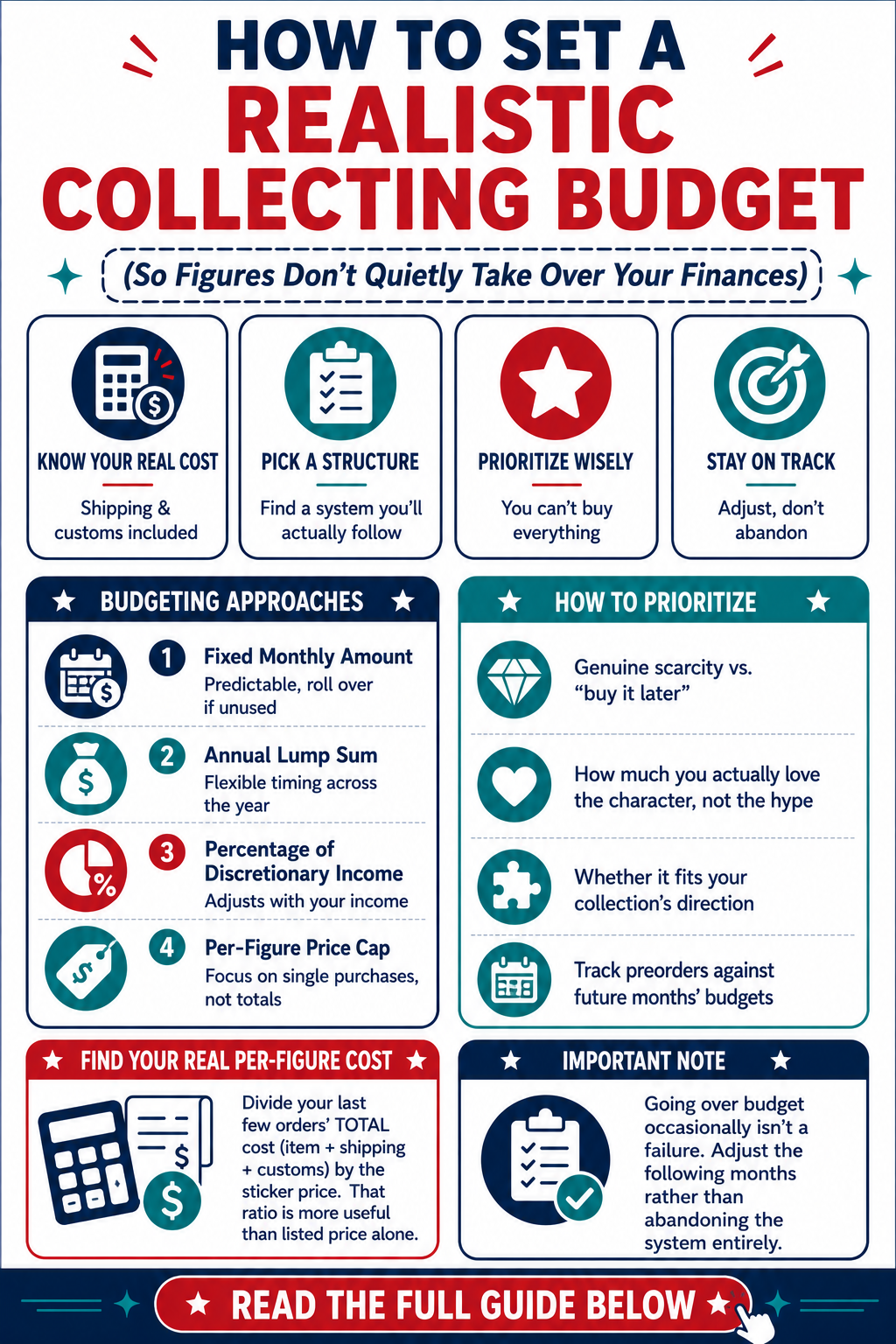
    The sticker price is only part of what you’ll actually pay. Depending on your country, shipping and customs can add a meaningful percentage on top — and this varies significantly by country, so use your own actual recent orders as a baseline rather than assuming a flat percentage.

    A simple way to find your real number: look back at your last few completed orders and calculate the actual total (item + shipping + any customs charged at delivery) divided by the sticker price. That ratio is a much more useful budgeting tool than the listed price alone, since it reflects what things really cost for you specifically.

    Step 2: Pick a Budgeting Structure That Fits Your Habits

    ApproachHow It WorksBest For
    Fixed monthly amountSet a consistent dollar amount each month, roll over unused amounts if you wantCollectors with steady income and a preference for predictability
    Annual lump sum, allocated as you goDecide a yearly total upfront, track spending against it as purchases happenCollectors who prefer flexibility around when big purchases happen
    Percentage of discretionary incomeA fixed percentage of what’s left after essentials, adjusted naturally as income changesCollectors whose income fluctuates
    Per-figure cap with unlimited quantityNo overall budget, but a maximum price per individual figureCollectors more concerned about single big purchases than total spending

    None of these is objectively correct — the right structure is whichever one you’ll actually follow. A perfectly designed budget you abandon after two months is less useful than a simpler one you stick with all year.

    Step 3: Build a Prioritization System

    A budget only works if you also have a way to decide what to buy when you can’t buy everything. A few practical filters:

    • Genuine scarcity vs. “buy it later.” If something is genuinely limited and won’t come back, prioritize it over something you could reasonably order in a few months. My preorder tracking system is useful here — knowing well in advance what’s coming lets you plan your budget around genuinely time-sensitive purchases rather than reacting to everything as urgent.
    • How much you actually love the character, rather than how much hype something has. Chasing every popular release is a much faster way to blow a budget than being selective about what you personally care about most.
    • Whether it fits your existing collection’s direction. If you’ve settled into collecting mostly from certain genres or a specific type, an impulse purchase far outside that pattern is worth a second look before committing.

    Dealing With Preorders in a Budget

    Preorders complicate budgeting because the payment timing varies by store, and money committed months in advance is easy to lose track of. A few practical habits:

    • Track preorders against future months’ budgets, not just the current one, especially with stores that charge at order time rather than at shipping
    • Know your store’s payment timing before committing — HLJ’s pay-when-it-ships model, for example, doesn’t tie up your budget the same way an upfront-payment preorder does
    • Keep a running list of committed-but-unshipped preorders and their expected cost, so you have visibility into money that’s already spoken for even though it hasn’t left your account yet

    When You’ve Gone Over Budget

    It happens. A few realistic options rather than just feeling bad about it:

    • Adjust future months rather than abandoning the budget entirely. One over-budget month doesn’t mean the system failed — spend less over the following months to balance it out.
    • Consider selling something to offset the cost. If your collecting priorities have shifted, my guide to selling figures safely covers how to do this without getting scammed or badly underpaid.
    • Revisit whether your budget number was realistic in the first place. If you’re consistently going over, the number itself might need adjusting rather than your habits.

    Frequently Asked Questions

    How much do most collectors actually spend per year? This varies enormously based on figure type, frequency, and country — a collector buying mostly Nendoroids a few times a year spends very differently than someone buying premium scale figures monthly. Rather than benchmarking against a stranger’s number, your own realistic budget matters more than any average.

    Should shipping and customs be part of my budget, or just the figure price? Definitely part of it — this is the single biggest reason budgets fail. Use your actual completed order totals (not just sticker prices) to set a realistic number.

    Is it bad to go over budget occasionally? Not inherently — the goal of a budget is general financial awareness and control, not perfect adherence every single month. Adjusting the following months to compensate is a completely reasonable response to an occasional overspend.

    What’s the best way to avoid impulse preorders wrecking my budget? A combination of tracking upcoming releases in advance (so nothing feels like a surprise you have to react to immediately) and giving yourself a short waiting period before committing to anything not already on your radar.

    Final Thoughts

    A collecting budget isn’t about spending less for its own sake — it’s about making sure your spending reflects an actual decision rather than a series of small purchases that add up before you notice. Know your real per-figure cost including shipping, pick a budgeting structure you’ll actually stick with, and build in a way to prioritize when you can’t buy everything you want.

    If you’re just getting your collecting habits established, it’s worth revisiting my comparison of trusted Japan-based retailers and shipping and customs cost breakdown — together, they’re the foundation for actually knowing what your collecting habit costs.
  • How to Buy Secondhand Anime Figures Safely (Understanding Condition Grades)

    How to Buy Secondhand Anime Figures Safely (Understanding Condition Grades)

    Affiliate Disclosure: This post contains affiliate links. If you buy through one of them, I may earn a small commission at no extra cost to you. I only recommend stores I’ve actually ordered from or researched thoroughly — my opinions are my own.

    The Problem: “Used” Can Mean Anything From “Displayed Once” to “Genuinely Rough”

    Secondhand figures are one of the best ways to find discontinued pieces or save money on something still in production — I’ve mentioned Mandarake elsewhere on this site specifically for this reason. But “used” is a genuinely wide range. It can mean a figure that was taken out of the box, looked at once, and put right back — or it can mean something with loose joints, faded paint, and a box that’s seen better days.

    In my experience, the collectors who get burned by secondhand buying aren’t usually victims of dishonest sellers — they’re victims of not knowing how to read a condition grade correctly, or not checking the specific things that actually matter for a used figure. This guide covers both.

    Who This Article Is NOT For

    • If you only buy new, in-production figures, this doesn’t apply to you directly — stick with trusted retailers selling new stock.
    • If box condition genuinely doesn’t matter to you at all, some of the advice here about box grading will be less relevant — you can safely prioritize item condition over packaging.
    • If you’re buying secondhand from an unfamiliar marketplace listing rather than a specialist retailer, read my guide to spotting bootlegs first — secondhand marketplaces carry more counterfeit risk than specialist secondhand retailers.

    How to Approach Buying Secondhand

    1. Understand that item condition and box condition are graded separately. A figure can be in excellent shape with a rough box, or vice versa — knowing which one matters more to you changes what you should look for.

    2. Know what condition grades actually describe, since the same word (“used,” “opened”) can mean different things depending on the seller or platform.

    3. Check for the specific issues that matter for the figure type you’re buying — articulated figures and static scale figures have different things worth inspecting.

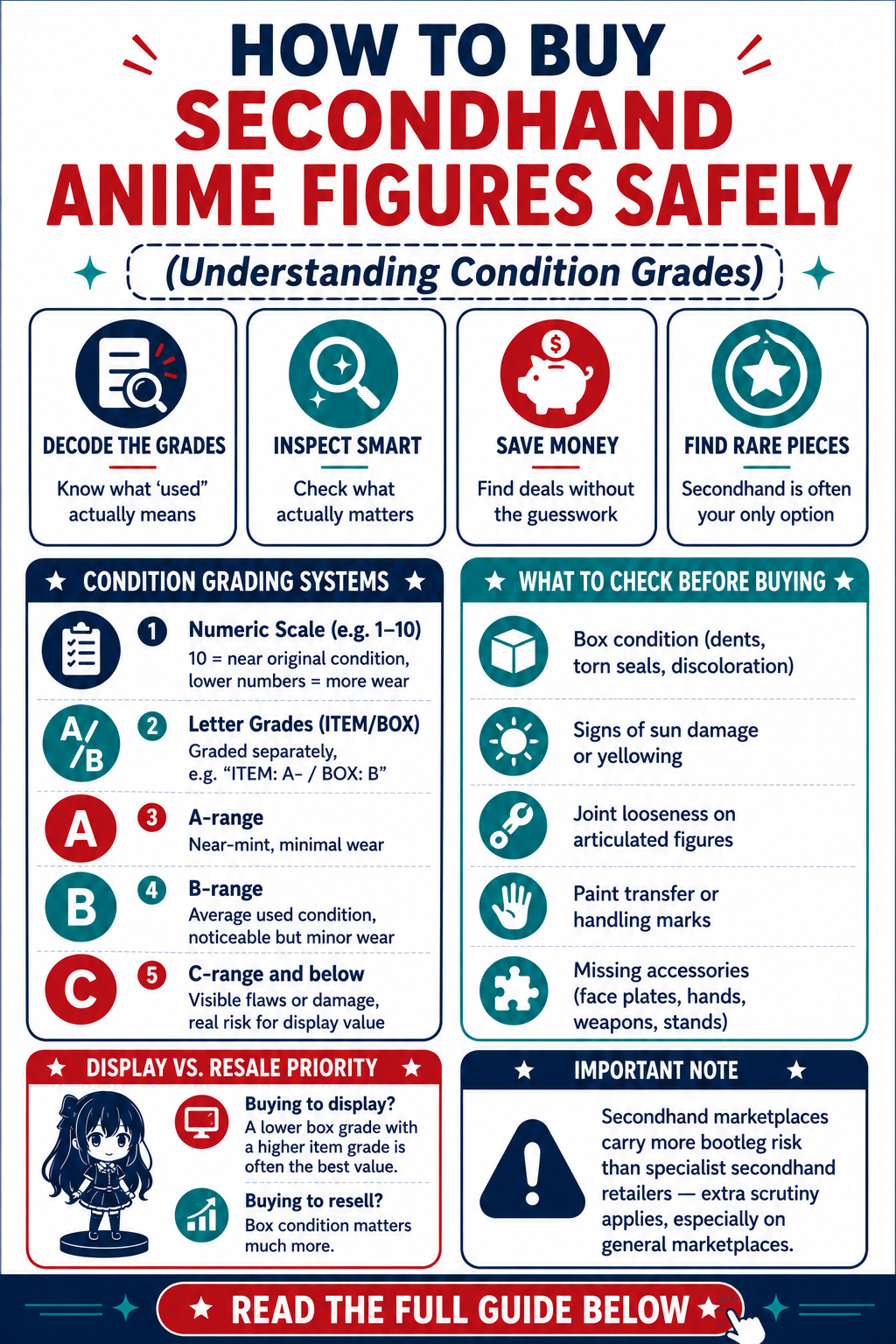
    Understanding Condition Grading Systems

    Different secondhand retailers use different grading systems, and it’s worth knowing the general logic rather than memorizing one specific scale:

    Numeric scales (e.g., Mandarake’s current system): Mandarake uses a 10-point rating scale across all item categories. A “10” represents essentially original, as-new condition; a “9” has minor imperfections that don’t affect appearance or function; going down the scale, you’ll see increasingly noticeable wear, cosmetic flaws, or functional issues. This applies to the item as a whole, though listings often note box condition separately in the description.

    Letter-based scales (common across other Japanese secondhand shops): Many other Japanese secondhand retailers use a two-part letter grade — one for the item, one for the box — written something like “ITEM: A- / BOX: B.” Under this style of grading:

    • A-range generally means near-mint to excellent condition, with minimal to no visible wear
    • B-range generally means average used condition — noticeable but not significant wear
    • C-range and below generally means visible flaws, damage, or significant wear, and often carries real risk if you’re buying primarily for display value

    A practical tip regardless of scale: if you’re buying to display rather than resell, a lower box grade with a higher item grade is often the best value — box damage frequently drops the price meaningfully more than it affects your actual display experience. If you’re buying with resale or serious collecting value in mind, box condition matters much more, since it directly affects what you could get for it later.

    What to Actually Check Before Buying

    • Box condition specifically: dents, discoloration, torn seals, or missing shrink wrap — even if you don’t care about keeping the box, box condition is often a useful proxy for how carefully the previous owner handled the whole item
    • Signs of sun damage or yellowing: check listing photos closely for uneven coloring, particularly on white or light-colored parts — this kind of damage is permanent once it happens, so it’s worth spotting before you buy, not after
    • Joint looseness on articulated figures: for a used Figma or similar posable figure, ask the seller directly whether joints still hold poses well, since repeated posing by a previous owner can loosen joints over time
    • Paint transfer or handling marks: a slightly “greasy” feel or faint marks where accessories rubbed against the figure during storage are common and usually harmless, but worth knowing about before you buy rather than being surprised on arrival
    • Missing accessories: face plates, extra hands, weapons, and stands are often the first things to go missing from a used figure — confirm what’s actually included, not just what came with the original release

    Where to Buy Secondhand Figures

    • Specialist secondhand retailers (like Mandarake) tend to offer the most transparent, standardized grading and the most reliable descriptions, since condition assessment is core to their business
    • Community marketplaces (MyFigureCollection’s forums and marketplace features, for example) connect you directly with other collectors, who often provide more candid, detailed condition notes than a commercial listing would
    • General marketplaces (eBay, Mercari) can offer good prices but require more of your own diligence — check seller feedback specifically related to figure sales, and don’t hesitate to ask for additional photos before committing

    Frequently Asked Questions

    Is it safe to buy a “used” figure without seeing it in person first? Generally yes, as long as you’re buying from a retailer with a standardized, transparent grading system or a seller with a solid track record — request additional photos if the listing photos don’t show what you need to see clearly.

    Does a lower box grade mean the figure itself is also damaged? Not necessarily — box and item condition are typically graded separately, and it’s common to find a figure in excellent shape with a box that’s simply a bit worn or dented from storage and handling.

    Should I worry about bootlegs when buying secondhand? It’s worth more caution than buying new from an authorized retailer, particularly on general marketplaces rather than specialist secondhand shops. My guide to spotting bootlegs applies just as much to secondhand purchases as new ones.

    Is secondhand a good way to find discontinued or limited figures? Yes — this is genuinely one of the best reasons to buy secondhand, since it’s often the only realistic way to find a figure that’s no longer in production. Just apply extra scrutiny to condition grading and seller reputation for anything you can’t get anywhere else, since a bad purchase on a hard-to-find piece is a bigger loss than on something you could simply reorder.

    Final Thoughts

    Buying secondhand well comes down to understanding that condition grading is a system, not a single word — knowing how item and box grades work separately, checking for the specific issues that matter (sun damage, joint looseness, missing accessories), and matching your grading standards to what you’re actually going to do with the figure (display versus resale) will keep you from unpleasant surprises.

    If you’re building a mixed collection of new and secondhand pieces, it’s worth pairing this with my storage and display guide — proper care matters just as much for a secondhand figure you’re now responsible for as it does for something bought brand new.

  • Good Smile Company vs. Kotobukiya vs. Alter: Anime Figure Manufacturers, Explained

    Good Smile Company vs. Kotobukiya vs. Alter: Anime Figure Manufacturers, Explained

    Affiliate Disclosure: This post contains affiliate links. If you buy through one of them, I may earn a small commission at no extra cost to you. I only recommend stores I’ve actually ordered from or researched thoroughly — my opinions are my own.

    The Problem: The Same Character, Made By Five Different Companies, Looking Five Different Ways

    Once you’ve been collecting for a little while, you’ll run into this: a character you love has been sculpted by Good Smile Company, Kotobukiya, Alter, and a couple of smaller manufacturers, and each version looks and costs noticeably different. Without knowing what each company is actually known for, it’s hard to tell whether you’re choosing based on real quality differences or just whichever product photo happened to look best.

    In my experience, once you learn a handful of manufacturers’ general reputations and specialties, this decision gets a lot easier — not because one company is universally “best,” but because each has a genuinely distinct style and focus that suits different priorities.

    Who This Article Is NOT For

    • If you only buy from one manufacturer already and you’re happy with that, there’s no need to overhaul your approach — this is most useful when you’re actively deciding between multiple versions of the same character.
    • If you haven’t read my Nendoroid vs Figma vs Scale Figure guide yet, that’s the more fundamental decision — this article assumes you already know roughly which type you want and are now choosing between manufacturers within that type.
    • If brand doesn’t matter to you at all and you buy purely on character and price, that’s a completely reasonable approach — this article is for the specific moment when you’re comparing multiple versions of the same figure.

    How These Manufacturers Actually Differ

    1. Style and sculpting approach. Some companies lean toward softer, cuter proportions; others aim for lifelike realism; still others specialize in dynamic, action-oriented poses.

    2. Price positioning. Manufacturers occupy genuinely different price tiers, and that’s tied to their production philosophy, not just brand markup.

    3. What they’re specifically known for. Most of these companies have a specialty — chibi figures, premium scale statues, highly articulated action figures — that’s worth knowing before comparing two versions of the same character.

    Quick Comparison: Major Manufacturers

    ManufacturerKnown ForTypical Price RangeStyle Signature
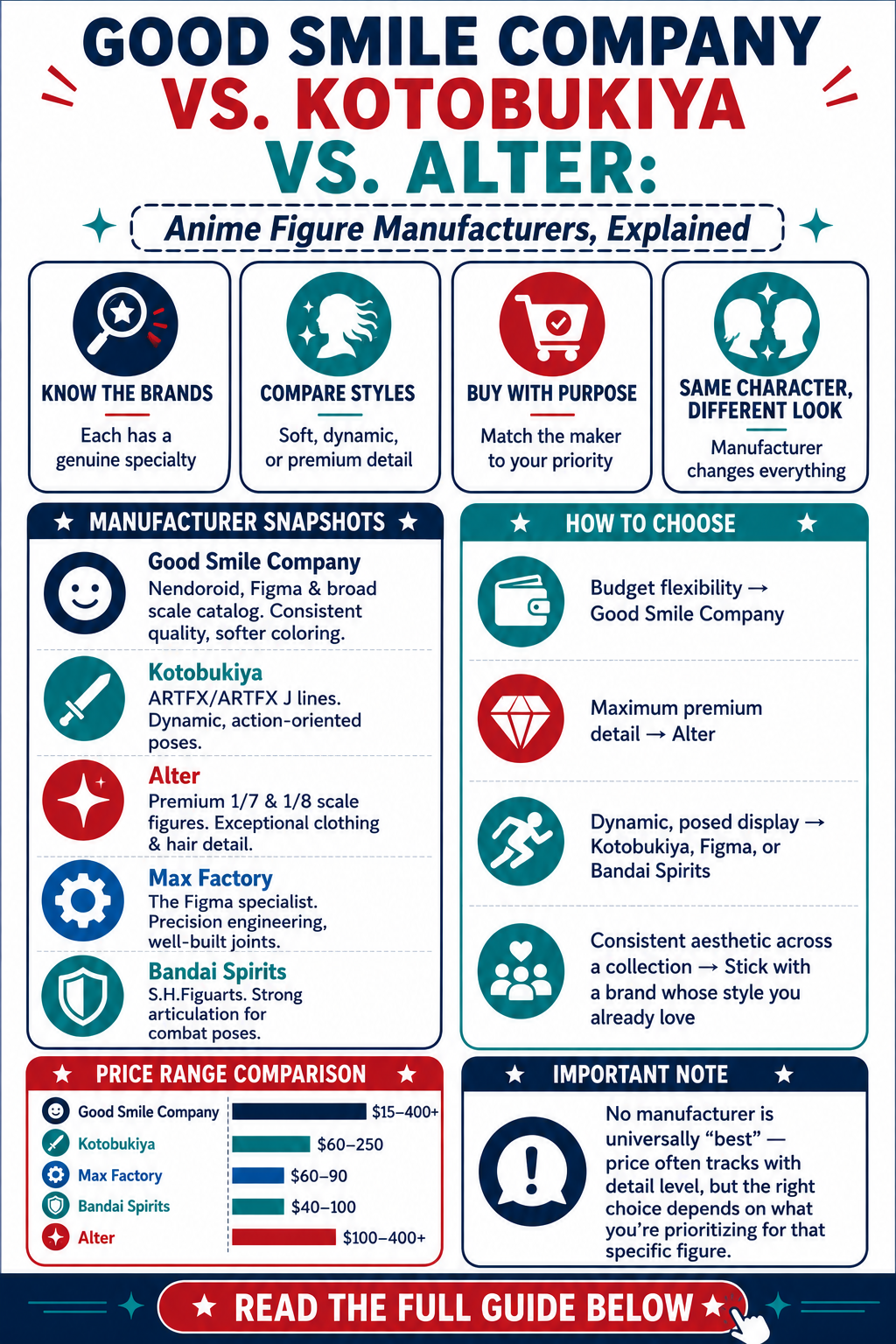
    Good Smile Company (GSC)Nendoroid, Figma (via Max Factory), and a broad scale figure catalog$15–400+ depending on lineConsistent quality, softer color palettes, distinctive illustrated box art
    KotobukiyaARTFX/ARTFX J lines, Bishoujo statues, plastic model kits$60–250Dynamic poses, strong presence in both anime and game character figures
    AlterPremium 1/7 and 1/8 scale figures$100–400+Exceptionally detailed sculpting, especially clothing and hair; among the most premium-positioned manufacturers
    Max FactoryFigma line specifically, plus some scale work$60–90 for FigmaEngineered articulation, often described as combining Alter-level precision with GSC’s softer coloring
    Bandai SpiritsS.H.Figuarts and other highly articulated action-figure-style lines$40–100Strong articulation aimed at dynamic action poses, particularly for battle-heavy series

    Good Smile Company: The Broad, Reliable Generalist

    Good Smile Company is probably the name you’ll encounter most often, and for good reason — their catalog spans budget-friendly chibi figures all the way up to premium scale pieces, and their quality is generally consistent across that whole range. They’re the company behind Nendoroid and, through their relationship with Max Factory, Figma, which alone makes them a company most collectors end up owning something from.

    Collectors often describe GSC’s scale figures as having a slightly softer color palette compared to Alter’s more true-to-source coloring, and their packaging is genuinely notable in its own right — GSC scale figure boxes typically include original illustration artwork on the side, which some collectors display or keep specifically for that reason.

    Kotobukiya: Dynamic Poses and Broad Franchise Coverage

    Kotobukiya has been producing figures since the 1980s, and their ARTFX and ARTFX J lines are known for dynamic, action-oriented poses across both anime and video game franchises. They also have a significant presence in plastic model kits, which sets them apart from manufacturers focused purely on pre-painted figures.

    If you’re comparing a Kotobukiya version of a character against a more static competitor, the pose itself is often the differentiator — Kotobukiya tends to favor capturing a character mid-action rather than a calm, neutral stance.

    Alter: The Premium Specialist

    Alter has built its entire reputation around one thing: exceptionally detailed 1/7 and 1/8 scale figures, generally positioned at the premium end of the price range. Collectors consistently point to their clothing and hair detail work as a standout, along with expressive, lifelike facial sculpting. This isn’t the manufacturer to look at if you’re working with a tight budget, but if you’re choosing a single showpiece figure for a character you love most, Alter is frequently the answer serious collectors reach for.

    Max Factory: The Figma Specialist

    Max Factory is closely associated with Good Smile Company and is specifically responsible for the Figma line. Collectors often describe their work as combining Alter-level sculpting precision with Good Smile’s softer color approach — a reasonable way to think about them is as the company behind the articulated, posable side of the hobby specifically, with a reputation for genuinely well-engineered joints that hold up to repeated posing.

    Bandai Spirits: Built for Action

    Bandai Spirits’ S.H.Figuarts line (and similar offerings) leans heavily into strong articulation aimed at recreating dynamic combat and action poses, which pairs naturally with battle-heavy series. If Figma is your reference point for posable figures, Bandai Spirits’ lines are worth comparing directly against it — both prioritize dynamic posing, but with different engineering approaches and slightly different aesthetic sensibilities.

    How to Actually Choose Between Manufacturers for the Same Character

    • If budget is your main constraint, Good Smile Company’s broader price range generally offers the most flexibility, from budget-friendly to premium within the same brand.
    • If you want the most premium, detailed version available, Alter is usually the name to check first, accepting the higher price tag that comes with it.
    • If you want the figure posed dynamically rather than standing still, compare Kotobukiya, Figma (Max Factory), and Bandai Spirits’ offerings for that character rather than a static scale figure.
    • If you already know you love a specific line’s overall aesthetic (GSC’s softer coloring, Alter’s lifelike detail, Kotobukiya’s dynamic energy), that consistency across their catalog is often a more reliable guide than judging any single product photo in isolation.

    Frequently Asked Questions

    Is one manufacturer objectively “the best”? No — each has a genuine specialty and price positioning, and “best” depends entirely on what you’re prioritizing: budget flexibility (Good Smile Company), premium detail (Alter), dynamic posing (Kotobukiya, Figma, Bandai Spirits), or a specific aesthetic style.

    Why do two figures of the same character look so different depending on manufacturer? Each company interprets the source material through its own sculpting and coloring approach — this is a real, consistent stylistic difference, not just random variation between individual products.

    Are more expensive manufacturers always higher quality? Generally, price does track with detail level and production care in this hobby, but “higher quality” doesn’t automatically mean “better for you” — a Nendoroid from Good Smile Company and a premium Alter scale figure are both well-made, just built for completely different purposes and budgets.

    Does the manufacturer affect authenticity risk? Not directly, but well-known manufacturers and their popular lines are more frequently targeted by bootleggers simply due to higher demand — buying from a trusted retailer matters regardless of which manufacturer made the figure.

    Final Thoughts

    Once you know a handful of manufacturers’ general reputations, choosing between multiple versions of the same character stops being a guessing game based on product photos alone. Good Smile Company offers breadth and reliability, Alter specializes in premium detail, Kotobukiya and Bandai Spirits lean into dynamic posing, and Max Factory anchors the articulated Figma line specifically — knowing which of those priorities matters most to you makes the decision genuinely straightforward.

    If you’re still working out which figure type suits you best before worrying about manufacturer, my Nendoroid vs Figma vs Scale Figure guide is the right place to start, followed by my comparison of trusted Japan-based retailers for where to actually buy.

  • Prize Figures and Ichiban Kuji, Explained: The Budget-Friendly Side of Figure Collecting

    Prize Figures and Ichiban Kuji, Explained: The Budget-Friendly Side of Figure Collecting

    Affiliate Disclosure: This post contains affiliate links. If you buy through one of them, I may earn a small commission at no extra cost to you. I only recommend stores I’ve actually ordered from or researched thoroughly — my opinions are my own.

    The Problem: Cheap Figures Feel Like They Must Be a Catch

    If you’ve browsed figure listings and noticed some surprisingly affordable pieces — often $25–50 for something that looks reasonably detailed in photos — your instinct might be to assume there’s a catch. After everything I’ve covered about spotting bootlegs, a little suspicion toward “too cheap to be true” pricing is a healthy habit.

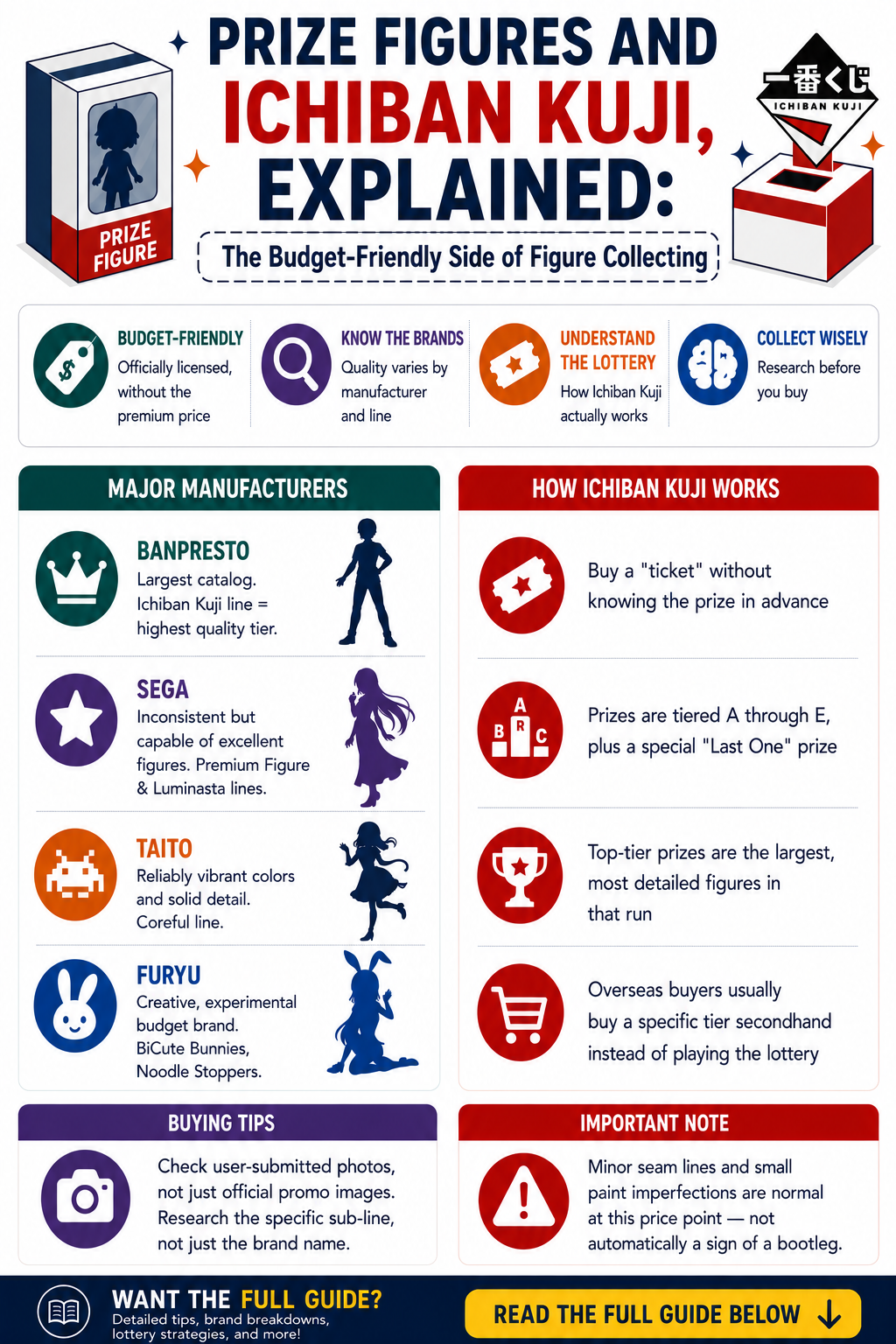
    But this is actually a completely legitimate, well-established corner of the hobby: prize figures and Ichiban Kuji figures. They’re officially licensed, made by real manufacturers, and genuinely budget-friendly by design — they’re just built and distributed differently than the scale figures and Nendoroids I usually cover. This guide explains what they are and how to collect them well.

    Who This Article Is NOT For

    • If you only want museum-grade sculpting and paint detail, prize figures generally won’t satisfy that — they’re a different value proposition entirely, and premium scale figures are the better fit.
    • If inconsistent quality within the same product line bothers you, this is worth knowing upfront: prize figure quality varies meaningfully between manufacturers, sub-lines, and even individual units of the same figure.
    • If you’re not interested in a budget-friendly way to expand your collection, and price isn’t a concern for you, this category may simply not be necessary for how you already collect.

    What Actually Defines This Category

    1. Original distribution method. Prize figures were originally designed to be won from Japanese arcade crane games (“UFO catchers”), while Ichiban Kuji figures come from a ticket-based lottery system — neither started as a normal retail product, even though both are now widely available for direct purchase.

    2. Price point by design. These are intentionally more affordable than scale figures, generally in the $25–50 range for standard prize figures, with kuji top prizes running higher.

    3. Quality that varies by manufacturer and sub-line, much more than you’d see with premium scale figure brands — this is the trade-off for the lower price.

    The Major Manufacturers and Their Sub-Lines

    ManufacturerKnown ForNotable Sub-Lines
    Banpresto (Bandai Namco subsidiary)The largest catalog and release pace in this categoryGrandista (larger, premium-leaning), Ichiban Kuji (their lottery line, generally the highest quality tier), QPosket (chibi-style)
    SEGAInconsistent but capable of genuinely excellent figuresPremium Figure, Luminasta, SPM (Super Premium)
    TaitoKnown for reliably vibrant colors and solid detail for the priceCoreful
    FuRyuA creative, experimental budget-friendly brandBiCute Bunnies, Noodle Stoppers (novelty figures designed to sit on instant ramen cup lids)

    A practical note on quality: even within a single manufacturer, sub-lines aren’t interchangeable in quality. Banpresto’s Ichiban Kuji line, for example, is generally considered the strongest tier they produce — sometimes genuinely rivaling older scale figures — while their standard prize figure lines are more of a mixed bag. It’s worth researching the specific sub-line, not just the manufacturer name, before buying.

    How Ichiban Kuji Actually Works

    Ichiban Kuji (一番くじ) is Bandai’s lottery figure system, and it works differently from a normal purchase:

    • You buy a “ticket,” typically at a Japanese convenience store, without knowing in advance which prize you’ll receive
    • Prizes are organized into tiers, usually labeled A through E (or similar), with a special final “Last One” prize awarded to whoever draws the final ticket in a given run
    • The top-tier prizes are typically the largest, most detailed figures in that specific run, and tend to command the highest resale prices outside Japan
    • Since the system is genuinely randomized, getting a specific tier isn’t guaranteed by buying tickets — this is part of why top-tier kuji prizes often resell at a real premium afterward

    For overseas collectors, buying individual lottery tickets generally isn’t practical unless you’re actually in Japan. The realistic path is buying a specific prize tier secondhand or through a specialty importer, which does mean paying above the original lottery price — but it removes the randomness if you want a specific prize.

    Where to Actually Buy Prize Figures and Kuji Prizes

    • General retailers that also carry prize figure and kuji stock. It’s worth checking whether your preferred trusted retailer carries this category alongside their standard figure catalog, since several do.
    • Secondhand specialists. Mandarake, which I’ve mentioned before for rare and discontinued figures, is also a reasonable place to find specific kuji prize tiers and older prize figures.
    • Marketplace listings, with the same caution that applies elsewhere on this site — check seller reputation, and be appropriately skeptical of prices that seem unusually low even by prize-figure standards, since bootlegging isn’t exclusive to premium scale figures.

    Tips for Buying Prize Figures Well

    • Look at user-submitted photos, not just official promotional images, before buying a specific figure. Community sites and marketplace review photos tend to show more realistic paint and sculpt quality than polished official product shots.
    • Research the specific sub-line, not just the brand. As covered above, quality varies enormously even within one manufacturer’s catalog — a quick search on the specific line name before buying is worth the extra minute.
    • Expect minor imperfections as normal for this category. Seam lines, slightly off-center decals, and small paint inconsistencies are common at this price point and aren’t necessarily signs of a bootleg — they’re a known trade-off of mass production at a lower cost.
    • Buy at launch if you want the best price on a hyped kuji prize. Popular kuji top prizes can genuinely double in resale price within months of a sold-out run, similar to the scarcity dynamics I’ve covered with limited editions.

    Frequently Asked Questions

    Are prize figures bootlegs or lower-quality knockoffs? No — they’re officially licensed products from real manufacturers like Banpresto, SEGA, Taito, and FuRyu, just made and distributed differently (and more cheaply) than premium scale figures. Quality varies more than premium lines, but legitimacy isn’t the issue.

    Is it worth buying a specific Ichiban Kuji prize tier secondhand instead of trying the lottery myself? For overseas collectors, this is usually the more realistic option, since buying individual lottery tickets typically requires being in Japan. You’ll generally pay above the original ticket price for a guaranteed specific tier, which is the trade-off for removing the randomness.

    Why do some prize figures from the same line look better than others? Quality control varies more in this category than in premium scale figure lines, partly because of the lower price point and higher production volume. Checking user-submitted photos before buying a specific figure is the best way to set realistic expectations.

    Can prize figures be a good starting point for a new collector on a budget? Yes, genuinely — the price point makes them accessible, and reputable sub-lines like Banpresto’s Ichiban Kuji or Taito’s Coreful line offer solid quality-to-price value. Just go in expecting more variability than you’d see with Nendoroid, Figma, or premium scale lines.

    Final Thoughts

    Prize figures and Ichiban Kuji occupy a genuinely useful niche in the hobby: officially licensed, budget-friendly, and accessible even for collectors who aren’t ready to spend $100+ on a premium scale figure. The trade-off is real — quality varies more than you’ll see elsewhere — but with a bit of research into specific sub-lines and a habit of checking real user photos before buying, this category can be a smart way to expand a collection without straining your budget.

    If you’re building out your collecting knowledge, it’s worth revisiting my breakdown of Nendoroid, Figma, and scale figures to see how prize figures fit alongside the other major categories, and my guide to trusted Japan-based retailers for where to actually shop.

  • The Best Type of Figure for Your Favorite Anime Genre (Battle, Slice-of-Life, and More)

    The Best Type of Figure for Your Favorite Anime Genre (Battle, Slice-of-Life, and More)

    Affiliate Disclosure: This post contains affiliate links. If you buy through one of them, I may earn a small commission at no extra cost to you. I only recommend stores I’ve actually ordered from or researched thoroughly — my opinions are my own.

    The Problem: The “Right” Figure Type Depends on What You Actually Watch

    I’ve written before about the practical differences between Nendoroid, Figma, and scale figures — price, posability, size. But there’s a layer on top of that practical comparison that matters just as much: what kind of anime you actually love changes which figure type tends to suit it best.

    In my experience, this is genuinely one of those “it depends” situations, but not in a frustrating way — once you know your favorite genre’s general personality, the right figure type becomes a lot more obvious. A static, cute chibi figure does something completely different for a slice-of-life character than it does for someone mid-battle in a shonen series, and neither is wrong — they’re just suited to different kinds of shows.

    Who This Article Is NOT For

    • If you only care about one specific character, regardless of genre, buy the figure of that character in whatever type suits your budget and taste — genre patterns are a helpful starting point, not a rule.
    • If you haven’t read my Nendoroid vs Figma vs Scale Figure breakdown yet, it’s worth reading that first — this article builds on those basics rather than repeating them.
    • If you collect across every genre equally, that’s genuinely one of the best positions to be in as a collector (mine included) — feel free to treat this as a buffet rather than a strict guide.

    How Genre Actually Influences Figure Choice

    1. How dynamic the source material is. Shows built around movement, combat, or dramatic poses tend to translate better into posable figures — static pieces can feel like they’re missing the point.

    2. The visual tone of the character designs. Some genres lean into exaggerated, expressive character designs that suit chibi styles beautifully; others rely on grounded, detailed designs that shine more in realistic scale sculpts.

    3. How you’re likely to actually display it. A genre built around big emotional or dramatic moments often benefits from a scale figure capturing one iconic scene; a genre built around everyday charm often benefits from a rotating cast of smaller figures instead.

    Quick Reference: Genre to Figure Type

    GenreBest FitWhy
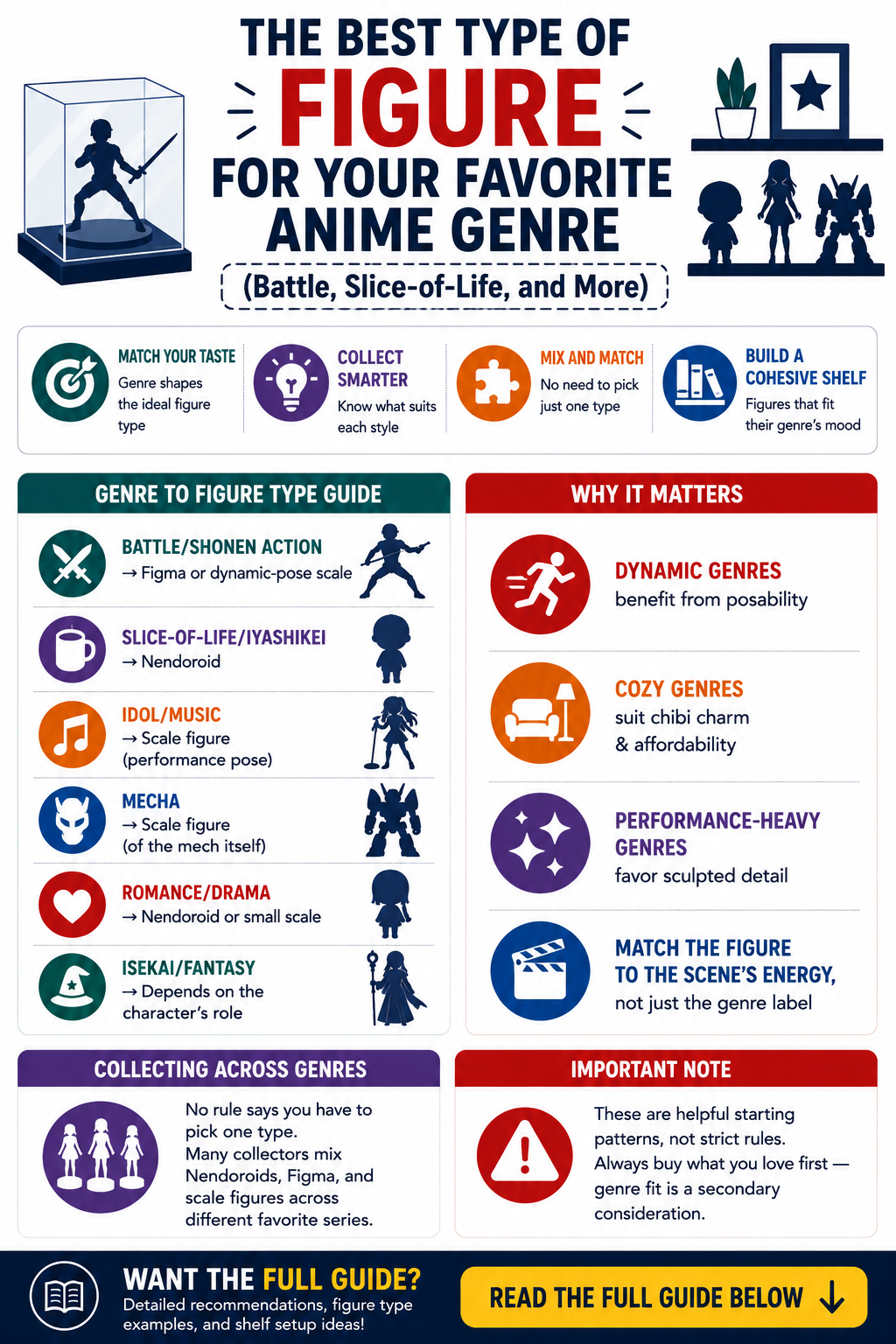
    Battle / Shonen ActionFigma, or dynamic-pose scale figuresPosability and dramatic sculpted poses do justice to combat-heavy characters
    Slice-of-Life / IyashikeiNendoroidChibi charm suits the genre’s cozy, low-stakes tone; affordable enough to collect a whole cast
    Idol / MusicScale figures, often in performance posesThese series are built around visually striking stage moments that scale figures capture well
    MechaScale figures (often of the mecha itself, not just the pilot)Mechanical detail work is a major part of the appeal, and static display suits large, complex models
    Romance / DramaNendoroid or smaller scale figuresCharacter-focused, emotionally driven shows often suit a more intimate, expressive figure style
    Isekai / Fantasy AdventureMix of Figma and scale, depending on the specific character’s roleWide variance within the genre — action-heavy protagonists suit Figma, iconic “hero shot” moments suit scale

    Battle and Action Series: Lean Into Posability

    If your favorite shows are built around fight scenes, tournaments, or big dramatic confrontations, a static figure genuinely underdelivers on what made you love the character in the first place. This is where Figma earns its reputation — the articulation exists specifically to let you recreate the kind of dynamic moment that defines these characters.

    That said, don’t rule out scale figures entirely here. A lot of manufacturers specifically sculpt action-series scale figures in a dynamic mid-combat pose rather than a neutral stance — you lose posability, but gain a level of sculpted detail (flowing capes, motion lines, impact effects) that a Figma’s engineered joints can’t fully replicate. If you have a single defining character you love, a well-sculpted dynamic-pose scale figure can be a genuine showpiece.

    Slice-of-Life and Iyashikei: Lean Into Charm and Collectability

    Shows built around everyday moments, gentle humor, and cozy atmospheres tend to suit Nendoroids remarkably well. The chibi style matches the genre’s general visual warmth, and because these shows are often ensemble-focused, Nendoroids’ relative affordability makes it realistic to actually collect the whole main cast rather than picking just one favorite.

    This is also a genre where interchangeable face plates genuinely add value — a lot of slice-of-life charm comes from small expressive moments, and being able to swap a figure’s expression to match your mood (or the scene you’re recreating) fits the tone of these shows particularly well.

    Idol and Music Series: Lean Into Performance Moments

    These series are usually built around visually spectacular stage performances, elaborate costumes, and specific iconic scenes — exactly the kind of thing a scale figure, sculpted in a single striking pose, captures better than an articulated alternative. Costume and hair detail tend to be a big part of what makes these characters visually distinctive, and that level of sculpted and painted detail is squarely a scale figure’s strength.

    Mecha: Lean Into the Machine, Not Just the Pilot

    If mecha is your genre, don’t overlook figures of the mechs themselves, not just their pilots. This is a genre where the machine design is often as central to the appeal as any individual character, and scale model kits or figures of the mecha itself can be some of the most satisfying pieces to display — particularly for anyone who also enjoys the more hands-on side of the hobby covered in my garage kit guide.

    Romance and Character Drama: Lean Into Intimacy

    Shows centered on close character relationships and emotional nuance tend to suit smaller, more personal figure formats — Nendoroids for a warmer, approachable feel, or smaller scale figures for something a bit more detailed without going to a large, imposing showpiece size. These genres are less about dramatic action poses and more about capturing a character’s personality, which smaller formats tend to do well.

    Isekai and Fantasy Adventure: It Depends on the Specific Character

    This genre spans a wide range — some isekai leans heavily into action and power fantasy (suiting Figma or dynamic scale figures), while other entries lean more into worldbuilding, comedy, or slower-paced adventure (suiting Nendoroid or standard-pose scale figures). Rather than a single genre-wide recommendation, it’s worth thinking about which specific character or moment you’re drawn to and matching the figure type to that scene’s energy rather than the genre label alone.

    Building a Collection Across Multiple Genres

    If, like a lot of collectors (myself included), your taste spans several genres, there’s no need to pick one figure type and stick with it exclusively. A shelf mixing a couple of Nendoroids from a slice-of-life favorite, a dynamic Figma from a battle series, and one standout scale figure as a centerpiece is a completely normal, and honestly pretty common, way to collect. The genre-to-type patterns above are a useful starting point for a specific purchase decision, not a rule about how your whole collection needs to look.

    If you’re building out a mixed collection like this, it’s worth revisiting my storage and display guide for tips on protecting a varied shelf that includes both posable and static pieces, since they have slightly different care considerations.

    Frequently Asked Questions

    Is it “wrong” to buy a Nendoroid of a serious battle series character? Not at all — plenty of intense action series also get Nendoroid releases, and the contrast between the character’s serious source material and their chibi figure can be part of the appeal. These are general patterns based on what tends to suit a genre well, not hard rules.

    Which genre tends to have the most figure variety to choose from? Popular, long-running battle/shonen series tend to have the largest catalogs across all figure types, simply due to how much merchandise gets produced for major franchises. Niche or newer series in any genre may have more limited options regardless of genre fit.

    Should I buy based on genre fit or just what I love most? What you love most, always — genre patterns are meant to help you decide which type of figure to get for a character you already want, not to talk you out of a figure that doesn’t fit the “expected” mold for its genre.

    Final Thoughts

    There’s no strict rulebook here — plenty of great figures break these patterns entirely, and the best figure for you is ultimately the one of a character and moment you actually love. But if you’re stuck deciding between a Nendoroid, Figma, or scale figure for a specific character, thinking about your favorite genre’s general personality — dynamic and action-driven, or cozy and character-focused — is a genuinely useful starting point.

    If you haven’t already, my full breakdown of Nendoroid vs Figma vs scale figures and comparison of trusted Japan-based figure stores are the natural next steps once you’ve settled on a direction.

  • How to Sell Your Anime Figures Safely (Without Getting Scammed or Underpaid)

    How to Sell Your Anime Figures Safely (Without Getting Scammed or Underpaid)

    Affiliate Disclosure: This post contains affiliate links. If you buy through one of them, I may earn a small commission at no extra cost to you. I only recommend stores I’ve actually ordered from or researched thoroughly — my opinions are my own.

    The Problem: Selling Is a Completely Different Skill Than Buying

    Everything I usually cover on this site is about buying figures well — but eventually, most collectors end up needing to sell a few. Maybe your taste shifted, maybe you’re downsizing, or maybe you just have duplicates from a gift that didn’t quite land. Whatever the reason, selling comes with its own set of risks that buying simply doesn’t: pricing something fairly, avoiding scam buyers, and getting a fragile item safely into someone else’s hands without it arriving broken.

    In my experience, collectors who’ve only ever bought figures tend to underestimate how different selling is — it’s not just buying in reverse. This guide covers where to actually list your figures, how to price them realistically, and how to avoid the scams that specifically target sellers.

    Who This Article Is NOT For

    • If you’re trying to sell a bootleg or recast, knowingly or not, stop and read my guide to spotting fakes first — selling a counterfeit, even unintentionally, can create real problems for you as the seller, not just the original bootleg seller.
    • If you’re expecting to make a profit on figures you bought at retail, it’s worth resetting expectations — most figures depreciate rather than appreciate, and treating a sale as “recovering some of what you spent” is usually more realistic than expecting a profit.
    • If you only have one or two figures to sell, the lower-effort options (local Facebook groups, a quick Mercari listing) are probably more worth your time than setting up accounts on multiple platforms — save the heavier options below for larger collections.

    How to Approach Selling

    1. Know what you actually have before you price it. Condition, box status, and whether it’s a genuinely limited piece all affect price — my guide to identifying real limited editions is useful background here.

    2. Match the platform to the size of what you’re selling. A single figure and a fifty-piece collection call for different approaches.

    3. Protect yourself from the scams that specifically target sellers, which look different from the scams that target buyers.

    Where to Actually Sell

    PlatformBest ForTradeoffs
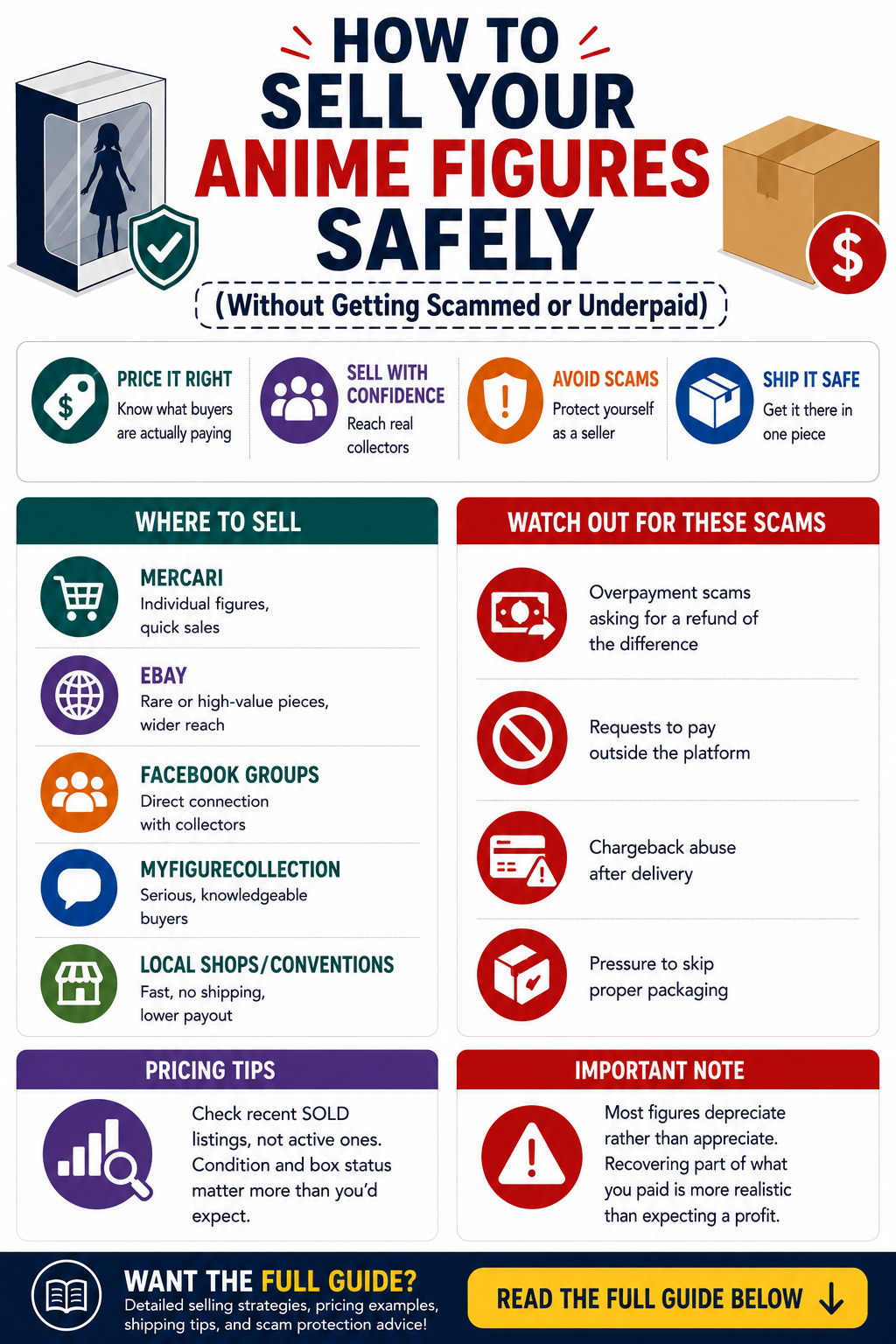
    MercariIndividual figures, relatively quick salesFees apply; pricing can be inconsistent buyer-to-buyer
    eBayRare or high-value pieces, broader buyer reachListing/selling fees; more setup effort for a single item
    Facebook groups / collector communitiesDirect connection with engaged collectors, sometimes better pricesRequires more manual back-and-forth; payment safety is entirely on you to manage
    MyFigureCollection (MFC) marketplace/forumsReaching serious, knowledgeable collectorsSmaller audience than eBay, but often better-informed buyers
    Local shops or conventionsFast, no shipping hassle, immediate cashTypically the lowest payout, since the shop needs their own margin

    A general pattern worth knowing: community-based options (Facebook groups, MFC) sometimes yield better prices than broad marketplaces, since you’re reaching people who specifically collect and understand what they’re buying — but they also require more manual effort per sale than a straightforward marketplace listing.

    Pricing Your Figures Realistically

    • Check recent sold listings, not active ones. Active listings show what sellers are asking, not what buyers are actually paying — sold/completed listings on eBay or Mercari give a much more accurate picture.
    • Condition matters more than you’d expect. A figure with a well-preserved box, no dust, and no handling wear will sell for noticeably more than the same figure in rough shape — box condition specifically is something collectors care about a lot.
    • Know whether it’s genuinely limited. If you’re not sure, my breakdown of limited edition terminology can help you figure out whether a piece is likely to command a premium or whether “limited” was more marketing language than real scarcity.
    • Price to sell if you actually want it gone. Pricing at what you originally paid, or above, often means a listing sits for months. If your goal is actually clearing space rather than maximizing every dollar, pricing modestly below recent sold comparables moves things faster.

    Writing a Listing That Sells

    • Photograph in good, even lighting, ideally without harsh flash that washes out paint detail — natural light near a window works well for most figures
    • Show multiple angles, including close-ups of any damage, discoloration, or wear — being upfront about condition builds trust and reduces disputes later
    • Include the box in photos if you still have it, since box condition is a real factor in how collectors value a piece
    • Be specific and honest in the description — exact release name, manufacturer, and any known flaws. Vague listings get fewer serious offers, not more

    Shipping Safely (So It Arrives in One Piece)

    • Individually wrap and secure parts that could shift during transit, especially removable accessories or delicate extensions like weapons or flowing hair
    • Use snug-fitting boxes with real padding — bubble wrap or packing paper, not just loose space that lets the figure shift around
    • Double-box for extra protection on higher-value pieces, especially scale figures — an inner box with the figure and padding, placed inside a larger outer box with additional cushioning
    • Buy shipping insurance for anything valuable enough that a loss would actually hurt, since standard carrier liability rarely covers the full value of a rare figure

    Avoiding Scams That Target Sellers

    Selling comes with a different set of scam risks than buying, and it’s worth knowing what to watch for specifically:

    • Overpayment scams: a buyer sends more than the asking price and asks you to refund the difference — the original payment is often fraudulent or later reversed, leaving you out both the figure and the “refund” you sent
    • Requests to move off-platform: a buyer asking to pay outside your selling platform’s official payment system removes your dispute protection entirely — legitimate buyers rarely have a strong reason to insist on this
    • Chargeback abuse: a buyer claims an item never arrived or was “not as described” after receiving it, then requests a refund through their payment provider — tracking numbers and delivery confirmation are your main protection here, so always ship with tracking
    • Payment before you’re ready to ship: don’t feel pressured into skipping your normal packaging process because a buyer is impatient — a rushed, poorly protected shipment is a real risk to the item itself, separate from any scam concern

    Frequently Asked Questions

    Should I expect to make a profit selling my figures? Generally no — most figures depreciate rather than appreciate, so recovering a reasonable portion of what you paid is a more realistic expectation than turning a profit, except for the genuinely rare pieces that do hold or increase in value.

    Is it safe to accept payment through Facebook Messenger or similar direct methods? This carries more risk than a platform with built-in buyer/seller protection, since you’re relying entirely on the payment method’s own dispute process (or lack of one). If you do sell through community groups, using a payment method that offers some form of seller protection is worth prioritizing over convenience.

    Does it matter if I don’t have the original box anymore? It affects price, but it doesn’t make the figure unsellable — just expect a lower price than an equivalent item with box included, since box condition is something serious collectors specifically look for.

    How do I know if I’m accidentally selling a bootleg I didn’t know was fake? If you bought the figure secondhand or from an unfamiliar source originally, it’s worth checking it against my guide to spotting bootlegs before listing it for sale, particularly if you never fully verified authenticity when you first acquired it.

    Final Thoughts

    Selling figures well comes down to the same theme as buying them well: be accurate, be patient, and don’t skip the steps that protect you. Price based on real sold data rather than wishful thinking, photograph and describe honestly, package like the item actually matters, and stay alert to the scam patterns that specifically target sellers rather than buyers.

    If you’re selling because your collecting priorities have shifted rather than stepping away from the hobby entirely, it might be worth revisiting my guide to choosing between Nendoroid, Figma, and scale figures — sometimes clearing out figures that no longer fit your collection is really just making room for the ones that do.

  • How to Tell If an Anime Figure Is Actually Limited Edition (Small Lot vs. Large Lot, Explained)

    How to Tell If an Anime Figure Is Actually Limited Edition (Small Lot vs. Large Lot, Explained)

    Affiliate Disclosure: This post contains affiliate links. If you buy through one of them, I may earn a small commission at no extra cost to you. I only recommend stores I’ve actually ordered from or researched thoroughly — my opinions are my own.

    The Problem: “Limited Edition” Gets Used Loosely, and It’s Not Always Meaningful

    Here’s something that trips up a lot of collectors, myself included when I was newer to this: the word “limited” shows up on a huge percentage of figure listings, and it doesn’t always mean what you’d assume. Sometimes it genuinely means a few hundred pieces ever produced, never to be made again. Other times it means “available for a restricted ordering window” on a figure the manufacturer might reprint again in a year or two anyway.

    In my experience, understanding what these terms actually mean matters most in two situations: deciding whether to rush a purchase because something really won’t come back, and not overpaying on the secondary market for something that turns out not to be as scarce as it looked. This guide breaks down the terminology so you can tell the difference.

    Who This Article Is NOT For

    • If you buy figures purely because you love the character, regardless of production numbers, none of this changes your decision much — buy what you love. This matters most if scarcity or long-term value factors into your choice.
    • If you’re treating figure collecting primarily as a financial investment, it’s worth resetting expectations here: most figures depreciate over time, and genuine appreciation is the exception, not the rule, even among figures marketed as limited.
    • If you haven’t figured out where to buy safely yet, start with my comparison of trusted Japan-based figure stores — the terminology below matters most once you’re actually navigating real listings.

    How These Terms Actually Break Down

    1. Whether a specific production number is disclosed. A genuine small-lot limited release usually states or strongly implies a specific quantity — vague “limited” language without any numbers is a weaker signal.

    2. Whether it’s restricted by time, by retailer, or by actual unit count. These are three different kinds of “limited,” and they don’t all carry the same scarcity.

    3. Whether the manufacturer has a track record of re-releasing similar items. Some companies have reprinted or re-released figures previously marketed as exclusive — worth knowing before you pay a premium purely for scarcity.

    Figure Production Terminology, Explained

    TermWhat It Actually MeansScarcity Level
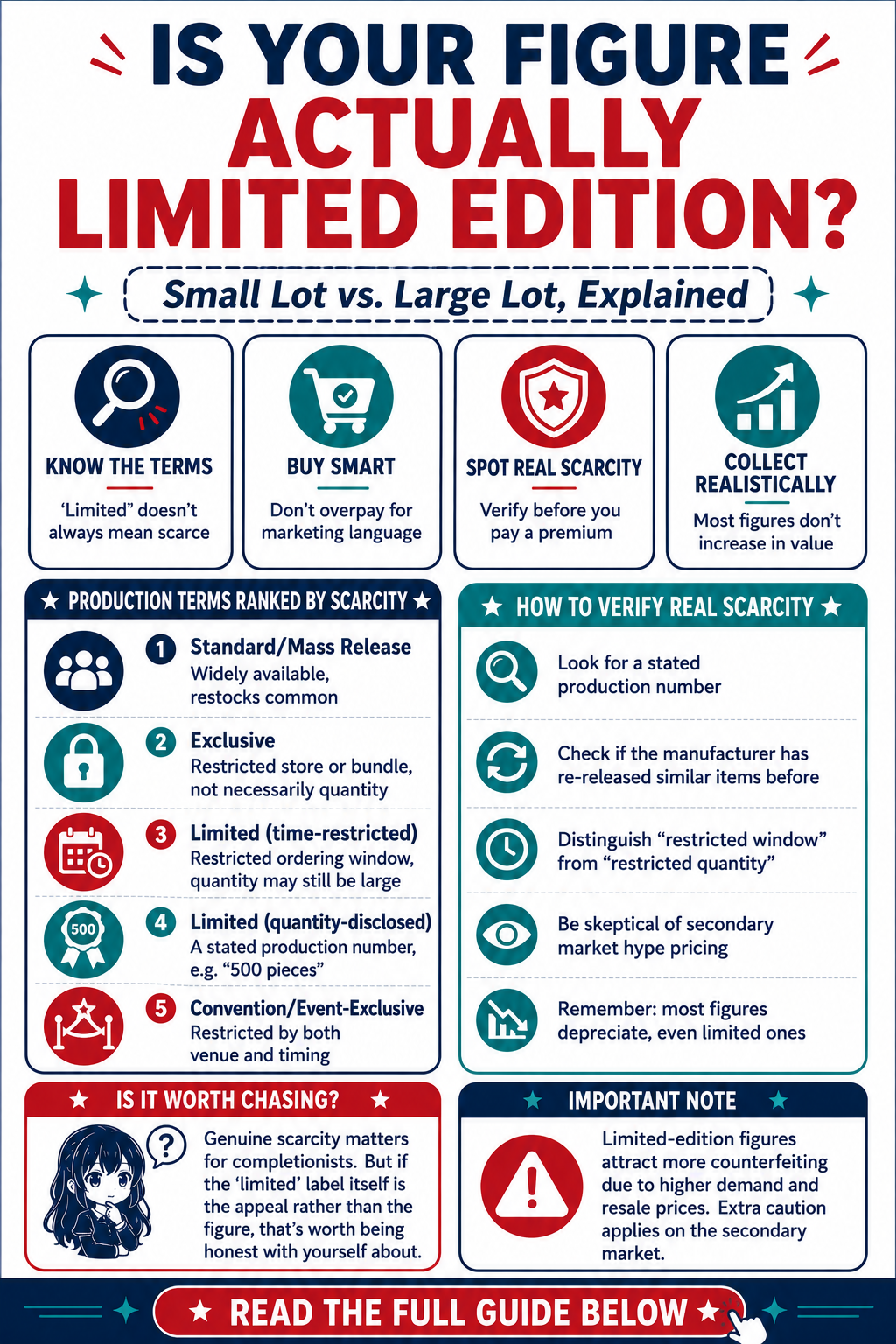
    Standard / Mass ReleaseOngoing production, widely available through normal retail channelsLow — restocks are common
    ExclusiveBundled with another item, or only sold through a specific store or mail orderModerate — availability is restricted by channel, not necessarily by total quantity
    Limited (time-restricted)Available only during a specific ordering windowModerate — the order period is limited, but the total quantity produced may still be fairly large
    Limited (quantity-disclosed)A specific, stated production number (e.g., “500 pieces worldwide”)High — this is the strongest, most verifiable form of “limited”
    Convention-only / Event-exclusiveSold only at a specific event, sometimes a single dayHigh — genuinely restricted by both venue and timing
    Kuji / Prize figuresMass-produced, won through lottery-style sales (kuji) or arcade claw machinesLow individually, though specific prizes within a set can be scarcer than others
    CancelledProduction was stopped and the item was never released, or discontinued after a runVaries — sometimes genuinely rare, sometimes reflects low original demand

    How to Verify Real Scarcity Before Paying a Premium

    • Look for a stated production number. This is the clearest, most verifiable signal. “Limited” without any number attached is a much weaker claim than “limited to 300 units.”
    • Check whether the manufacturer has re-released similar items before. Some companies have brought back figures originally marketed as one-time exclusives, sometimes as a color variant of the same sculpt. This doesn’t happen with every limited release, but it’s common enough to be worth a quick search on the specific figure and manufacturer before assuming true, permanent scarcity.
    • Distinguish “restricted ordering window” from “restricted total quantity.” A figure that was only orderable for two weeks might still have had a fairly large total production run within that window — time-limited isn’t automatically the same as scarce.
    • Be skeptical of secondary market hype pricing. Resale prices climbing well above retail reflect current demand and FOMO as much as genuine long-term scarcity. A figure trading at a premium today doesn’t guarantee it’ll hold that value — most figures depreciate over time, and even rare pieces from well-known series are the exception rather than the rule when it comes to appreciating in value.

    Should Scarcity Actually Influence Your Buying Decision?

    If you’re a completionist collector of a specific character or series, genuine limited availability is a real reason to prioritize a purchase — a figure you can never get again is a different situation from one you can pick up next month.

    If you’re chasing figures specifically because they’re marketed as limited, it’s worth pausing to ask whether you actually want the figure, or whether the scarcity framing itself is driving the appeal. Both are valid reasons to buy something, but it’s worth being honest with yourself about which one it is.

    If you’re considering figures as a long-term investment, treat that as a secondary consideration at best. The honest reality is that most figures — including many marketed as limited — depreciate rather than appreciate, and predicting which ones will hold or gain value is genuinely difficult even for experienced collectors.

    A Word of Caution on the Secondary Market

    Figures marketed as scarce or limited are also disproportionately likely to attract counterfeiting, simply because higher demand and higher resale prices make bootlegging more profitable. If you’ve missed a genuinely limited release and are considering a secondary market purchase, it’s worth revisiting my guide to spotting bootleg figures before paying a premium for something that might not be authentic.

    If you’d rather avoid the missed-preorder situation entirely, building a habit of tracking preorders and release announcements is the more reliable long-term solution than relying on the secondary market later.

    Frequently Asked Questions

    Does “limited edition” always mean a figure will increase in value? No. Most figures, limited or not, depreciate over time rather than appreciate. Genuine long-term value increases happen, but they’re the exception rather than something you should count on when buying.

    Can a company re-release a figure that was originally marketed as limited? Yes, this does happen — sometimes as a direct reprint, sometimes as a color variant or slightly modified re-release of the same sculpt. It’s not universal, but it’s common enough that “limited” shouldn’t automatically be read as “permanently unavailable again in any form.”

    What’s the difference between an exclusive and a limited figure? “Exclusive” typically refers to restricted sales channels (a specific store or bundle), while “limited” can refer to either a restricted time window or an actual capped production quantity. They’re related but not interchangeable terms.

    Are kuji and prize figures considered “limited”? Not usually in the collector sense — these are typically mass-produced, even though individual prizes within a specific kuji set or lottery campaign can be harder to obtain than others due to the randomized distribution.

    Final Thoughts

    “Limited edition” is a spectrum, not a single guarantee — everything from a two-week ordering window on a fairly large production run to a genuinely one-time, numbered release at a single convention gets described with the same word. Learning to tell the difference helps you make better calls about when a purchase is genuinely time-sensitive and when the “limited” label is doing more marketing work than actual scarcity work.

    If you’re building a collection with an eye toward pieces that are genuinely hard to find again, it’s worth pairing this knowledge with a solid preorder tracking habit and buying from retailers you already trust — that combination will serve you better than chasing marketing language alone.

  • What Is a Garage Kit? A Beginner’s Guide to Buying and Building Resin Anime Figures

    What Is a Garage Kit? A Beginner’s Guide to Buying and Building Resin Anime Figures

    Affiliate Disclosure: This post contains affiliate links. If you buy through one of them, I may earn a small commission at no extra cost to you. I only recommend stores I’ve actually ordered from or researched thoroughly — my opinions are my own.

    The Problem: “Garage Kit” Sounds Like a Red Flag, But It Isn’t (Usually)

    If you’ve spent any time browsing figure marketplaces, you’ve probably come across a listing for a “garage kit” and felt a little suspicious of it — an unpainted, unassembled resin figure, sold outside the usual retailers, sometimes at a price that seems too good to be true for the detail shown in the photos. After everything I’ve covered about spotting bootlegs, that instinct to be cautious is a good one.

    But garage kits are a completely different, legitimate category of the hobby — they’re just built differently, sold differently, and require a different kind of buyer than the pre-painted figures I usually cover on this site. This guide explains what they actually are, how to tell a legitimate one from a piracy problem specific to this corner of the hobby, and whether they’re worth getting into.

    Who This Article Is NOT For

    • If you want a figure that arrives ready to display straight out of the box, garage kits are not for you — by definition, they require assembly and painting. Stick with Nendoroid, Figma, or pre-painted scale figures instead.
    • If you don’t have any interest in a hands-on hobby beyond collecting, that’s a completely reasonable preference, and garage kits genuinely aren’t for everyone — there’s no shame in preferring finished figures.
    • If you’re specifically looking for character variety and guaranteed availability, garage kits are often small-run, sometimes one-off releases sold at a single convention — this isn’t a category where you can reliably find any character you want on demand.

    What Actually Defines a Garage Kit

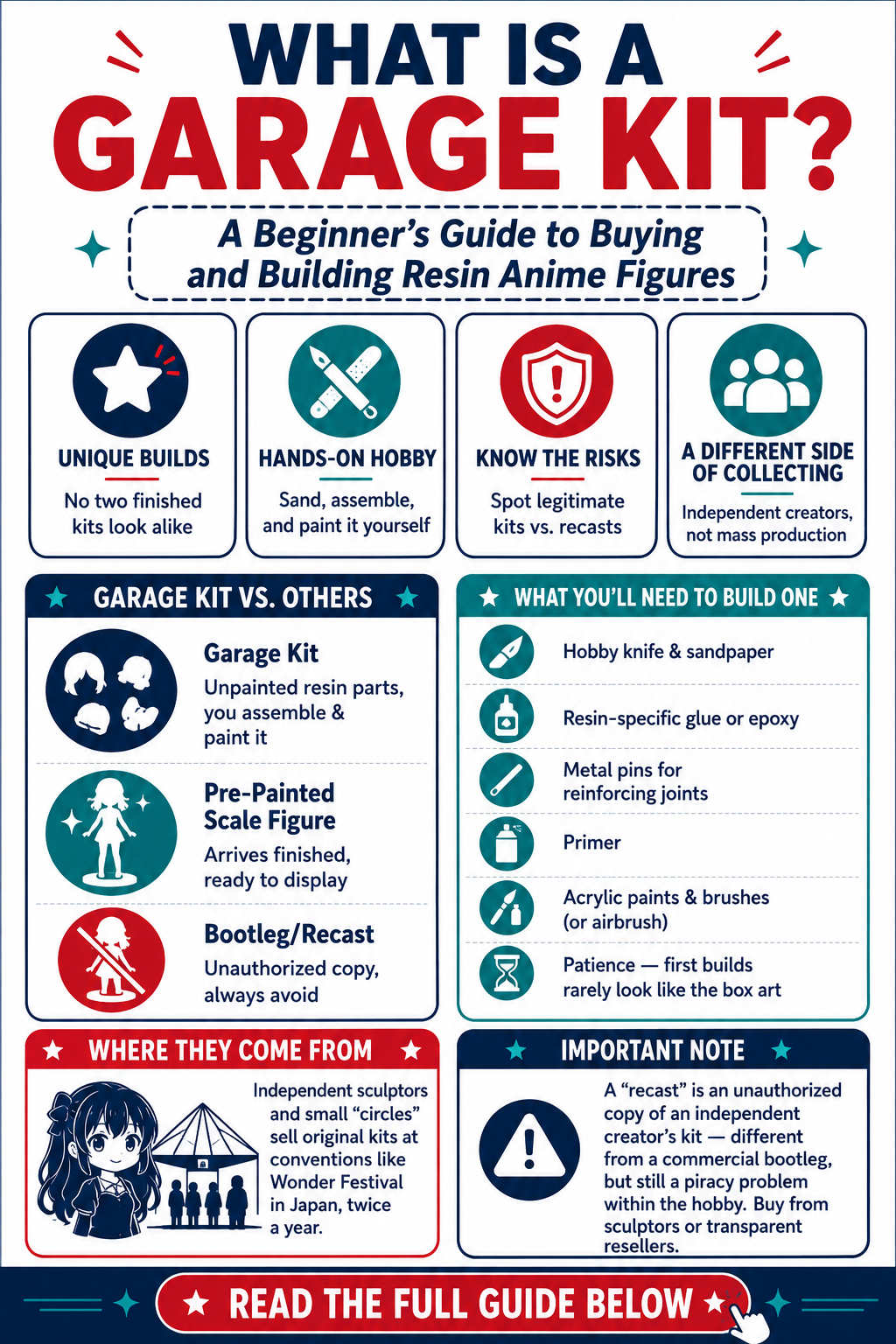
    1. It’s unpainted and unassembled. This is the core, defining trait — you receive separate resin parts, not a finished figure.

    2. It’s typically made in polyurethane resin, not the PVC/ABS plastic used in mass-produced commercial figures, which is part of why the sculpting can achieve extremely fine detail.

    3. It’s usually produced independently, by an individual sculptor or small “circle” (the hobbyist term for a small creative group), rather than by a major manufacturer like Good Smile Company or Kotobukiya.

    Garage Kit vs. Pre-Painted Figure vs. Bootleg: What’s the Difference?

    Garage KitPre-Painted Scale FigureBootleg / Recast
    Condition on arrivalUnpainted, unassembled resin partsFully assembled and paintedFully assembled and painted (imitation)
    Who makes itIndependent sculptor or small “circle”Major manufacturer (Alter, Kotobukiya, etc.)Unauthorized copier
    Official/licensed?Often unlicensed fan work, though some are licensedLicensed by the IP holderNever licensed — always unauthorized
    Where it’s soldConventions (Wonder Festival), secondhand marketplaces, specialty importersAuthorized retailersMarketplace listings, often disguised as genuine
    Buyer’s effort requiredSignificant — sanding, gluing, priming, paintingNoneNone
    Legitimacy concernGenerally accepted as part of dojin (fan-creator) culture, though a real piracy problem exists within the hobby (see below)None, if bought from an authorized sourceAlways illegitimate

    Where Garage Kits Actually Come From

    Garage kits trace back to hobbyists in Japan in the early 1980s producing small-batch resin models — often of characters or subjects that official manufacturers weren’t making at the time — literally out of home workshops, which is where the name comes from. Over time, this grew into an organized part of hobby culture, most visibly through Wonder Festival (often shortened to “Wonfes”), a convention held roughly twice a year in Japan where independent sculptors and small circles sell their original resin kits directly to attendees.

    This is genuinely a different world from the manufacturer-driven side of the hobby I usually cover — it’s closer to independent/fan-creator culture than to retail shopping, and a lot of kits are produced in very limited quantities, sometimes only for a single event.

    The Piracy Problem Within the Garage Kit Hobby Itself

    Here’s a nuance that catches people off guard: garage kit collectors use the term “recast” specifically to describe something that happens within their own hobby — someone taking an independent sculptor’s original kit, copying the mold without permission, and selling unauthorized reproductions. This is a real, ongoing issue in the garage kit community and is generally looked down upon, since it directly undercuts small, independent creators who often aren’t making much money from their work to begin with.

    This is a related but distinct issue from the commercial bootlegs I cover elsewhere on this site — there, the concern is unauthorized copies of a major manufacturer’s licensed, mass-produced figure. Here, it’s unauthorized copies of an independent creator’s original, often small-batch resin sculpt. The underlying problem (unauthorized mold-copying) is the same concept, just applied to a different part of the hobby.

    If you’re buying a garage kit, a few practical signs of a legitimate “original” kit:

    • It’s sold directly by the sculptor/circle, or by a retailer who’s transparent about sourcing from the original creator
    • Pricing is in a reasonable range for hand-produced small-batch resin work, not suspiciously cheap for the apparent detail level
    • The listing doesn’t use official commercial product photography that doesn’t match what’s actually being sold

    What You’ll Actually Need to Build One

    This is the part that surprises first-timers most: a garage kit is genuinely a hands-on craft project, not a quick assembly.

    • Basic modeling tools: hobby knife, sandpaper (various grits), files for cleaning up resin parts
    • Adhesive: typically a resin-specific glue or two-part epoxy, since standard plastic model cement doesn’t always work well on resin
    • Pinning materials: small metal rods (often brass) used to reinforce joints between parts, since resin is more brittle than injection-molded plastic
    • Painting supplies: at minimum, acrylic paints and brushes; most serious builders eventually use an airbrush for smoother results, especially on larger surface areas
    • Primer: resin surfaces generally need priming before paint will adhere properly and evenly
    • Patience and realistic expectations for your first kit — the learning curve is real, and a first build rarely looks like the box art

    Should You Actually Get Into Garage Kits?

    If you enjoy modeling, painting, or hands-on craft hobbies already, garage kits are a genuinely rewarding extension of figure collecting — you end up with something no mass-produced figure can replicate, since your specific paint job and assembly choices are unique to your build.

    If you just want to grow a display collection without a big time investment, this probably isn’t the right path — stick with pre-painted figures from trusted retailers, where the entire appeal is that someone else already did the hard part.

    If you’re curious but not ready to commit, a lower-cost, smaller kit is a reasonable way to test whether you enjoy the process before investing in an expensive, detailed piece.

    Frequently Asked Questions

    Are garage kits legal? This exists in a genuinely gray area. Many garage kits are unlicensed fan works, which technically involves IP rights that haven’t been formally licensed — historically, this has been tolerated to varying degrees within Japan’s dojin (independent creator) culture, though the situation isn’t uniform across every franchise or rights holder. This is different from a bootleg or recast, which is a clear-cut piracy issue even within the hobby’s own norms.

    Can beginners realistically build a garage kit? Yes, though it’s genuinely more difficult than assembling a standard plastic model kit — resin requires different adhesives, careful sanding, and priming before painting. Starting with a smaller, simpler kit rather than an ambitious first project is the more realistic path in.

    Where can I find garage kits if I can’t attend Wonder Festival in person? Secondhand marketplaces and specialty resellers are the most realistic option for overseas buyers, since a lot of kits are sold in person at Japanese conventions first. Mandarake, which I’ve mentioned elsewhere as a source for rare and discontinued figures, is also a reasonable starting point for browsing secondhand garage kits, though selection varies.

    Is a garage kit the same thing as a bootleg? No — a legitimate garage kit is an independently produced, often unlicensed fan creation sold transparently as such. A bootleg is an unauthorized copy of someone else’s commercial or independent work, sold in a way that misrepresents what it actually is. The distinction matters even though both involve unlicensed production.

    Final Thoughts

    Garage kits are one of the more misunderstood corners of figure collecting — easy to mistake for something shady if you’ve only ever bought pre-painted figures, but really just a different, more hands-on branch of the same hobby with its own culture and history. Whether they’re worth getting into really comes down to whether you want figures, or whether you want a craft project that happens to result in one.

    If the hands-on side doesn’t appeal to you, that’s completely fine — most of what I cover on this site focuses on the pre-painted side of collecting, starting with my guide to choosing between Nendoroid, Figma, and scale figures and where to buy them safely.

  • How to Track Anime Figure Preorders and Release Dates (So You Never Miss One)

    How to Track Anime Figure Preorders and Release Dates (So You Never Miss One)

    Affiliate Disclosure: This post contains affiliate links. If you buy through one of them, I may earn a small commission at no extra cost to you. I only recommend stores I’ve actually ordered from or researched thoroughly — my opinions are my own.

    The Problem: Preorder Windows Close Fast, and Nobody Sends You a Personal Reminder

    Here’s the frustrating part about figure preorders that nobody warns you about until you’ve missed one: the popular ones don’t stay open for long, announcements don’t always happen where you’re looking, and once a limited preorder window closes, your options usually shrink to paying a steep markup on the secondary market or waiting for a re-release that might never come.

    In my experience, the collectors who never seem to miss a preorder aren’t just lucky or more plugged in socially — they’ve built a small, repeatable system for catching announcements before the window closes. That’s really all this comes down to: a system, not luck. This guide walks through how to build one.

    Who This Article Is NOT For

    • If you’re not interested in preordering and only buy in-stock figures, most of this doesn’t apply to you directly — though the tracking habits here still help if a specific character or series you love tends to get preordered out quickly once it does become available.
    • If you haven’t picked a store yet, start with my comparison of trusted Japan-based figure stores — the tracking system below assumes you already know where you’re likely to place your order.
    • If you’re brand new to ordering from Japan generally, my first-time buyer’s guide covers the checkout and preorder payment process itself, which is a useful companion to this article.

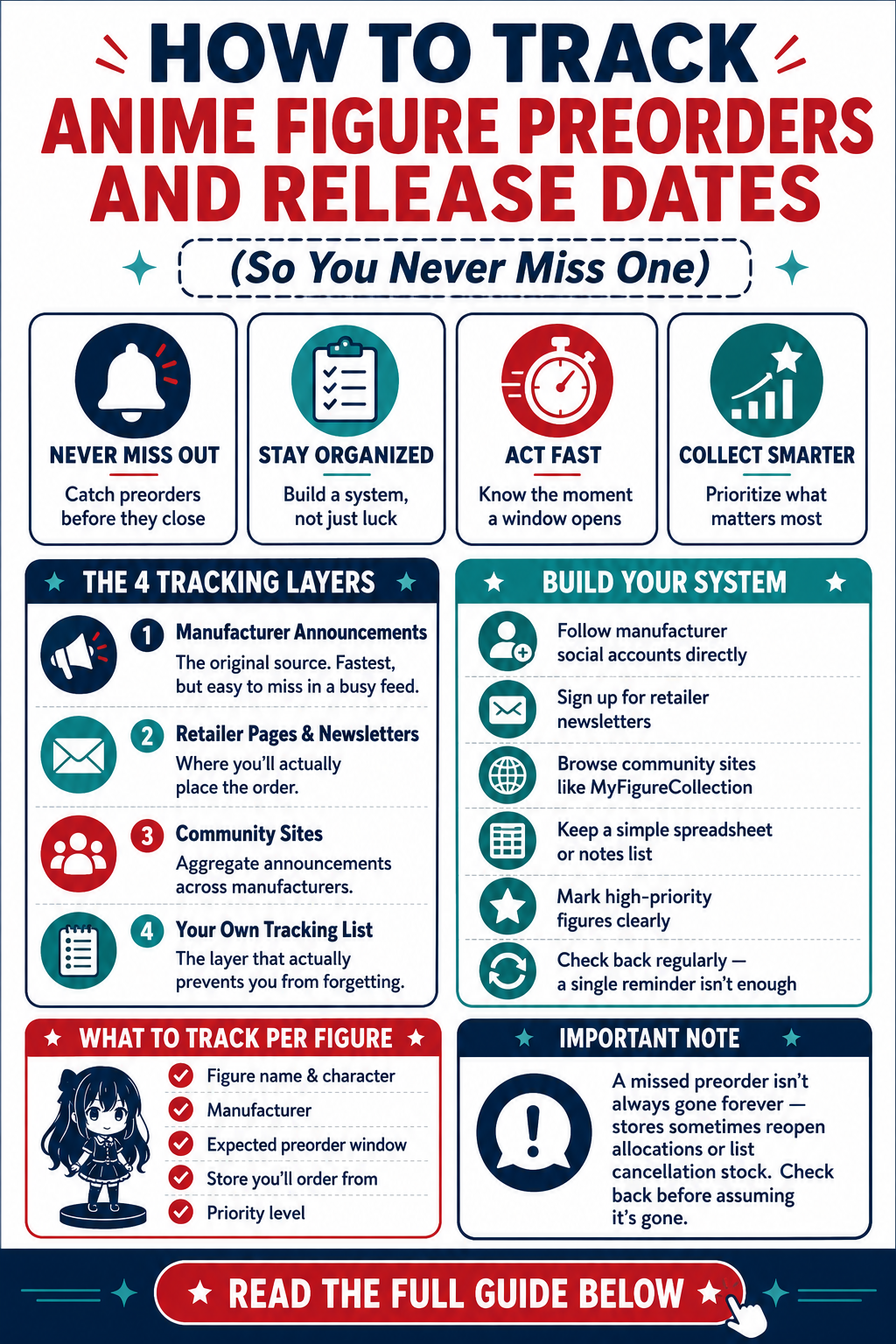
    The Four Layers of a Good Tracking System

    No single source catches everything reliably, which is exactly why relying on just one tends to fail eventually. A solid system layers a few different sources together:

    1. Manufacturer and brand announcements — the original source of “this figure exists,” usually the fastest to know but not always the most convenient to monitor constantly.

    2. Retailer preorder pages — where you’ll actually place the order, and where preorder windows, bonuses, and availability changes show up first from a purchasing standpoint.

    3. Community tracking sites — collector-run databases that aggregate announcements across manufacturers, often faster to browse than checking each manufacturer individually.

    4. Your own tracking list — the layer that actually prevents you from forgetting, regardless of how good the first three are at surfacing information.

    Quick Comparison: Tracking Methods

    MethodBest ForLimitation
    Manufacturer social media (X/Twitter, official sites)Earliest announcements, straight from the sourceEasy to miss in a busy feed; some manufacturers post primarily in Japanese
    Retailer preorder pages & newslettersKnowing exactly when you can actually buyOnly shows what that specific retailer carries
    Community database sites (e.g., MyFigureCollection)Browsing broadly, following specific characters/series across all manufacturersRequires actively checking or setting up notifications yourself
    Personal tracking list (spreadsheet, notes app, calendar)Never forgetting something you’ve already decided you wantOnly useful for things you already know about — doesn’t surface new announcements

    Building Each Layer

    Follow Manufacturers Directly

    Good Smile Company, Max Factory, Kotobukiya, Alter, and similar manufacturers post new figure announcements on their official social accounts and websites, often before retailers even open preorders. Following these directly is the fastest way to hear about something the moment it’s revealed — the tradeoff is that it takes active attention, since a single announcement can easily scroll past in a busy feed.

    Practical tip: if a manufacturer’s official account posts in both Japanese and English, following both can occasionally give you a small heads-up, since the two don’t always post at exactly the same time.

    Use Retailer Preorder Pages and Newsletters

    This is where your tracking actually turns into a purchase. Once you know a figure exists, check whether your preferred store has opened preorders for it, and sign up for that store’s newsletter if you haven’t already — this is genuinely one of the more reliable ways to catch preorder openings and reopenings without manually checking every day.

    If you’re deciding between HLJ, CDJapan, and Solaris Japan, my full store comparison covers how each handles preorders specifically, including HLJ’s no-upfront-payment model, which is worth knowing about if you’re planning to track and preorder regularly.

    Use a Community Tracking Site

    Collector-run community sites — MyFigureCollection (MFC) being the most established example — let you follow specific characters, series, or manufacturers, and often surface community discussion the moment a new figure is announced or a preorder window opens. These sites work well as a broader net, since they aggregate across manufacturers rather than requiring you to check each one individually.

    Keep Your Own List

    This is the step people skip, and it’s the one that actually prevents missed preorders. Even a simple spreadsheet, notes app list, or calendar with reminders works — the goal is just to have somewhere you write down “this exists, I want it, here’s the expected preorder window” the moment you learn about a figure, rather than trusting yourself to remember it later.

    A simple format that works well:

    • Figure name / character
    • Manufacturer
    • Expected preorder open date (if known)
    • Which store you plan to order from
    • Priority level (so your top-priority figures don’t get lost among “would be nice” ones)

    Tips for Not Missing the Ones That Matter Most

    • Mark your genuinely high-priority figures clearly, separate from ones you’re only mildly interested in. If everything gets equal attention in your tracking system, the ones you actually care about are more likely to slip through.
    • Check back periodically, not just once. A single reminder for an estimated release window isn’t enough — preorder dates shift, and windows sometimes open earlier or later than originally announced.
    • Don’t assume a missed preorder is gone forever. Retailers occasionally reopen allocations, list cancellation stock, or get additional inventory after the original window closes — it’s always worth checking back rather than assuming your only remaining option is the secondary market.
    • Be cautious about secondary market pricing if you do miss a window. A missed preorder showing up at a steep markup on a resale site is also exactly the kind of listing where bootleg risk increases — my guide to spotting fakes is worth a look if you end up going this route.

    Frequently Asked Questions

    Where do most preorder announcements happen first? Usually the manufacturer’s own social media or website, slightly ahead of when individual retailers open preorders for that item. Retailer newsletters tend to be the fastest way to know exactly when you can place an order, even if they’re not always the very first announcement.

    Is it worth using more than one tracking method at once? Yes — this is really the core idea of this guide. No single source catches everything reliably, so combining a couple of sources (a retailer newsletter plus a personal tracking list, for example) meaningfully reduces the chance of missing something you actually wanted.

    What should I do if I miss a preorder window? Check back periodically, since reopened allocations and cancellation stock do happen. If you do end up buying secondhand or from a resale listing at a markup, apply extra scrutiny for authenticity, since marked-up secondary listings carry more bootleg risk than a direct retailer preorder.

    Do I need to follow Japanese-language accounts to catch announcements early? Not necessarily, but it can occasionally help, since some manufacturers post in Japanese slightly ahead of their English content. It’s optional rather than essential — a well-built system using English-language retailer and community sources will still catch the vast majority of what you’re looking for.

    Final Thoughts

    Missing a preorder almost never comes down to bad luck — it usually comes down to relying on a single source that didn’t happen to catch that particular announcement in time. Layering a few tracking habits together (following manufacturers, signing up for retailer newsletters, browsing a community site occasionally, and keeping your own simple list) turns “hoping you don’t miss it” into an actual system.

    If you’re building out your preorder habits, it’s worth revisiting my first-time buyer’s guide for how the actual preorder payment process works once you’ve found what you’re looking for.

  • How to Store and Display Anime Figures the Right Way (Without Ruining Them)

    How to Store and Display Anime Figures the Right Way (Without Ruining Them)

    Affiliate Disclosure: This post contains affiliate links. If you buy through one of them, I may earn a small commission at no extra cost to you. I only recommend stores I’ve actually ordered from or researched thoroughly — my opinions are my own.

    The Problem: The Damage Happens So Slowly You Don’t Notice Until It’s Done

    Here’s what makes figure damage particularly frustrating: it’s almost never sudden. Nobody drops a figure and shatters it on day one — instead, it sits on a sunny shelf for a year, and one day you notice the white parts have gone slightly yellow, or a color that used to look vivid now looks faded. By the time you notice, the damage is already done and generally can’t be reversed.

    In my experience, most collectors don’t lose figures to accidents — they lose them slowly to sunlight, dust, and humidity, simply because nobody told them these were actual threats worth planning around. This guide covers what’s actually causing that slow decline and what to do about it, without requiring you to build a museum-grade archive for a $60 Nendoroid.

    Who This Article Is NOT For

    • If you keep your figures sealed in the box and never display them, most of this doesn’t apply to you — an unopened box already provides a lot of natural protection. This guide is for collectors who actually want to display their figures.
    • If you’re looking for repair advice for a figure that’s already yellowed or faded, unfortunately this kind of damage is largely permanent — this guide is about prevention going forward, not restoration.
    • If you only own one or two figures and keep them somewhere naturally dim and stable, you probably don’t need to overhaul your setup. This matters most as your collection grows and stays displayed long-term.

    What Actually Damages Figures (and Why)

    1. UV light causes yellowing and fading — and it’s irreversible. This is the single biggest threat to a displayed figure, and it’s also the one most collectors underestimate.

    2. Dust is more than cosmetic. It settles into fine detail work and, combined with humidity, can contribute to surface degradation over time.

    3. Humidity and temperature swings affect materials over the long term. PVC and joint materials react to their environment more than most people expect.

    Quick Reference: Threats and Fixes

    ThreatWhat It DoesHow to Prevent It
    Direct or indirect sunlightCauses yellowing and uneven color fading, especially on white/light parts — cumulative and permanentKeep figures away from windows; use UV-filtering acrylic cases if displaying near any natural light
    Artificial light (some LEDs, fluorescent)Lower-level version of the same UV damage over long exposureUse “UV-free” or high-CRI LED lighting, positioned a reasonable distance from the figure
    DustSettles into detail work, can scratch paint if wiped incorrectly, contributes to grime buildupRegular gentle dusting with a soft brush or microfiber cloth; enclosed cases for long-term display
    High humidityCan promote mold on painted surfaces and affect adhesives over timeKeep relative humidity in a moderate range; use silica gel packets in enclosed cases, particularly in humid climates
    Heat / temperature swingsAccelerates plastic aging and can warp or loosen jointsAvoid placing figures near vents, radiators, or direct heat sources
    Improper handlingOils from skin, accidental drops, joint stress on posable figuresHandle by the base/torso rather than limbs; consider light gloves for particularly valuable pieces

    Light: The Threat That Does the Most Damage

    If you only fix one thing after reading this article, make it light exposure. UV radiation breaks down the plastic polymers used in most figures, which shows up as yellowing (especially on white or light-colored parts) and uneven color fading over time — and once it happens, it doesn’t reverse.

    The tricky part is that this isn’t limited to figures sitting in direct sunlight. Indirect daylight through a window still carries enough UV to cause gradual damage, just more slowly. A figure that looks fine after a few months on a sunlit shelf can show noticeable fading within a year or two.

    Practical steps:

    • Keep figures away from windows, and especially away from direct sun exposure at any point in the day
    • If you’re using a display case, UV-filtering acrylic panels meaningfully reduce this risk compared to plain glass or open shelving
    • For artificial lighting, look for LED lighting specifically labeled low-UV or UV-free, and avoid older fluorescent bulbs
    • If you’re storing figures long-term rather than displaying them, darkness is genuinely the safest option

    Dust: Small Particles, Real Consequences

    Dust isn’t just an aesthetic annoyance. It settles into fine sculpted details — hair strands, fabric texture, small accessories — and over time can dull the finish and make cleaning harder without risking damage. Combined with humidity, accumulated dust can also contribute to mold growth in genuinely humid environments.

    Practical steps:

    • Dust regularly with a soft brush or microfiber cloth rather than letting it build up — it’s much easier to remove lightly and often than to clean off a thick layer later
    • Avoid wiping dust off with a rough cloth or paper towel, which can scratch paint on close inspection
    • Enclosed display cases dramatically reduce dust accumulation compared to open shelving, at the cost of being slightly less convenient to interact with

    Humidity and Temperature: The Slower-Moving Threats

    These matter more for long-term collections than for a single figure sitting out for a few months, but they’re worth knowing about as your collection grows.

    • Moderate, stable humidity is the goal. Excessive humidity can promote mold on painted surfaces and affect glue or adhesive points over time; excessively dry conditions can increase static buildup, which in turn attracts more dust.
    • Avoid placing figures near heat sources — radiators, direct sun-warmed surfaces, or vents — since heat accelerates the same aging processes as UV exposure.
    • A stable environment matters more than a “perfect” one. You don’t need lab-grade climate control for a normal collection; the goal is just avoiding extremes and big swings, not hitting an exact number.

    Handling: Don’t Let Posability Work Against You

    This one’s specific to articulated figures — Figma in particular, given how much of its appeal is built around posing.

    • Support joints properly when posing, rather than forcing a limb past its natural range of motion
    • Handle by the torso or base, not by grabbing an extended limb or weapon, which puts unnecessary stress on the joint or a thin sculpted part
    • Avoid repositioning too frequently. Repeated posing does put gradual wear on joints over time — it’s fine to enjoy displaying your figure dynamically, just be mindful that constant repositioning isn’t free
    • Consider light cotton gloves for particularly valuable pieces, since skin oils can transfer to certain finishes over repeated handling

    Choosing a Display Setup That Fits Your Collection

    Open shelving is the simplest and most accessible option — you can rearrange and interact with figures easily — but it offers no protection from dust or light on its own. This works best in a room that’s already naturally dim and away from windows.

    Enclosed display cases (glass or acrylic) meaningfully reduce dust exposure and, if UV-filtering, reduce light damage as well. The tradeoff is cost and slightly less spontaneous access to your collection.

    Rotating your collection — keeping some figures on display and others stored safely — is a practical middle ground if you own more figures than you can properly protect all at once. This also has the side benefit of evenly distributing light exposure if you periodically swap which figures are up front.

    Frequently Asked Questions

    Can yellowing be reversed once it happens? Generally no. Yellowing results from a chemical change in the plastic itself, not just surface discoloration, so it’s not something you can simply clean or polish away. Prevention is genuinely the only reliable strategy here.

    Is it safe to display figures on an open shelf, or do I need an enclosed case? Open shelving is fine as long as the location is reasonably protected from direct and indirect sunlight and isn’t in a high-dust environment. Enclosed cases become more valuable as your collection grows in both size and value, or if your display space gets any natural light.

    Do I need to worry about this for a single Nendoroid on my desk? Realistically, the risk scales with time and light exposure, not just figure count. A single figure kept away from a window for a year or two isn’t at serious risk — the concerns in this guide matter most for larger, longer-term, or sunlit displays.

    Does the original box protect the figure if I keep it stored away? Yes, generally — original packaging offers a reasonable degree of protection against light and dust for figures you’re not actively displaying, which is part of why some collectors keep a portion of their collection boxed rather than out on shelves.

    Final Thoughts

    None of this requires turning your home into a museum. The core principles are simple: keep figures out of direct and indirect sunlight, dust them gently and regularly, avoid extreme humidity or heat, and handle articulated figures with a bit of care around the joints. Do those four things consistently, and most of the damage that quietly ruins collections over the years simply won’t happen to yours.

    If you’re still building your collection, it’s worth revisiting my guides on choosing between Nendoroid, Figma, and scale figures and buying from trusted Japan-based retailers — starting with an authentic figure from a reliable source is the first step toward a collection that’s actually worth protecting long-term.