ブログ

  • The Best Hunter x Hunter Figures for Collectors: A Buying Guide by Character and Type

    The Best Hunter x Hunter Figures for Collectors: A Buying Guide by Character and Type

    Affiliate Disclosure: This post contains affiliate links. If you buy through one of them, I may earn a small commission at no extra cost to you. I only recommend stores I’ve actually ordered from or researched thoroughly — my opinions are my own.

    The Problem: Not Every Main Character Gets Equal Treatment

    Hunter x Hunter is a genuinely unusual case among the franchises I’ve covered — the main cast isn’t equally represented in the figure catalog. Gon and Killua have solid, growing support across multiple lines. Kurapika has a genuine “holy grail” piece that commands serious secondhand prices. Leorio, by comparison, has been left with comparatively little figure attention at all. Knowing this going in saves you from assuming every main character will be equally easy to find.

    Following the same approach I’ve used for Demon Slayer, Dragon Ball, and Bleach, this guide applies my general figure-buying framework specifically to Hunter x Hunter’s catalog.

    Who This Article Is NOT For

    • If you haven’t read my Nendoroid vs Figma vs Scale Figure guide yet, start there first.
    • If you’re specifically hunting a Leorio-focused collection, expect a genuinely thin catalog compared to the rest of the main cast — this is worth knowing upfront rather than discovering through frustration.
    • If you’re not prepared for real secondhand markups on certain “grail” pieces, some Hunter x Hunter figures (Kurapika’s premium scale release in particular) command significantly above original retail on the secondhand market.

    The Manufacturers Actively Producing Hunter x Hunter Figures

    ManufacturerLine(s)Style
    Bandai Spirits / Tamashii NationsS.H.Figuarts, Vibration StarsArticulated figures built around each character’s Nen ability, with dedicated effect parts included
    Good Smile CompanyNendoroid, POP UP PARADE, HELLO! GOOD SMILEChibi entry points at multiple price tiers — Nendoroid support for this franchise has genuinely expanded in recent releases
    BanprestoHunting Archives, World Collectable FigureBudget-to-mid prize lines
    KotobukiyaARTFX JPremium scale statues — home to the franchise’s most sought-after secondhand piece
    MegaHouseG.E.M. SeriesPrecision-sculpted premium prize-adjacent releases, including a notably hard-to-find Leorio piece
    FuRyuExceed CreativePremium prize-adjacent statue line

    Matching Character (and Catalog Reality) to Format

    Gon and Killua have the deepest and most actively growing catalog of the main cast, spanning Nendoroid, S.H.Figuarts (with dedicated Nen-ability effect parts), and multiple prize lines — a safe, accessible starting point regardless of format preference.

    Kurapika has a smaller catalog overall, but includes what’s widely regarded as the franchise’s definitive collector piece: Kotobukiya’s ARTFX J 1/8 scale release, particularly the Scarlet Eyes version, which commands a real premium on the secondhand market. If you want this specific figure, budget for paying meaningfully above whatever the original retail price was.

    Hisoka shows up heavily in Ichiban Kuji lottery exclusives rather than standard retail figures — Banpresto has run Hisoka-focused kuji lines for years, meaning some of the character’s best pieces were never sold through normal retail channels at all and require secondhand hunting specifically for that reason.

    Leorio, unfortunately, is the clear outlier — comparatively little figure support exists across any manufacturer. MegaHouse’s G.E.M. series Leorio release is generally considered the definitive piece specifically because there’s so little competition, and it commands a real secondhand premium as a result, similar in spirit to genuine scarcity driven by low original production rather than marketing hype.

    A Note on the Manga’s Publication History

    Hunter x Hunter’s manga has a well-documented history of extended hiatuses, and merchandise output has generally tracked alongside active publication and adaptation periods. If the source material returns to more consistent output, it’s reasonable to expect renewed manufacturer attention to follow, similar to the pattern I’ve covered for Bleach’s Thousand-Year Blood War revival — worth keeping an eye on if you’re specifically hoping for expanded merchandise support for underserved characters like Leorio.

    Where to Actually Buy Hunter x Hunter Figures

    Solaris Japan maintains a dedicated Hunter x Hunter figures collection, worth checking directly for current stock. CDJapan are also worth checking for broader catalog searches and preorders on recent announcements.

    Which Should You Buy First? (By Priority)

    “I want an affordable, broadly appealing entry point.” A Nendoroid or prize figure of Gon or Killua — the deepest catalog support of the main cast, at accessible pricing.

    “I want something that captures a signature Nen ability.” An S.H.Figuarts release with included effect parts — built specifically to recreate each character’s distinctive abilities.

    “I’m chasing the franchise’s definitive collector piece.” Kotobukiya’s ARTFX J Kurapika — just budget realistically for secondhand market pricing rather than expecting to find it near original retail.

    “I’m specifically building a Leorio collection.” Start your search with MegaHouse’s G.E.M. series release and expect a genuinely limited catalog compared to the rest of the main cast — patience and secondhand searching are part of the process here.

    Frequently Asked Questions

    Why does Leorio have so few figures compared to Gon, Killua, and Kurapika? This reflects the franchise’s overall merchandising patterns rather than any single explanation — manufacturers have simply produced far fewer Leorio-focused pieces across every line, making existing releases genuinely scarce by comparison.

    Why are some Hisoka figures only available secondhand? A meaningful portion of Hisoka’s best pieces were released exclusively through Ichiban Kuji lottery sales rather than standard retail, meaning they were never available for direct purchase outside of winning or buying a specific lottery tier — secondhand markets are often the only realistic path to these releases now.

    Is it worth paying a premium for the Kurapika ARTFX J figure? This comes down to personal priorities — it’s widely regarded as the franchise’s standout collector piece, but the secondhand premium is real and worth budgeting for deliberately rather than being surprised by it.

    Is Hunter x Hunter merchandise at meaningful bootleg risk? Popular franchises with genuinely scarce, high-value pieces (like Kurapika’s ARTFX J) are particularly attractive bootleg targets — my general bootleg guide is especially worth reviewing before a secondhand purchase of a high-demand, hard-to-find piece.

    Final Thoughts

    Hunter x Hunter’s figure catalog rewards going in with realistic expectations — Gon and Killua are accessible and well-supported, Kurapika’s best piece is a genuine (and genuinely pricey) grail, Hisoka’s rarest figures require secondhand hunting through the kuji market, and Leorio fans should expect a thin catalog overall. Knowing this upfront saves real frustration compared to assuming every main character gets equal treatment.

    If you haven’t already, my Nendoroid vs Figma vs Scale Figure guide and guide to buying secondhand safely are especially useful companion reads for this particular franchise, given how much of its best material lives in the secondhand market.
  • The Best Bleach Figures for Collectors: A Buying Guide by Character and Type

    The Best Bleach Figures for Collectors: A Buying Guide by Character and Type

    Affiliate Disclosure: This post contains affiliate links. If you buy through one of them, I may earn a small commission at no extra cost to you. I only recommend stores I’ve actually ordered from or researched thoroughly — my opinions are my own.

    The Problem: A Franchise That Went Quiet, Then Came Roaring Back

    Bleach is a genuinely interesting case study in how anime merchandise timing works: the manga wrapped up years ago, and figure releases slowed to match. Then the Thousand-Year Blood War anime adaptation brought the franchise back into the spotlight, and the figure catalog picked up dramatically — new sculpts, new lines, and a level of manufacturer attention the franchise hadn’t seen in years.

    Following the same approach I’ve used for Dragon Ball this guide applies my general figure-buying framework specifically to Bleach’s catalog.

    Who This Article Is NOT For

    • If you haven’t read my Nendoroid vs Figma vs Scale Figure guide yet, start there first.
    • If you’re specifically hunting original-series (pre-Thousand-Year Blood War) figures from the franchise’s first anime run, expect more secondhand searching, since current manufacturer attention is concentrated heavily on Thousand-Year Blood War designs.
    • If you’re not familiar with the “revival” pattern in anime merchandising, it’s worth knowing this is genuinely common — a completed or dormant manga getting a new anime adaptation frequently restarts figure production, and Bleach is one of the clearer recent examples.

    The Manufacturers Actively Producing Bleach Figures

    ManufacturerLine(s)Style
    Bandai Spirits / Tamashii NationsS.H.FiguartsHighly articulated figures with extensive effect-part sets, built specifically to recreate signature techniques like Getsuga Tensho
    Bandai Spirits / Tamashii NationsFiguarts ZERODynamic static sculpts with built-in battle effects
    BanprestoIchibansho/Masterlise, Solid and SoulsLarge-format premium prize statues (some standing nearly 10 inches) alongside standard prize lines
    MegaHouseLook Up (Rukappu), G.E.M. Series, Mega Cat ProjectA distinctive sitting-figure format shared with other popular franchises, plus a precision-sculpted premium prize-adjacent line and a chibi cat-themed novelty line

    Bleach also has an active Ichiban Kuji presence (the ongoing “Stirring Souls” series, for example), regularly introducing new character designs tied to the Thousand-Year Blood War storyline.

    Matching Character to Format

    Ichigo Kurosaki, as the franchise’s central character, has by far the deepest catalog — S.H.Figuarts alone has released multiple versions covering different forms (Bankai, Dual Zangetsu, and others), each with extensive interchangeable parts for recreating specific signature moves.

    Signature techniques and Bankai forms are where S.H.Figuarts’ effect-part sets genuinely matter — these releases are specifically engineered with swappable hands, expressions, and technique-effect pieces (Getsuga Tensho energy effects, multiple sword configurations) rather than a single static pose.

    Major antagonists and supporting cast from the Thousand-Year Blood War arc are seeing particularly strong support right now, reflecting the anime adaptation’s current storyline focus — a good area to watch if you’re after recent, arc-accurate designs.

    If you want something outside the standard articulated/scale format lineup, MegaHouse’s Look Up series offers the same charming sitting-figure format that’s proven popular across several franchises, as a lower-footprint alternative.

    A Note on the Revival Effect

    Bleach is a genuinely useful example of the pattern I’ve covered in my guide to catching figure announcements for new and airing content — merchandise attention tracks demonstrated current popularity, and an anime adaptation of previously-completed source material can meaningfully reignite a figure catalog. If you’re a fan of a franchise that’s gone quiet on merchandise, a new adaptation announcement is worth watching closely.

    Where to Actually Buy Bleach Figures

    Given the renewed release schedule tied to Thousand-Year Blood War, it’s worth checking your preferred trusted retailer directly for current stock. Solaris Japan maintains a dedicated Bleach collection, worth checking directly for current stock. CDJapan is also worth checking for broader searches and preorders on recent announcements.

    Which Should You Buy First? (By Priority)

    “I want an affordable entry point.” A Banpresto prize figure of Ichigo or a favorite character — accessible pricing with the franchise’s renewed release attention keeping the catalog fresh.

    “I want something that captures a signature technique.” An S.H.Figuarts release with included effect parts — this line exists specifically to recreate the franchise’s most iconic combat moments.

    “I want a large, imposing display piece.” Banpresto’s Ichibansho/Masterlise line, which favors larger-format premium statues over standard prize sizing.

    “I want something different from the usual formats.” MegaHouse’s Look Up series or Mega Cat Project offer distinctive, lower-footprint alternatives to a standard figure.

    Frequently Asked Questions

    Why does Bleach’s figure catalog feel more active recently than a few years ago? The Thousand-Year Blood War anime adaptation significantly revived manufacturer attention on the franchise, following a period of relatively quiet merchandise output after the original manga concluded — a good example of how adaptations can restart a dormant catalog.

    Is it hard to find original-series (pre-TYBW) Bleach figures? Generally yes, relative to current Thousand-Year Blood War-focused releases — current manufacturer attention is concentrated on the newer arc, so older designs often require more secondhand searching. My guide to buying secondhand safely is worth pairing with that search.

    Is Bleach merchandise at meaningful bootleg risk? Any popular, high-demand franchise carries elevated counterfeiting risk — see my general bootleg guide for the checks that apply here as much as anywhere else.

    What’s the difference between S.H.Figuarts and Figuarts ZERO for this franchise? S.H.Figuarts is fully articulated, built for hands-on posing and technique recreation with swappable parts; Figuarts ZERO is a static sculpt with built-in dynamic effects baked directly into the piece — similar tradeoff to what I’ve covered for other action-focused franchises on this site.

    Final Thoughts

    Bleach’s figure catalog is a genuinely good illustration of how anime merchandising responds to renewed popularity — the Thousand-Year Blood War adaptation turned a relatively quiet catalog back into an actively supported one, with S.H.Figuarts’ technique-focused releases and Banpresto’s large-format prize statues leading the current wave. Whether you’re chasing a signature Bankai moment or just want an accessible entry point, matching format to what draws you to the franchise is the right starting approach.

    If you haven’t already, my Nendoroid vs Figma vs Scale Figure guide and comparison of trusted retailers are the foundational reads before diving further into this catalog.

  • The Best Dragon Ball Figures for Collectors: A Buying Guide by Character and Type

    The Best Dragon Ball Figures for Collectors: A Buying Guide by Character and Type

    Affiliate Disclosure: This post contains affiliate links. If you buy through one of them, I may earn a small commission at no extra cost to you. I only recommend stores I’ve actually ordered from or researched thoroughly — my opinions are my own.

    The Problem: The Same Character Has Been Redesigned Across Four Different Eras

    Dragon Ball’s figure catalog carries a specific complication most other franchises don’t have to the same degree: the franchise spans Dragon Ball Z, Dragon Ball Super, Dragon Ball GT, and the newer Dragon Ball Daima, and the same character can look meaningfully different across each era — before you even get into the dozens of power-up forms within a single series. Picking “a Goku figure” isn’t really one decision; it’s several.

    Following the same approach I’ve used for One Piece, and Naruto, this guide applies my general figure-buying framework specifically to Dragon Ball’s catalog.

    Who This Article Is NOT For

    • If you haven’t read my Nendoroid vs Figma vs Scale Figure guide yet, start there first.
    • If you only want US-market, domestically available figures without importing, note that Bandai’s Dragon Stars line (a separate American toy line) may suit you better than the Japan-focused imports covered here.
    • If you’re not sure which series era you’re actually a fan of, it’s worth figuring that out before buying — Z, Super, GT, and Daima each have meaningfully different visual styles for the same characters.

    The Manufacturers and Lines Actively Producing Dragon Ball Figures

    ManufacturerLine(s)Style
    Bandai Spirits / Tamashii NationsS.H.FiguartsThe franchise’s largest and longest-running articulated line — over 200 releases since 2009, covering nearly every major character, form, and era
    Bandai Spirits / Tamashii NationsFiguarts ZERO / EXTRA BATTLEDynamic static sculpts with built-in energy and battle effects
    BanprestoIchibansho/Masterlise, Grandista, Match Makers, Blood of Saiyans, History BoxA wide spread of budget-to-mid-tier prize figures, spanning different sculptural styles and price points
    MegaHouseDesktop Real McCoySmaller, charming diorama-style petit figures, often featuring character pairs
    Various (HQS Plus)Ultra-premium 1/6 scale limited statuesThe franchise’s top-tier collector statues — comparable in positioning to Naruto’s Tsume Art HQS line

    A note for US-based buyers: Bandai also produces a separate domestic toy line called Dragon Stars, sold through normal US retail channels rather than imported from Japan — worth knowing about if you’d rather avoid international shipping for a more toy-oriented (rather than premium collector-oriented) figure.

    Matching Character, Form, and Era to Format

    Central characters across every era (Goku and Vegeta especially) have by far the deepest catalog, spanning every manufacturer, era, and price tier — if you’re not sure where to start, either character is a safe bet for availability.

    Specific transformation forms (Super Saiyan levels, Super Saiyan God, Ultra Instinct, and similar) are where S.H.Figuarts and Figuarts ZERO’s effect parts genuinely matter — these lines are built specifically to distinguish between forms visually, often through included aura or energy-effect accessories, rather than requiring you to imagine the power-up yourself.

    Villains and major antagonists (Frieza, Cell, Majin Buu, and similar) show up across nearly every line, from budget Banpresto prize figures to premium HQS Plus statues — a good franchise for building out a villain-focused display if that’s your preference.

    If you’re specifically loyal to one era’s art style (Z vs. Super vs. GT vs. Daima), check the listing carefully before buying — the same character name can refer to meaningfully different character designs depending on which era a specific figure is sculpted after.

    A Note on Ultra-Premium Statues

    Similar to Naruto’s Tsume Art tier, Dragon Ball has its own ultra-premium collector statue category through lines like HQS Plus — limited-edition 1/6 scale pieces built for serious, dedicated collectors rather than casual buyers. Treat this as a tier to grow into once you have a clear sense of your favorite characters and moments, not a typical starting point.

    Where to Actually Buy Dragon Ball Figures

    Given the franchise’s long history and huge catalog, it’s worth checking your preferred trusted retailer directly, since availability spans both current releases and older, harder-to-find pieces from earlier eras. Solaris Japan maintains a dedicated Dragon Ball collection, worth checking directly for current stock. CDJapan is also worth checking for broader searches and preorders on recent announcements.

    Which Should You Buy First? (By Priority)

    “I want an affordable entry point.” A Banpresto prize figure (Ichibansho, Match Makers, or similar) of Goku or your favorite character — accessible pricing with a wide selection to choose from.

    “I want something that captures a specific transformation.” An S.H.Figuarts or Figuarts ZERO piece with included effect parts for the specific power-up form you’re after.

    “I want a smaller, charming display piece.” MegaHouse’s Desktop Real McCoy line offers character-pair dioramas at a more modest size and price than premium scale statues.

    “I’m a dedicated collector chasing the definitive version of a favorite character.” Research the HQS Plus line, understanding this is a genuine investment-tier purchase rather than a casual one.

    Frequently Asked Questions

    Why does the same character look different across different Dragon Ball figures? The franchise spans multiple distinct eras (Z, Super, GT, Daima) with genuinely different character designs for the same characters, plus dozens of transformation forms within each era — always check which specific era and form a figure represents before buying.

    What’s the difference between S.H.Figuarts and Dragon Stars? S.H.Figuarts is a premium, Japan-produced articulated line aimed at serious collectors; Dragon Stars is a separate, more toy-oriented domestic US line sold through normal retail channels. They serve different collecting goals and budgets.

    Is Dragon Ball merchandise at meaningful bootleg risk? Given the franchise’s decades-long popularity and huge catalog with many discontinued pieces, yes — the same caution from my general bootleg guide applies strongly here.

    Should I collect figures from one specific era, or mix eras on my shelf? This is entirely personal preference — some collectors focus on a single era’s art style for visual consistency, while others enjoy mixing designs across eras to show the character’s full history. Neither approach is more “correct” than the other.

    Final Thoughts

    Dragon Ball’s figure catalog rewards knowing which era, form, and price tier you’re actually after before you start browsing — the franchise’s decades-long history means “a Goku figure” can mean dozens of meaningfully different things. Start with an accessible tier and a specific era or form you’re genuinely drawn to, and treat the ultra-premium HQS Plus tier as something to grow into.

    If you haven’t already, my Nendoroid vs Figma vs Scale Figure guide and budgeting guide are useful companion reads before diving further into this catalog.

  • The Best Naruto Figures for Collectors: A Buying Guide by Character and Type

    The Best Naruto Figures for Collectors: A Buying Guide by Character and Type

    Affiliate Disclosure: This post contains affiliate links. If you buy through one of them, I may earn a small commission at no extra cost to you. I only recommend stores I’ve actually ordered from or researched thoroughly — my opinions are my own.

    The Problem: Naruto’s Catalog Spans a Wider Price Range Than Almost Any Other Franchise

    Naruto has been running long enough, and popular enough, that its figure catalog stretches from budget lottery prizes worth a few dollars all the way up to museum-grade resin statues that cost more than most people’s entire monthly figure budget. Understanding where you actually want to land on that spectrum matters more here than for most franchises.

    Following the same approach I’ve used for Frieren this guide applies my general figure-buying framework specifically to Naruto’s catalog.

    Who This Article Is NOT For

    • If you haven’t read my Nendoroid vs Figma vs Scale Figure guide yet, start there first.
    • If a five- or six-figure yen budget for a single statue sounds absurd to you, that’s a completely reasonable reaction — the ultra-premium tier covered below is a genuine niche within a niche, not a typical starting point.
    • If you’re specifically hunting original-series (pre-Shippuden) merchandise, availability skews heavily toward Shippuden-era releases in the current catalog — expect more secondhand hunting for earlier-series pieces.

    The Price Tiers of Naruto Figures

    Naruto’s catalog is genuinely useful to think about in tiers, since the price range is unusually wide even by anime figure standards:

    TierExamplesRough Price Range
    Budget prize figuresBanpresto Ichibansho, World Collectable FigureRoughly ¥3,500–7,000 in Japan — a genuine bargain compared to marked-up Western retail pricing
    Mid-tier dynamic/statue linesGrandista, Masterlise, Figuarts ZERO / EXTRA BATTLEModerate pricing, larger and more detailed than standard prize figures
    Premium articulated action figuresS.H.Figuarts, Medicom’s MAFEXRoughly ¥8,000–12,000+, built for serious posability and accessory sets
    Ultra-premium resin statuesTsume Art’s HQS lineRoughly ¥80,000–180,000 depending on character — genuinely museum-tier pieces aimed at the most dedicated collectors

    Matching Character to Format

    Naruto and other central protagonists have the deepest catalog across every tier, from budget Ichibansho prizes to premium S.H.Figuarts releases with extensive accessory sets (multiple interchangeable hands, facial expressions, and technique-effect parts).

    Combat techniques and transformation forms (Sage Mode, Kurama Link Mode, and similar) are where S.H.Figuarts and Figuarts ZERO’s built-in effect parts genuinely pay off — these figures are specifically engineered around recreating iconic technique moments, not just standing poses.

    Antagonists and dramatic character moments (Madara, Itachi, and similar) show up frequently in the Grandista and Masterlise lines, which favor imposing, large-scale sculptural presentation over articulation.

    If you’re a genuinely dedicated collector chasing the absolute best version of a specific character, Tsume Art’s HQS line is worth knowing about even if you never buy one — pieces like their Minato Namikaze statue are consistently cited as some of the finest Naruto figures ever produced, and command real secondhand premiums as a result.

    A Note on Arc-Tied Ichiban Kuji

    Naruto has a long history of Ichiban Kuji releases tied to specific story arcs (the Kazekage Rescue Arc, for example), each with its own tiered prize lineup. If you’re after a figure of a specific character in a specific arc-accurate design, checking Ichiban Kuji history for that arc is often more fruitful than searching standard figure lines alone.

    Where to Actually Buy Naruto Figures

    Given the franchise’s decades-long catalog, it’s worth checking your preferred trusted retailer directly, since availability spans both current releases and older, harder-to-find pieces. Solaris Japan maintains a dedicated Naruto collection, worth checking directly for current stock. CDJapan is also worth checking for broader searches and preorders on recent announcements.

    Which Should You Buy First? (By Priority)

    “I want an affordable entry point.” A Banpresto Ichibansho prize figure — genuinely good value, especially compared to marked-up Western retail pricing on the same pieces.

    “I want something that captures a signature jutsu or technique.” An S.H.Figuarts piece with technique-effect parts included, or Figuarts ZERO/EXTRA BATTLE for built-in dynamic effects without full articulation.

    “I want an imposing, large-scale display piece.” Grandista or Masterlise — favored for their large, dramatic sculptural presentation.

    “I’m a serious collector chasing the best possible version of my favorite character.” Research Tsume Art’s HQS line — understand this is a genuine investment-tier purchase, not a casual one, and budget accordingly.

    Frequently Asked Questions

    Why is there such a big price gap between Naruto figure tiers? The franchise’s long history and broad popularity support manufacturers targeting very different collector budgets simultaneously — from mass-produced lottery prizes to hand-finished premium resin statues aimed at serious, dedicated collectors.

    Are Ichibansho prize figures actually worth buying for this franchise? Yes, generally — Naruto’s Ichibansho pricing in Japan is notably reasonable, and buying through a trusted Japan-based retailer avoids the substantial markup these pieces often see through Western resellers.

    Is Tsume Art’s HQS line worth the price for a casual fan? Probably not — this tier is built for serious, dedicated collectors chasing the definitive version of a specific character, not a typical entry point. If you’re newer to collecting this franchise, start with a more accessible tier first.

    Should I expect to find original-series (pre-Shippuden) merchandise easily? Not as easily as Shippuden-era pieces — current catalogs skew heavily toward Shippuden and later content, so original-series hunting often means more secondhand searching. My guide to buying secondhand safely is worth pairing with that search.

    Final Thoughts

    Naruto’s figure catalog rewards knowing which price tier actually fits your goals — a budget Ichibansho prize figure and a Tsume Art HQS statue are both legitimately “Naruto figures,” but they serve completely different collecting purposes and budgets. Start with an accessible tier, and treat the ultra-premium end of the catalog as something to grow into rather than a typical starting point.

    If you haven’t already, my Nendoroid vs Figma vs Scale Figure guide and budgeting guide are useful companion reads before diving into a catalog with this much price range.

  • The Best One Piece Figures for Collectors: A Buying Guide by Character and Type

    The Best One Piece Figures for Collectors: A Buying Guide by Character and Type

    Affiliate Disclosure: This post contains affiliate links. If you buy through one of them, I may earn a small commission at no extra cost to you. I only recommend stores I’ve actually ordered from or researched thoroughly — my opinions are my own.

    The Problem: One Piece’s Merchandise Pipeline Is Bigger Than Almost Any Other Franchise

    One Piece is the best-selling manga series of all time, and its figure catalog reflects a scale most franchises simply can’t match — decades of releases, multiple competing premium lines from the same manufacturer, and a genuinely dizzying number of sub-lines for popular characters like Luffy alone. This isn’t a franchise where you’re short on options; it’s one where the options themselves need a map.

    Following the same approach I used for Demon Slayer, this guide applies my general figure-buying framework specifically to One Piece’s catalog.

    Who This Article Is NOT For

    • If you haven’t read my Nendoroid vs Figma vs Scale Figure guide yet, start there first.
    • If you’re only interested in a single specific character, you may want to search that character directly rather than reading the full manufacturer breakdown below.
    • If you’re chasing vintage, out-of-print figures from earlier in the series’ decades-long run, that’s a more specialized secondhand-hunting situation — see my guide to buying secondhand safely alongside this one.

    The Manufacturers Actively Producing One Piece Figures

    ManufacturerLine(s)Style
    MegaHousePortrait of Pirates (P.O.P)The premium scale line — larger, highly detailed, static display pieces, generally the top choice for serious collectors
    Bandai Spirits / Tamashii NationsS.H.FiguartsFully articulated figures built for dynamic combat posing
    Bandai Spirits / Tamashii NationsFiguarts ZERODynamic static sculpts with built-in battle effects (flames, lightning, haki energy) — a strong middle ground between P.O.P’s premium presentation and S.H.Figuarts’ full articulation
    BanprestoIchibansho, DXF, World Collectable FigureBudget-friendly prize figures — quality has improved enough in recent years that some Ichibansho pieces genuinely compete with pricier lines

    Understanding Portrait of Pirates’ Sub-Lines

    This is worth its own section, since P.O.P alone has enough internal variation to confuse new collectors:

    • Neo — earlier, pre-timeskip character designs
    • Sailing Again — post-timeskip designs
    • MAX — larger-scale releases, generally for bigger-statured characters
    • SOC (Sitting On Chair) — male characters in seated poses
    • BB (Bathing Beauties) — female characters in swimsuit-themed releases
    • Evolutionary History — recent-arc releases tied to the Egghead arc and beyond
    • Limited Edition — restricted releases, worth checking against my guide to identifying genuine limited editions before assuming a piece is genuinely scarce

    Scale isn’t fully consistent across every sub-line either — a Neo-era release of a character may be noticeably smaller than a Sailing Again version of the same character, so check the specific listed height rather than assuming uniformity across the line.

    Matching Character to Format

    Luffy, Zoro, and other central Straw Hats have by far the deepest catalog across every manufacturer and line — if you’re not sure where to start, one of these characters is a safe bet for availability.

    Gear transformations and major combat moments (Luffy’s various Gear forms in particular) are where Figuarts ZERO’s built-in battle effects or S.H.Figuarts’ articulation genuinely earn their price — a static, effect-free figure undersells these moments significantly.

    A single favorite character as a premium centerpiece is exactly what Portrait of Pirates exists for — larger, more detailed, and priced accordingly compared to the mid-tier lines.

    Budget-conscious collecting across a wide cast is where Banpresto’s prize lines make the most sense, letting you build out a broader Straw Hat crew display without the per-figure cost of premium lines.

    A Word on Bootleg Risk

    One Piece’s massive popularity and decades-long merchandise history make it a genuinely significant target for counterfeiters — this is a franchise where the combination of high demand, long out-of-production runs, and complex sub-line variations creates real opportunities for bootleg sellers to blend in. My general guide to spotting bootlegs applies especially strongly here — buying from an established retailer matters more for this franchise than almost any other on this site.

    Where to Actually Buy One Piece Figures

    Solaris Japan explicitly stocks a dedicated One Piece collection spanning MegaHouse, Banpresto, and Bandai releases, from accessible everyday pieces to premium display figures — a solid starting point given the franchise’s scale. CDJapan are also worth checking for preorders and broader catalog searches.

    Which Should You Buy First? (By Priority)

    “I want an affordable, broadly appealing entry point.” A Banpresto Ichibansho or DXF prize figure of Luffy or Zoro — accessible pricing with surprisingly solid quality on many recent releases.

    “I want something that captures a signature combat moment.” A Figuarts ZERO piece with built-in battle effects, or S.H.Figuarts if you specifically want posability.

    “I want one premium showpiece of my favorite character.” A Portrait of Pirates release — just double-check which sub-line (Neo vs. Sailing Again vs. MAX, etc.) matches the specific design era you want.

    “I want to build out the whole crew without breaking the budget.” Lean on Banpresto’s prize lines across multiple characters rather than committing to P.O.P for the entire cast.

    Frequently Asked Questions

    What’s the difference between Portrait of Pirates and Figuarts ZERO? P.O.P is MegaHouse’s premium, larger-scale static line aimed at serious collectors; Figuarts ZERO is Bandai’s mid-tier line that emphasizes dynamic combat effects (flames, lightning, energy) at a more accessible price and size. Many collectors own both, using them for different purposes.

    Why does the same character look different sizes across different P.O.P releases? Scale isn’t fully standardized across P.O.P’s sub-lines (Neo, Sailing Again, MAX, etc.) — always check the specific listed height for the release you’re considering rather than assuming consistency.

    Is One Piece merchandise at higher bootleg risk than other franchises? Given its scale, popularity, and decades-long catalog with many discontinued pieces, yes — this is one of the franchises where authenticity checks matter most. See my bootleg-spotting guide for details.

    Are Banpresto’s budget prize figures actually worth buying for this franchise? Increasingly yes — quality on recent Ichibansho releases in particular has improved enough that some pieces genuinely compete with pricier mid-tier lines, making them a reasonable way to build out a broader collection affordably.

    Final Thoughts

    One Piece’s figure catalog rewards a bit of homework before buying — knowing which manufacturer and sub-line fits your priorities (premium showpiece vs. combat-effect display vs. budget-friendly crew-building) makes a genuinely overwhelming catalog much easier to navigate. Given the franchise’s scale and popularity, sticking with an established retailer matters more here than almost anywhere else on this site.

    If you haven’t already, my Nendoroid vs Figma vs Scale Figure guide and manufacturer comparison guide are useful companion reads before diving further into this catalog.

  • The Best Frieren Figures for Collectors: A Buying Guide by Character and Type

    The Best Frieren Figures for Collectors: A Buying Guide by Character and Type

    Affiliate Disclosure: This post contains affiliate links. If you buy through one of them, I may earn a small commission at no extra cost to you. I only recommend stores I’ve actually ordered from or researched thoroughly — my opinions are my own.

    The Problem: Frieren’s Figure Catalog Has a Very Different Personality Than Most Action-Heavy Franchises

    Frieren: Beyond Journey’s End is a quieter, more reflective series than most heavily merchandised anime, and its figure catalog actually reflects that tone in a genuinely distinctive way — alongside the usual Nendoroid and scale figure lines, you’ll find formats built specifically around the show’s contemplative, melancholic atmosphere rather than dynamic combat poses. If you’re used to shopping for action-focused franchises, Frieren’s catalog rewards a slightly different approach.

    Following the same framework I’ve used for Demon Slayer and Jujutsu Kaisen, this guide applies my general figure-buying approach specifically to Frieren’s catalog.

    Who This Article Is NOT For

    • If you haven’t read my Nendoroid vs Figma vs Scale Figure guide yet, start there first.
    • If you’re specifically looking for dynamic, combat-posed figures, Frieren’s catalog leans much more toward contemplative and static formats than franchises like Demon Slayer or Jujutsu Kaisen — worth knowing before you start browsing.
    • If you already collect from one specific line for this series, the manufacturer breakdown below is likely already familiar.

    The Manufacturers Actively Producing Frieren Figures

    ManufacturerLine(s)Style
    Good Smile CompanyNendoroid, Nendoroid Surprise, POP UP PARADE, figmaChibi entry point, a distinctive blind-box mini format, and simplified scale-style pieces
    KotobukiyaARTFX JDetailed scale statues
    SEGALuminasta, PM Perching Figure, TenitolBudget-to-mid-range prize figures, including sitting/perching-pose pieces that suit the show’s quieter character moments
    FuRyuNoodle Stoppers and other prize linesBudget-friendly, officially licensed
    Various (Glasscape line)Diorama-style figures with glass backdrop settingsA distinctly atmospheric format built around recreating specific quiet, reflective scenes from the series

    A Format Unique to This Franchise: Nendoroid Surprise

    Worth calling out specifically: Good Smile Company has released Frieren-specific “Nendoroid Surprise” figures — smaller, blind-box style mini Nendoroids (roughly 70mm) sold in sets, where the specific character and included accessory parts are randomized. This is a genuinely different collecting experience than a standard Nendoroid purchase, closer in spirit to prize figures or Ichiban Kuji in that you don’t fully control which specific outcome you get. If you want a guaranteed specific character, a standard Nendoroid release is the more predictable choice.

    Matching Character to Format

    Frieren and Fern, as the show’s central figures, have by far the deepest catalog support — standard Nendoroids, POP UP PARADE pieces, ARTFX J statues, and multiple prize figure variants across different outfits and moods.

    Quieter, reflective character moments suit the “Perching Figure” and “Glasscape” style formats particularly well — these are built specifically to capture the show’s contemplative tone rather than a dynamic action pose, which is a genuinely different display experience than what you’d look for in a more action-oriented franchise.

    Himmel, Heiter, and Eisen (the original hero party) tend to appear in figures and Ichiban Kuji sets that lean into nostalgia and memory, fitting their narrative role in the series — worth prioritizing if you’re specifically drawn to the show’s themes around legacy and time passing.

    Aura the Guillotine and other antagonists get comparatively fewer figure releases than the protagonists, which tracks with the show’s narrative balance — don’t expect the same villain-focused catalog depth you’d see in a more combat-centric franchise.

    Where to Actually Buy Frieren Figures

    Given Frieren’s strong international popularity, it’s worth checking your preferred trusted retailer for current stock, since the catalog spans several manufacturers and formats. Solaris Japan maintains a dedicated Frieren collection, worth checking directly for current stock. CDJapan is also worth checking for broader searches and preorders on recent announcements.

    Which Should You Buy First? (By Priority)

    “I want the most iconic, broadly appealing entry point.” A standard Nendoroid of Frieren or Fern — both represent the series’ core visual identity and have the deepest catalog support.

    “I want something that captures the show’s quieter, reflective tone.” Look at the Perching Figure or Glasscape-style releases rather than a standard action-posed figure — these formats exist specifically to capture that atmosphere.

    “I like the idea of a surprise/collectible element.” Nendoroid Surprise sets offer a lower-cost, randomized alternative to committing to one specific full-size Nendoroid — just go in knowing you won’t control exactly which character or parts you receive.

    “I want a premium showpiece.” Check Kotobukiya’s ARTFX J line for detailed scale statue treatment of the main cast.

    Frequently Asked Questions

    Why does Frieren’s figure catalog feel different from more action-focused franchises? The figure formats genuinely reflect the show’s tone — alongside standard Nendoroid and scale lines, you’ll find contemplative, sitting-pose, and diorama-style figures built specifically to match the series’ quieter, more reflective atmosphere, rather than the dynamic combat poses common in action-heavy franchises.

    What’s the difference between a standard Nendoroid and Nendoroid Surprise? A standard Nendoroid is a specific, guaranteed character you choose directly. Nendoroid Surprise is a smaller (roughly 70mm), blind-box style format where the character and included parts are randomized within a set — closer in spirit to a prize figure or kuji purchase than a typical Nendoroid order.

    Does Frieren have as much merchandise as bigger action franchises like Demon Slayer or Jujutsu Kaisen? The catalog is genuinely deep and actively growing given the show’s popularity, though the balance leans more toward the main cast and atmospheric formats than the broad villain-heavy lineups you’d see in more combat-focused franchises.

    Is Frieren merchandise at meaningful bootleg risk? Any popular, high-demand franchise carries elevated counterfeiting risk for the reasons covered in my general bootleg guide — buying from an established retailer is worth prioritizing given the show’s strong international following.

    Final Thoughts

    Frieren’s figure catalog is a good reminder that not every franchise’s merchandise should be approached the same way — this series rewards paying attention to formats built around its contemplative tone (Perching Figures, Glasscape dioramas) alongside the more standard Nendoroid and scale options. Whether you want the guaranteed familiarity of a standard Nendoroid or the surprise element of a blind-box release, matching the format to what actually draws you to the show is the right starting point.

    If you haven’t already, my Nendoroid vs Figma vs Scale Figure guide and comparison of trusted retailers are the foundational reads before exploring this catalog further.

  • The Best Jujutsu Kaisen Figures for Collectors: A Buying Guide by Character and Type

    The Best Jujutsu Kaisen Figures for Collectors: A Buying Guide by Character and Type

    Affiliate Disclosure: This post contains affiliate links. If you buy through one of them, I may earn a small commission at no extra cost to you. I only recommend stores I’ve actually ordered from or researched thoroughly — my opinions are my own.

    The Problem: Jujutsu Kaisen’s Catalog Spans Everything From Chibi to Premium Showpieces

    Jujutsu Kaisen has become one of the most heavily merchandised franchises in the current anime landscape, and the figure catalog reflects that — a dozen-plus manufacturers, dynamic combat-focused action lines, and even a viral sitting-figure format that doesn’t really exist for most other franchises. If you’re trying to figure out where to start, the sheer variety is the actual obstacle.

    Following the same approach I used for my Demon Slayer figure guide, this article applies the general figure-buying framework I’ve built out across this site specifically to Jujutsu Kaisen’s catalog.

    Who This Article Is NOT For

    • If you haven’t read my Nendoroid vs Figma vs Scale Figure guide yet, start there — this article builds on those format fundamentals.
    • If you’re looking for non-figure merchandise (apparel, plushies tied to the “Fuwa Kororin” line, or trading goods), that’s outside this guide’s scope.
    • If you already know exactly which line you collect for this series, the manufacturer breakdown below is likely familiar territory already.

    The Manufacturers Actively Producing Jujutsu Kaisen Figures

    ManufacturerLine(s)Style
    Good Smile CompanyNendoroid, POP UP PARADEChibi entry point and simplified scale-style pieces
    Bandai SpiritsS.H.FiguartsHighly articulated figures built specifically for recreating cursed technique poses and Domain Expansion moments
    KotobukiyaARTFX JDynamic-pose scale figures
    MegaHouseLook Up (sometimes called “Rukappu”)A distinctive sitting-figure format that’s become genuinely viral for this franchise specifically — worth knowing about as a format outside the usual Nendoroid/Figma/scale categories
    FuRyuF:Nex and other premium linesPremium scale pieces, including notably detailed villain releases
    Prize manufacturers (Banpresto, SEGA/Luminasta, Taito)VariousBudget-friendly, officially licensed, more variable quality — see my prize figures guide

    Jujutsu Kaisen also has an unusually deep Ichiban Kuji presence, with releases regularly tied to specific story arcs like the Culling Game — worth watching if you’re after a specific arc-tied character design.

    Matching Character to Format

    Gojo, Itadori, and other central protagonists have the deepest Nendoroid and POP UP PARADE support, making them the most accessible entry point regardless of your budget.

    Combat-heavy characters and Domain Expansion moments are where S.H.Figuarts-style articulation genuinely matters — this franchise’s biggest visual moments are built around specific techniques and poses, and a static figure of, say, Gojo’s Infinity technique undersells the character in a way an articulated figure doesn’t. S.H.Figuarts has built a lineup specifically designed around recreating these iconic combat poses, often with optional hands and parts for exactly this purpose.

    Sukuna and other major antagonists tend to get the most premium scale treatment — FuRyu’s premium lines in particular have produced notably detailed, higher-priced Sukuna pieces that lean into the character’s dramatic visual design.

    If you want something different from the usual format lineup, MegaHouse’s Look Up series is worth a look — the sitting-figure format has developed a genuine following specifically within this fanbase, and it’s a fun, lower-footprint alternative to a full-size Nendoroid or scale figure.

    A Note on Arc-Tied and Kuji Releases

    Given how frequently Jujutsu Kaisen merchandise ties into specific story arcs, my guide to catching figure announcements for new and airing content is especially relevant here — arc-specific figures and Ichiban Kuji sets tend to follow the broadcast/adaptation schedule closely, and popular arc tie-ins can move fast once announced.

    Where to Actually Buy Jujutsu Kaisen Figures

    Given the franchise’s popularity, it’s worth checking your preferred trusted retailer directly for current Jujutsu Kaisen stock, Solaris Japan maintains a dedicated Jujutsu Kaisen collection, worth checking directly for current stock. CDJapan is also worth checking for broader searches and preorders on recent announcements.

    Which Should You Buy First? (By Priority)

    “I want an affordable, broadly appealing entry point.” A Nendoroid of Gojo or Itadori — both have extensive Nendoroid support and represent the franchise’s core visual identity.

    “I want something dynamic that captures a signature technique.” An S.H.Figuarts piece of your favorite sorcerer — this line exists specifically to recreate the franchise’s most iconic combat moments.

    “I want a premium showpiece of a major villain.” Check FuRyu’s premium lines for Sukuna, or Kotobukiya’s ARTFX J for dynamic antagonist poses.

    “I want something different from the usual figure formats.” MegaHouse’s Look Up series offers a genuinely distinct, lower-footprint alternative worth trying.

    Frequently Asked Questions

    Which Jujutsu Kaisen character has the deepest figure catalog? Gojo Satoru and Itadori Yuji consistently have the broadest support across nearly every manufacturer and format, reflecting their status as the franchise’s most central characters.

    What is the “Look Up” series, and is it worth collecting? It’s a MegaHouse line of sitting-pose figures that’s become particularly popular within the Jujutsu Kaisen fanbase specifically — a fun, distinctive alternative if you want something outside the standard Nendoroid/Figma/scale format lineup.

    Is Jujutsu Kaisen merchandise at elevated bootleg risk given its popularity? Yes, generally — high-demand franchises attract more counterfeiting for the reasons covered in my general bootleg guide. Buying from an established retailer matters even more for a franchise this in-demand.

    Should I chase Ichiban Kuji prizes tied to specific arcs? This depends on whether you want a specific arc’s version of a character — my Ichiban Kuji guide covers how the lottery system works and what to expect if you’re chasing a specific tier secondhand.

    Final Thoughts

    Jujutsu Kaisen’s figure catalog rewards knowing what you’re actually looking for before you start browsing — Nendoroids for accessible, expressive entries; S.H.Figuarts for the franchise’s combat-defining moments; premium scale pieces for a standout villain centerpiece; and the Look Up series if you want something genuinely different from the usual format lineup..

  • The Best Demon Slayer Figures for Collectors: A Buying Guide by Character and Type

    The Best Demon Slayer Figures for Collectors: A Buying Guide by Character and Type

    Affiliate Disclosure: This post contains affiliate links. If you buy through one of them, I may earn a small commission at no extra cost to you. I only recommend stores I’ve actually ordered from or researched thoroughly — my opinions are my own.

    The Problem: Demon Slayer Has One of the Deepest Figure Catalogs in the Hobby, and That’s Overwhelming

    Demon Slayer is one of those franchises where the merchandise problem isn’t scarcity — it’s abundance. Between Good Smile Company, Bandai Spirits, Kotobukiya, Aniplex, and several prize figure manufacturers all producing figures of the same characters in different styles, price points, and formats, picking a starting point can feel harder than it should.

    In my experience, the trick isn’t finding a Demon Slayer figure — it’s matching the right manufacturer and format to the specific character and moment you actually want on your shelf. This guide applies the general framework I’ve covered elsewhere on this site specifically to Demon Slayer’s catalog.

    Who This Article Is NOT For

    • If you haven’t read my Nendoroid vs Figma vs Scale Figure guide yet, it’s worth reading first — this article builds directly on those format basics rather than re-explaining them.
    • If you’re looking for merchandise beyond figures (apparel, plushies, prop replicas), that’s outside the scope of this guide, which focuses specifically on collectible figures.
    • If you only collect from one specific manufacturer already, you probably don’t need the manufacturer breakdown below — feel free to skip to the character-specific section instead.

    The Manufacturers Actively Producing Demon Slayer Figures

    ManufacturerLine(s)Style
    Good Smile CompanyNendoroid, POP UP PARADEChibi-style entry point and simplified scale-style pieces
    Bandai SpiritsS.H.Figuarts, Figuarts Zero, Figuarts miniHighly articulated action figures built for dynamic combat poses, plus smaller chibi-proportioned pieces
    KotobukiyaARTFX JDynamic-pose scale figures
    AniplexConoFig and other linesOfficially licensed figures tied closely to the anime’s own visual style
    Prize figure manufacturers (SEGA, Banpresto, and others)Various (e.g., Luminasta)Budget-friendly, officially licensed, more variable quality — see my prize figures guide for what to expect

    Matching Character to Format

    Protagonists and emotionally central characters (Tanjiro, Nezuko, Zenitsu, Inosuke) tend to work exceptionally well as Nendoroids — the series’ expressive character designs translate naturally into the chibi style, and Good Smile Company has consistently supported these characters across multiple Nendoroid releases and variants.

    Hashira and other combat-heavy characters are where Figma-style articulation or Bandai Spirits’ S.H.Figuarts line genuinely earn their price premium — these characters are defined by their breathing-style combat techniques, and a static figure undersells that in a way an articulated one doesn’t. S.H.Figuarts in particular has built out an extensive lineup covering most major Hashira and antagonists in dynamic, combat-ready poses.

    Villains and Upper/Lower Moon demons tend to suit both articulated figures (for combat poses) and premium scale pieces (for a single dramatic showpiece), depending on whether you want posability or maximum sculpted detail for a specific character’s most iconic moment.

    A Note on Movie and Arc-Tied Releases

    Demon Slayer’s ongoing film releases (including the Infinity Castle arc adaptation) have historically driven waves of new figure announcements tied to specific story arcs and key scenes. If you’re tracking a character tied to a currently adapting arc, my guide to catching figure announcements for new and airing content applies directly here — arc-specific merchandise around major film or season releases tends to follow the same “demonstrated popularity drives announcements” pattern covered there, and can move fast once revealed.

    Where to Actually Buy Demon Slayer Figures

    Demon Slayer is popular enough that it’s explicitly stocked as its own category by multiple retailers I already recommend. Solaris Japan in particular lists Demon Slayer as one of its featured franchises, alongside fixed-pose figures, scale figures, Nendoroid, and Figma options — worth checking directly if you’re hunting for a specific character or format. For preorders on upcoming releases, CDJapan are also worth checking given the franchise’s consistently active release schedule.

    Which Should You Buy First? (By Priority)

    “I want an affordable entry point with broad appeal.” A Nendoroid of Tanjiro or Nezuko — both have deep Nendoroid support and represent the series’ iconic visual identity well at an accessible price.

    “I want something dynamic that captures a signature combat move.” An S.H.Figuarts or Figuarts Zero piece of your favorite Hashira — this is where the line’s articulation and combat-focused sculpting pays off most.

    “I want one premium showpiece figure of my absolute favorite character.” A Kotobukiya ARTFX J or premium scale release — check my manufacturer comparison guide for how these companies’ styles differ before choosing.

    “I want to test the waters on a budget before committing.” A prize figure of a favorite character is a reasonable low-cost starting point, with the understanding that quality varies more than premium lines — see my prize figure guide for what to expect.

    Frequently Asked Questions

    Which Demon Slayer character has the most figure options? Tanjiro and Nezuko consistently have the deepest catalogs across nearly every manufacturer and format, given their status as the series’ central characters — a reasonable default if you’re not sure where to start.

    Is Demon Slayer merchandise at higher risk of bootlegging given its popularity? Popular, high-demand franchises do tend to attract more counterfeiting, for the same reasons covered in my general guide to spotting bootlegs — buying from an established retailer matters even more for a franchise this popular.

    Should I wait for Infinity Castle arc-specific figures instead of buying earlier-series releases now? This depends on whether you’re after a specific arc’s version of a character or are happy with earlier designs — earlier releases are already available and won’t disappear, while arc-tied announcements follow their own release timeline covered in my new-anime tracking guide.

    Do all Demon Slayer figures come from Japan-based manufacturers? The core lines (Good Smile Company, Bandai Spirits, Kotobukiya, Aniplex) are all Japan-based, though Western retailers do stock and import their releases — buying through a Japan-focused retailer directly is generally the most reliable path to authentic stock.

    Final Thoughts

    Demon Slayer’s figure catalog is deep enough that the real decision isn’t “should I buy a figure” — it’s matching the right manufacturer and format to the specific character and moment you want on your shelf. Nendoroids suit the series’ expressive protagonists beautifully, articulated lines like S.H.Figuarts do justice to the Hashira’s combat techniques, and premium scale pieces make sense for a single character you love most.

  • My Figure Has a Manufacturing Defect — Now What? (It’s Not a Bootleg)

    My Figure Has a Manufacturing Defect — Now What? (It’s Not a Bootleg)

    Affiliate Disclosure: This post contains affiliate links. If you buy through one of them, I may earn a small commission at no extra cost to you. I only recommend stores I’ve actually ordered from or researched thoroughly — my opinions are my own.

    The Problem: Something’s Wrong, But It’s Genuinely Authentic

    You’ve bought from a trusted retailer, checked the authentication details, and you’re confident it’s real — but something is genuinely wrong. A bow that’s supposed to be sewn onto the skirt is missing. The paint on a bare-skin part looks discolored in a way it shouldn’t. A joint doesn’t hold its pose at all right out of the box. This isn’t a bootleg problem — it’s a manufacturing defect, and it happens even to major, reputable manufacturers.

    The good news is that legitimate manufacturers generally do have a real process for this — it’s just a different process than a shipping damage claim or a bootleg situation, and knowing which one applies matters for actually getting it resolved.

    Who This Article Is NOT For

    • If you suspect the figure itself might not be authentic, this isn’t the right guide — check my bootleg-spotting guide first, since manufacturer defect support only applies to genuine products.
    • If the box arrived visibly crushed or the figure was clearly damaged in transit, that’s a shipping damage situation, not a manufacturing defect — see my shipping insurance and damage claims guide instead.
    • If you dropped, broke, or lost a part yourself after opening the figure, manufacturers generally don’t cover this — see the eligibility section below for why.

    How to Tell the Difference: Defect vs. Damage vs. Bootleg

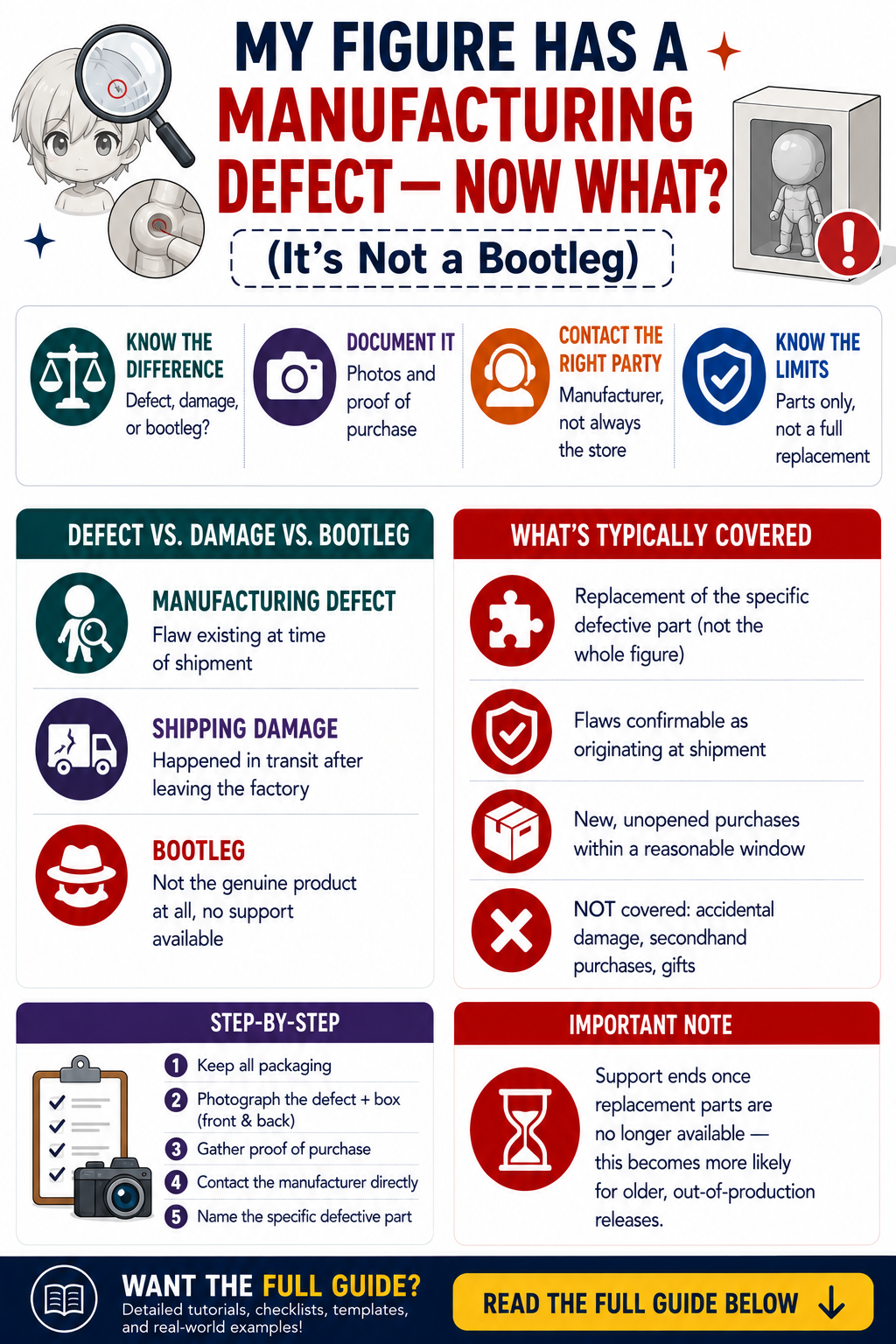
    1. A manufacturing defect is a flaw that existed at the time the product left the factory — discoloration, a missing accessory that should have been included, paint that never adhered correctly, or a joint that was assembled incorrectly.

    2. Shipping damage happens after the figure left the factory in good condition, during transit — a cracked box, a snapped part from rough handling, or damage clearly caused by impact.

    3. A bootleg isn’t the genuine product at all — it’s an unauthorized copy, and no legitimate manufacturer will offer support for it, regardless of how convincing the fake is.

    Manufacturers generally require you to sort out which category applies before contacting them, since defect support and damage claims go through different processes entirely.

    What Manufacturers Will Actually Cover

    Based on how major manufacturers like Good Smile Company structure their support policies, a few consistent patterns show up:

    • They typically replace or exchange only the defective part, not the entire figure — don’t expect a full replacement unit in most cases
    • The defect generally needs to be something confirmable as originating at the time of shipment, not something that could plausibly have happened after you received it
    • Cosmetic flaws in areas that don’t affect visible appearance (a scuff on the underside of a base, for example) are often explicitly excluded from support, even if technically a manufacturing imperfection
    • Support typically doesn’t extend to opened, secondhand, or long-held items. A common cutoff is products already transferred to a third party, or held for several months past delivery — check the specific manufacturer’s policy, since exact windows vary
    • Gifts and items bought through private/secondhand marketplaces are frequently excluded, since the manufacturer generally can’t verify the original purchase chain
    • Support ends once replacement parts are no longer available, which becomes more likely for older releases — a manufacturer may simply not be able to help with a defect on a figure that’s been out of production for years

    What to Do, Step by Step

    1. Don’t discard any packaging or accessories, even ones that seem unrelated to the defect — you may be asked to document the full contents
    2. Photograph the defect clearly, along with the figure as a whole and both the front and back of the box
    3. Gather your proof of purchase — order confirmation, receipt, or account order history showing when and where you bought it
    4. Contact the manufacturer directly, not just the retailer, for defect-specific issues — major manufacturers typically handle this through their own dedicated support channels rather than through the store you purchased from
    5. Describe the specific defective part clearly, using the part name or code from the instruction manual if one was included, since manufacturers generally process requests part-by-part rather than as a general complaint
    6. Be patient with the review process. Each case is typically reviewed individually, and response times vary — this isn’t usually an instant resolution

    A Note on Known, Larger-Scale Defect Issues

    Occasionally, a manufacturer identifies a defect affecting an entire product line rather than isolated units — for example, a paint finish issue that causes gradual discoloration on bare-skin parts across a specific run of figures. When this happens, reputable manufacturers have issued public notices, extended replacement request windows (sometimes even for units not yet showing symptoms), and proactively supported affected customers. If you own a figure from a release that’s had public attention for a known issue, it’s worth checking the manufacturer’s official announcements page directly, since these situations sometimes come with specific deadlines to request support.

    Frequently Asked Questions

    Will the manufacturer replace my entire figure if a small part is defective? Generally no — expect a replacement of the specific defective part rather than the whole figure, based on how major manufacturers structure this kind of support.

    Can I get defect support if I bought the figure secondhand? Usually not — most manufacturer defect policies explicitly exclude secondhand purchases and gifts, since they can’t verify the original purchase chain. This is one more reason buying new from a trusted retailer has real advantages beyond just authenticity.

    What if I accidentally broke a part myself — will they still help? Typically not. Manufacturer defect support is generally limited to flaws that existed at the time of shipment, not damage that occurred afterward, even if it was accidental on your part.

    Should I contact the retailer or the manufacturer for a defect? For manufacturing defects specifically, major manufacturers generally prefer to handle this directly through their own support channels, rather than through the retailer. Retailers are usually your first stop for shipping damage or order issues instead.

    Final Thoughts

    A manufacturing defect on a genuine figure isn’t the same problem as a bootleg or a shipping accident, and treating it as the right category matters for actually getting it resolved. Document everything, contact the manufacturer directly with clear photos and proof of purchase, and understand upfront that support typically covers replacement parts rather than a whole new figure — and generally only for items bought new, held for a reasonable window, and not already transferred to someone else.

    If you’re not sure whether what you’re looking at is a defect, shipping damage, or something more concerning, my guide to spotting bootlegs and shipping insurance guide cover the other two situations in more depth.

  • How to Catch Figure Announcements Early for New and Currently Airing Anime

    How to Catch Figure Announcements Early for New and Currently Airing Anime

    Affiliate Disclosure: This post contains affiliate links. If you buy through one of them, I may earn a small commission at no extra cost to you. I only recommend stores I’ve actually ordered from or researched thoroughly — my opinions are my own.

    The Problem: By the Time You Hear About It, the Preorder’s Already Closing

    There’s a specific kind of frustration that comes from falling in love with a brand-new series mid-season, only to discover the figure preorder for your favorite character has already been open for weeks and is about to close. New and currently airing anime move fast, and figure announcements tied to them don’t always show up where you’d expect to see them first.

    I’ve already covered a general system for tracking preorders — this guide is more specific: how merchandise timing actually relates to a show’s broadcast, and where to actually watch if you want to catch announcements for something that’s airing right now.

    Who This Article Is NOT For

    • If you’re not interested in new/currently airing series specifically, my general preorder tracking guide covers the broader system without this article’s seasonal focus.
    • If you’re tracking a long-established franchise with years of merchandise history, the dynamics here are less relevant — established series tend to have more predictable, ongoing merchandise release patterns rather than this specific “new show, will it get figures” uncertainty.
    • If you haven’t read my figure type guide yet, it’s worth knowing what you’re actually watching for before diving into the tracking side.

    How Merchandise Timing Actually Relates to Broadcast

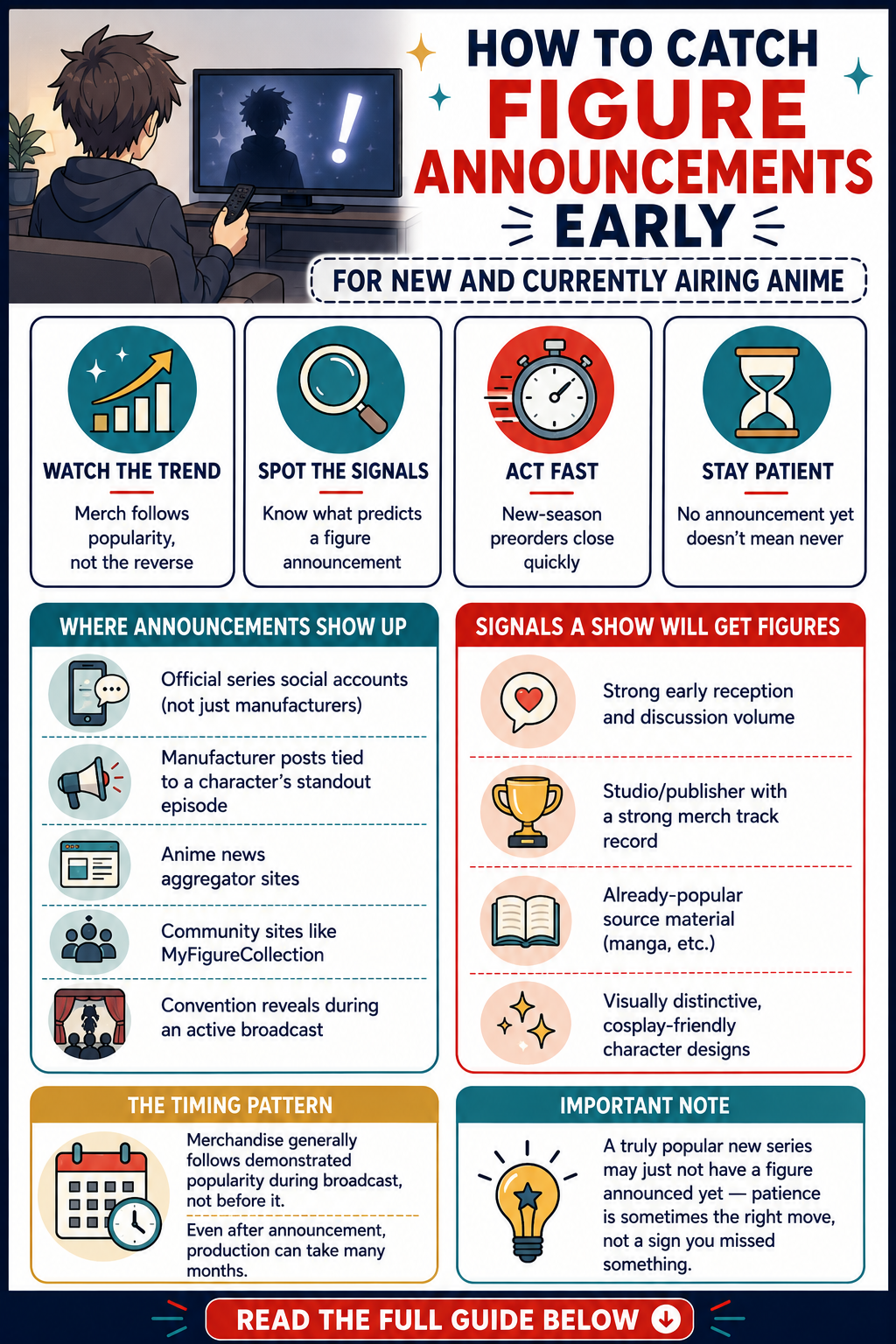
    1. Merchandise generally follows broadcast success, not the other way around. The anime industry has largely moved toward a “screen first, merchandise after” model — a show typically needs to demonstrate real popularity during its actual broadcast before manufacturers commit to figure production, rather than merchandise being announced far in advance of a show even airing.

    2. Popularity during the first few episodes matters enormously. A show that catches on quickly is far more likely to see figure announcements during its original broadcast run than one that builds a following slowly over time — this is part of why watching (or at least following) the first few episodes closely matters if you’re hoping to catch early merchandise news.

    3. Production lead time is long, regardless of how fast an announcement comes. Even once a figure is announced, scale figures and premium pieces can take many months to actually release — so “catching it early” mainly means catching the preorder window, not getting the actual figure quickly.

    Where Announcements for New Series Actually Show Up

    • Official series social media accounts, not just the figure manufacturer’s — a lot of merchandise news for currently airing shows gets announced through the anime’s own official account before or alongside the manufacturer’s own posts
    • Manufacturer announcements tied to key visual moments. Figures are often announced around a character’s most iconic or visually striking scene airing, rather than at a fixed point in the broadcast schedule — paying attention to when a character has a standout episode is a reasonable signal to watch more closely afterward
    • Anime news aggregator sites, which frequently cover merchandise announcements as a specific news category, separate from episode reviews or industry news
    • Community sites like MyFigureCollection, where users actively discuss and share new figure reveals, often faster than official retailer listings catch up
    • Convention announcements, if a series has any presence at conventions happening during its broadcast window — these often serve as a venue for merchandise reveals timed to build hype while the show is still airing

    Signals That a Currently Airing Show Is Likely to Get Figures

    • Strong early reception and discussion volume, since merchandise decisions increasingly track real, demonstrated popularity rather than pre-broadcast hype alone
    • An established studio or franchise history with strong merchandise support, since some studios and source material publishers have consistent track records of quick merchandise turnaround for successful shows
    • Existing manga or source material with an already-active fanbase, since adaptations of already-popular source material tend to see merchandise commitments faster than fully original anime, which still need to prove themselves during broadcast
    • Visually distinctive character designs, since characters that are especially popular for cosplay, fan art, or general visual appeal tend to attract merchandise interest faster than those who are narratively important but visually less distinctive

    Practical Habits for the Duration of a Season

    • Follow the studio or publisher’s official account for the specific show, not just general figure manufacturer accounts, especially in the first few weeks of a new season
    • Check back on community and news sites weekly during an active season, rather than assuming announcements will find you — this is a faster-moving environment than tracking an established franchise’s occasional new releases
    • Once an announcement does happen, move quickly on the preorder decision. Popular new-season figures can see fast-closing preorder windows, especially if the character or scene depicted was a particularly memorable moment from the show
    • Don’t assume no announcement yet means no figure is coming. Given production lead times, a truly popular new series may simply not have a figure announced yet even months into a successful run — patience is sometimes the right move rather than assuming you’ve missed something

    Frequently Asked Questions

    How soon after a show starts airing do figures typically get announced? This varies significantly and depends heavily on how the show performs — there’s no fixed timeline, since the modern merchandising approach generally waits for demonstrated popularity rather than committing before a show has aired.

    Should I preorder based on early hype, or wait to see if the show stays popular? This is a personal risk tolerance question — early hype doesn’t guarantee a show maintains its popularity, but waiting too long risks missing preorder windows entirely for characters that do get announced. There’s no universally correct answer here.

    Do all popular anime eventually get figures? Not necessarily, and it depends on licensing agreements, manufacturer interest, and how sustained the show’s popularity is beyond its initial broadcast — a strong opening doesn’t guarantee merchandise materializes.

    Is it worth following a series’ official account versus just the figure manufacturers? Yes, particularly during an active broadcast — official series accounts often announce merchandise collaborations and figure reveals before or alongside the manufacturer’s own posts, especially for currently airing shows building hype in real time.

    Final Thoughts

    Catching figure announcements for new and currently airing anime is less about a fixed schedule and more about understanding that merchandise now generally follows demonstrated popularity rather than preceding it. Watching how a show performs in its first few episodes, following the show’s own official accounts alongside manufacturer pages, and checking community sites regularly during an active season are your best tools for not missing something you’ll wish you’d caught in time.

    Once you’ve caught an announcement, my general preorder tracking system and first-time buyer’s guide cover what to actually do next.