Affiliate Disclosure: This post contains affiliate links. If you buy through one of them, I may earn a small commission at no extra cost to you. I only recommend stores I’ve actually ordered from or researched thoroughly — my opinions are my own.
The Problem: Every Listing Assumes You Already Know the Jargon
If you’re new to collecting, figure listings can read like a different language — “1/7 PVC scale figure, exclusive, limited, preorder, GK, recast warning” — and most sites assume you already know what all of that means. In my experience, this jargon barrier is one of the quieter reasons new collectors hesitate to buy their first figure: not because they don’t want one, but because they’re not entirely sure what they’re actually looking at.
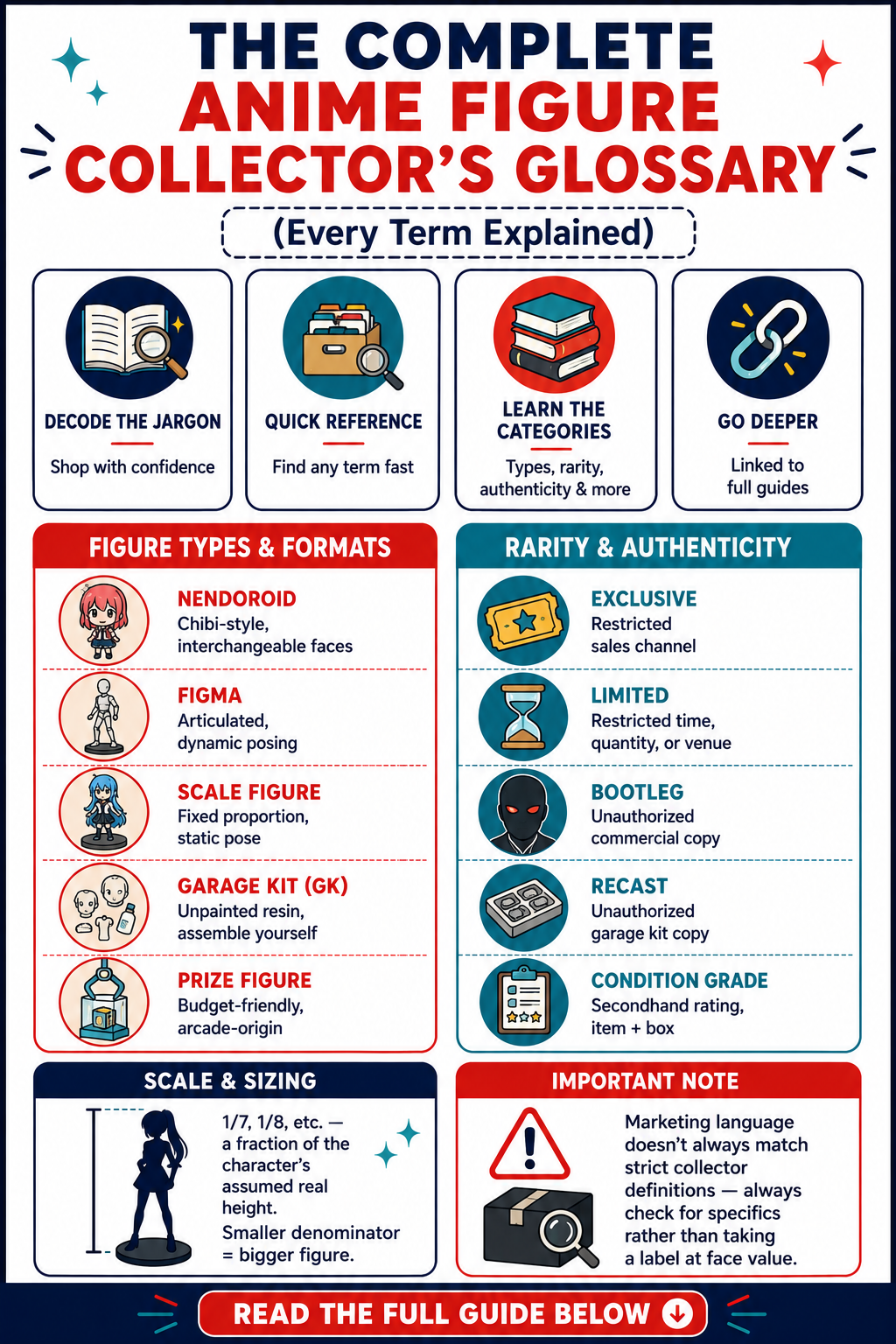
This glossary exists to fix that. Every term below is one you’ll genuinely run into while shopping, organized by category so you can find what you need quickly — and linked to a full guide wherever I’ve covered a topic in more depth elsewhere on the site.
Who This Article Is NOT For
- If you’ve been collecting for years, you probably know most of this already — feel free to use it as a quick reference rather than reading start to finish.
- If you’re looking for buying advice rather than definitions, start with my comparison of trusted retailers or first-time buyer’s guide instead.
Figure Types and Formats
| Term | What It Means |
|---|---|
| Nendoroid | Good Smile Company’s chibi-style figure line — big head, small body, interchangeable face plates. The most affordable common format. Full breakdown |
| Figma | Max Factory’s articulated, realistically proportioned figure line, built for dynamic posing. Full breakdown |
| Scale Figure | A figure sculpted at a fixed proportion of the character’s assumed real-life height (e.g., 1/7), static pose, no articulation. Full breakdown |
| POP UP PARADE | Good Smile Company’s simplified, more affordable scale-style line — less detail than a full scale figure, priced accordingly |
| S.H.Figuarts | Bandai Spirits’ highly articulated action-figure-style line, known for strong posability |
| Garage Kit (GK) | An unpainted, unassembled resin kit, typically made independently and requiring assembly and painting by the buyer. Full guide |
| Prize Figure | A budget-friendly, officially licensed figure originally distributed through arcade crane games, from brands like Banpresto, SEGA, and Taito. Full guide |
| Ichiban Kuji | Bandai’s lottery-ticket figure system, with tiered prizes (A through E, plus a “Last One” prize). Full guide |
| Non-Scale | A figure line (like Nendoroid or Figma) that doesn’t follow strict proportional scale to the character’s real height, prioritizing consistent display size instead |
Materials and Construction
| Term | What It Means |
|---|---|
| PVC | Polyvinyl chloride — the standard plastic used for most pre-painted commercial figures |
| ABS | A more rigid plastic often used for jointed or load-bearing parts, sometimes combined with PVC in the same figure |
| Resin | The material used for garage kits — typically polyurethane resin, allowing for finer sculpted detail than mass-production plastics |
| Articulation | A figure’s range of joint movement and posability, most relevant to Figma and S.H.Figuarts-style lines |
| Seam Line | A visible line where two mold halves meet during manufacturing — more common on budget-tier figures like prize figures |
Scale and Sizing
| Term | What It Means |
|---|---|
| Scale Ratio (1/7, 1/8, etc.) | A fraction describing how much a figure is shrunk down from the character’s assumed real-life height — smaller denominator means a bigger figure. Full guide |
| 1/1 Scale / Life-Size | A figure or bust produced at actual real-world size — rare and typically very expensive |
| Bust | A figure depicting only the head, shoulders, and upper torso, rather than a full-body sculpt |
Availability and Rarity
| Term | What It Means |
|---|---|
| MSRP | Manufacturer’s suggested retail price — the baseline price before any store discount or markup |
| Preorder | Ordering a figure before it’s been produced or shipped, based on an estimated future release date. Full guide on tracking these |
| Exclusive | Sold only through a specific store, bundle, or mail-order channel — doesn’t necessarily mean a capped total quantity |
| Limited | Restricted by time, quantity, or venue — the exact meaning varies significantly, so it’s worth checking which kind of “limited” applies. Full breakdown |
| Small Lot / Large Lot | Informal terms describing whether a production run was genuinely small (verifiably scarce) or larger than the “limited” label might suggest |
| Cancelled | Production was stopped, either before release or after a partial run — sometimes genuinely rare, sometimes reflecting low original demand |
| Restock | A store receiving additional inventory of a previously sold-out item |
| Reissue / Rerelease | A manufacturer producing a figure again after its original run, sometimes as a color variant of the same sculpt |
Authenticity and Condition
| Term | What It Means |
|---|---|
| Bootleg | An unauthorized, unlicensed copy of a commercial figure, sold to deceive buyers into thinking it’s genuine. Full guide |
| Recast | Within the garage kit hobby specifically, an unauthorized copy of an independent sculptor’s original kit — a related but distinct issue from commercial bootlegging. Full explanation |
| Authentication Sticker / Hologram Seal | A manufacturer’s holographic or metallic seal on packaging, used to help verify authenticity — a missing or non-holographic seal is a red flag |
| Condition Grade | A rating (numeric or letter-based) describing a secondhand figure’s physical condition, often scored separately for the item and the box. Full guide |
| MIB (Mint in Box) | A figure that remains unopened and in original packaging, in as-new condition |
Manufacturers and Production Culture
| Term | What It Means |
|---|---|
| Good Smile Company (GSC) | Major manufacturer behind Nendoroid, POP UP PARADE, and a broad scale figure catalog. Manufacturer comparison |
| Max Factory | The manufacturer behind the Figma line specifically, closely associated with Good Smile Company |
| Alter | A manufacturer known for premium, highly detailed scale figures at a higher price tier |
| Kotobukiya | A manufacturer known for dynamic-pose scale figures (ARTFX/ARTFX J lines) and plastic model kits |
| Circle | The hobbyist term for a small, independent group of creators producing garage kits, often under a shared name |
| Wonder Festival (Wonfes) | A convention held in Japan roughly twice a year, where independent sculptors and circles sell original garage kits directly to attendees |
Shopping and Logistics
| Term | What It Means |
|---|---|
| De Minimis | The value threshold below which imported goods aren’t subject to duty or tax — varies significantly by country and can change with trade policy. Full country-by-country breakdown |
| Consolidation / Private Warehouse | A service that holds multiple orders and ships them together in one package to reduce total shipping cost |
| Proxy Shopping Service | A third-party service that purchases items from Japan-only stores or listings on your behalf and forwards them internationally |
| EMS | A common express international shipping method from Japan, generally faster and pricier than economy alternatives |
VTuber-Specific Terms
| Term | What It Means |
|---|---|
| VTuber | A virtual, animated on-screen persona used by a streamer or performer for content, backed by an agency that produces official merchandise |
| hololive production | A major VTuber agency operated by Cover Corporation. VTuber figures guide |
| Nijisanji | A major VTuber agency operated by Anycolor. VTuber figures guide |
Frequently Asked Questions
What’s the difference between “exclusive” and “limited”? “Exclusive” typically refers to a restricted sales channel (a specific store or bundle), while “limited” can mean either a restricted time window or an actual capped production quantity. They’re related concepts but not interchangeable.
Is a recast the same thing as a bootleg? They’re closely related — both involve unauthorized copying — but “recast” is specifically used within the garage kit hobby to describe unauthorized copies of an independent creator’s original kit, while “bootleg” more broadly describes unauthorized copies of commercial, licensed figures.
What does “non-scale” mean if Nendoroid and Figma still have a size? It means the figure’s size isn’t calculated as a strict proportion of the character’s real-life height the way scale figures are — a very tall character and a very short character end up roughly similar sizes in these lines, prioritizing a consistent display format over proportional accuracy.
Why do some terms (like “limited”) get used so loosely? Marketing language doesn’t always match strict collector definitions — this is exactly why it’s worth checking for specifics (a stated production number, a defined ordering window) rather than taking a label at face value.
Final Thoughts
Jargon shouldn’t be the thing standing between you and your first figure. Bookmark this page as a reference, and whenever a listing uses a term you’re not sure about, it’s probably covered here — with a link to a full guide if you want to go deeper on any specific topic.
If you’re ready to put this vocabulary to use, my comparison of trusted Japan-based retailers and first-time buyer’s guide are the natural next steps.