タグ: Buying Tips

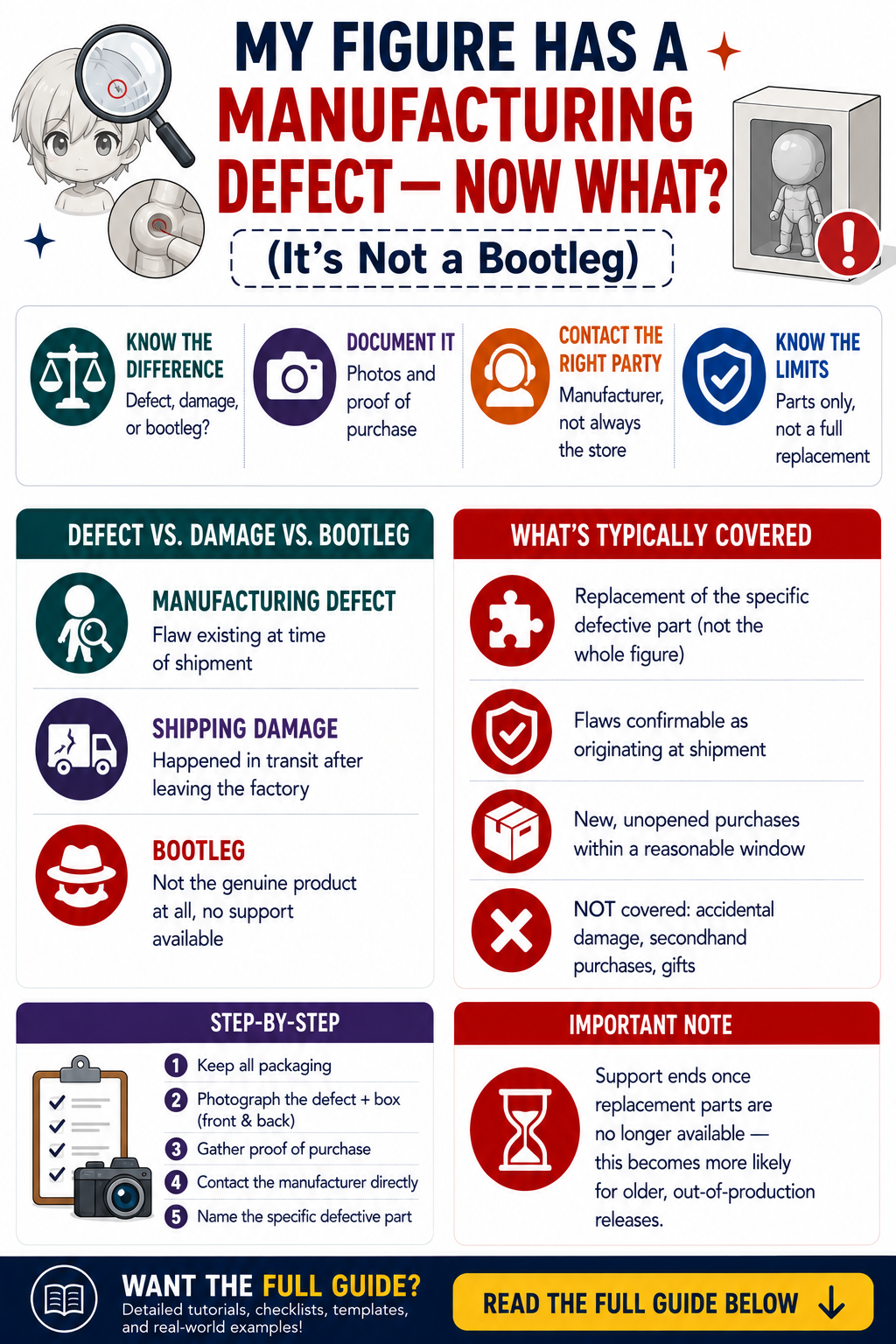
  • My Figure Has a Manufacturing Defect — Now What? (It’s Not a Bootleg)

    My Figure Has a Manufacturing Defect — Now What? (It’s Not a Bootleg)

    Affiliate Disclosure: This post contains affiliate links. If you buy through one of them, I may earn a small commission at no extra cost to you. I only recommend stores I’ve actually ordered from or researched thoroughly — my opinions are my own.

    The Problem: Something’s Wrong, But It’s Genuinely Authentic

    You’ve bought from a trusted retailer, checked the authentication details, and you’re confident it’s real — but something is genuinely wrong. A bow that’s supposed to be sewn onto the skirt is missing. The paint on a bare-skin part looks discolored in a way it shouldn’t. A joint doesn’t hold its pose at all right out of the box. This isn’t a bootleg problem — it’s a manufacturing defect, and it happens even to major, reputable manufacturers.

    The good news is that legitimate manufacturers generally do have a real process for this — it’s just a different process than a shipping damage claim or a bootleg situation, and knowing which one applies matters for actually getting it resolved.

    Who This Article Is NOT For

    • If you suspect the figure itself might not be authentic, this isn’t the right guide — check my bootleg-spotting guide first, since manufacturer defect support only applies to genuine products.
    • If the box arrived visibly crushed or the figure was clearly damaged in transit, that’s a shipping damage situation, not a manufacturing defect — see my shipping insurance and damage claims guide instead.
    • If you dropped, broke, or lost a part yourself after opening the figure, manufacturers generally don’t cover this — see the eligibility section below for why.

    How to Tell the Difference: Defect vs. Damage vs. Bootleg

    1. A manufacturing defect is a flaw that existed at the time the product left the factory — discoloration, a missing accessory that should have been included, paint that never adhered correctly, or a joint that was assembled incorrectly.

    2. Shipping damage happens after the figure left the factory in good condition, during transit — a cracked box, a snapped part from rough handling, or damage clearly caused by impact.

    3. A bootleg isn’t the genuine product at all — it’s an unauthorized copy, and no legitimate manufacturer will offer support for it, regardless of how convincing the fake is.

    Manufacturers generally require you to sort out which category applies before contacting them, since defect support and damage claims go through different processes entirely.

    What Manufacturers Will Actually Cover

    Based on how major manufacturers like Good Smile Company structure their support policies, a few consistent patterns show up:

    • They typically replace or exchange only the defective part, not the entire figure — don’t expect a full replacement unit in most cases
    • The defect generally needs to be something confirmable as originating at the time of shipment, not something that could plausibly have happened after you received it
    • Cosmetic flaws in areas that don’t affect visible appearance (a scuff on the underside of a base, for example) are often explicitly excluded from support, even if technically a manufacturing imperfection
    • Support typically doesn’t extend to opened, secondhand, or long-held items. A common cutoff is products already transferred to a third party, or held for several months past delivery — check the specific manufacturer’s policy, since exact windows vary
    • Gifts and items bought through private/secondhand marketplaces are frequently excluded, since the manufacturer generally can’t verify the original purchase chain
    • Support ends once replacement parts are no longer available, which becomes more likely for older releases — a manufacturer may simply not be able to help with a defect on a figure that’s been out of production for years

    What to Do, Step by Step

    1. Don’t discard any packaging or accessories, even ones that seem unrelated to the defect — you may be asked to document the full contents
    2. Photograph the defect clearly, along with the figure as a whole and both the front and back of the box
    3. Gather your proof of purchase — order confirmation, receipt, or account order history showing when and where you bought it
    4. Contact the manufacturer directly, not just the retailer, for defect-specific issues — major manufacturers typically handle this through their own dedicated support channels rather than through the store you purchased from
    5. Describe the specific defective part clearly, using the part name or code from the instruction manual if one was included, since manufacturers generally process requests part-by-part rather than as a general complaint
    6. Be patient with the review process. Each case is typically reviewed individually, and response times vary — this isn’t usually an instant resolution

    A Note on Known, Larger-Scale Defect Issues

    Occasionally, a manufacturer identifies a defect affecting an entire product line rather than isolated units — for example, a paint finish issue that causes gradual discoloration on bare-skin parts across a specific run of figures. When this happens, reputable manufacturers have issued public notices, extended replacement request windows (sometimes even for units not yet showing symptoms), and proactively supported affected customers. If you own a figure from a release that’s had public attention for a known issue, it’s worth checking the manufacturer’s official announcements page directly, since these situations sometimes come with specific deadlines to request support.

    Frequently Asked Questions

    Will the manufacturer replace my entire figure if a small part is defective? Generally no — expect a replacement of the specific defective part rather than the whole figure, based on how major manufacturers structure this kind of support.

    Can I get defect support if I bought the figure secondhand? Usually not — most manufacturer defect policies explicitly exclude secondhand purchases and gifts, since they can’t verify the original purchase chain. This is one more reason buying new from a trusted retailer has real advantages beyond just authenticity.

    What if I accidentally broke a part myself — will they still help? Typically not. Manufacturer defect support is generally limited to flaws that existed at the time of shipment, not damage that occurred afterward, even if it was accidental on your part.

    Should I contact the retailer or the manufacturer for a defect? For manufacturing defects specifically, major manufacturers generally prefer to handle this directly through their own support channels, rather than through the retailer. Retailers are usually your first stop for shipping damage or order issues instead.

    Final Thoughts

    A manufacturing defect on a genuine figure isn’t the same problem as a bootleg or a shipping accident, and treating it as the right category matters for actually getting it resolved. Document everything, contact the manufacturer directly with clear photos and proof of purchase, and understand upfront that support typically covers replacement parts rather than a whole new figure — and generally only for items bought new, held for a reasonable window, and not already transferred to someone else.

    If you’re not sure whether what you’re looking at is a defect, shipping damage, or something more concerning, my guide to spotting bootlegs and shipping insurance guide cover the other two situations in more depth.
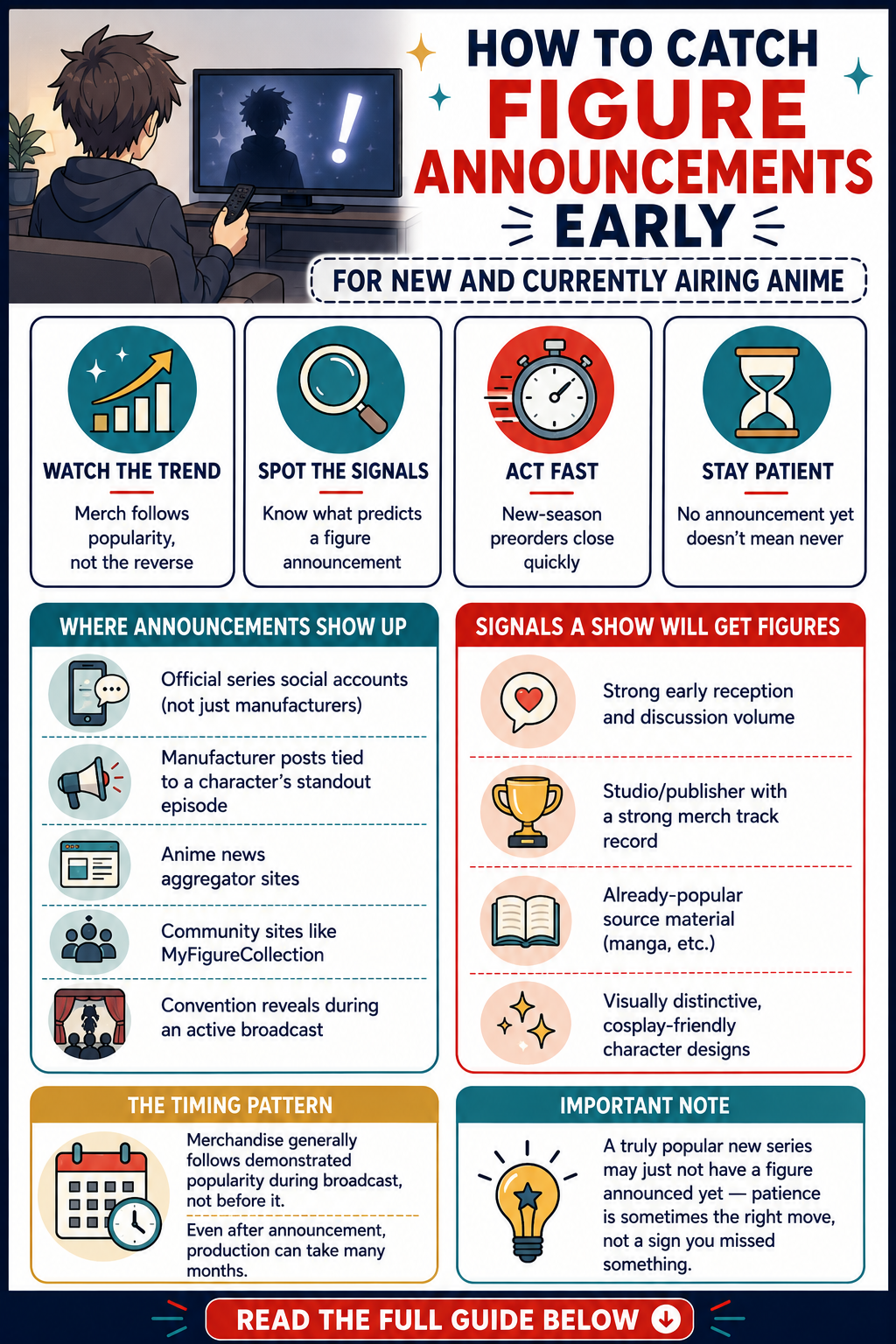
  • How to Catch Figure Announcements Early for New and Currently Airing Anime

    How to Catch Figure Announcements Early for New and Currently Airing Anime

    Affiliate Disclosure: This post contains affiliate links. If you buy through one of them, I may earn a small commission at no extra cost to you. I only recommend stores I’ve actually ordered from or researched thoroughly — my opinions are my own.

    The Problem: By the Time You Hear About It, the Preorder’s Already Closing

    There’s a specific kind of frustration that comes from falling in love with a brand-new series mid-season, only to discover the figure preorder for your favorite character has already been open for weeks and is about to close. New and currently airing anime move fast, and figure announcements tied to them don’t always show up where you’d expect to see them first.

    I’ve already covered a general system for tracking preorders — this guide is more specific: how merchandise timing actually relates to a show’s broadcast, and where to actually watch if you want to catch announcements for something that’s airing right now.

    Who This Article Is NOT For

    • If you’re not interested in new/currently airing series specifically, my general preorder tracking guide covers the broader system without this article’s seasonal focus.
    • If you’re tracking a long-established franchise with years of merchandise history, the dynamics here are less relevant — established series tend to have more predictable, ongoing merchandise release patterns rather than this specific “new show, will it get figures” uncertainty.
    • If you haven’t read my figure type guide yet, it’s worth knowing what you’re actually watching for before diving into the tracking side.

    How Merchandise Timing Actually Relates to Broadcast

    1. Merchandise generally follows broadcast success, not the other way around. The anime industry has largely moved toward a “screen first, merchandise after” model — a show typically needs to demonstrate real popularity during its actual broadcast before manufacturers commit to figure production, rather than merchandise being announced far in advance of a show even airing.

    2. Popularity during the first few episodes matters enormously. A show that catches on quickly is far more likely to see figure announcements during its original broadcast run than one that builds a following slowly over time — this is part of why watching (or at least following) the first few episodes closely matters if you’re hoping to catch early merchandise news.

    3. Production lead time is long, regardless of how fast an announcement comes. Even once a figure is announced, scale figures and premium pieces can take many months to actually release — so “catching it early” mainly means catching the preorder window, not getting the actual figure quickly.

    Where Announcements for New Series Actually Show Up

    • Official series social media accounts, not just the figure manufacturer’s — a lot of merchandise news for currently airing shows gets announced through the anime’s own official account before or alongside the manufacturer’s own posts
    • Manufacturer announcements tied to key visual moments. Figures are often announced around a character’s most iconic or visually striking scene airing, rather than at a fixed point in the broadcast schedule — paying attention to when a character has a standout episode is a reasonable signal to watch more closely afterward
    • Anime news aggregator sites, which frequently cover merchandise announcements as a specific news category, separate from episode reviews or industry news
    • Community sites like MyFigureCollection, where users actively discuss and share new figure reveals, often faster than official retailer listings catch up
    • Convention announcements, if a series has any presence at conventions happening during its broadcast window — these often serve as a venue for merchandise reveals timed to build hype while the show is still airing

    Signals That a Currently Airing Show Is Likely to Get Figures

    • Strong early reception and discussion volume, since merchandise decisions increasingly track real, demonstrated popularity rather than pre-broadcast hype alone
    • An established studio or franchise history with strong merchandise support, since some studios and source material publishers have consistent track records of quick merchandise turnaround for successful shows
    • Existing manga or source material with an already-active fanbase, since adaptations of already-popular source material tend to see merchandise commitments faster than fully original anime, which still need to prove themselves during broadcast
    • Visually distinctive character designs, since characters that are especially popular for cosplay, fan art, or general visual appeal tend to attract merchandise interest faster than those who are narratively important but visually less distinctive

    Practical Habits for the Duration of a Season

    • Follow the studio or publisher’s official account for the specific show, not just general figure manufacturer accounts, especially in the first few weeks of a new season
    • Check back on community and news sites weekly during an active season, rather than assuming announcements will find you — this is a faster-moving environment than tracking an established franchise’s occasional new releases
    • Once an announcement does happen, move quickly on the preorder decision. Popular new-season figures can see fast-closing preorder windows, especially if the character or scene depicted was a particularly memorable moment from the show
    • Don’t assume no announcement yet means no figure is coming. Given production lead times, a truly popular new series may simply not have a figure announced yet even months into a successful run — patience is sometimes the right move rather than assuming you’ve missed something

    Frequently Asked Questions

    How soon after a show starts airing do figures typically get announced? This varies significantly and depends heavily on how the show performs — there’s no fixed timeline, since the modern merchandising approach generally waits for demonstrated popularity rather than committing before a show has aired.

    Should I preorder based on early hype, or wait to see if the show stays popular? This is a personal risk tolerance question — early hype doesn’t guarantee a show maintains its popularity, but waiting too long risks missing preorder windows entirely for characters that do get announced. There’s no universally correct answer here.

    Do all popular anime eventually get figures? Not necessarily, and it depends on licensing agreements, manufacturer interest, and how sustained the show’s popularity is beyond its initial broadcast — a strong opening doesn’t guarantee merchandise materializes.

    Is it worth following a series’ official account versus just the figure manufacturers? Yes, particularly during an active broadcast — official series accounts often announce merchandise collaborations and figure reveals before or alongside the manufacturer’s own posts, especially for currently airing shows building hype in real time.

    Final Thoughts

    Catching figure announcements for new and currently airing anime is less about a fixed schedule and more about understanding that merchandise now generally follows demonstrated popularity rather than preceding it. Watching how a show performs in its first few episodes, following the show’s own official accounts alongside manufacturer pages, and checking community sites regularly during an active season are your best tools for not missing something you’ll wish you’d caught in time.

    Once you’ve caught an announcement, my general preorder tracking system and first-time buyer’s guide cover what to actually do next.

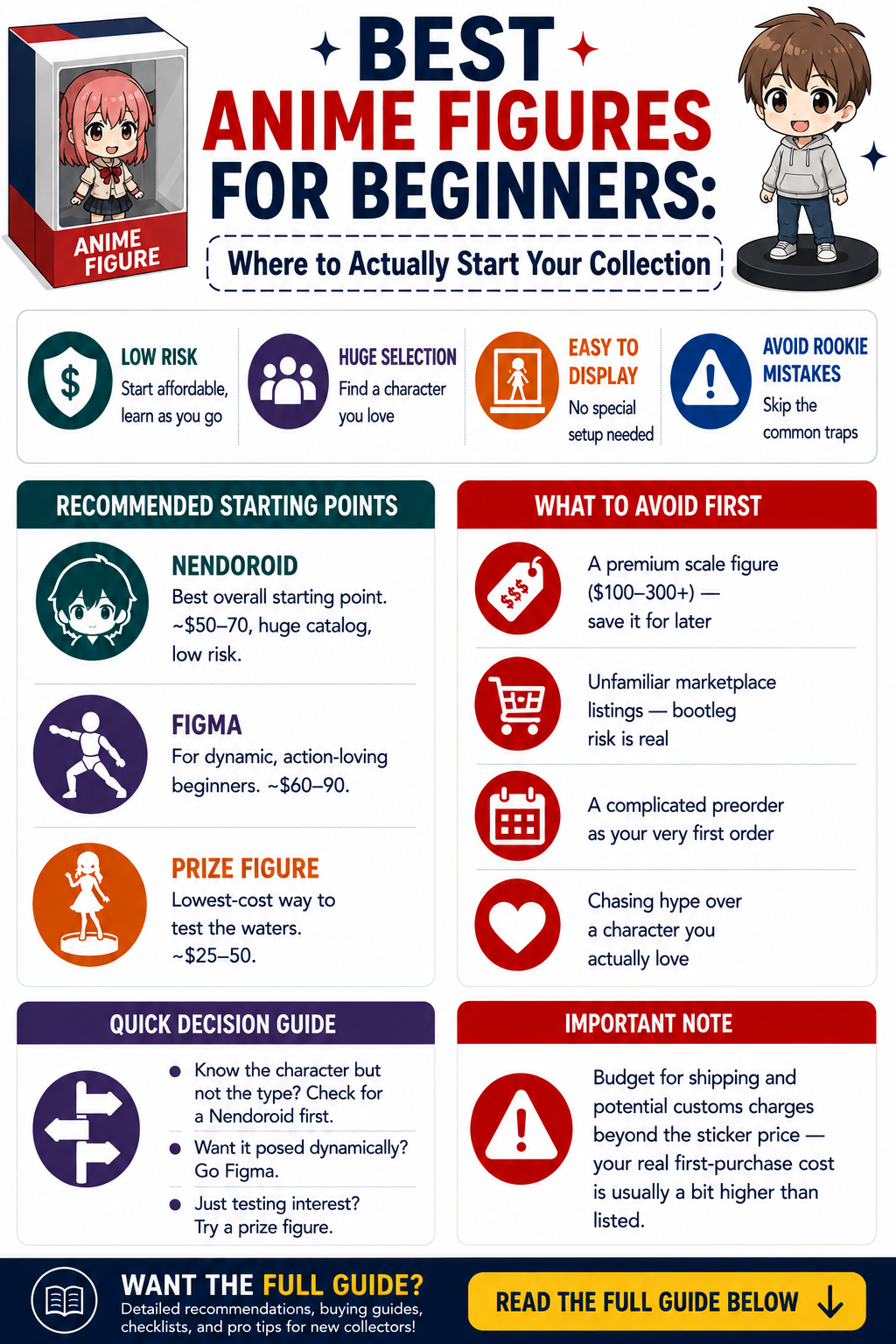
  • Best Anime Figures for Beginners: Where to Actually Start Your Collection

    Best Anime Figures for Beginners: Where to Actually Start Your Collection

    Affiliate Disclosure: This post contains affiliate links. If you buy through one of them, I may earn a small commission at no extra cost to you. I only recommend stores I’ve actually ordered from or researched thoroughly — my opinions are my own.

    The Problem: Too Many Options Makes It Hard to Just Start

    If you’ve decided you want to start collecting anime figures, the sheer number of options can be genuinely paralyzing — Nendoroid or Figma or scale figure, which manufacturer, which character, how much to spend, where to even buy it from. It’s a lot to figure out before you’ve even made your first purchase.

    In my experience, the collectors who get stuck the longest aren’t the ones who don’t know what they like — they’re the ones trying to make the “perfect” first decision instead of just making a reasonable one. This guide is meant to cut through that: a straightforward starting point based on what actually works well for a first purchase, without needing to have every preference figured out in advance.

    Who This Article Is NOT For

    • If you’ve already made your first purchase and are past this stage, this is more useful to share with someone else just getting started than for yourself at this point.
    • If you already know exactly what you want, there’s no need to overthink it with a “beginner framework” — go buy it.
    • If budget genuinely isn’t a factor for your first purchase, some of the cost-based reasoning here matters less — buy whatever excites you most.

    What Actually Makes a Good First Figure

    1. Low financial risk. Your first purchase is also your first chance to learn how a store’s shipping, packaging, and process actually works — you want that learning experience to come from something affordable, not your most expensive purchase.

    2. Broad appeal and availability. A figure type with a huge catalog gives you the best chance of finding a character you already love, rather than compromising on your first purchase.

    3. Manageable commitment. Something that doesn’t require special display considerations, extensive posing skill, or a big shelf investment right away.

    The Recommended Starting Point: Nendoroid

    If you only take one piece of advice from this article, it’s this: for almost every new collector, a Nendoroid is the right first purchase.

    • Price is low-risk. Generally in the $50–70 range, which means a purchase that doesn’t go perfectly (wrong character choice, wanting something different next time) doesn’t sting financially.
    • The catalog is enormous. If a character has merchandise at all, there’s a strong chance a Nendoroid exists for them, which means you’re very likely to find one of a character you already love rather than settling.
    • They’re genuinely fun, not just a “starter” compromise. Interchangeable face plates and small accessories make them engaging to own, not just a stepping stone to something else.
    • They’re forgiving to display. Small footprint, no special lighting or case requirements to get started, and durable enough for a first-time buyer still learning how to handle and store figures carefully.

    If You Want Something More Dynamic: Figma

    If you already know you’re drawn to action-heavy series and want your first figure posed dynamically rather than sitting still, Figma is a reasonable alternative starting point — slightly pricier than a Nendoroid (roughly $60–90), but still well within low-risk territory for a first purchase.

    If You Want to Test the Waters Before Spending Much at All

    Prize figures are a genuinely reasonable way to dip a toe in before committing to a full-price figure — officially licensed, generally in the $25–50 range, with the tradeoff of more variable quality between manufacturers and sub-lines. This is a fine way to see whether collecting appeals to you at all before spending more.

    What to Avoid for Your First Purchase

    • A premium scale figure, however tempting. The price (often $100–300+) and lack of forgiveness if you’re not sure about display space or long-term interest make this a riskier first move — save it for once you know you’re genuinely committed to the hobby.
    • Buying from an unfamiliar marketplace listing to save a few dollars. Your first purchase is the worst time to accidentally receive a bootleg — stick with a trusted retailer for your first order, even if it costs slightly more.
    • A complicated preorder as your very first order. Preorders involve payment timing quirks and release delays that are easier to navigate once you already understand how a store’s process works — an in-stock item is a gentler introduction. My first-time buyer’s guide covers both paths in detail once you’re ready.
    • Chasing hype over genuine interest. A popular figure you don’t actually care about tends to be a less satisfying first purchase than a less-hyped figure of a character you genuinely love.

    A Simple Decision Framework

    “I know exactly which character I want, but not which figure type.” Check whether a Nendoroid exists for that character first — it’s the lowest-risk way to start, and you can always add a Figma or scale figure of the same character later once you know you’re committed.

    “I’m not sure which character I even want yet.” Take some time browsing a trusted retailer’s Nendoroid catalog specifically — the format’s broad coverage makes it a good way to browse without narrowing yourself to one figure type’s limited selection first.

    “I want to spend as little as possible to see if I even like collecting.” Start with a prize figure rather than a full-price Nendoroid — lower stakes, though expect more variability in quality.

    “I already know I want something dynamic and posed.” Go with Figma over a static scale figure for your first purchase — you get the posability you’re after without the price and space commitment of a premium scale piece.

    Frequently Asked Questions

    Is a Nendoroid really the best choice for every beginner? It’s the best choice for most beginners specifically because of the combination of low price, huge catalog, and low display commitment — but if you already know you want something more dynamic or detailed, that’s a completely valid reason to start elsewhere.

    Should my first figure be a character I already love, or whatever looks good? A character you already love, if possible. First purchases you’re genuinely attached to tend to hold up better as a positive first experience than ones chosen purely because they were available or discounted.

    Is it a mistake to start with a scale figure if that’s genuinely what I want most? Not necessarily a mistake, but it does raise the stakes on your first purchase before you’ve learned how shipping, condition, and display actually work in practice. If you’re confident and prepared for that, it’s a personal choice rather than an objective error.

    How much should I expect to spend on my first figure, all in? Beyond the figure’s sticker price, factor in shipping and potential customs charges, which vary by country — budgeting for a total somewhat above the listed price avoids an unpleasant surprise at checkout or delivery.

    Final Thoughts

    The “right” first figure isn’t a single universal answer, but a Nendoroid of a character you genuinely love is the starting point that works well for the vast majority of new collectors — affordable enough that a less-than-perfect first choice doesn’t sting, broad enough in catalog that you’re likely to find exactly what you want, and forgiving enough to display without any special setup.

    Once you’ve made that first purchase and have a feel for the process, my Nendoroid vs Figma vs Scale Figure guide and comparison of trusted retailers are the natural next steps for figuring out where your collection goes from here.

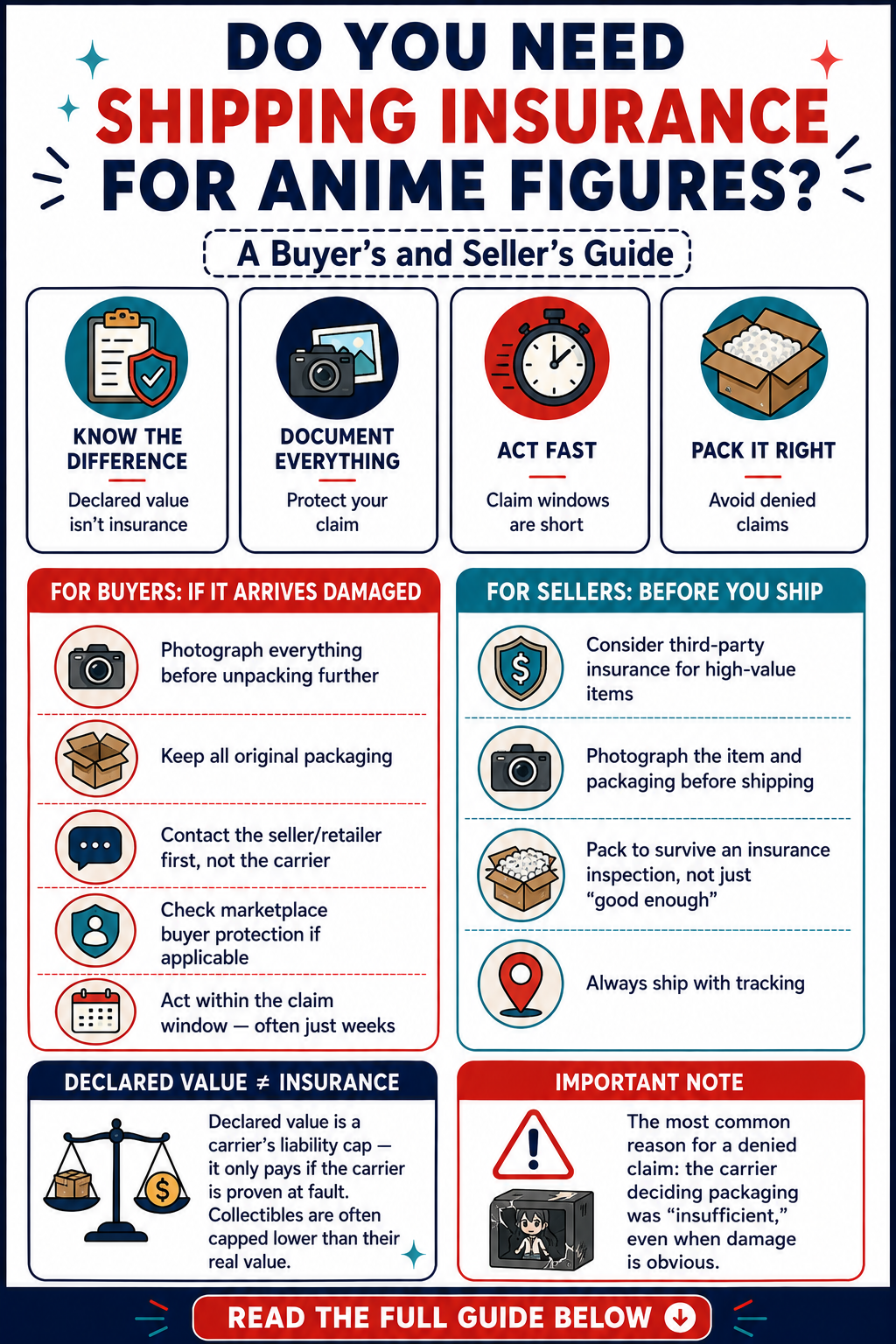
  • Do You Need Shipping Insurance for Anime Figures? A Buyer’s and Seller’s Guide

    Do You Need Shipping Insurance for Anime Figures? A Buyer’s and Seller’s Guide

    Affiliate Disclosure: This post contains affiliate links. If you buy through one of them, I may earn a small commission at no extra cost to you. I only recommend stores I’ve actually ordered from or researched thoroughly — my opinions are my own.

    The Problem: “Declared Value” Sounds Like Insurance, But It Usually Isn’t

    Here’s a distinction that catches a lot of people off guard, whether you’re receiving a figure or shipping one out: what carriers call “declared value” and what you’d normally think of as “insurance” are often two genuinely different things. Major carriers are explicit about this in their own terms — declared value is a cap on their liability if they’re proven at fault, not a guarantee that you’ll be compensated if something goes wrong.

    In my experience, this distinction matters most in the exact moment you don’t want to be learning it: after a figure has already arrived damaged, or after you’ve shipped one out and the buyer is asking where their compensation is. This guide covers what actual protection exists, from both sides of the transaction.

    Who This Article Is NOT For

    • If you’re buying exclusively from retailers with strong buyer protection policies and haven’t had a damage issue, this is more of a “know before it happens” reference than an urgent read.
    • If you’re not currently selling figures, the seller-side section won’t apply to you directly — check my guide to selling figures safely if that changes.
    • If you’re looking for packaging advice specifically, that’s covered in more depth in my selling guide — this article focuses on what happens after something goes wrong, not how to prevent it.

    The Key Distinction: Declared Value vs. Real Insurance

    Declared value is a carrier’s maximum liability for a shipment, and it only pays out if the carrier is proven to be at fault for the damage or loss. Major carriers state this directly — it is explicitly not insurance, and coverage is often capped at a low amount specifically for collectibles, regardless of how much you declare.

    True shipping insurance is a separate product, sometimes purchased through the carrier’s affiliated insurance option, sometimes through a third-party insurer, and it generally offers broader, more reliable coverage than declared value alone — particularly for items in categories carriers commonly exclude or cap.

    Why this matters for figures specifically: collectibles are frequently singled out in carrier terms with reduced maximum declared values compared to general merchandise, precisely because they’re harder to independently verify the value of. A $300 scale figure shipped with a high declared value doesn’t necessarily mean you’re covered for the full $300 if something goes wrong.

    For Buyers: What Protection Actually Exists

    1. Check your retailer’s own policy first, before relying on carrier-level protection. Established retailers often have their own procedures for damaged-in-transit items, separate from whatever the shipping carrier itself offers — this is frequently your fastest and most reliable path to a resolution.

    2. Photograph everything immediately upon arrival, before you’ve even fully unpacked the figure — the outer box, the inner packaging, and the damage itself. Carriers and retailers alike often require this documentation, and some will deny claims if the outer box shows no visible damage, even if the contents were harmed by rough handling during transit.

    3. Keep all original packaging until the issue is resolved. Claims processes frequently require the ability to inspect the original box and packing materials — discarding them early can complicate or invalidate a claim.

    4. Act quickly. Claim windows are often surprisingly short — sometimes just a few weeks from delivery — so don’t sit on a damaged shipment assuming you have unlimited time to report it.

    5. Understand that “insufficient packaging” is a common denial reason. This is frustrating when you weren’t the one who packed it, but it’s worth knowing that a claim can be denied if the carrier determines the item wasn’t adequately protected for transit — this is generally an argument between the shipper and the carrier, so a paper trail with your retailer matters more than a fight with the carrier directly.

    For Sellers: Protecting Yourself When Shipping Out

    If you’re selling figures, the insurance conversation flips — you’re the one deciding whether to add it and how to handle a dispute if the buyer claims damage.

    • Consider third-party insurance for higher-value items, rather than relying solely on a carrier’s declared value option, given how often collectibles are capped or excluded from full carrier liability.
    • Photograph the item and packaging before you ship it. This protects you if a buyer later disputes the condition it arrived in — having your own “before” documentation is genuinely valuable if a dispute happens.
    • Pack to a standard that would survive an insurance inspection, not just “good enough.” Since claims can be denied over inadequate packaging, packing well protects both your buyer’s item and your own ability to file a successful claim if the carrier damages it.
    • Always ship with tracking, regardless of item value — this is your primary protection against claims that an item never arrived at all, which is a separate issue from physical damage but comes up just as often.

    What to Do If a Figure Arrives Damaged

    1. Don’t discard any packaging until the situation is resolved
    2. Photograph the damage, the inner packaging, and the outer box from multiple angles before doing anything else
    3. Contact the seller or retailer first, rather than going straight to a carrier claim — many retailers have their own resolution process that’s faster than a formal carrier claim
    4. If buying from a marketplace, most major platforms have buyer protection policies for items that arrive significantly damaged or not as described — this is often a more realistic path than pursuing the shipping carrier directly, since you as the buyer typically weren’t the one with a carrier account to file through in the first place
    5. Escalate to a carrier claim only if the retailer or platform can’t resolve it, and expect to provide the documentation described above

    Frequently Asked Questions

    Is “declared value” the same thing as insurance? No — carriers are explicit that declared value is a liability cap that only pays out if they’re proven at fault, not a guarantee of compensation. True insurance, whether through the carrier or a third party, generally offers broader protection.

    Why would a damage claim get denied even with obvious damage? The most common reason is a carrier determining the packaging was inadequate for transit, or the outer box showing no visible external damage despite internal contents being harmed — both are frustrating but genuinely common reasons for denial.

    Should I buy extra insurance on an expensive scale figure? It’s worth considering, particularly since collectibles are often capped at a reduced declared value by major carriers regardless of the item’s actual worth. For a high-value piece, third-party insurance can offer more realistic protection than relying on carrier declared value alone.

    What should I do first if my figure arrives broken? Photograph everything before unpacking further, keep all packaging, and contact the seller or retailer directly rather than assuming you need to deal with the shipping carrier yourself — this is usually the faster and more reliable path to a resolution.

    Final Thoughts

    The uncomfortable reality is that “declared value” and genuine insurance protection aren’t the same thing, and collectibles specifically tend to get less favorable treatment from major carriers than general merchandise. Whether you’re buying or selling, the practical defense is the same: document everything, keep your packaging, act quickly, and go through your retailer or marketplace’s own resolution process before assuming a carrier claim is your only option.

    If you’re building your overall buying confidence, it’s worth pairing this with my breakdown of shipping and customs costs and comparison of trusted retailers — buying from a retailer with a solid track record on damaged shipments is worth more in practice than any amount of after-the-fact insurance paperwork.

  • VTuber Figures 101: A Beginner’s Guide to Collecting Hololive, Nijisanji, and Beyond

    VTuber Figures 101: A Beginner’s Guide to Collecting Hololive, Nijisanji, and Beyond

    Affiliate Disclosure: This post contains affiliate links. If you buy through one of them, I may earn a small commission at no extra cost to you. I only recommend stores I’ve actually ordered from or researched thoroughly — my opinions are my own.

    The Problem: VTuber Merch Follows Different Rules Than Standard Anime Figures

    If you’ve made the jump from anime figures into VTuber collecting, you’ve probably noticed the buying process feels a bit different — drops that sell out in minutes, region-restricted official shops, and event-exclusive goods that only ever get sold at a single physical pop-up in Japan. None of this means VTuber figures are riskier or harder to collect well, but it does mean the playbook that works for standard anime figures needs a few adjustments.

    In my experience, most of the frustration collectors run into here comes from not knowing the category exists separately from general anime merch, rather than the buying process itself being genuinely difficult. This guide covers the basics: who the major players are, what figure types you’ll actually encounter, and how to buy without getting caught out by a sold-out drop.

    Who This Article Is NOT For

    • If you’re not familiar with VTubers at all, this guide assumes some basic familiarity with the concept — a VTuber is a virtual, animated on-screen persona used by a streamer/performer for content, backed by an agency that produces official merchandise for that persona.
    • If you already collect VTuber merch regularly, most of this will be familiar — feel free to skip to the “Dealing with Sold-Out Drops” section for the parts most likely to still be useful.
    • If you haven’t read my Nendoroid vs Figma vs Scale Figure guide yet, it’s worth reading first — VTuber figures use the exact same format categories, just applied to a different kind of character.

    The Two Major Agencies You’ll Run Into Most

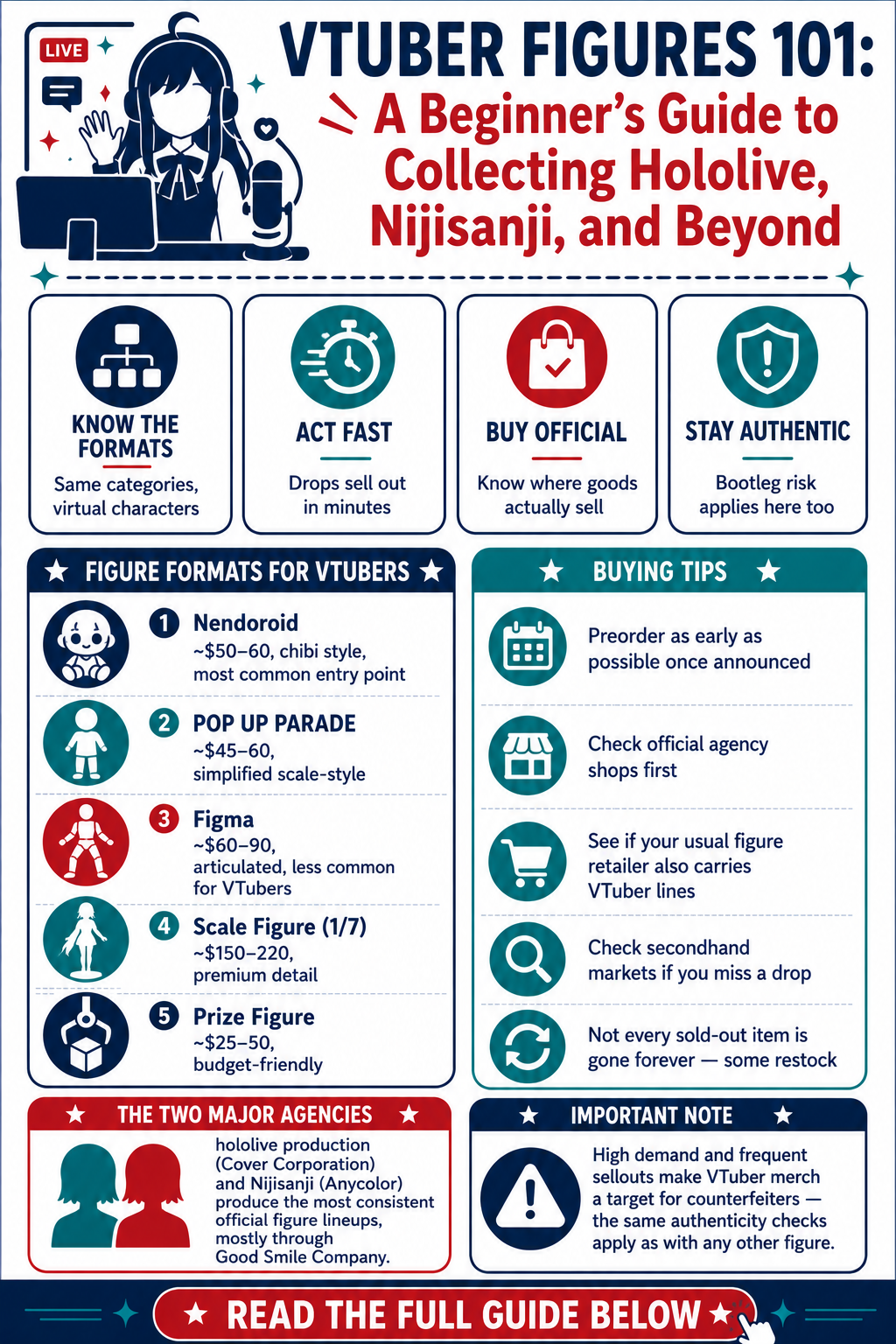
    hololive production, operated by Cover Corporation, is one of the largest VTuber agencies, and its talents get consistent figure support across Nendoroid, Figma, POP UP PARADE, and scale figure lines, mostly through Good Smile Company.

    Nijisanji, operated by Anycolor, is the other major name you’ll encounter constantly, with its own steady stream of scale figures and merchandise, including collaborations with figure retailers running region-specific preorders.

    There are smaller and independent VTuber talents and agencies as well, though official figure support tends to concentrate most heavily around these two larger agencies simply due to scale and demand.

    Figure Categories for VTubers (Same Formats, Different Characters)

    VTuber figures use the same category system as standard anime figures — the format decision is the same, just applied to a virtual streamer persona instead of an anime character:

    FormatWhat to ExpectTypical Price
    NendoroidChibi-style, interchangeable face plates, the most common entry point~$50–60
    POP UP PARADEGood Smile Company’s mid-tier, simplified scale-style line — less detailed than a full scale figure but more affordable~$45–60
    FigmaArticulated, posable — less common for VTubers than Nendoroid, but does exist for some popular talents~$60–90
    Scale Figures (typically 1/7)Full detail, static pose, the premium option~$150–220
    Prize FiguresBudget-friendly, licensed but more variable quality — same category I’ve covered for general anime figures~$25–50

    If you’ve already read my guides on figure types and prize figures, you already understand the tradeoffs here — VTuber collecting doesn’t introduce new format logic, just a new category of character.

    Where Official VTuber Goods Actually Sell

    • Official agency shops (hololive’s official shop, for example) sell merchandise directly, though a meaningful portion of drops and campaigns are structured primarily for Japan-based buyers, which can limit direct access for overseas fans on certain items
    • General figure retailers increasingly carry VTuber figures alongside their standard anime catalog — it’s worth checking whether your preferred retailer stocks this category, since several mainstream import-friendly shops do carry Good Smile Company’s VTuber lines
    • Event-exclusive goods are sometimes only available at physical conventions or pop-up stores in Japan, similar in spirit to the convention-exclusive garage kits I’ve covered elsewhere — these are the hardest category to access without being in Japan in person

    Dealing With Sold-Out Drops

    This is genuinely the biggest adjustment coming from standard anime figure collecting — VTuber merch, especially limited or event-tied goods, can sell out dramatically faster than a typical figure preorder, sometimes within minutes of going live.

    • Preorder as early as possible once an item is announced, rather than waiting to see if you’re still interested — popular talent merchandise in particular can disappear from official stock quickly
    • Check secondhand marketplaces if you miss a drop. Sold-out VTuber goods do turn up on Japanese secondhand platforms afterward, though usually at a premium over the original price
    • Apply the same scarcity-checking logic I’ve covered for limited editions here — not every sold-out item stays permanently unavailable, and some do get restocked or reprinted, so it’s worth checking back rather than assuming a missed drop is gone forever

    Authenticity Still Matters Here Too

    Don’t assume the bootleg risk that applies to standard anime figures somehow doesn’t apply to VTuber merchandise — if anything, the combination of high demand and frequent sold-out drops makes VTuber figures an attractive target for counterfeiters for exactly the same reasons limited editions attract more bootlegging in general. The same checks — official packaging, authentication stickers, seller reputation — apply just as much here as with any other figure purchase.

    Frequently Asked Questions

    Do VTuber figures use different formats than regular anime figures? No — they use the same category system (Nendoroid, Figma, POP UP PARADE, scale figures, prize figures). The only real difference is the character being represented, not the format logic itself.

    Why do some VTuber goods sell out so much faster than typical anime figures? A combination of large, highly engaged fanbases and genuinely limited production runs on certain items, particularly event-exclusive or campaign-tied merchandise, creates faster sellouts than you’d typically see with standard figure preorders.

    Can I buy VTuber figures from the same stores I already use for anime figures? Often yes — it’s worth checking whether your regular retailer carries this category, since several mainstream import-friendly shops now stock official VTuber merchandise from Good Smile Company alongside their standard catalog.

    Is it worth buying VTuber merch secondhand if I miss a drop? It can be a reasonable option, with the same caution that applies to any secondhand figure purchase — check my guide to buying secondhand safely and stay alert for bootleg risk on especially hyped, sold-out items.

    Final Thoughts

    VTuber figure collecting isn’t a fundamentally different hobby from standard anime figure collecting — it’s the same format categories and the same authenticity concerns, layered with a faster-moving, higher-demand buying environment. The biggest adjustment is speed: preorder early, know where official and secondhand markets exist for a specific talent, and don’t assume a sold-out item is gone forever without checking back.

    If you’re new to this side of the hobby entirely, it’s worth starting with my breakdown of figure types and comparison of trusted retailers before diving into VTuber-specific drops — the fundamentals carry over directly.

  • How to Set a Realistic Collecting Budget (So Figures Don’t Quietly Take Over Your Finances)

    How to Set a Realistic Collecting Budget (So Figures Don’t Quietly Take Over Your Finances)

    Affiliate Disclosure: This post contains affiliate links. If you buy through one of them, I may earn a small commission at no extra cost to you. I only recommend stores I’ve actually ordered from or researched thoroughly — my opinions are my own.

    The Problem: Figure Collecting Rarely Blows Your Budget All at Once

    Nobody accidentally spends $2,000 on figures in a single afternoon. What actually happens is smaller and sneakier: a $65 Nendoroid here, a preorder there, shipping and customs tacked onto each one, and by the end of the year the total is a genuine surprise when you actually add it up.

    In my experience, the collectors who feel good about their spending aren’t the ones who spend the least — they’re the ones who set an actual number ahead of time and have a system for tracking against it. This guide walks through how to build a collecting budget that’s realistic rather than aspirational, so it’s something you’ll actually stick to.

    Who This Article Is NOT For

    • If you already track your spending closely and feel good about it, you probably don’t need this — keep doing what’s working.
    • If you’re buying your first figure and just want to get started, budgeting can wait until you have a better sense of your actual habits — start with my first-time buyer’s guide instead, and come back here once you’ve made a few purchases.
    • If money genuinely isn’t a constraint for you, this article’s core value (help you avoid overspending) doesn’t really apply — buy what you love.

    How to Build a Budget That Actually Works

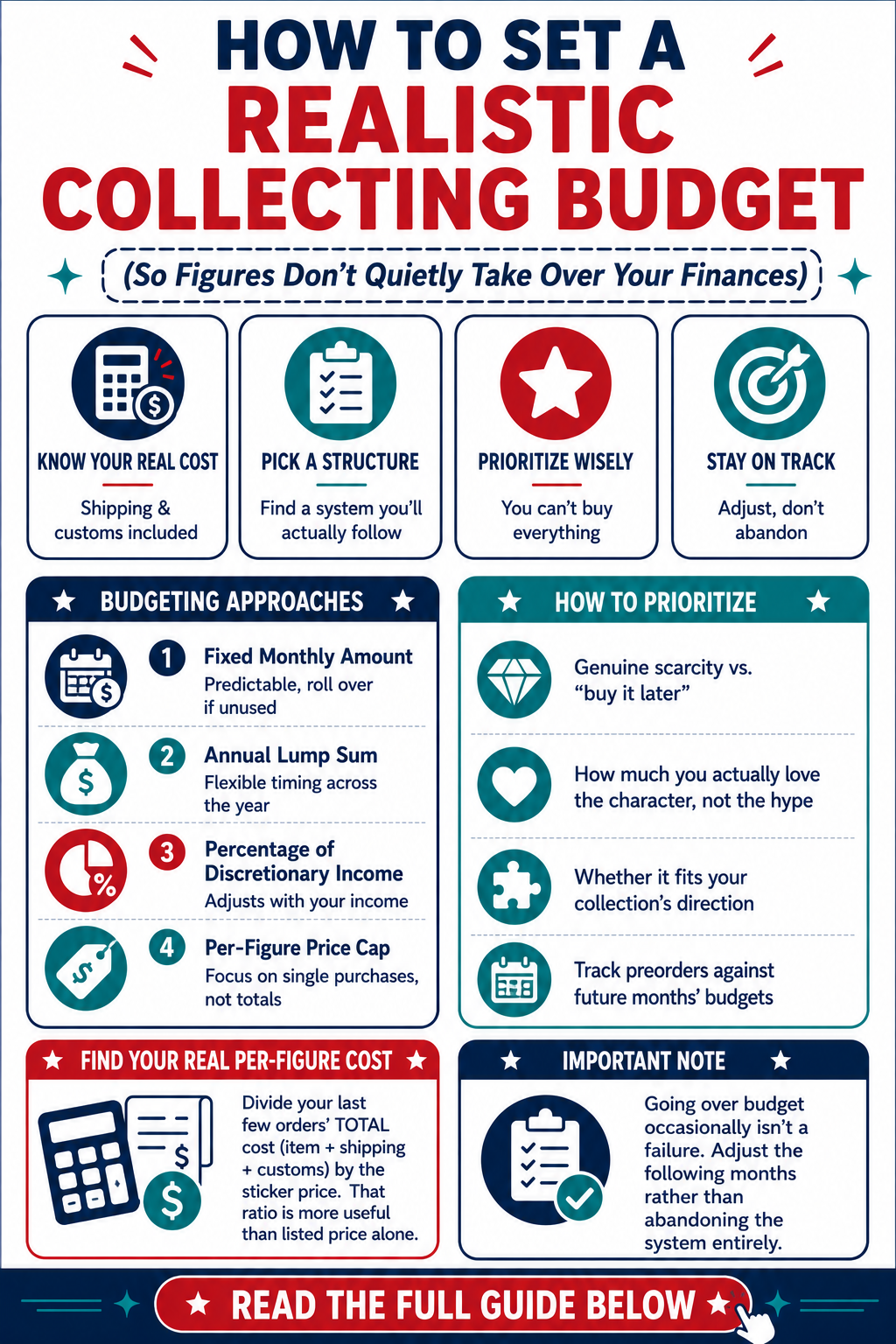
    1. Calculate your true per-figure cost, not just the sticker price. Shipping and customs meaningfully change the real number, and skipping this step is the most common reason budgets fail.

    2. Set a number before you start browsing, not after. Deciding what you can spend while looking at something you already want to buy rarely results in a realistic number.

    3. Build in a system for prioritizing, since a fixed budget means you can’t buy everything — deciding in advance how you’ll choose matters more than the exact dollar figure.

    Step 1: Know Your Real Per-Figure Cost

    The sticker price is only part of what you’ll actually pay. Depending on your country, shipping and customs can add a meaningful percentage on top — and this varies significantly by country, so use your own actual recent orders as a baseline rather than assuming a flat percentage.

    A simple way to find your real number: look back at your last few completed orders and calculate the actual total (item + shipping + any customs charged at delivery) divided by the sticker price. That ratio is a much more useful budgeting tool than the listed price alone, since it reflects what things really cost for you specifically.

    Step 2: Pick a Budgeting Structure That Fits Your Habits

    ApproachHow It WorksBest For
    Fixed monthly amountSet a consistent dollar amount each month, roll over unused amounts if you wantCollectors with steady income and a preference for predictability
    Annual lump sum, allocated as you goDecide a yearly total upfront, track spending against it as purchases happenCollectors who prefer flexibility around when big purchases happen
    Percentage of discretionary incomeA fixed percentage of what’s left after essentials, adjusted naturally as income changesCollectors whose income fluctuates
    Per-figure cap with unlimited quantityNo overall budget, but a maximum price per individual figureCollectors more concerned about single big purchases than total spending

    None of these is objectively correct — the right structure is whichever one you’ll actually follow. A perfectly designed budget you abandon after two months is less useful than a simpler one you stick with all year.

    Step 3: Build a Prioritization System

    A budget only works if you also have a way to decide what to buy when you can’t buy everything. A few practical filters:

    • Genuine scarcity vs. “buy it later.” If something is genuinely limited and won’t come back, prioritize it over something you could reasonably order in a few months. My preorder tracking system is useful here — knowing well in advance what’s coming lets you plan your budget around genuinely time-sensitive purchases rather than reacting to everything as urgent.
    • How much you actually love the character, rather than how much hype something has. Chasing every popular release is a much faster way to blow a budget than being selective about what you personally care about most.
    • Whether it fits your existing collection’s direction. If you’ve settled into collecting mostly from certain genres or a specific type, an impulse purchase far outside that pattern is worth a second look before committing.

    Dealing With Preorders in a Budget

    Preorders complicate budgeting because the payment timing varies by store, and money committed months in advance is easy to lose track of. A few practical habits:

    • Track preorders against future months’ budgets, not just the current one, especially with stores that charge at order time rather than at shipping
    • Know your store’s payment timing before committing — HLJ’s pay-when-it-ships model, for example, doesn’t tie up your budget the same way an upfront-payment preorder does
    • Keep a running list of committed-but-unshipped preorders and their expected cost, so you have visibility into money that’s already spoken for even though it hasn’t left your account yet

    When You’ve Gone Over Budget

    It happens. A few realistic options rather than just feeling bad about it:

    • Adjust future months rather than abandoning the budget entirely. One over-budget month doesn’t mean the system failed — spend less over the following months to balance it out.
    • Consider selling something to offset the cost. If your collecting priorities have shifted, my guide to selling figures safely covers how to do this without getting scammed or badly underpaid.
    • Revisit whether your budget number was realistic in the first place. If you’re consistently going over, the number itself might need adjusting rather than your habits.

    Frequently Asked Questions

    How much do most collectors actually spend per year? This varies enormously based on figure type, frequency, and country — a collector buying mostly Nendoroids a few times a year spends very differently than someone buying premium scale figures monthly. Rather than benchmarking against a stranger’s number, your own realistic budget matters more than any average.

    Should shipping and customs be part of my budget, or just the figure price? Definitely part of it — this is the single biggest reason budgets fail. Use your actual completed order totals (not just sticker prices) to set a realistic number.

    Is it bad to go over budget occasionally? Not inherently — the goal of a budget is general financial awareness and control, not perfect adherence every single month. Adjusting the following months to compensate is a completely reasonable response to an occasional overspend.

    What’s the best way to avoid impulse preorders wrecking my budget? A combination of tracking upcoming releases in advance (so nothing feels like a surprise you have to react to immediately) and giving yourself a short waiting period before committing to anything not already on your radar.

    Final Thoughts

    A collecting budget isn’t about spending less for its own sake — it’s about making sure your spending reflects an actual decision rather than a series of small purchases that add up before you notice. Know your real per-figure cost including shipping, pick a budgeting structure you’ll actually stick with, and build in a way to prioritize when you can’t buy everything you want.

    If you’re just getting your collecting habits established, it’s worth revisiting my comparison of trusted Japan-based retailers and shipping and customs cost breakdown — together, they’re the foundation for actually knowing what your collecting habit costs.

  • How to Buy Secondhand Anime Figures Safely (Understanding Condition Grades)

    How to Buy Secondhand Anime Figures Safely (Understanding Condition Grades)

    Affiliate Disclosure: This post contains affiliate links. If you buy through one of them, I may earn a small commission at no extra cost to you. I only recommend stores I’ve actually ordered from or researched thoroughly — my opinions are my own.

    The Problem: “Used” Can Mean Anything From “Displayed Once” to “Genuinely Rough”

    Secondhand figures are one of the best ways to find discontinued pieces or save money on something still in production — I’ve mentioned Mandarake elsewhere on this site specifically for this reason. But “used” is a genuinely wide range. It can mean a figure that was taken out of the box, looked at once, and put right back — or it can mean something with loose joints, faded paint, and a box that’s seen better days.

    In my experience, the collectors who get burned by secondhand buying aren’t usually victims of dishonest sellers — they’re victims of not knowing how to read a condition grade correctly, or not checking the specific things that actually matter for a used figure. This guide covers both.

    Who This Article Is NOT For

    • If you only buy new, in-production figures, this doesn’t apply to you directly — stick with trusted retailers selling new stock.
    • If box condition genuinely doesn’t matter to you at all, some of the advice here about box grading will be less relevant — you can safely prioritize item condition over packaging.
    • If you’re buying secondhand from an unfamiliar marketplace listing rather than a specialist retailer, read my guide to spotting bootlegs first — secondhand marketplaces carry more counterfeit risk than specialist secondhand retailers.

    How to Approach Buying Secondhand

    1. Understand that item condition and box condition are graded separately. A figure can be in excellent shape with a rough box, or vice versa — knowing which one matters more to you changes what you should look for.

    2. Know what condition grades actually describe, since the same word (“used,” “opened”) can mean different things depending on the seller or platform.

    3. Check for the specific issues that matter for the figure type you’re buying — articulated figures and static scale figures have different things worth inspecting.

    Understanding Condition Grading Systems

    Different secondhand retailers use different grading systems, and it’s worth knowing the general logic rather than memorizing one specific scale:

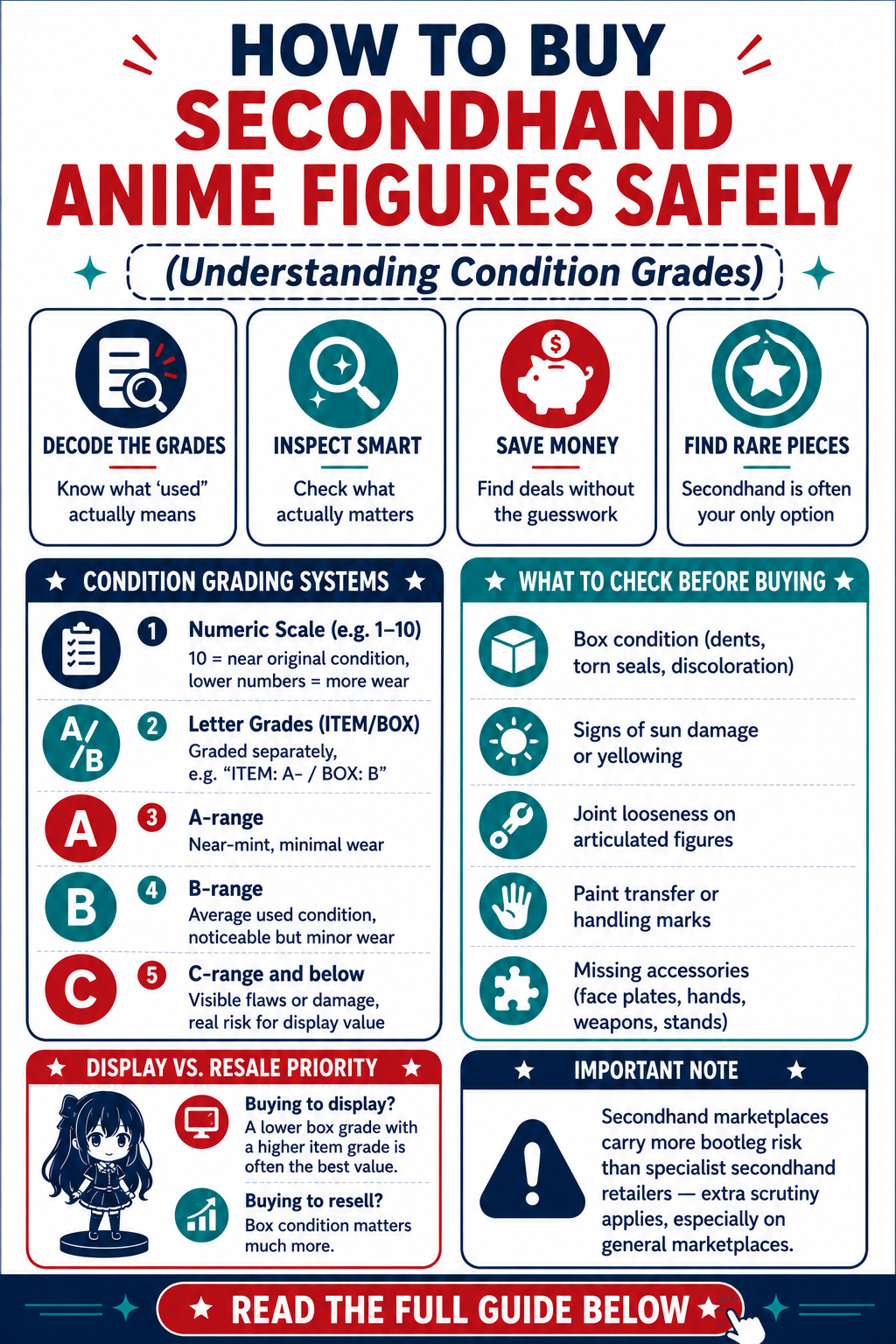
    Numeric scales (e.g., Mandarake’s current system): Mandarake uses a 10-point rating scale across all item categories. A “10” represents essentially original, as-new condition; a “9” has minor imperfections that don’t affect appearance or function; going down the scale, you’ll see increasingly noticeable wear, cosmetic flaws, or functional issues. This applies to the item as a whole, though listings often note box condition separately in the description.

    Letter-based scales (common across other Japanese secondhand shops): Many other Japanese secondhand retailers use a two-part letter grade — one for the item, one for the box — written something like “ITEM: A- / BOX: B.” Under this style of grading:

    • A-range generally means near-mint to excellent condition, with minimal to no visible wear
    • B-range generally means average used condition — noticeable but not significant wear
    • C-range and below generally means visible flaws, damage, or significant wear, and often carries real risk if you’re buying primarily for display value

    A practical tip regardless of scale: if you’re buying to display rather than resell, a lower box grade with a higher item grade is often the best value — box damage frequently drops the price meaningfully more than it affects your actual display experience. If you’re buying with resale or serious collecting value in mind, box condition matters much more, since it directly affects what you could get for it later.

    What to Actually Check Before Buying

    • Box condition specifically: dents, discoloration, torn seals, or missing shrink wrap — even if you don’t care about keeping the box, box condition is often a useful proxy for how carefully the previous owner handled the whole item
    • Signs of sun damage or yellowing: check listing photos closely for uneven coloring, particularly on white or light-colored parts — this kind of damage is permanent once it happens, so it’s worth spotting before you buy, not after
    • Joint looseness on articulated figures: for a used Figma or similar posable figure, ask the seller directly whether joints still hold poses well, since repeated posing by a previous owner can loosen joints over time
    • Paint transfer or handling marks: a slightly “greasy” feel or faint marks where accessories rubbed against the figure during storage are common and usually harmless, but worth knowing about before you buy rather than being surprised on arrival
    • Missing accessories: face plates, extra hands, weapons, and stands are often the first things to go missing from a used figure — confirm what’s actually included, not just what came with the original release

    Where to Buy Secondhand Figures

    • Specialist secondhand retailers (like Mandarake) tend to offer the most transparent, standardized grading and the most reliable descriptions, since condition assessment is core to their business
    • Community marketplaces (MyFigureCollection’s forums and marketplace features, for example) connect you directly with other collectors, who often provide more candid, detailed condition notes than a commercial listing would
    • General marketplaces (eBay, Mercari) can offer good prices but require more of your own diligence — check seller feedback specifically related to figure sales, and don’t hesitate to ask for additional photos before committing

    Frequently Asked Questions

    Is it safe to buy a “used” figure without seeing it in person first? Generally yes, as long as you’re buying from a retailer with a standardized, transparent grading system or a seller with a solid track record — request additional photos if the listing photos don’t show what you need to see clearly.

    Does a lower box grade mean the figure itself is also damaged? Not necessarily — box and item condition are typically graded separately, and it’s common to find a figure in excellent shape with a box that’s simply a bit worn or dented from storage and handling.

    Should I worry about bootlegs when buying secondhand? It’s worth more caution than buying new from an authorized retailer, particularly on general marketplaces rather than specialist secondhand shops. My guide to spotting bootlegs applies just as much to secondhand purchases as new ones.

    Is secondhand a good way to find discontinued or limited figures? Yes — this is genuinely one of the best reasons to buy secondhand, since it’s often the only realistic way to find a figure that’s no longer in production. Just apply extra scrutiny to condition grading and seller reputation for anything you can’t get anywhere else, since a bad purchase on a hard-to-find piece is a bigger loss than on something you could simply reorder.

    Final Thoughts

    Buying secondhand well comes down to understanding that condition grading is a system, not a single word — knowing how item and box grades work separately, checking for the specific issues that matter (sun damage, joint looseness, missing accessories), and matching your grading standards to what you’re actually going to do with the figure (display versus resale) will keep you from unpleasant surprises.

    If you’re building a mixed collection of new and secondhand pieces, it’s worth pairing this with my storage and display guide — proper care matters just as much for a secondhand figure you’re now responsible for as it does for something bought brand new.

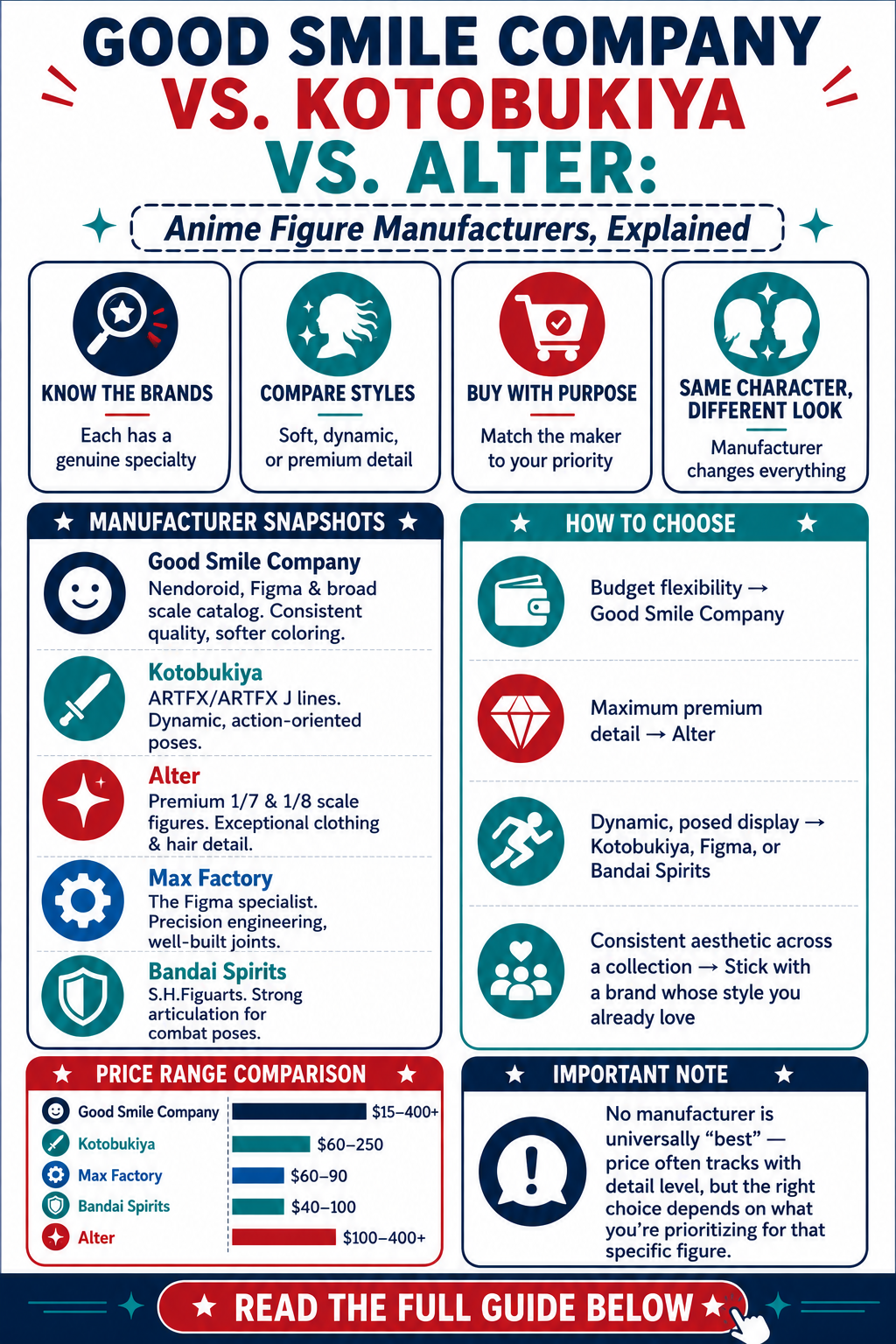
  • Good Smile Company vs. Kotobukiya vs. Alter: Anime Figure Manufacturers, Explained

    Good Smile Company vs. Kotobukiya vs. Alter: Anime Figure Manufacturers, Explained

    Affiliate Disclosure: This post contains affiliate links. If you buy through one of them, I may earn a small commission at no extra cost to you. I only recommend stores I’ve actually ordered from or researched thoroughly — my opinions are my own.

    The Problem: The Same Character, Made By Five Different Companies, Looking Five Different Ways

    Once you’ve been collecting for a little while, you’ll run into this: a character you love has been sculpted by Good Smile Company, Kotobukiya, Alter, and a couple of smaller manufacturers, and each version looks and costs noticeably different. Without knowing what each company is actually known for, it’s hard to tell whether you’re choosing based on real quality differences or just whichever product photo happened to look best.

    In my experience, once you learn a handful of manufacturers’ general reputations and specialties, this decision gets a lot easier — not because one company is universally “best,” but because each has a genuinely distinct style and focus that suits different priorities.

    Who This Article Is NOT For

    • If you only buy from one manufacturer already and you’re happy with that, there’s no need to overhaul your approach — this is most useful when you’re actively deciding between multiple versions of the same character.
    • If you haven’t read my Nendoroid vs Figma vs Scale Figure guide yet, that’s the more fundamental decision — this article assumes you already know roughly which type you want and are now choosing between manufacturers within that type.
    • If brand doesn’t matter to you at all and you buy purely on character and price, that’s a completely reasonable approach — this article is for the specific moment when you’re comparing multiple versions of the same figure.

    How These Manufacturers Actually Differ

    1. Style and sculpting approach. Some companies lean toward softer, cuter proportions; others aim for lifelike realism; still others specialize in dynamic, action-oriented poses.

    2. Price positioning. Manufacturers occupy genuinely different price tiers, and that’s tied to their production philosophy, not just brand markup.

    3. What they’re specifically known for. Most of these companies have a specialty — chibi figures, premium scale statues, highly articulated action figures — that’s worth knowing before comparing two versions of the same character.

    Quick Comparison: Major Manufacturers

    ManufacturerKnown ForTypical Price RangeStyle Signature
    Good Smile Company (GSC)Nendoroid, Figma (via Max Factory), and a broad scale figure catalog$15–400+ depending on lineConsistent quality, softer color palettes, distinctive illustrated box art
    KotobukiyaARTFX/ARTFX J lines, Bishoujo statues, plastic model kits$60–250Dynamic poses, strong presence in both anime and game character figures
    AlterPremium 1/7 and 1/8 scale figures$100–400+Exceptionally detailed sculpting, especially clothing and hair; among the most premium-positioned manufacturers
    Max FactoryFigma line specifically, plus some scale work$60–90 for FigmaEngineered articulation, often described as combining Alter-level precision with GSC’s softer coloring
    Bandai SpiritsS.H.Figuarts and other highly articulated action-figure-style lines$40–100Strong articulation aimed at dynamic action poses, particularly for battle-heavy series

    Good Smile Company: The Broad, Reliable Generalist

    Good Smile Company is probably the name you’ll encounter most often, and for good reason — their catalog spans budget-friendly chibi figures all the way up to premium scale pieces, and their quality is generally consistent across that whole range. They’re the company behind Nendoroid and, through their relationship with Max Factory, Figma, which alone makes them a company most collectors end up owning something from.

    Collectors often describe GSC’s scale figures as having a slightly softer color palette compared to Alter’s more true-to-source coloring, and their packaging is genuinely notable in its own right — GSC scale figure boxes typically include original illustration artwork on the side, which some collectors display or keep specifically for that reason.

    Kotobukiya: Dynamic Poses and Broad Franchise Coverage

    Kotobukiya has been producing figures since the 1980s, and their ARTFX and ARTFX J lines are known for dynamic, action-oriented poses across both anime and video game franchises. They also have a significant presence in plastic model kits, which sets them apart from manufacturers focused purely on pre-painted figures.

    If you’re comparing a Kotobukiya version of a character against a more static competitor, the pose itself is often the differentiator — Kotobukiya tends to favor capturing a character mid-action rather than a calm, neutral stance.

    Alter: The Premium Specialist

    Alter has built its entire reputation around one thing: exceptionally detailed 1/7 and 1/8 scale figures, generally positioned at the premium end of the price range. Collectors consistently point to their clothing and hair detail work as a standout, along with expressive, lifelike facial sculpting. This isn’t the manufacturer to look at if you’re working with a tight budget, but if you’re choosing a single showpiece figure for a character you love most, Alter is frequently the answer serious collectors reach for.

    Max Factory: The Figma Specialist

    Max Factory is closely associated with Good Smile Company and is specifically responsible for the Figma line. Collectors often describe their work as combining Alter-level sculpting precision with Good Smile’s softer color approach — a reasonable way to think about them is as the company behind the articulated, posable side of the hobby specifically, with a reputation for genuinely well-engineered joints that hold up to repeated posing.

    Bandai Spirits: Built for Action

    Bandai Spirits’ S.H.Figuarts line (and similar offerings) leans heavily into strong articulation aimed at recreating dynamic combat and action poses, which pairs naturally with battle-heavy series. If Figma is your reference point for posable figures, Bandai Spirits’ lines are worth comparing directly against it — both prioritize dynamic posing, but with different engineering approaches and slightly different aesthetic sensibilities.

    How to Actually Choose Between Manufacturers for the Same Character

    • If budget is your main constraint, Good Smile Company’s broader price range generally offers the most flexibility, from budget-friendly to premium within the same brand.
    • If you want the most premium, detailed version available, Alter is usually the name to check first, accepting the higher price tag that comes with it.
    • If you want the figure posed dynamically rather than standing still, compare Kotobukiya, Figma (Max Factory), and Bandai Spirits’ offerings for that character rather than a static scale figure.
    • If you already know you love a specific line’s overall aesthetic (GSC’s softer coloring, Alter’s lifelike detail, Kotobukiya’s dynamic energy), that consistency across their catalog is often a more reliable guide than judging any single product photo in isolation.

    Frequently Asked Questions

    Is one manufacturer objectively “the best”? No — each has a genuine specialty and price positioning, and “best” depends entirely on what you’re prioritizing: budget flexibility (Good Smile Company), premium detail (Alter), dynamic posing (Kotobukiya, Figma, Bandai Spirits), or a specific aesthetic style.

    Why do two figures of the same character look so different depending on manufacturer? Each company interprets the source material through its own sculpting and coloring approach — this is a real, consistent stylistic difference, not just random variation between individual products.

    Are more expensive manufacturers always higher quality? Generally, price does track with detail level and production care in this hobby, but “higher quality” doesn’t automatically mean “better for you” — a Nendoroid from Good Smile Company and a premium Alter scale figure are both well-made, just built for completely different purposes and budgets.

    Does the manufacturer affect authenticity risk? Not directly, but well-known manufacturers and their popular lines are more frequently targeted by bootleggers simply due to higher demand — buying from a trusted retailer matters regardless of which manufacturer made the figure.

    Final Thoughts

    Once you know a handful of manufacturers’ general reputations, choosing between multiple versions of the same character stops being a guessing game based on product photos alone. Good Smile Company offers breadth and reliability, Alter specializes in premium detail, Kotobukiya and Bandai Spirits lean into dynamic posing, and Max Factory anchors the articulated Figma line specifically — knowing which of those priorities matters most to you makes the decision genuinely straightforward.

    If you’re still working out which figure type suits you best before worrying about manufacturer, my Nendoroid vs Figma vs Scale Figure guide is the right place to start, followed by my comparison of trusted Japan-based retailers for where to actually buy.

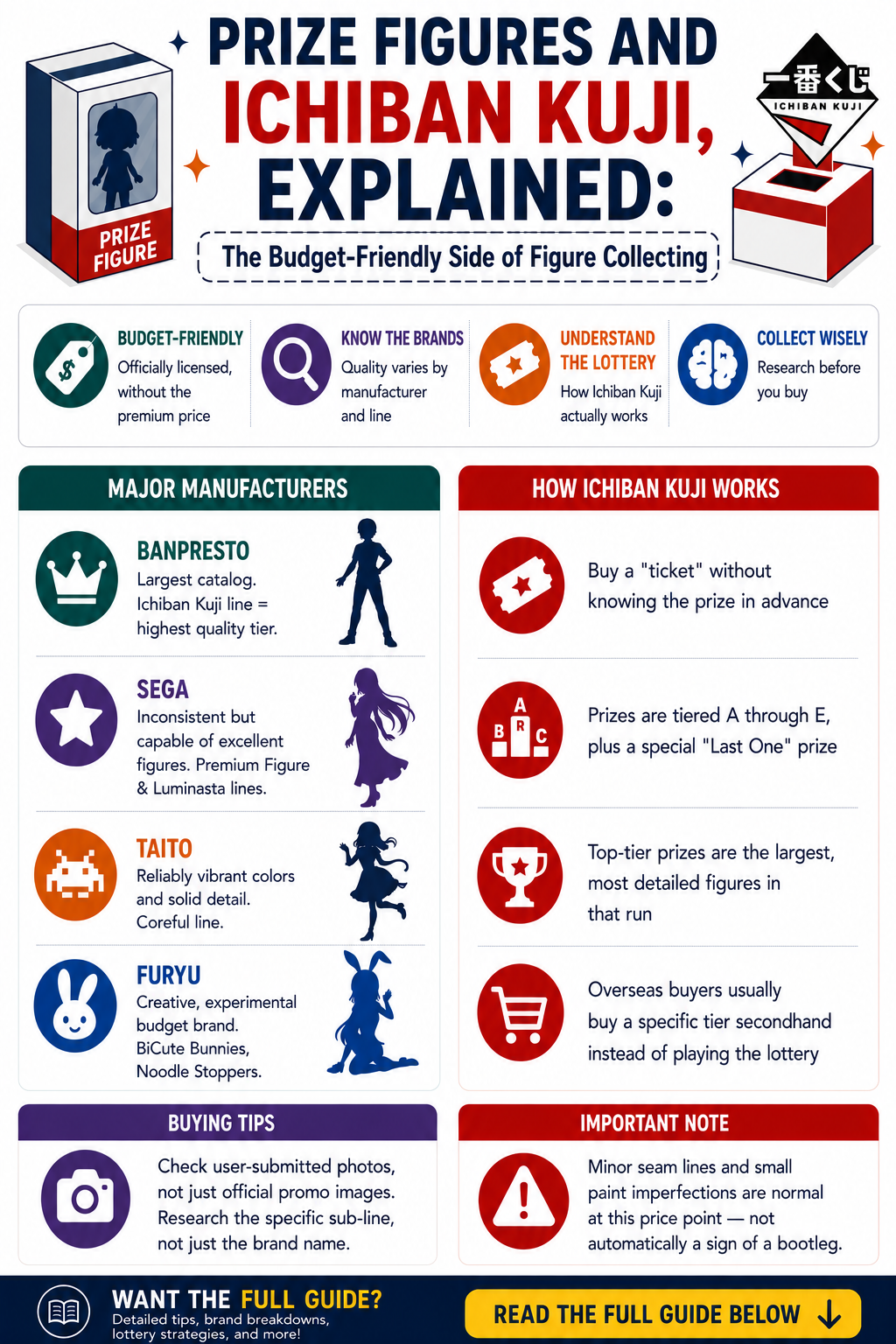
  • Prize Figures and Ichiban Kuji, Explained: The Budget-Friendly Side of Figure Collecting

    Prize Figures and Ichiban Kuji, Explained: The Budget-Friendly Side of Figure Collecting

    Affiliate Disclosure: This post contains affiliate links. If you buy through one of them, I may earn a small commission at no extra cost to you. I only recommend stores I’ve actually ordered from or researched thoroughly — my opinions are my own.

    The Problem: Cheap Figures Feel Like They Must Be a Catch

    If you’ve browsed figure listings and noticed some surprisingly affordable pieces — often $25–50 for something that looks reasonably detailed in photos — your instinct might be to assume there’s a catch. After everything I’ve covered about spotting bootlegs, a little suspicion toward “too cheap to be true” pricing is a healthy habit.

    But this is actually a completely legitimate, well-established corner of the hobby: prize figures and Ichiban Kuji figures. They’re officially licensed, made by real manufacturers, and genuinely budget-friendly by design — they’re just built and distributed differently than the scale figures and Nendoroids I usually cover. This guide explains what they are and how to collect them well.

    Who This Article Is NOT For

    • If you only want museum-grade sculpting and paint detail, prize figures generally won’t satisfy that — they’re a different value proposition entirely, and premium scale figures are the better fit.
    • If inconsistent quality within the same product line bothers you, this is worth knowing upfront: prize figure quality varies meaningfully between manufacturers, sub-lines, and even individual units of the same figure.
    • If you’re not interested in a budget-friendly way to expand your collection, and price isn’t a concern for you, this category may simply not be necessary for how you already collect.

    What Actually Defines This Category

    1. Original distribution method. Prize figures were originally designed to be won from Japanese arcade crane games (“UFO catchers”), while Ichiban Kuji figures come from a ticket-based lottery system — neither started as a normal retail product, even though both are now widely available for direct purchase.

    2. Price point by design. These are intentionally more affordable than scale figures, generally in the $25–50 range for standard prize figures, with kuji top prizes running higher.

    3. Quality that varies by manufacturer and sub-line, much more than you’d see with premium scale figure brands — this is the trade-off for the lower price.

    The Major Manufacturers and Their Sub-Lines

    ManufacturerKnown ForNotable Sub-Lines
    Banpresto (Bandai Namco subsidiary)The largest catalog and release pace in this categoryGrandista (larger, premium-leaning), Ichiban Kuji (their lottery line, generally the highest quality tier), QPosket (chibi-style)
    SEGAInconsistent but capable of genuinely excellent figuresPremium Figure, Luminasta, SPM (Super Premium)
    TaitoKnown for reliably vibrant colors and solid detail for the priceCoreful
    FuRyuA creative, experimental budget-friendly brandBiCute Bunnies, Noodle Stoppers (novelty figures designed to sit on instant ramen cup lids)

    A practical note on quality: even within a single manufacturer, sub-lines aren’t interchangeable in quality. Banpresto’s Ichiban Kuji line, for example, is generally considered the strongest tier they produce — sometimes genuinely rivaling older scale figures — while their standard prize figure lines are more of a mixed bag. It’s worth researching the specific sub-line, not just the manufacturer name, before buying.

    How Ichiban Kuji Actually Works

    Ichiban Kuji (一番くじ) is Bandai’s lottery figure system, and it works differently from a normal purchase:

    • You buy a “ticket,” typically at a Japanese convenience store, without knowing in advance which prize you’ll receive
    • Prizes are organized into tiers, usually labeled A through E (or similar), with a special final “Last One” prize awarded to whoever draws the final ticket in a given run
    • The top-tier prizes are typically the largest, most detailed figures in that specific run, and tend to command the highest resale prices outside Japan
    • Since the system is genuinely randomized, getting a specific tier isn’t guaranteed by buying tickets — this is part of why top-tier kuji prizes often resell at a real premium afterward

    For overseas collectors, buying individual lottery tickets generally isn’t practical unless you’re actually in Japan. The realistic path is buying a specific prize tier secondhand or through a specialty importer, which does mean paying above the original lottery price — but it removes the randomness if you want a specific prize.

    Where to Actually Buy Prize Figures and Kuji Prizes

    • General retailers that also carry prize figure and kuji stock. It’s worth checking whether your preferred trusted retailer carries this category alongside their standard figure catalog, since several do.
    • Secondhand specialists. Mandarake, which I’ve mentioned before for rare and discontinued figures, is also a reasonable place to find specific kuji prize tiers and older prize figures.
    • Marketplace listings, with the same caution that applies elsewhere on this site — check seller reputation, and be appropriately skeptical of prices that seem unusually low even by prize-figure standards, since bootlegging isn’t exclusive to premium scale figures.

    Tips for Buying Prize Figures Well

    • Look at user-submitted photos, not just official promotional images, before buying a specific figure. Community sites and marketplace review photos tend to show more realistic paint and sculpt quality than polished official product shots.
    • Research the specific sub-line, not just the brand. As covered above, quality varies enormously even within one manufacturer’s catalog — a quick search on the specific line name before buying is worth the extra minute.
    • Expect minor imperfections as normal for this category. Seam lines, slightly off-center decals, and small paint inconsistencies are common at this price point and aren’t necessarily signs of a bootleg — they’re a known trade-off of mass production at a lower cost.
    • Buy at launch if you want the best price on a hyped kuji prize. Popular kuji top prizes can genuinely double in resale price within months of a sold-out run, similar to the scarcity dynamics I’ve covered with limited editions.

    Frequently Asked Questions

    Are prize figures bootlegs or lower-quality knockoffs? No — they’re officially licensed products from real manufacturers like Banpresto, SEGA, Taito, and FuRyu, just made and distributed differently (and more cheaply) than premium scale figures. Quality varies more than premium lines, but legitimacy isn’t the issue.

    Is it worth buying a specific Ichiban Kuji prize tier secondhand instead of trying the lottery myself? For overseas collectors, this is usually the more realistic option, since buying individual lottery tickets typically requires being in Japan. You’ll generally pay above the original ticket price for a guaranteed specific tier, which is the trade-off for removing the randomness.

    Why do some prize figures from the same line look better than others? Quality control varies more in this category than in premium scale figure lines, partly because of the lower price point and higher production volume. Checking user-submitted photos before buying a specific figure is the best way to set realistic expectations.

    Can prize figures be a good starting point for a new collector on a budget? Yes, genuinely — the price point makes them accessible, and reputable sub-lines like Banpresto’s Ichiban Kuji or Taito’s Coreful line offer solid quality-to-price value. Just go in expecting more variability than you’d see with Nendoroid, Figma, or premium scale lines.

    Final Thoughts

    Prize figures and Ichiban Kuji occupy a genuinely useful niche in the hobby: officially licensed, budget-friendly, and accessible even for collectors who aren’t ready to spend $100+ on a premium scale figure. The trade-off is real — quality varies more than you’ll see elsewhere — but with a bit of research into specific sub-lines and a habit of checking real user photos before buying, this category can be a smart way to expand a collection without straining your budget.

    If you’re building out your collecting knowledge, it’s worth revisiting my breakdown of Nendoroid, Figma, and scale figures to see how prize figures fit alongside the other major categories, and my guide to trusted Japan-based retailers for where to actually shop.

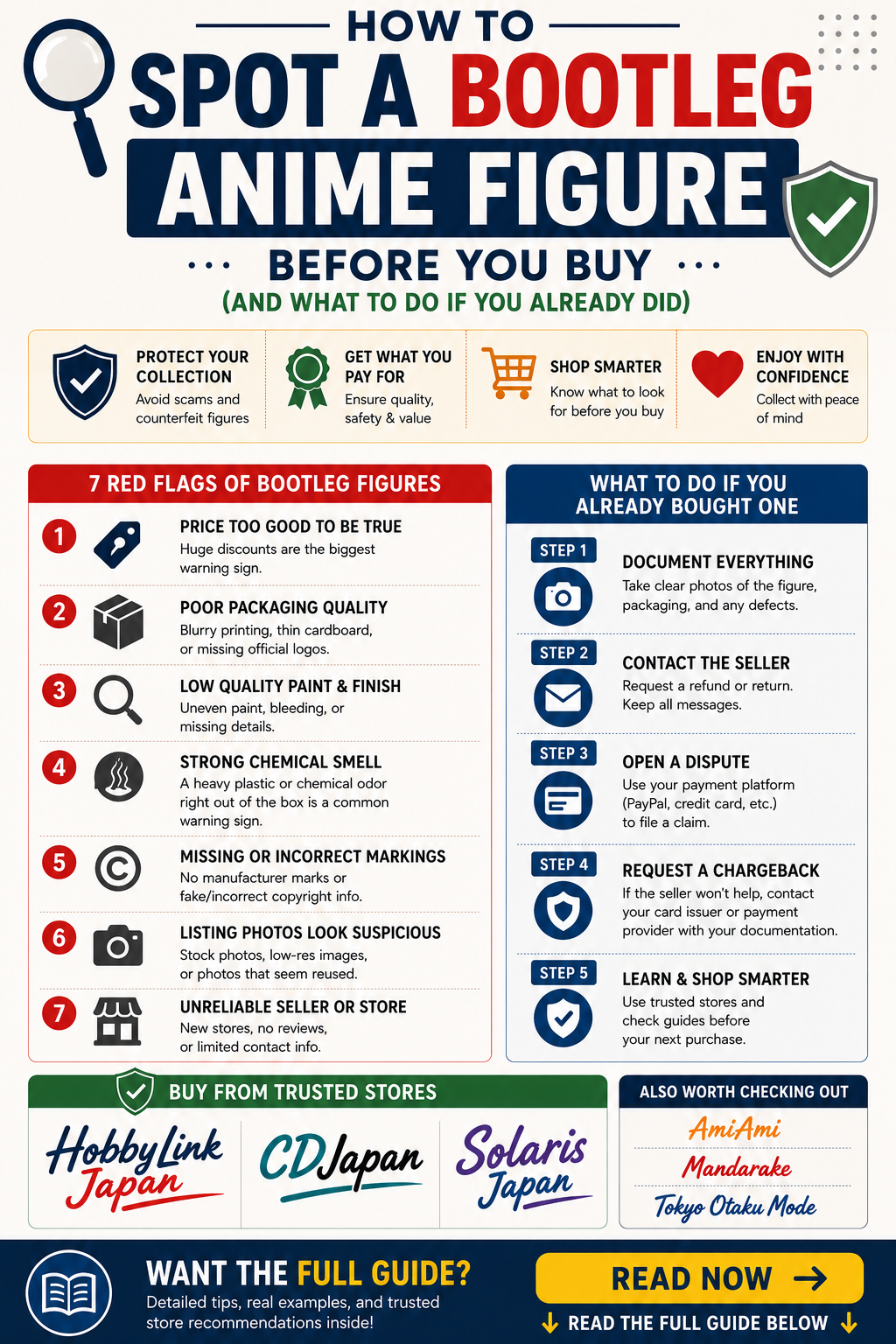
  • How to Spot a Bootleg Anime Figure Before You Buy (And What to Do If You Already Did)

    How to Spot a Bootleg Anime Figure Before You Buy (And What to Do If You Already Did)

    Affiliate Disclosure: This post contains affiliate links. If you buy through one of them, I may earn a small commission at no extra cost to you. I only recommend stores I’ve actually ordered from or researched thoroughly — my opinions are my own.

    The Problem: That “Great Deal” Might Not Be a Figure At All — It Might Be a Recast

    Here’s an uncomfortable truth about figure collecting: bootlegs (often called “recasts” in the hobby, because they’re literally cast from a mold copied off an official figure) have gotten a lot better at looking real. A few years ago, spotting a fake was almost trivial — bad paint, obviously wrong packaging, a price that was suspiciously low. Today, some of these knockoffs are convincing enough to fool collectors who’ve been in the hobby for years, let alone someone buying their first figure.

    In my experience, the moment this actually stings isn’t when you first suspect something’s off — it’s weeks later, when you finally compare your figure side-by-side against official photos and realize the hair is subtly wrong, the paint has bled slightly outside the lines, or the box just feels cheap in a way you can’t quite explain until you’ve held a real one.

    This guide walks through exactly what to check, in the order I’d actually check it, so you can catch a fake before you buy — or at least before your return window closes.

    Who This Article Is NOT For

    • If you’re only buying from stores I’ve already vetted — HobbyLink Japan, CDJapan, and Solaris Japan all source directly from official distributors, so bootlegs essentially aren’t a risk there. This guide matters most if you’re buying from marketplaces, resellers, or anywhere outside a trusted specialist retailer.
    • If you’re deliberately buying garage kits (GKs) or fan-made resin kits that are openly sold as unofficial, unlicensed pieces — that’s a different (and legal, as long as it’s disclosed) category from a bootleg being passed off as authentic.
    • If you haven’t picked a figure type yet, back up to my Nendoroid vs Figma vs Scale Figure guide first — it’s easier to spot something wrong once you know what the real thing is supposed to look like.

    How This Checklist Is Built

    1. Check the packaging before the figure itself. Bootleggers often nail the sculpt reasonably well but cut corners hard on the box, since that’s the part original manufacturers actually spend real money protecting.

    2. Check the details real manufacturers can’t afford to get wrong. Paint bleed, seam lines, and material quality are expensive to get right — legitimate companies invest in it, and copies almost always show the strain somewhere.

    3. Check the context of the sale. Price, seller reputation, and where the listing lives tell you a lot before the figure even arrives.

    Quick Red-Flag Checklist

    CategoryAuthentic FigureBootleg / Recast
    PriceMatches typical retail or preorder pricingNoticeably below market price, “too good to be true”
    Box printingCrisp, high-resolution art and textBlurry, pixelated, or slightly off-color printing
    Authentication stickerHolographic or metallic manufacturer seal presentMissing, or a flat sticker with no holographic effect
    Hair/sculpt tipsSharp, pointed detail matching official rendersRounded, softened, or slightly misshapen edges
    Paint applicationClean lines, no bleed between colorsSmearing, bleeding outside lines, uneven coverage
    Smell (fresh from box)Little to no odor, or mild plastic smellStrong chemical or “heavy plastic” smell
    Seller/listingAuthorized retailer or manufacturer-recognized shopMarketplace listing using stolen official photos, vague seller history

    What to Actually Check, Step by Step

    1. Start With the Box, Not the Figure

    Before you even touch the figure itself, the box tells you most of what you need to know. Legitimate manufacturers like Good Smile Company, Bandai, and Kotobukiya spend real money on packaging because it’s part of protecting a premium product — bootleggers are usually working from scanned images of the original box art, which shows up as blurry or slightly pixelated printing once you look closely.

    The single most reliable box-level check is the authentication sticker. Most major manufacturers place a holographic or metallic seal somewhere on the box — tilt it under a light and you should see a multi-layered, shifting logo effect. If that sticker is missing entirely, or present but completely flat with no holographic shimmer, that’s one of the strongest single signals you’re looking at a fake.

    Watch out for sellers who explain away a missing sticker or box with phrases like “factory reject” or “unboxed unofficial stock.” Manufacturers don’t sell damaged or rejected stock through unofficial channels — that explanation is a workaround bootleg sellers use, not a real category of product.

    2. Look at the Fine Detail Work

    Once you’re looking at the actual figure, focus on the parts that are genuinely expensive to get right: hair tips, fabric texture, and small painted details like eyes or emblem work.

    Hair and sculpted edges are a surprisingly reliable tell. Authentic figures tend to have sharp, defined tips wherever the sculpt calls for it. Recasts are made from a mold taken off an existing figure, and that process tends to soften and round out fine points — so hair that should end in a crisp tip often looks slightly melted or blunt on a bootleg.

    Paint application is another strong indicator. Look at the most visually complex areas of the figure — eyes, patterned clothing, small emblems — since that’s where a rushed paint job shows the most. Bleeding between colors, visible smearing, or paint that looks either too thin or oddly caked on are all signs of a lower-quality reproduction rather than an official production run.

    3. Trust Your Nose (Seriously)

    This sounds strange, but it’s a genuinely useful check: authentic figures typically have little to no smell straight out of the box, or at most a very mild plastic scent. Bootlegs are frequently made with cheaper, non-regulated materials, and a strong chemical or “heavy plastic” odor right after unboxing is a real warning sign — not proof on its own, but worth combining with the other checks above.

    One caveat: older figures, or ones that have sat in a hot or sun-exposed environment, can develop an odor or slightly degraded paint from age rather than being fake. Use smell as one data point among several, not a standalone verdict.

    4. Investigate the Listing Itself, Before You Even Buy

    A lot of this can be checked before the figure ever ships:

    • Price that’s dramatically below typical retail is the single biggest predictor of a bootleg. Authentic figures cost what they cost because of material quality and licensing — a steep discount almost always means something’s off.
    • Stock photos vs. seller photos. If a listing only uses official promotional images and never shows an actual photo of the item the seller has in hand, be cautious — this is a common tactic for disguising a bootleg.
    • Seller history and reviews. Check whether other buyers have specifically mentioned receiving a bootleg from that seller. On larger marketplaces, this is often searchable directly in the reviews.
    • Where the listing lives. Marketplace listings (eBay, general marketplace apps, social media shops) carry meaningfully more bootleg risk than a dedicated, specialist retailer that sources directly from manufacturers or authorized distributors.

    If You Think You Already Bought a Bootleg

    • Compare against official reference photos from the manufacturer’s own product page, focusing on the checkpoints above (hair tips, paint bleed, box printing).
    • If you bought through a major marketplace (eBay, Amazon, similar platforms), most have explicit buyer protection policies for counterfeit or “significantly not as described” items — file a claim through the platform rather than trying to negotiate directly with the seller.
    • If you bought from a private seller or an unfamiliar site, a chargeback through your card issuer or payment provider is usually your strongest option once you have comparison photos ready.

    The Simplest Long-Term Fix

    Realistically, the checklist above is useful for marketplace purchases, secondhand buys, or anywhere you’re not 100% sure of the source. But the easiest way to avoid ever needing it is to buy from retailers that source directly from official distributors in the first place. That’s the whole reason I put together my comparison of trusted Japan-based figure stores — HobbyLink Japan, CDJapan, and Solaris Japan all source through legitimate channels, so this entire checklist becomes unnecessary if you’re ordering from them.

    Frequently Asked Questions

    What does “recast” mean in figure collecting? A recast is a bootleg figure made by taking a mold directly off an existing official figure, then producing unauthorized copies from that mold. The term is used somewhat interchangeably with “bootleg” in the collecting community, though recast specifically refers to this mold-copying process.

    Are bootleg figures illegal? Yes — bootlegs are unlicensed reproductions that infringe on the original manufacturer’s and copyright holder’s rights. Beyond the legal issue, they’re also frequently made with lower-quality, non-regulated materials.

    Can a bootleg figure look identical to the real thing in photos? Increasingly, yes. Some high-quality bootlegs are convincing enough in online listing photos that the differences only become clear once you inspect the packaging, paint, and sculpt details in person — which is why checking seller reputation and price before buying matters as much as inspecting the item after it arrives.

    Is it safe to buy secondhand anime figures? It can be, but the bootleg risk is higher than buying new from an authorized retailer, since you’re relying entirely on the seller’s honesty and your own inspection. Apply the checklist above, and be especially cautious of secondhand listings priced well below typical resale value.