投稿者: Ant

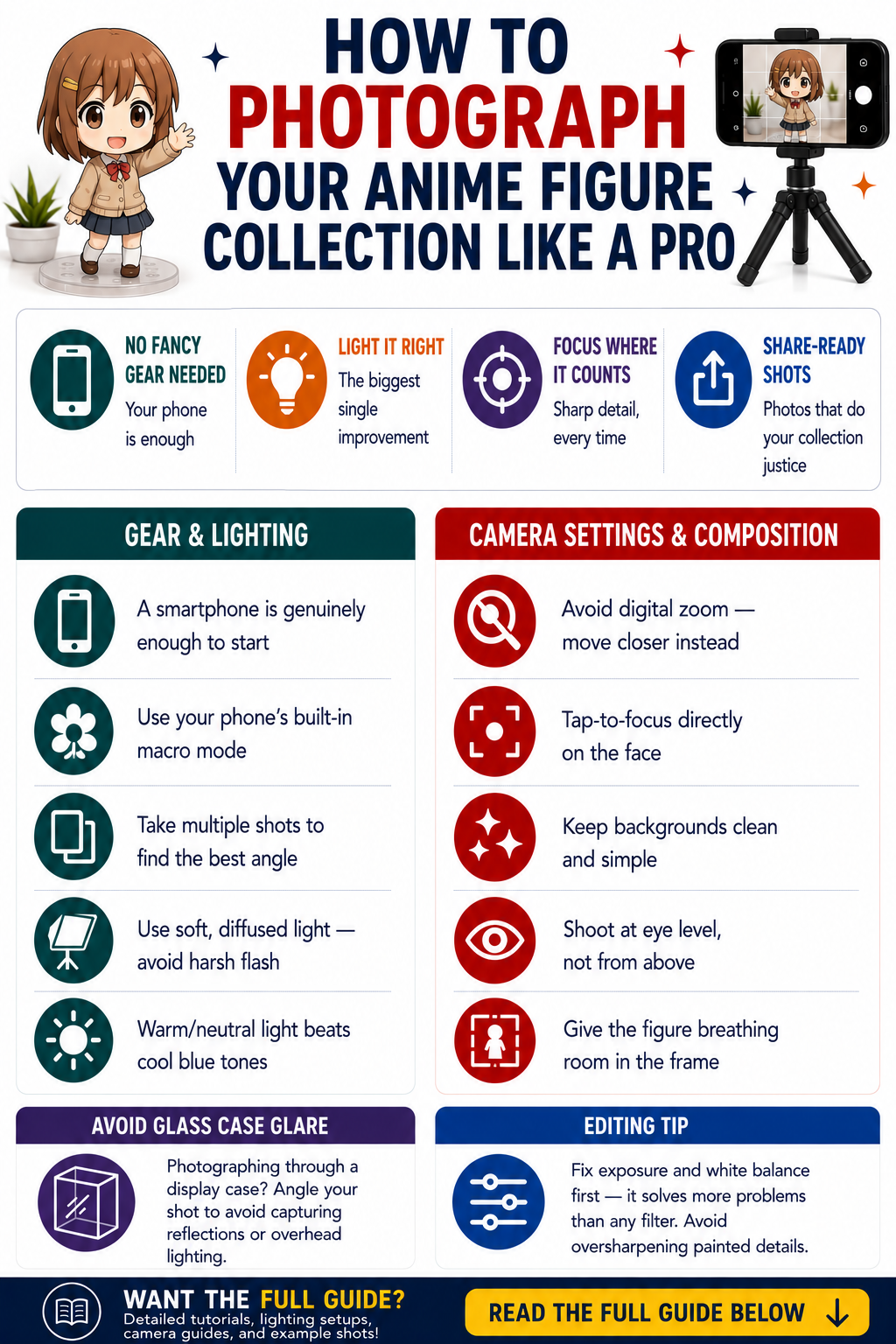
  • How to Photograph Your Anime Figure Collection (Tips for Instagram-Worthy Shots)

    How to Photograph Your Anime Figure Collection (Tips for Instagram-Worthy Shots)

    Affiliate Disclosure: This post contains affiliate links. If you buy through one of them, I may earn a small commission at no extra cost to you. I only recommend stores I’ve actually ordered from or researched thoroughly — my opinions are my own.

    The Problem: The Figure Looks Great in Person, Terrible in the Photo

    You’ve got the lighting sorted, the shelf looks great, and then you pull out your phone to snap a photo and the result looks flat, washed out, or just… underwhelming compared to what you’re actually seeing. This is an extremely common gap, and it’s rarely about the figure itself — it’s almost always about a handful of photography fundamentals that are easy to fix once you know what’s going wrong.

    In my experience, the difference between a mediocre figure photo and one people actually stop to look at usually comes down to three things: light, background, and angle — none of which require expensive camera gear to get right.

    Who This Article Is NOT For

    • If you already have a photography workflow you’re happy with, this is more useful for someone still figuring theirs out.
    • If you haven’t read my display and lighting setup guide yet, it’s worth a look first — good display lighting and good photography lighting overlap significantly.
    • If you’re only interested in casual snapshots for yourself, most of this is aimed at people specifically trying to get social-media-ready results — feel free to skip if that’s not your goal.

    The Three Fundamentals That Actually Matter

    1. Lighting quality, which affects a photo more than any other single factor, camera quality included.

    2. Background and composition, since a cluttered or distracting background undersells even a well-lit figure.

    3. Angle and focus, which determine whether the shot actually highlights the figure’s best details.

    Lighting: Get This Right First

    • Natural, indirect light is genuinely the best free option available. Position your figure near a window, but not in direct sunlight — diffused daylight (an overcast day, or a spot just out of direct sun rays) produces soft, even lighting that’s hard to beat without professional equipment.
    • Avoid your phone’s built-in flash entirely. Direct flash creates harsh shadows and blown-out highlights on glossy figure surfaces, which tends to look worse than simply having less light overall.
    • If you’re shooting at night or without good natural light, use the same warm/neutral white LED setup recommended for display lighting. What looks good to the eye on your shelf generally photographs well too.
    • Diffuse harsh light sources. A simple trick: shooting through a thin white cloth or paper held between the light source and the figure softens harsh shadows significantly, similar to how professional photographers use diffusion panels.
    • Avoid mixed lighting temperatures in one shot. Combining warm indoor light with cool daylight in the same frame often produces an odd color cast that’s hard to correct afterward — pick one dominant light source per shot.

    Background and Composition

    • A plain, uncluttered background makes the figure the clear focal point. A single solid-color backdrop (poster board, fabric, or even a blank wall) consistently outperforms a busy shelf background for a dedicated photo.
    • Match your background to the figure’s tone, rather than defaulting to the same color every time — a dark backdrop tends to make bright colors pop, while a lighter backdrop suits figures with darker color palettes.
    • Give the figure breathing room in the frame. Don’t crop so tightly that the composition feels cramped, but also avoid so much empty space that the figure feels small and lost in the shot.
    • Consider a simple prop or two, used sparingly. A relevant small object (a book, a plant, a subtly thematic item) can add context without overwhelming the figure itself — but resist the urge to clutter the scene with too many props at once.

    Angle, Focus, and Camera Settings

    • Shoot at or slightly below the figure’s eye level, rather than straight down from above. This angle tends to feel more natural and makes the figure feel more like a “presence” in the frame rather than an object being looked down at.
    • Use your phone’s macro or close-up mode for detail shots, if your phone has one — this lets you get closer without the image becoming blurry, which is especially useful for showcasing fine paint or sculpt detail.
    • Tap to focus directly on the figure’s face or the most important detail, rather than trusting your phone’s automatic focus, especially in a busier composition.
    • Avoid digital zoom. Physically moving closer to the subject preserves image quality far better than zooming in digitally, which tends to introduce blur and softness.
    • Take more shots than you think you need. Small variations in angle and framing add up, and it’s much easier to pick the best result from several options than to nail the perfect shot on the first try.

    Basic Editing (Without Overdoing It)

    • Adjust brightness and contrast lightly to make sure the figure doesn’t look washed out or overly dark compared to how it actually looks in person
    • Correct white balance if the color temperature looks off, particularly if you shot under mixed or artificial lighting
    • Avoid heavy filters that shift the figure’s actual paint colors. A filter that looks nice aesthetically can misrepresent the figure’s real appearance, which matters if you’re posting for other collectors who care about accurate color reference
    • Crop for composition after the fact if needed, rather than always getting the framing perfect in-camera — small crop adjustments can meaningfully improve a shot’s balance

    Handling Figures Safely During a Photoshoot

    A quick reminder tied to proper figure care: repeated repositioning for photos does put some wear on articulated joints over time, and handling by delicate parts (weapons, extended hair, thin accessories) risks damage. If you’re doing a dedicated photoshoot, handle the figure by its base or torso when repositioning, and avoid excessive repeated posing purely for the sake of getting more shots.

    Frequently Asked Questions

    Do I need a professional camera to get good figure photos? No — a modern smartphone camera is genuinely capable of great results. Lighting and composition matter far more than camera hardware for this kind of photography.

    What’s the single biggest mistake people make photographing figures? Using direct flash or harsh overhead lighting. It’s an easy fix and probably has the biggest single impact on photo quality of anything covered in this guide.

    Should my display lighting and photography lighting be the same setup? They can overlap significantly — warm/neutral white LED lighting that looks good for display generally photographs well too, though you may want to supplement with natural light or diffusion specifically for photos.

    Is it safe to reposition my figure a lot for different photo angles? Occasional repositioning is fine, but repeated posing does add gradual wear to articulated joints over time — handle by the base or torso, and avoid excessive repositioning purely to maximize the number of shots you take in one session.

    Final Thoughts

    Great figure photography isn’t about expensive equipment — it’s about controlling light, keeping the background simple, and choosing an angle that flatters the piece. Start with natural, indirect light and a plain background, and you’ll likely see a bigger improvement than any camera upgrade would give you.

    If your display setup itself could use some work before you start photographing it, my display shelf and lighting guide is worth reading alongside this one — a well-lit, well-organized shelf makes for a better subject before the camera even comes out.
  • Best Anime Figures for Beginners: Where to Actually Start Your Collection

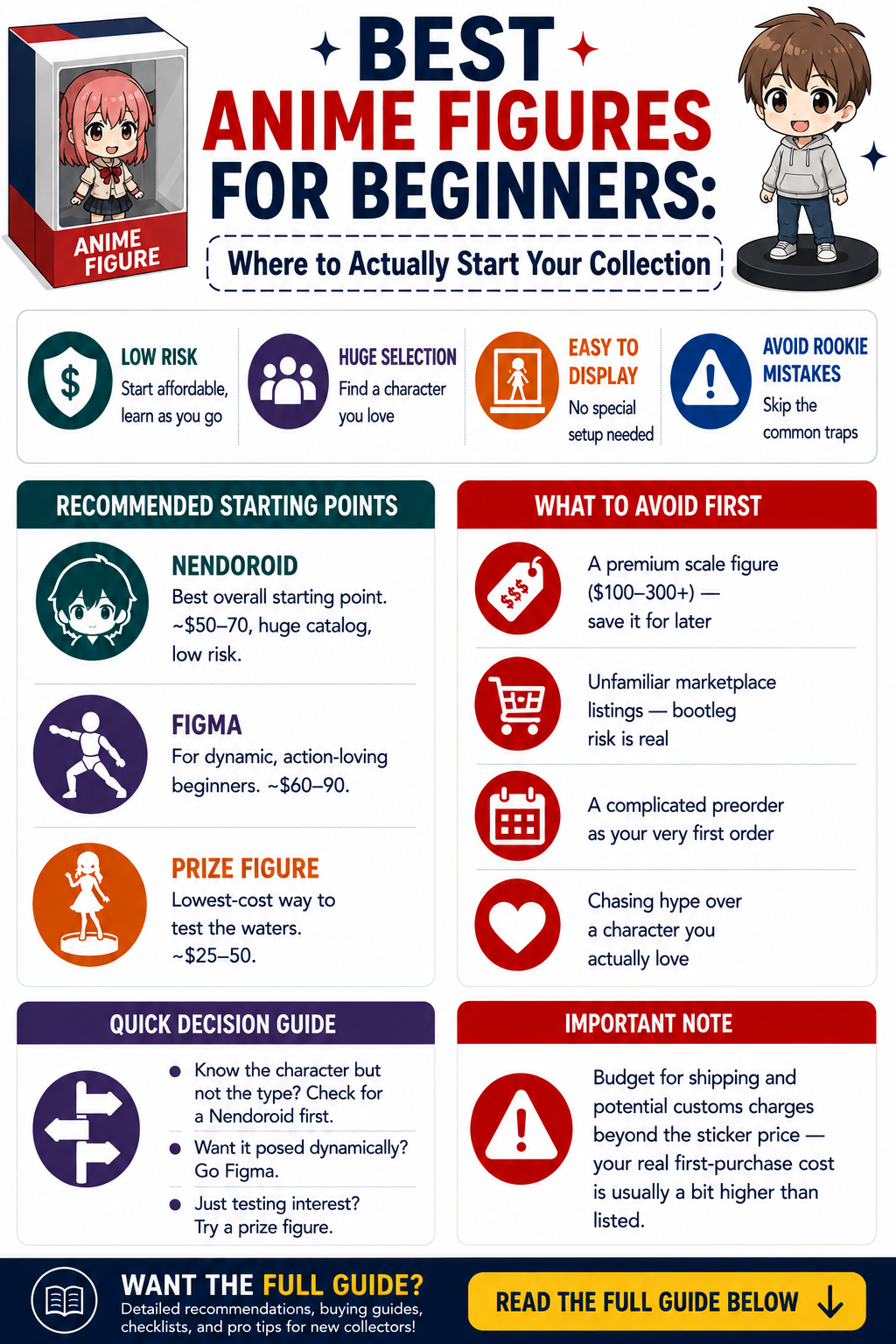
    Best Anime Figures for Beginners: Where to Actually Start Your Collection

    Affiliate Disclosure: This post contains affiliate links. If you buy through one of them, I may earn a small commission at no extra cost to you. I only recommend stores I’ve actually ordered from or researched thoroughly — my opinions are my own.

    The Problem: Too Many Options Makes It Hard to Just Start

    If you’ve decided you want to start collecting anime figures, the sheer number of options can be genuinely paralyzing — Nendoroid or Figma or scale figure, which manufacturer, which character, how much to spend, where to even buy it from. It’s a lot to figure out before you’ve even made your first purchase.

    In my experience, the collectors who get stuck the longest aren’t the ones who don’t know what they like — they’re the ones trying to make the “perfect” first decision instead of just making a reasonable one. This guide is meant to cut through that: a straightforward starting point based on what actually works well for a first purchase, without needing to have every preference figured out in advance.

    Who This Article Is NOT For

    • If you’ve already made your first purchase and are past this stage, this is more useful to share with someone else just getting started than for yourself at this point.
    • If you already know exactly what you want, there’s no need to overthink it with a “beginner framework” — go buy it.
    • If budget genuinely isn’t a factor for your first purchase, some of the cost-based reasoning here matters less — buy whatever excites you most.

    What Actually Makes a Good First Figure

    1. Low financial risk. Your first purchase is also your first chance to learn how a store’s shipping, packaging, and process actually works — you want that learning experience to come from something affordable, not your most expensive purchase.

    2. Broad appeal and availability. A figure type with a huge catalog gives you the best chance of finding a character you already love, rather than compromising on your first purchase.

    3. Manageable commitment. Something that doesn’t require special display considerations, extensive posing skill, or a big shelf investment right away.

    The Recommended Starting Point: Nendoroid

    If you only take one piece of advice from this article, it’s this: for almost every new collector, a Nendoroid is the right first purchase.

    • Price is low-risk. Generally in the $50–70 range, which means a purchase that doesn’t go perfectly (wrong character choice, wanting something different next time) doesn’t sting financially.
    • The catalog is enormous. If a character has merchandise at all, there’s a strong chance a Nendoroid exists for them, which means you’re very likely to find one of a character you already love rather than settling.
    • They’re genuinely fun, not just a “starter” compromise. Interchangeable face plates and small accessories make them engaging to own, not just a stepping stone to something else.
    • They’re forgiving to display. Small footprint, no special lighting or case requirements to get started, and durable enough for a first-time buyer still learning how to handle and store figures carefully.

    If You Want Something More Dynamic: Figma

    If you already know you’re drawn to action-heavy series and want your first figure posed dynamically rather than sitting still, Figma is a reasonable alternative starting point — slightly pricier than a Nendoroid (roughly $60–90), but still well within low-risk territory for a first purchase.

    If You Want to Test the Waters Before Spending Much at All

    Prize figures are a genuinely reasonable way to dip a toe in before committing to a full-price figure — officially licensed, generally in the $25–50 range, with the tradeoff of more variable quality between manufacturers and sub-lines. This is a fine way to see whether collecting appeals to you at all before spending more.

    What to Avoid for Your First Purchase

    • A premium scale figure, however tempting. The price (often $100–300+) and lack of forgiveness if you’re not sure about display space or long-term interest make this a riskier first move — save it for once you know you’re genuinely committed to the hobby.
    • Buying from an unfamiliar marketplace listing to save a few dollars. Your first purchase is the worst time to accidentally receive a bootleg — stick with a trusted retailer for your first order, even if it costs slightly more.
    • A complicated preorder as your very first order. Preorders involve payment timing quirks and release delays that are easier to navigate once you already understand how a store’s process works — an in-stock item is a gentler introduction. My first-time buyer’s guide covers both paths in detail once you’re ready.
    • Chasing hype over genuine interest. A popular figure you don’t actually care about tends to be a less satisfying first purchase than a less-hyped figure of a character you genuinely love.

    A Simple Decision Framework

    “I know exactly which character I want, but not which figure type.” Check whether a Nendoroid exists for that character first — it’s the lowest-risk way to start, and you can always add a Figma or scale figure of the same character later once you know you’re committed.

    “I’m not sure which character I even want yet.” Take some time browsing a trusted retailer’s Nendoroid catalog specifically — the format’s broad coverage makes it a good way to browse without narrowing yourself to one figure type’s limited selection first.

    “I want to spend as little as possible to see if I even like collecting.” Start with a prize figure rather than a full-price Nendoroid — lower stakes, though expect more variability in quality.

    “I already know I want something dynamic and posed.” Go with Figma over a static scale figure for your first purchase — you get the posability you’re after without the price and space commitment of a premium scale piece.

    Frequently Asked Questions

    Is a Nendoroid really the best choice for every beginner? It’s the best choice for most beginners specifically because of the combination of low price, huge catalog, and low display commitment — but if you already know you want something more dynamic or detailed, that’s a completely valid reason to start elsewhere.

    Should my first figure be a character I already love, or whatever looks good? A character you already love, if possible. First purchases you’re genuinely attached to tend to hold up better as a positive first experience than ones chosen purely because they were available or discounted.

    Is it a mistake to start with a scale figure if that’s genuinely what I want most? Not necessarily a mistake, but it does raise the stakes on your first purchase before you’ve learned how shipping, condition, and display actually work in practice. If you’re confident and prepared for that, it’s a personal choice rather than an objective error.

    How much should I expect to spend on my first figure, all in? Beyond the figure’s sticker price, factor in shipping and potential customs charges, which vary by country — budgeting for a total somewhat above the listed price avoids an unpleasant surprise at checkout or delivery.

    Final Thoughts

    The “right” first figure isn’t a single universal answer, but a Nendoroid of a character you genuinely love is the starting point that works well for the vast majority of new collectors — affordable enough that a less-than-perfect first choice doesn’t sting, broad enough in catalog that you’re likely to find exactly what you want, and forgiving enough to display without any special setup.

    Once you’ve made that first purchase and have a feel for the process, my Nendoroid vs Figma vs Scale Figure guide and comparison of trusted retailers are the natural next steps for figuring out where your collection goes from here.

  • Anime Figure Customizing and Repainting: A Beginner’s Guide

    Anime Figure Customizing and Repainting: A Beginner’s Guide

    Affiliate Disclosure: This post contains affiliate links. If you buy through one of them, I may earn a small commission at no extra cost to you. I only recommend stores I’ve actually ordered from or researched thoroughly — my opinions are my own.

    The Problem: You Love a Figure, But You Wish One Small Thing Were Different

    Sometimes a figure is nearly perfect except for one detail — a paint job that doesn’t quite match the anime’s actual color palette, a hairstyle you’d love to see in a different color, or just an itch to make something in your collection genuinely one-of-a-kind. This is where customizing and repainting come in, and it’s a much more approachable hobby than it might look from the outside.

    In my experience, the biggest barrier for new customizers isn’t skill — it’s the fear of ruining something. This guide covers what customizing actually involves, what to practice on first, and how to approach it without risking a figure you’d actually be upset to lose.

    Who This Article Is NOT For

    • If you’re not interested in a hands-on hobby beyond collecting, that’s a completely valid preference — there’s no obligation to customize anything, and plenty of collectors are perfectly happy with figures exactly as they arrive.
    • If you haven’t read my garage kit guide yet and you’re interested in building from scratch rather than modifying an existing figure, that’s a related but distinct hobby worth reading about separately.
    • If your first instinct is to practice on an expensive or sentimentally important figure, please don’t — the advice below is specifically about avoiding that mistake.

    What “Customizing” Actually Covers

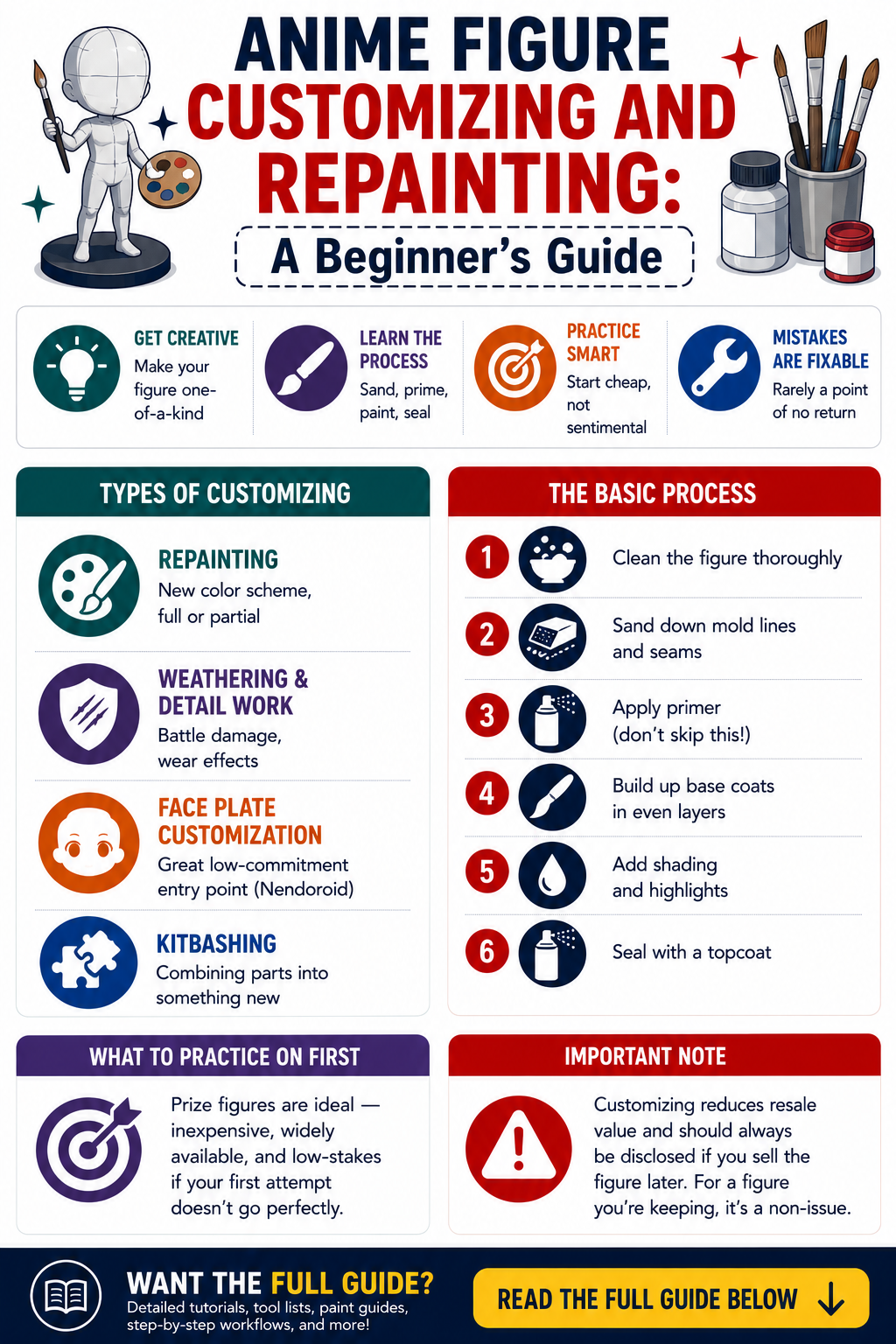
    Repainting means stripping some or all of a figure’s original paint and reapplying a new color scheme — sometimes to correct an inaccurate factory paint job, sometimes for a completely original look.

    Weathering and detail work adds effects like battle damage, dirt, or wear that the original sculpt and paint job didn’t include, without necessarily doing a full repaint.

    Face plate and part customization is common specifically with Nendoroid figures — customizing or hand-painting additional face plates, or modifying hair pieces, is a lower-commitment entry point than a full scale figure repaint.

    Kitbashing involves combining parts from multiple figures or kits into something new — less about improving a single figure and more about building something that doesn’t exist as an official release.

    Tools You’ll Actually Need

    • Fine-grit sandpaper or sanding sticks, for smoothing mold lines and rough spots before painting
    • Primer, to help paint adhere evenly to the figure’s surface — skipping this step is one of the most common reasons a repaint doesn’t hold up well
    • Acrylic paints, generally preferred for figure work over other paint types, along with a mixing palette for custom shades
    • A quality fine-tip brush (often labeled around size 0), since eyes and fine detail work demand more precision than a general-purpose brush
    • A sealant or topcoat, applied after painting to protect the finish
    • Good, consistent lighting, ideally a dedicated lamp — detail work is much harder to judge accurately under poor lighting
    • Mild detergent and water, for washing the figure before you start, to remove manufacturing residue and oils that can interfere with paint adhesion

    The General Process (Overview, Not a Full Tutorial)

    1. Clean the figure thoroughly with mild detergent and water, then let it dry completely
    2. Sand down any visible mold lines or rough seams left over from manufacturing
    3. Apply primer to create a surface the paint will actually hold onto
    4. Apply base coats, building up color in even layers rather than one thick coat
    5. Add shading and highlights to bring depth and dimension to the finished look
    6. Seal the finished paint job with a topcoat to protect it from handling and display wear

    This is a genuine skill that improves with repetition — don’t expect your first attempt to look like the polished examples you’ll see from experienced customizers online.

    What to Practice On First

    This is the single most important piece of advice in this entire guide: don’t practice on a figure you’d be upset to lose.

    Prize figures are genuinely ideal practice material — they’re inexpensive, widely available, and losing one to a botched first attempt costs you very little. Once you’re comfortable with the basic process on a low-stakes figure, you’ll have a much better sense of whether you want to attempt something you actually care more about.

    For Nendoroid-scale customization specifically, an extra or duplicate face plate is a lower-commitment way to practice fine detail work without touching the main figure at all.

    Common Beginner Mistakes (and Why They’re Rarely Fatal)

    • Skipping primer is one of the most common reasons a paint job doesn’t hold up — it’s tempting to skip since it doesn’t visually change much in the moment, but it matters more than it looks like it should.
    • Rushing the process when frustrated. If a session isn’t going well, stepping away and returning later tends to produce better results than pushing through frustration — the fatigue in the moment is usually the actual problem, not the figure itself.
    • Assuming a mistake ruins the figure permanently. Most paint issues are genuinely recoverable through sanding, re-priming, and repainting — very few mistakes at the beginner stage are actually unfixable.
    • Comparing your first attempt to experienced customizers’ finished work. Skill here builds through repetition, not talent you either have or don’t — a rough first attempt is a normal part of the process, not a sign you’re not cut out for it.

    A Note on Value and Authenticity

    Customizing or repainting a figure changes it permanently — it’s worth knowing this affects resale value, and a customized figure should always be clearly disclosed as such if you ever sell it later, since misrepresenting a customized piece as factory-original would be misleading to a buyer. This isn’t a reason to avoid customizing — it’s just a reason to be upfront about it, the same way you’d want a seller to be upfront with you.

    Frequently Asked Questions

    Is repainting figures hard to learn? The fundamentals are genuinely learnable by a complete beginner, and visible improvement typically shows up within the first couple of attempts. The main requirement is patience with preparation steps (cleaning, sanding, priming) that don’t feel exciting but matter enormously for the final result.

    Will customizing a figure ruin its value? It will generally reduce resale value compared to an untouched factory figure, since collectors buying secondhand are often specifically looking for original condition. This matters most for figures you might sell later — for a figure you plan to keep and display, it’s a non-issue.

    What should my first customization project be? A cheap prize figure or a spare Nendoroid face plate — something inexpensive enough that a mistake doesn’t sting. Save any figure you’re genuinely attached to for after you’ve built some basic confidence and skill.

    Can I undo a repaint if I don’t like the result? Often yes, through careful paint removal, sanding, and re-priming, though the exact process depends on the paint type and how much the original surface was affected. It’s rarely a true point of no return, especially for a beginner-stage mistake.

    Final Thoughts

    Customizing and repainting turn figure collecting from something purely acquisitive into something genuinely creative — but it’s a skill worth building deliberately rather than diving in on something you’d hate to lose. Start with a cheap prize figure or a spare part, accept that your first attempt won’t match what experienced customizers post online, and treat mistakes as recoverable rather than catastrophic.

    If you enjoy this hands-on side of the hobby, it’s worth also reading my guide to garage kits — building and painting a kit from scratch is a natural next step once you’re comfortable customizing existing figures.

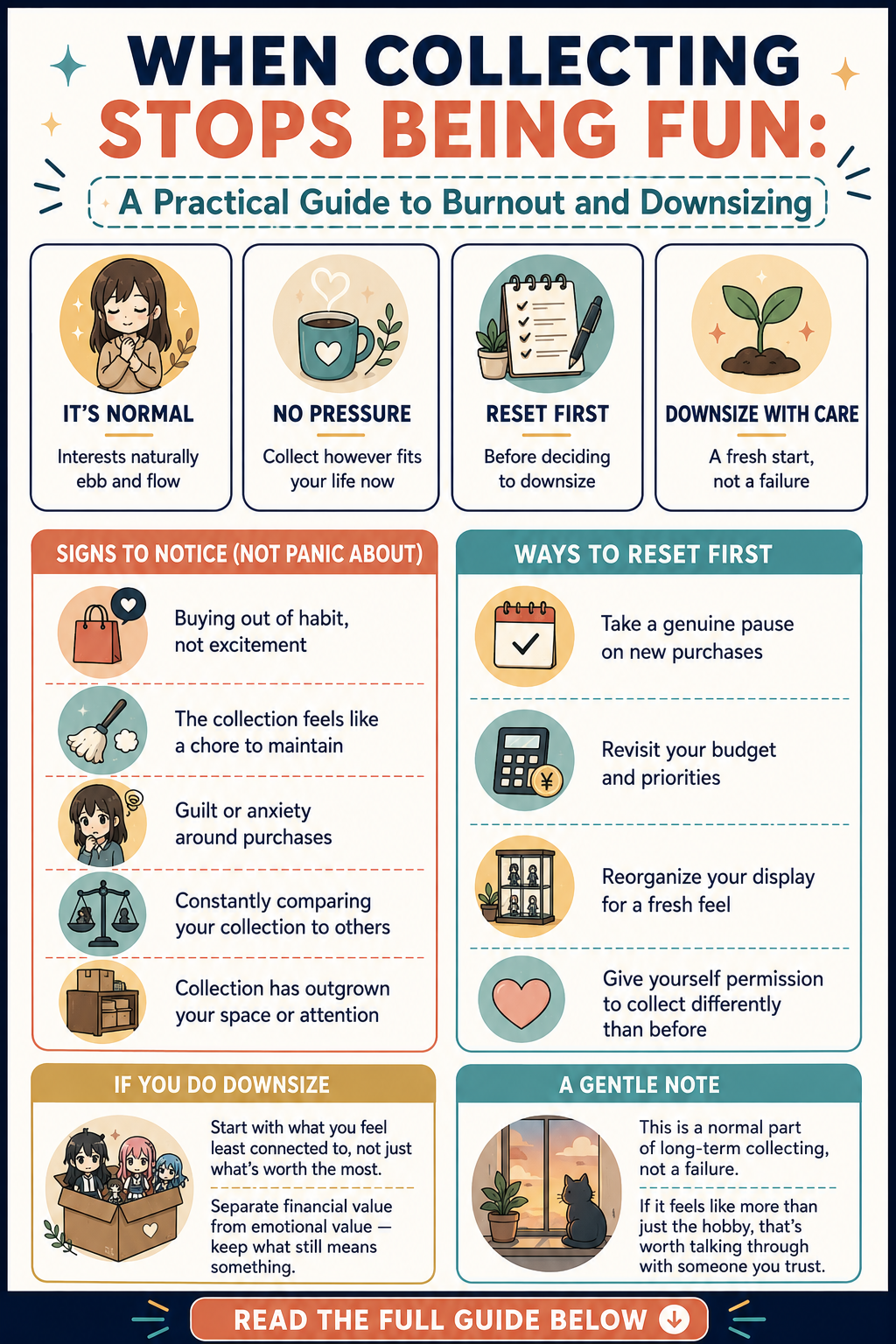
  • When Collecting Stops Being Fun: A Practical Guide to Burnout and Downsizing

    When Collecting Stops Being Fun: A Practical Guide to Burnout and Downsizing

    Affiliate Disclosure: This post contains affiliate links. If you buy through one of them, I may earn a small commission at no extra cost to you. I only recommend stores I’ve actually ordered from or researched thoroughly — my opinions are my own.

    The Problem: A Hobby You Loved Starts Feeling Like an Obligation

    Every collector eventually hits some version of this: a preorder shows up and instead of excitement, you feel something closer to obligation. A shelf that used to bring you joy starts to feel like clutter you have to manage. You keep buying because it’s what you do, not because you’re actually excited anymore.

    In my experience, this is a genuinely normal part of long-term collecting, not a sign that something’s wrong with you or that you need to quit entirely. Hobbies ebb and flow, interests shift, and a collection built up over years doesn’t always keep pace with who you are now. This guide is about recognizing that shift honestly and figuring out what to actually do about it — whether that’s a small reset, a partial downsize, or just permission to slow down for a while.

    Who This Article Is NOT For

    • If you’re just going through a temporarily quiet period and still genuinely enjoy your collection, that’s not burnout — that’s just a normal ebb in any hobby. No need to overhaul anything.
    • If you’re dealing with something that feels bigger than “my hobby isn’t fun right now” — a broader pattern affecting how you feel day to day — that’s worth talking through with a professional or someone you trust, not something a blog post about figure collecting can meaningfully address.
    • If you’re just looking for practical selling logistics, skip ahead to my guide to selling figures safely instead.

    Recognizing the Signs (Without Overreacting to Normal Ups and Downs)

    A few patterns worth paying attention to, without treating any single one as a crisis:

    • Buying out of habit rather than genuine excitement — preordering something mostly because you always preorder from that series, not because you’re actually looking forward to it
    • The collection feeling like a chore to maintain — dusting, organizing, or even just looking at your shelf starts to feel like a task rather than something you enjoy
    • Guilt or anxiety around purchases, rather than the anticipation that used to come with them
    • Comparing your collection to others’ constantly, in a way that makes your own feel inadequate rather than something to enjoy on its own terms
    • A growing gap between the size of your collection and the space or attention you can actually give it

    None of these individually mean you need to make a big change — they’re worth noticing as a pattern over time, not reacting to after one slow month.

    Why This Happens

    Interests genuinely shift. The characters, shows, and figure styles that excited you five years ago might not reflect who you are now — that’s not a failure of commitment, it’s just normal change.

    Completionism can quietly become pressure. If you’ve built a habit of “collecting everything from a series,” that habit can outlast the actual enjoyment, turning into an obligation rather than a choice.

    Social comparison changes how a hobby feels. Constantly seeing other collectors’ hauls and displays can shift collecting from something personal into something performative, which tends to drain the actual enjoyment out of it over time.

    A collection can simply outgrow your actual life. Space, budget, and time are all finite, and a collection that made sense at one size can start to feel unmanageable as it grows past what you can realistically maintain or enjoy.

    Practical Ways to Reset Without Necessarily Downsizing

    • Take a genuine pause on new purchases, even a short one, without treating it as “quitting.” A month or two without buying anything can clarify whether you actually miss it or were just on autopilot.
    • Revisit your collecting budget and priorities. Sometimes burnout is really about spending on things you don’t care about that much, rather than the hobby itself — tightening your priorities can restore some of the excitement.
    • Reorganize your display. Sometimes a stale-feeling collection just needs a genuinely fresh arrangement — my display and shelf setup guide has practical ideas if it’s been a while since you’ve changed anything.
    • Give yourself explicit permission to collect less, or differently, than you used to. Nothing says a hobby has to stay the same shape forever — moving from “everything from this series” to “only the pieces I genuinely love” is a completely valid shift, not a lesser way to collect.

    When Downsizing Makes Sense

    If a genuine reset doesn’t bring the enjoyment back, or if your collection has simply outgrown your space or budget in a way that’s causing real stress, downsizing is a completely reasonable next step — not a failure or an admission that you wasted money.

    • Start with what you feel least connected to, not necessarily what’s worth the most. A figure you barely look at is a better candidate for selling than a lower-value piece you still genuinely love.
    • Separate “financial value” from “emotional value” honestly. It’s okay to keep a lower-value figure because it still means something to you, and sell a higher-value one that doesn’t — the goal is a collection that fits your current life, not maximizing resale value.
    • Sell in batches rather than all at once, if the idea of downsizing feels overwhelming. You don’t need to decide on your entire collection’s fate in one sitting.
    • When you’re ready, my guide to selling figures safely covers pricing, platforms, and avoiding scams so the practical side doesn’t add extra stress to what’s already a bit of an emotional process.

    Frequently Asked Questions

    Does feeling burned out on collecting mean I should quit entirely? Not necessarily — for a lot of collectors, it’s a signal to pause, reset priorities, or downsize rather than a sign the hobby itself was a mistake. Interests naturally ebb and flow over years of collecting.

    Is it normal to feel guilty about downsizing a collection I spent a lot on? Yes, this is a common feeling, but it’s worth separating the money already spent from the decision in front of you now — a figure sitting unused isn’t giving you anything back just because you paid for it, and selling it doesn’t erase the enjoyment you got from it originally.

    How do I know if I’m burned out versus just going through a quiet period? A quiet period usually resolves on its own with time; burnout tends to persist as a pattern — buying out of habit rather than excitement, or the collection feeling like a chore — over a longer stretch. If you’re not sure, a genuine pause on new purchases is a low-risk way to find out.

    Should I sell figures I still love just because I haven’t looked at them recently? Not necessarily — “haven’t looked at it recently” and “don’t care about it anymore” aren’t the same thing. This is where separating emotional and financial value matters; keep what genuinely still means something to you, regardless of how often you’ve displayed it lately.

    Final Thoughts

    Collecting is supposed to bring you something — enjoyment, connection to characters and shows you love, a creative outlet, whatever it is for you personally. When it stops doing that, it’s worth taking seriously without treating it as a crisis. Sometimes the fix is a short break, a tighter budget, or a fresh shelf arrangement. Sometimes it’s genuinely time to let some of the collection go. Either way, there’s no obligation to keep collecting exactly the way you always have if it’s not serving you the way it used to.

    If you do decide it’s time to downsize, my guide to selling figures safely is the practical next step — and if you’re staying in the hobby but want to reset how you approach it going forward, my budgeting guide is a good place to rebuild from.

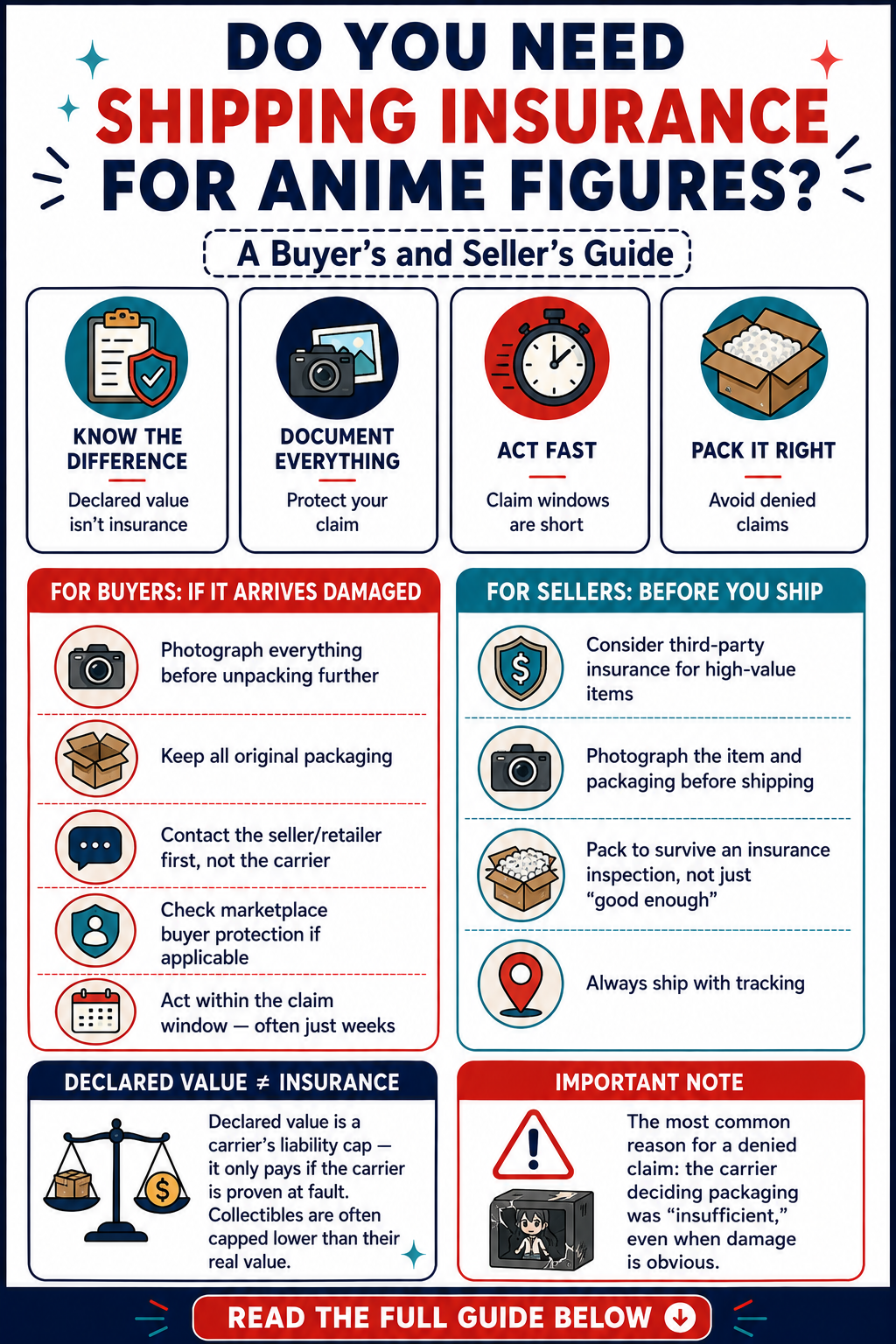
  • Do You Need Shipping Insurance for Anime Figures? A Buyer’s and Seller’s Guide

    Do You Need Shipping Insurance for Anime Figures? A Buyer’s and Seller’s Guide

    Affiliate Disclosure: This post contains affiliate links. If you buy through one of them, I may earn a small commission at no extra cost to you. I only recommend stores I’ve actually ordered from or researched thoroughly — my opinions are my own.

    The Problem: “Declared Value” Sounds Like Insurance, But It Usually Isn’t

    Here’s a distinction that catches a lot of people off guard, whether you’re receiving a figure or shipping one out: what carriers call “declared value” and what you’d normally think of as “insurance” are often two genuinely different things. Major carriers are explicit about this in their own terms — declared value is a cap on their liability if they’re proven at fault, not a guarantee that you’ll be compensated if something goes wrong.

    In my experience, this distinction matters most in the exact moment you don’t want to be learning it: after a figure has already arrived damaged, or after you’ve shipped one out and the buyer is asking where their compensation is. This guide covers what actual protection exists, from both sides of the transaction.

    Who This Article Is NOT For

    • If you’re buying exclusively from retailers with strong buyer protection policies and haven’t had a damage issue, this is more of a “know before it happens” reference than an urgent read.
    • If you’re not currently selling figures, the seller-side section won’t apply to you directly — check my guide to selling figures safely if that changes.
    • If you’re looking for packaging advice specifically, that’s covered in more depth in my selling guide — this article focuses on what happens after something goes wrong, not how to prevent it.

    The Key Distinction: Declared Value vs. Real Insurance

    Declared value is a carrier’s maximum liability for a shipment, and it only pays out if the carrier is proven to be at fault for the damage or loss. Major carriers state this directly — it is explicitly not insurance, and coverage is often capped at a low amount specifically for collectibles, regardless of how much you declare.

    True shipping insurance is a separate product, sometimes purchased through the carrier’s affiliated insurance option, sometimes through a third-party insurer, and it generally offers broader, more reliable coverage than declared value alone — particularly for items in categories carriers commonly exclude or cap.

    Why this matters for figures specifically: collectibles are frequently singled out in carrier terms with reduced maximum declared values compared to general merchandise, precisely because they’re harder to independently verify the value of. A $300 scale figure shipped with a high declared value doesn’t necessarily mean you’re covered for the full $300 if something goes wrong.

    For Buyers: What Protection Actually Exists

    1. Check your retailer’s own policy first, before relying on carrier-level protection. Established retailers often have their own procedures for damaged-in-transit items, separate from whatever the shipping carrier itself offers — this is frequently your fastest and most reliable path to a resolution.

    2. Photograph everything immediately upon arrival, before you’ve even fully unpacked the figure — the outer box, the inner packaging, and the damage itself. Carriers and retailers alike often require this documentation, and some will deny claims if the outer box shows no visible damage, even if the contents were harmed by rough handling during transit.

    3. Keep all original packaging until the issue is resolved. Claims processes frequently require the ability to inspect the original box and packing materials — discarding them early can complicate or invalidate a claim.

    4. Act quickly. Claim windows are often surprisingly short — sometimes just a few weeks from delivery — so don’t sit on a damaged shipment assuming you have unlimited time to report it.

    5. Understand that “insufficient packaging” is a common denial reason. This is frustrating when you weren’t the one who packed it, but it’s worth knowing that a claim can be denied if the carrier determines the item wasn’t adequately protected for transit — this is generally an argument between the shipper and the carrier, so a paper trail with your retailer matters more than a fight with the carrier directly.

    For Sellers: Protecting Yourself When Shipping Out

    If you’re selling figures, the insurance conversation flips — you’re the one deciding whether to add it and how to handle a dispute if the buyer claims damage.

    • Consider third-party insurance for higher-value items, rather than relying solely on a carrier’s declared value option, given how often collectibles are capped or excluded from full carrier liability.
    • Photograph the item and packaging before you ship it. This protects you if a buyer later disputes the condition it arrived in — having your own “before” documentation is genuinely valuable if a dispute happens.
    • Pack to a standard that would survive an insurance inspection, not just “good enough.” Since claims can be denied over inadequate packaging, packing well protects both your buyer’s item and your own ability to file a successful claim if the carrier damages it.
    • Always ship with tracking, regardless of item value — this is your primary protection against claims that an item never arrived at all, which is a separate issue from physical damage but comes up just as often.

    What to Do If a Figure Arrives Damaged

    1. Don’t discard any packaging until the situation is resolved
    2. Photograph the damage, the inner packaging, and the outer box from multiple angles before doing anything else
    3. Contact the seller or retailer first, rather than going straight to a carrier claim — many retailers have their own resolution process that’s faster than a formal carrier claim
    4. If buying from a marketplace, most major platforms have buyer protection policies for items that arrive significantly damaged or not as described — this is often a more realistic path than pursuing the shipping carrier directly, since you as the buyer typically weren’t the one with a carrier account to file through in the first place
    5. Escalate to a carrier claim only if the retailer or platform can’t resolve it, and expect to provide the documentation described above

    Frequently Asked Questions

    Is “declared value” the same thing as insurance? No — carriers are explicit that declared value is a liability cap that only pays out if they’re proven at fault, not a guarantee of compensation. True insurance, whether through the carrier or a third party, generally offers broader protection.

    Why would a damage claim get denied even with obvious damage? The most common reason is a carrier determining the packaging was inadequate for transit, or the outer box showing no visible external damage despite internal contents being harmed — both are frustrating but genuinely common reasons for denial.

    Should I buy extra insurance on an expensive scale figure? It’s worth considering, particularly since collectibles are often capped at a reduced declared value by major carriers regardless of the item’s actual worth. For a high-value piece, third-party insurance can offer more realistic protection than relying on carrier declared value alone.

    What should I do first if my figure arrives broken? Photograph everything before unpacking further, keep all packaging, and contact the seller or retailer directly rather than assuming you need to deal with the shipping carrier yourself — this is usually the faster and more reliable path to a resolution.

    Final Thoughts

    The uncomfortable reality is that “declared value” and genuine insurance protection aren’t the same thing, and collectibles specifically tend to get less favorable treatment from major carriers than general merchandise. Whether you’re buying or selling, the practical defense is the same: document everything, keep your packaging, act quickly, and go through your retailer or marketplace’s own resolution process before assuming a carrier claim is your only option.

    If you’re building your overall buying confidence, it’s worth pairing this with my breakdown of shipping and customs costs and comparison of trusted retailers — buying from a retailer with a solid track record on damaged shipments is worth more in practice than any amount of after-the-fact insurance paperwork.

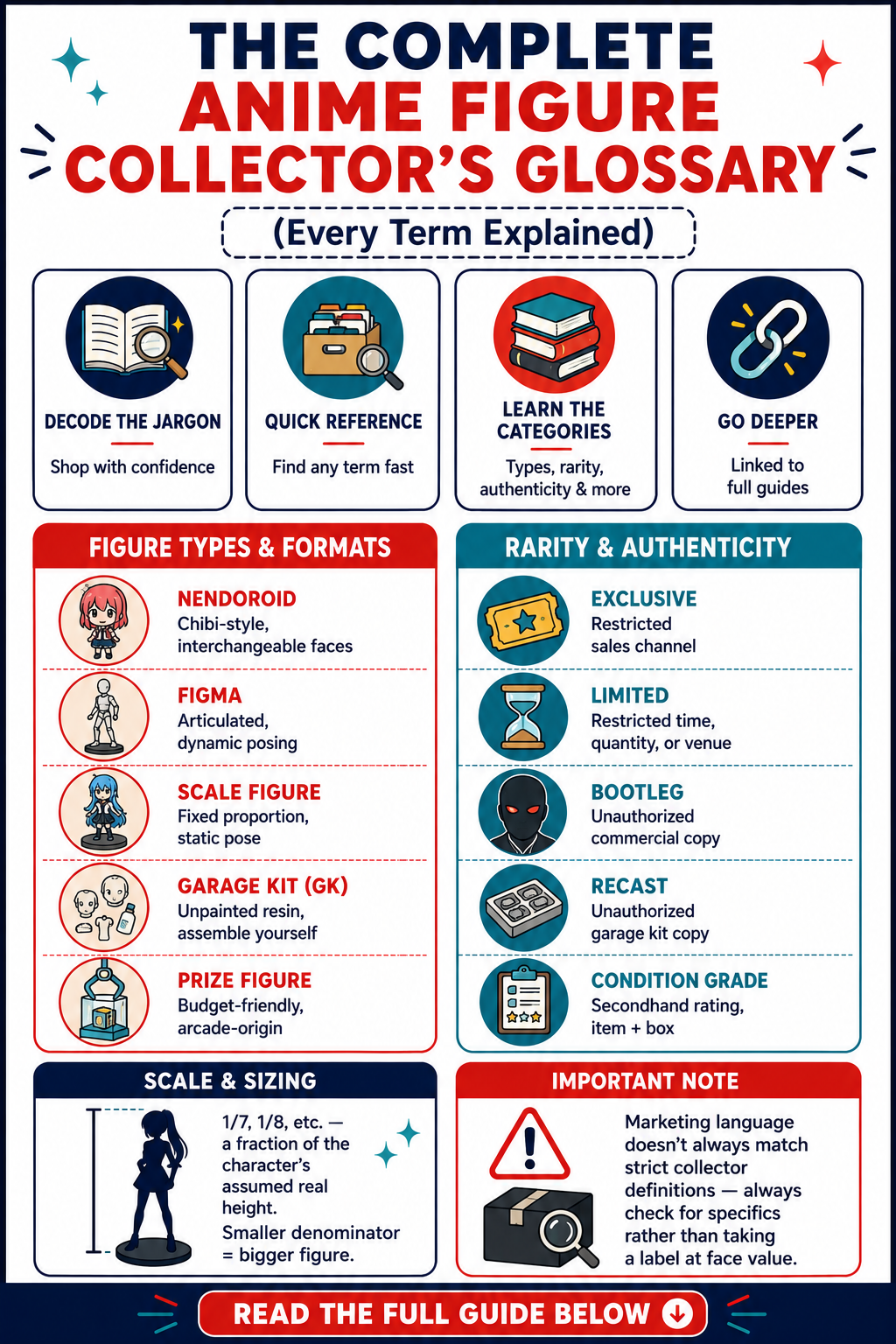
  • The Complete Anime Figure Collector’s Glossary (Every Term Explained)

    The Complete Anime Figure Collector’s Glossary (Every Term Explained)

    Affiliate Disclosure: This post contains affiliate links. If you buy through one of them, I may earn a small commission at no extra cost to you. I only recommend stores I’ve actually ordered from or researched thoroughly — my opinions are my own.

    The Problem: Every Listing Assumes You Already Know the Jargon

    If you’re new to collecting, figure listings can read like a different language — “1/7 PVC scale figure, exclusive, limited, preorder, GK, recast warning” — and most sites assume you already know what all of that means. In my experience, this jargon barrier is one of the quieter reasons new collectors hesitate to buy their first figure: not because they don’t want one, but because they’re not entirely sure what they’re actually looking at.

    This glossary exists to fix that. Every term below is one you’ll genuinely run into while shopping, organized by category so you can find what you need quickly — and linked to a full guide wherever I’ve covered a topic in more depth elsewhere on the site.

    Who This Article Is NOT For

    • If you’ve been collecting for years, you probably know most of this already — feel free to use it as a quick reference rather than reading start to finish.
    • If you’re looking for buying advice rather than definitions, start with my comparison of trusted retailers or first-time buyer’s guide instead.

    Figure Types and Formats

    TermWhat It Means
    NendoroidGood Smile Company’s chibi-style figure line — big head, small body, interchangeable face plates. The most affordable common format. Full breakdown
    FigmaMax Factory’s articulated, realistically proportioned figure line, built for dynamic posing. Full breakdown
    Scale FigureA figure sculpted at a fixed proportion of the character’s assumed real-life height (e.g., 1/7), static pose, no articulation. Full breakdown
    POP UP PARADEGood Smile Company’s simplified, more affordable scale-style line — less detail than a full scale figure, priced accordingly
    S.H.FiguartsBandai Spirits’ highly articulated action-figure-style line, known for strong posability
    Garage Kit (GK)An unpainted, unassembled resin kit, typically made independently and requiring assembly and painting by the buyer. Full guide
    Prize FigureA budget-friendly, officially licensed figure originally distributed through arcade crane games, from brands like Banpresto, SEGA, and Taito. Full guide
    Ichiban KujiBandai’s lottery-ticket figure system, with tiered prizes (A through E, plus a “Last One” prize). Full guide
    Non-ScaleA figure line (like Nendoroid or Figma) that doesn’t follow strict proportional scale to the character’s real height, prioritizing consistent display size instead

    Materials and Construction

    TermWhat It Means
    PVCPolyvinyl chloride — the standard plastic used for most pre-painted commercial figures
    ABSA more rigid plastic often used for jointed or load-bearing parts, sometimes combined with PVC in the same figure
    ResinThe material used for garage kits — typically polyurethane resin, allowing for finer sculpted detail than mass-production plastics
    ArticulationA figure’s range of joint movement and posability, most relevant to Figma and S.H.Figuarts-style lines
    Seam LineA visible line where two mold halves meet during manufacturing — more common on budget-tier figures like prize figures

    Scale and Sizing

    TermWhat It Means
    Scale Ratio (1/7, 1/8, etc.)A fraction describing how much a figure is shrunk down from the character’s assumed real-life height — smaller denominator means a bigger figure. Full guide
    1/1 Scale / Life-SizeA figure or bust produced at actual real-world size — rare and typically very expensive
    BustA figure depicting only the head, shoulders, and upper torso, rather than a full-body sculpt

    Availability and Rarity

    TermWhat It Means
    MSRPManufacturer’s suggested retail price — the baseline price before any store discount or markup
    PreorderOrdering a figure before it’s been produced or shipped, based on an estimated future release date. Full guide on tracking these
    ExclusiveSold only through a specific store, bundle, or mail-order channel — doesn’t necessarily mean a capped total quantity
    LimitedRestricted by time, quantity, or venue — the exact meaning varies significantly, so it’s worth checking which kind of “limited” applies. Full breakdown
    Small Lot / Large LotInformal terms describing whether a production run was genuinely small (verifiably scarce) or larger than the “limited” label might suggest
    CancelledProduction was stopped, either before release or after a partial run — sometimes genuinely rare, sometimes reflecting low original demand
    RestockA store receiving additional inventory of a previously sold-out item
    Reissue / RereleaseA manufacturer producing a figure again after its original run, sometimes as a color variant of the same sculpt

    Authenticity and Condition

    TermWhat It Means
    BootlegAn unauthorized, unlicensed copy of a commercial figure, sold to deceive buyers into thinking it’s genuine. Full guide
    RecastWithin the garage kit hobby specifically, an unauthorized copy of an independent sculptor’s original kit — a related but distinct issue from commercial bootlegging. Full explanation
    Authentication Sticker / Hologram SealA manufacturer’s holographic or metallic seal on packaging, used to help verify authenticity — a missing or non-holographic seal is a red flag
    Condition GradeA rating (numeric or letter-based) describing a secondhand figure’s physical condition, often scored separately for the item and the box. Full guide
    MIB (Mint in Box)A figure that remains unopened and in original packaging, in as-new condition

    Manufacturers and Production Culture

    TermWhat It Means
    Good Smile Company (GSC)Major manufacturer behind Nendoroid, POP UP PARADE, and a broad scale figure catalog. Manufacturer comparison
    Max FactoryThe manufacturer behind the Figma line specifically, closely associated with Good Smile Company
    AlterA manufacturer known for premium, highly detailed scale figures at a higher price tier
    KotobukiyaA manufacturer known for dynamic-pose scale figures (ARTFX/ARTFX J lines) and plastic model kits
    CircleThe hobbyist term for a small, independent group of creators producing garage kits, often under a shared name
    Wonder Festival (Wonfes)A convention held in Japan roughly twice a year, where independent sculptors and circles sell original garage kits directly to attendees

    Shopping and Logistics

    TermWhat It Means
    De MinimisThe value threshold below which imported goods aren’t subject to duty or tax — varies significantly by country and can change with trade policy. Full country-by-country breakdown
    Consolidation / Private WarehouseA service that holds multiple orders and ships them together in one package to reduce total shipping cost
    Proxy Shopping ServiceA third-party service that purchases items from Japan-only stores or listings on your behalf and forwards them internationally
    EMSA common express international shipping method from Japan, generally faster and pricier than economy alternatives

    VTuber-Specific Terms

    TermWhat It Means
    VTuberA virtual, animated on-screen persona used by a streamer or performer for content, backed by an agency that produces official merchandise
    hololive productionA major VTuber agency operated by Cover Corporation. VTuber figures guide
    NijisanjiA major VTuber agency operated by Anycolor. VTuber figures guide

    Frequently Asked Questions

    What’s the difference between “exclusive” and “limited”? “Exclusive” typically refers to a restricted sales channel (a specific store or bundle), while “limited” can mean either a restricted time window or an actual capped production quantity. They’re related concepts but not interchangeable.

    Is a recast the same thing as a bootleg? They’re closely related — both involve unauthorized copying — but “recast” is specifically used within the garage kit hobby to describe unauthorized copies of an independent creator’s original kit, while “bootleg” more broadly describes unauthorized copies of commercial, licensed figures.

    What does “non-scale” mean if Nendoroid and Figma still have a size? It means the figure’s size isn’t calculated as a strict proportion of the character’s real-life height the way scale figures are — a very tall character and a very short character end up roughly similar sizes in these lines, prioritizing a consistent display format over proportional accuracy.

    Why do some terms (like “limited”) get used so loosely? Marketing language doesn’t always match strict collector definitions — this is exactly why it’s worth checking for specifics (a stated production number, a defined ordering window) rather than taking a label at face value.

    Final Thoughts

    Jargon shouldn’t be the thing standing between you and your first figure. Bookmark this page as a reference, and whenever a listing uses a term you’re not sure about, it’s probably covered here — with a link to a full guide if you want to go deeper on any specific topic.

    If you’re ready to put this vocabulary to use, my comparison of trusted Japan-based retailers and first-time buyer’s guide are the natural next steps.

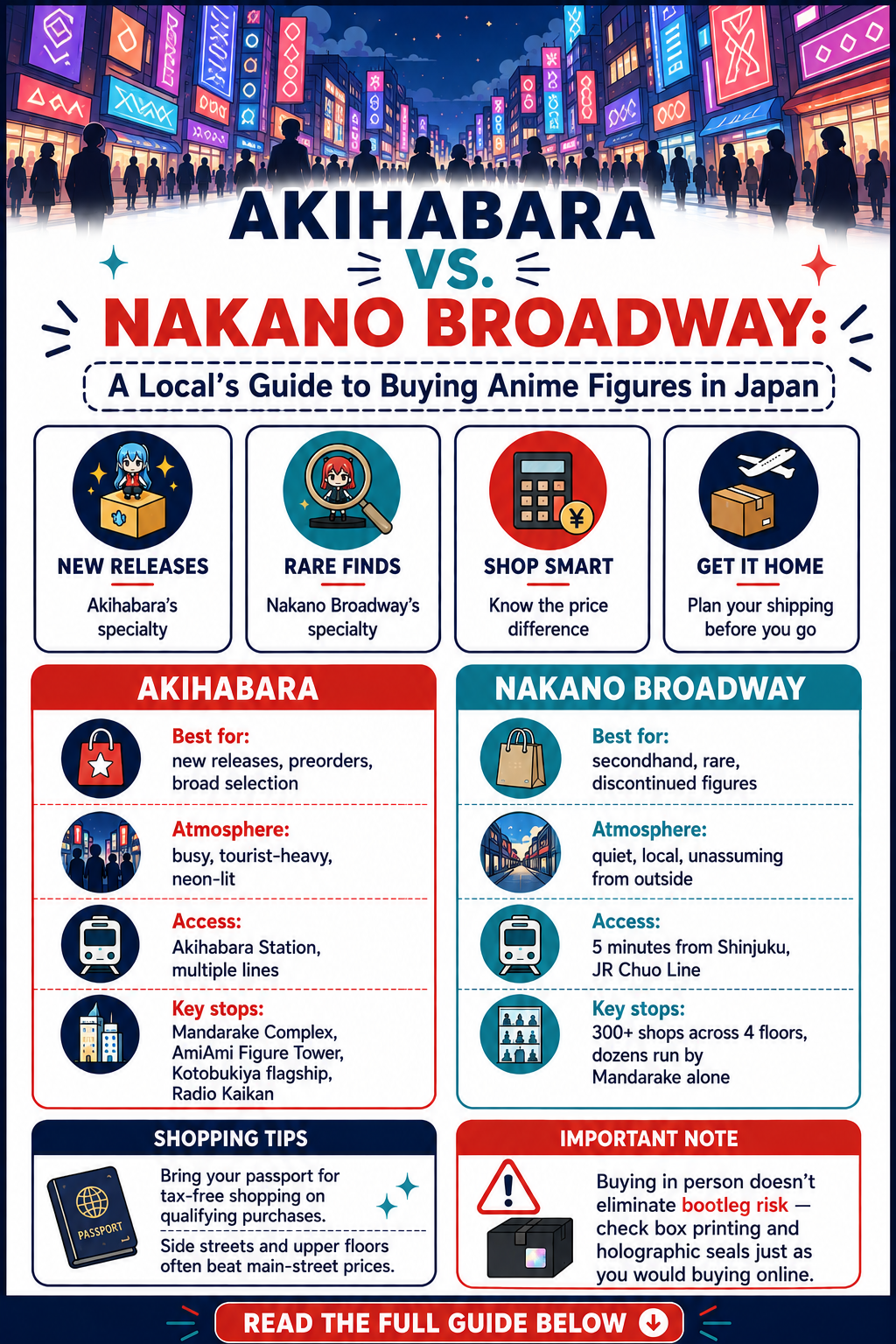
  • Akihabara vs. Nakano Broadway: A Local’s Guide to Buying Anime Figures in Japan

    Akihabara vs. Nakano Broadway: A Local’s Guide to Buying Anime Figures in Japan

    Affiliate Disclosure: This post contains affiliate links. If you buy through one of them, I may earn a small commission at no extra cost to you. I only recommend stores I’ve actually ordered from or researched thoroughly — my opinions are my own.

    The Problem: Everyone Says “Go to Akihabara,” But That’s Only Half the Story

    If you’re planning a trip to Japan and figure shopping is on your list, Akihabara is probably the only name you’ve heard so far — and it’s a completely legitimate recommendation. But after living in Japan for 24 years, I can tell you it’s not the only place worth your time, and depending on what you’re actually hunting for, it might not even be the best one.

    In my experience, most first-time visitors end up doing Akihabara exactly the way every travel blog describes, then leaving without ever hearing about Nakano Broadway — which, for serious collectors specifically, is often the better trip. This guide covers both, honestly, so you can plan around what you’re actually looking for rather than just following the crowd.

    Who This Article Is NOT For

    • If you’re not planning to visit Japan in person, this doesn’t apply to you directly — stick with my comparison of trusted online retailers instead.
    • If you want a full otaku-culture day out (arcades, maid cafes, gachapon) rather than focused figure shopping, Akihabara covers that broader experience much better than Nakano Broadway does — this guide focuses specifically on figure buying.
    • If you’re chasing only brand-new releases and don’t care about secondhand or rare finds, Akihabara’s newer-focused stores will serve you better than Nakano Broadway’s secondhand-heavy ecosystem.

    How These Two Districts Actually Differ

    1. New vs. secondhand emphasis. Akihabara leans toward new releases and current stock; Nakano Broadway leans heavily toward secondhand, rare, and out-of-production figures.

    2. Atmosphere and crowd level. Akihabara is loud, tourist-heavy, and can carry a bit of a markup because of it; Nakano Broadway is quieter, more locally-oriented, and often better value as a result.

    3. Store density and specialization. Akihabara has large individual stores with broad selection; Nakano Broadway has dozens of small, hyper-specialized shops under one roof.

    Quick Comparison: Akihabara vs. Nakano Broadway

    AkihabaraNakano Broadway
    Best forNew releases, preorders, broad selectionSecondhand, rare, discontinued figures
    AtmosphereBusy, tourist-heavy, neon-litQuiet, local, unassuming from outside
    AccessAkihabara Station, multiple lines5 minutes from Shinjuku on the JR Chuo Line
    PricingCan run higher on the main street, especially for tourist-facing shopsOften noticeably better value, particularly for secondhand
    Store structureFewer, larger stores300+ shops across four floors, dozens run by Mandarake alone

    Akihabara: Your Best Bet for New Releases and Broad Selection

    Akihabara is genuinely worth the trip, and it earns its reputation. A few stores worth prioritizing:

    • Mandarake Complex — an eight-floor building dedicated to secondhand figures, manga, and collectibles, organized by category per floor. Even though Mandarake is more associated with Nakano Broadway, this Akihabara location is a serious destination in its own right.
    • AmiAmi’s Akihabara figure tower — a multi-floor store from the well-known online retailer, stocked with new scale figures, prize figures, and preorders.
    • Kotobukiya’s flagship Akihabara store — their own scale figures, plastic model kits, and store-exclusive goods, all under one roof.
    • Akihabara Radio Kaikan — a landmark hobby building near the station with roughly ten floors of figure, model, and collectible shops.

    A practical tip: the main street draws heavy tourist traffic, and pricing on that strip can reflect it. Side streets and upper floors of the larger buildings tend to hold better value than the ground-floor, main-street storefronts.

    Nakano Broadway: The Serious Collector’s Trip

    Nakano Broadway doesn’t look like much from the outside — it reads as a fairly ordinary neighborhood shopping building. Inside, it’s genuinely one of the densest concentrations of rare anime and figure merchandise anywhere in Tokyo, and it’s where Mandarake itself was founded back in 1980.

    Mandarake alone operates dozens of individual specialty shops here, each focused on a specific category rather than one general store:

    • Mandarake Main Store — general manga, artbooks, and anime goods; a reasonable starting point if you’re not sure exactly what you’re hunting for
    • Mandarake Special — dedicated to figures and model kits, including a genuinely enormous selection of out-of-production pieces you won’t easily find anywhere else
    • Additional specialty shops covering doujinshi, vintage toys, cosplay items, and more, each run independently under the same umbrella

    If you’ve read my guide to buying secondhand figures, the condition grading concepts there apply directly here — Japanese secondhand shops are generally meticulous about condition assessment, and Nakano Broadway’s Mandarake locations are a great place to actually practice reading those grades in person before you buy.

    Practical Tips for Shopping in Person

    • Tax-free shopping is genuinely worth using. As a visiting tourist, you can generally get purchases exempted from Japan’s consumption tax on qualifying totals at participating stores — bring your passport, since it’s required for the tax-free process.
    • Check authenticity the same way you would buying online. My guide to spotting bootlegs still applies in person — look for crisp box printing, manufacturer holographic seals, and buy from reputable, established shops rather than unfamiliar sellers.
    • Plan for how you’ll get everything home. Figures are fragile and often bulky — decide before you go whether you’re checking a bag with extra padding, or looking into international shipping services from Japan for a larger haul, since carrying multiple scale figures home in a carry-on isn’t always realistic.
    • Budget more time for Nakano Broadway than you’d expect. The sheer number of small specialty shops means a thorough visit takes longer than the compact footprint suggests — don’t try to squeeze it into a rushed hour between other plans.
    • Compare in-person prices against what you’d pay importing. Figures are often somewhat cheaper bought directly in Japan than imported, since you’re skipping international shipping and, depending on your country, potential customs charges — worth keeping in mind if you’re deciding between buying now in person or preordering something for later delivery.

    Which Should You Visit? (By Priority)

    “I want new releases, preorders, and a big otaku-culture day out.” Akihabara. It’s the more complete experience if figure shopping is one part of a broader visit.

    “I’m hunting something discontinued or rare that I can’t find anywhere else.” Nakano Broadway, specifically Mandarake’s figure-focused shops. This is genuinely one of the best places in the world for exactly this kind of hunt.

    “I only have time for one district.” If your main goal is buying figures rather than the broader Akihabara experience, Nakano Broadway often delivers better value and a calmer shopping pace — but if you want the full sensory experience of Japan’s otaku culture (arcades, themed cafes, the neon and crowds), Akihabara is worth prioritizing instead.

    “I want both, but I’m short on time.” They’re genuinely doable in one trip if you plan for it — Nakano Broadway is about 25 minutes from Akihabara via Shinjuku, so a determined collector can realistically hit both in a single day with early planning.

    Frequently Asked Questions

    Is Nakano Broadway harder to get to than Akihabara? Not really — it’s about five minutes from Shinjuku Station on the JR Chuo Line, making it genuinely accessible from most parts of central Tokyo.

    Are prices actually better at Nakano Broadway? Generally yes, particularly for secondhand goods, since it draws a more local, less tourist-driven crowd than Akihabara’s main strip. New releases are priced similarly across both areas.

    Do I need to worry about bootlegs shopping in person the same way I would online? Yes — buying in person doesn’t eliminate authenticity risk, though established shops like Mandarake, AmiAmi, and Kotobukiya are reliable choices either way. The same checks that apply to online purchases are worth keeping in mind in person too.

    Can I ship my purchases home instead of carrying them? Many larger stores can arrange this, and dedicated shipping/forwarding services exist specifically for this purpose if you’ve bought more than you can reasonably carry. Worth asking about at the point of purchase if you’re planning a larger haul.

    Final Thoughts

    Akihabara earns its reputation, but it’s genuinely only half the picture for serious figure collectors visiting Japan. If your trip allows for it, seeing both districts gives you the best of new-release excitement and rare secondhand hunting — but if you have to choose, let what you’re actually looking for (new vs. rare, browsing vs. hunting) make the decision rather than just following whichever place gets mentioned first online.

    If a trip to Japan isn’t in your near future, the good news is you don’t need one to collect well — my comparison of trusted online retailers covers how to buy safely and confidently from anywhere in the US, UK, Australia, or Canada.

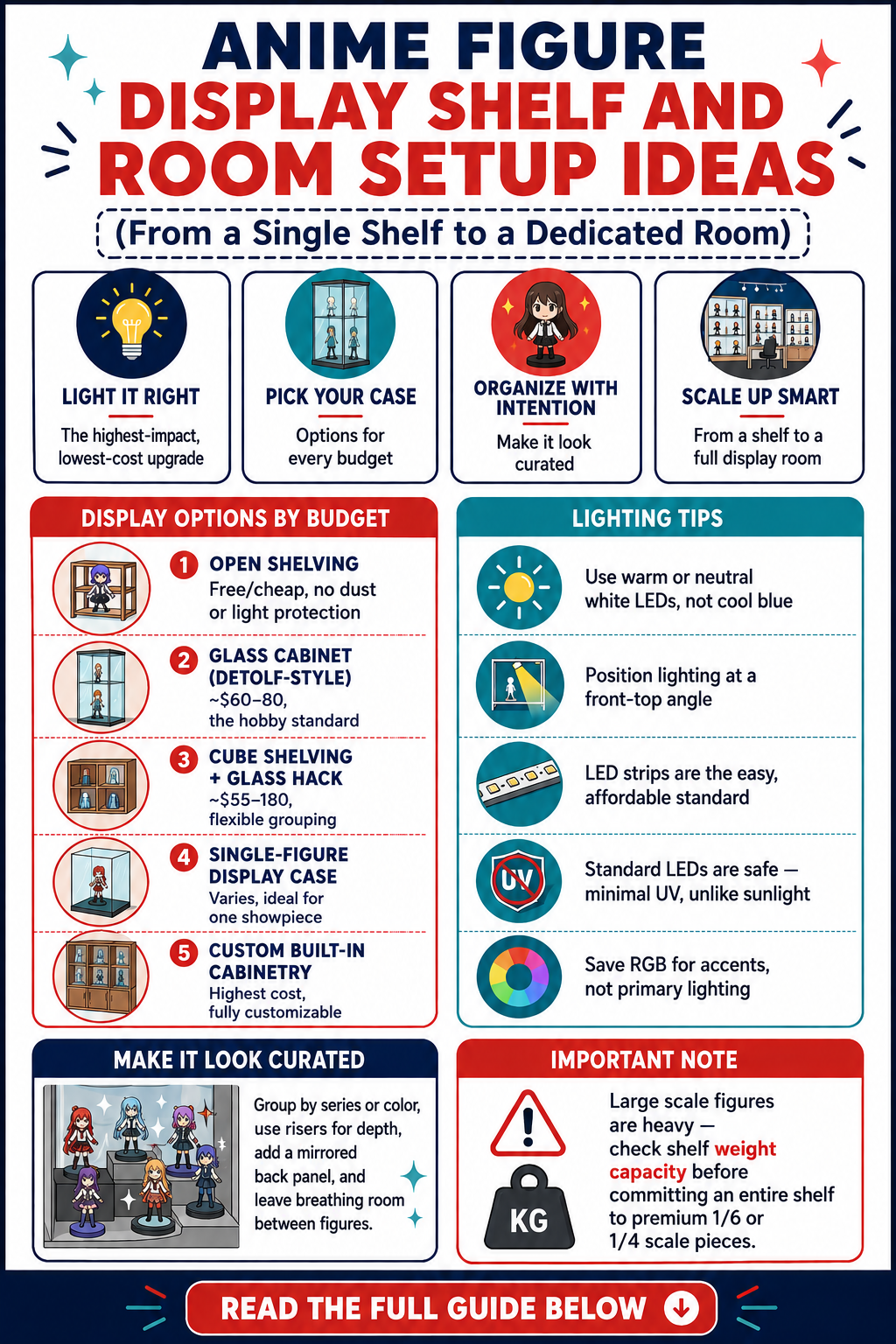
  • Anime Figure Display Shelf and Room Setup Ideas (From a Single Shelf to a Dedicated Room)

    Anime Figure Display Shelf and Room Setup Ideas (From a Single Shelf to a Dedicated Room)

    Affiliate Disclosure: This post contains affiliate links. If you buy through one of them, I may earn a small commission at no extra cost to you. I only recommend stores I’ve actually ordered from or researched thoroughly — my opinions are my own.

    The Problem: A Great Collection Can Still Look Underwhelming in a Bad Setup

    I’ve written before about protecting your figures from sunlight, dust, and humidity — but there’s a separate question that matters just as much for how much you actually enjoy your collection: does the setup actually look good? A genuinely impressive figure lineup can still feel underwhelming crammed onto a cluttered shelf with bad lighting, while a more modest collection can look like a dedicated exhibit with the right setup.

    In my experience, the gap between “figures on a shelf” and “a display that makes people stop and look” usually comes down to three things: the case or shelving itself, lighting, and a bit of intentional organization — none of which require a huge budget to get right.

    Who This Article Is NOT For

    • If you already have a display setup you’re happy with, this is more useful for someone actively planning or upgrading their setup.
    • If you haven’t read my storage and display care guide yet, read that first — it covers the preservation side (UV, dust, humidity) that should inform any setup you build.
    • If your collection is small enough that a single shelf handles it comfortably, most of this scales up for larger collections — feel free to take just the lighting section and leave the rest for later.

    What Actually Makes a Display Setup Look Good

    1. Consistent, flattering lighting. This single factor probably has the biggest visual impact for the least effort and cost.

    2. A case or shelving system that fits your budget and space, from fully open shelving to a dedicated glass cabinet.

    3. Intentional organization, rather than figures placed wherever there happened to be room.

    Display Options by Budget

    OptionApproximate CostProsCons
    Open shelving (bookshelf, floating shelves)Whatever shelving you already haveFree or cheap, easy to access and rearrangeNo dust or light protection on its own
    IKEA Detolf-style glass cabinetRoughly $60–80The most popular dedicated option in the hobby for good reason — glass panels, real dust protection, widely availableFixed shelf spacing; the door magnet on some versions isn’t very strong
    Cube/cubby shelving (e.g., Kallax-style) with a glass-front hackRoughly $55–180 depending on size and configurationFlexible grouping by cube, good for larger collections, popular DIY modification targetRequires more setup effort if you’re adding glass fronts yourself
    Dedicated single-figure display caseVaries, often sold specifically for premium figuresIdeal for a single showpiece scale figure; often comes with built-in lightingNot cost-effective for a large collection
    Built-in or custom cabinetryHighest cost, highly variableThe most polished, “museum” look; fully customizableRequires real budget and often professional installation

    For most collectors starting a dedicated display for the first time, a glass cabinet in the IKEA Detolf style is genuinely the standard recommendation across the hobby — it’s affordable, provides real dust protection, and looks clean without requiring any DIY skill.

    Lighting: The Highest-Impact Upgrade for the Lowest Cost

    If you upgrade only one thing, make it lighting. A well-lit display with basic figures consistently looks better than an unlit one with premium figures.

    • Use warm or neutral white LEDs, not cool blue. Cool-toned lighting tends to make skin tones and paint finishes look artificial and washed out; warm or neutral white (roughly in the 2700–4000K range) is generally considered the most flattering for figure display.
    • Position lighting at a front-top angle, angled slightly downward and inward. This avoids the harsh shadows that come from lighting figures straight-on or from directly above.
    • LED strip lighting is the standard, affordable solution. Adhesive LED strips along the interior top edge of a case or shelf are inexpensive, easy to install without any wiring experience, and dramatically improve how a collection looks.
    • Standard household LEDs are safe for long-term use. Unlike natural sunlight, quality LED lighting emits minimal UV and produces very little heat, which matters given how permanent UV damage is — this is genuinely one of the safer lighting choices for long-term figure display, as opposed to leaving a case near a window.
    • Avoid relying on RGB lighting as your primary light source. It looks flashy in photos but tends to render fine paint and sculpt detail less accurately than warm or neutral white — reserve colored lighting for accent effects rather than your main illumination.

    Organizing Your Collection So It Actually Looks Curated

    • Group by series, color palette, or figure line rather than placing figures in the order you acquired them — a shelf that flows logically reads as intentional, while a random arrangement reads as cluttered even with great individual pieces.
    • Use risers or small stands to add depth. Placing every figure at the same flat level makes even a great collection look one-dimensional; small clear acrylic risers (the kind sold for cupcake displays or spice racks work fine) let you stagger height and create visual layers.
    • Consider a mirrored back panel for glass cabinets. This is a common upgrade for Detolf-style cases specifically, and it makes a shelf look fuller and adds visibility to details on the back of figures you’d otherwise never see.
    • Leave some breathing room. Packing figures edge-to-edge undersells detail work on figures that deserve room to be seen individually — a slightly sparser, well-spaced shelf often looks more premium than a tightly packed one.
    • Mind weight capacity if you collect larger scale figures. Larger scale pieces can weigh considerably more than Nendoroids or Figma figures, and cheaper particle-board shelving can bow under sustained heavy loads over time — this is worth checking before committing an entire shelf to premium 1/6 or 1/4 scale pieces.

    Scaling Up: From a Shelf to a Room

    If your collection has genuinely outgrown a single case, a few practical approaches for scaling up:

    • Add cases incrementally rather than all at once. Multiple matching glass cabinets (several Detolf-style units side by side, for example) create a cohesive “wall of figures” look without needing a single large custom build.
    • Dedicate a specific wall or corner rather than spreading figures throughout a room. A concentrated display area reads as much more intentional than figures scattered across multiple pieces of furniture in different parts of a room.
    • Plan lighting at the room level, not just per case. Ambient room lighting affects how your case lighting reads — a dim room with well-lit cases tends to make the display pop more than a brightly lit room competing with your case lighting.
    • Think of the space progressively, like a small museum. As a collection grows, treating the display space as something to plan intentionally — sightlines, groupings, focal pieces — pays off more than continuing to add figures to whatever shelf has room left.

    Frequently Asked Questions

    Is the IKEA Detolf actually the best option, or just the most popular? It’s popular because it hits a genuinely strong balance of price, availability, and function — real glass panels, decent dust protection, and a size that works for most rooms. It’s not the only good option, but it’s a reliable, low-risk starting point if you’re not sure what to get.

    Does lighting actually make that much difference? Yes, more than most new collectors expect. The same figures under flat ambient room light versus a well-angled warm-white LED setup can look like a completely different display — it’s consistently the highest-impact, lowest-cost upgrade available.

    Will LED lighting damage my figures the way sunlight does? Standard household LED lighting is a safe long-term choice, since it produces minimal UV output compared to natural sunlight, which is where the real risk of yellowing and fading comes from. It’s a meaningfully safer choice than displaying figures anywhere near a window.

    How do I keep a large collection from looking cluttered? Grouping by series or color, using risers for visual depth, and leaving some breathing room between pieces all help a large collection read as curated rather than crowded — it’s more about organization than simply having more shelf space.

    Final Thoughts

    A great display setup doesn’t require a huge budget — it requires a bit of intention about lighting, a case that fits your space and collection size, and organization that lets individual figures actually stand out rather than competing for attention. Start with lighting if you do nothing else; it’s the single change most likely to make your existing collection look noticeably better.

    Once your display setup is sorted, it’s worth revisiting my guide to protecting figures long-term to make sure your new setup is working with your figures’ longevity, not against it — and if you’re still growing the collection itself, my comparison of trusted Japan-based retailers is the place to start for what goes on those new shelves.

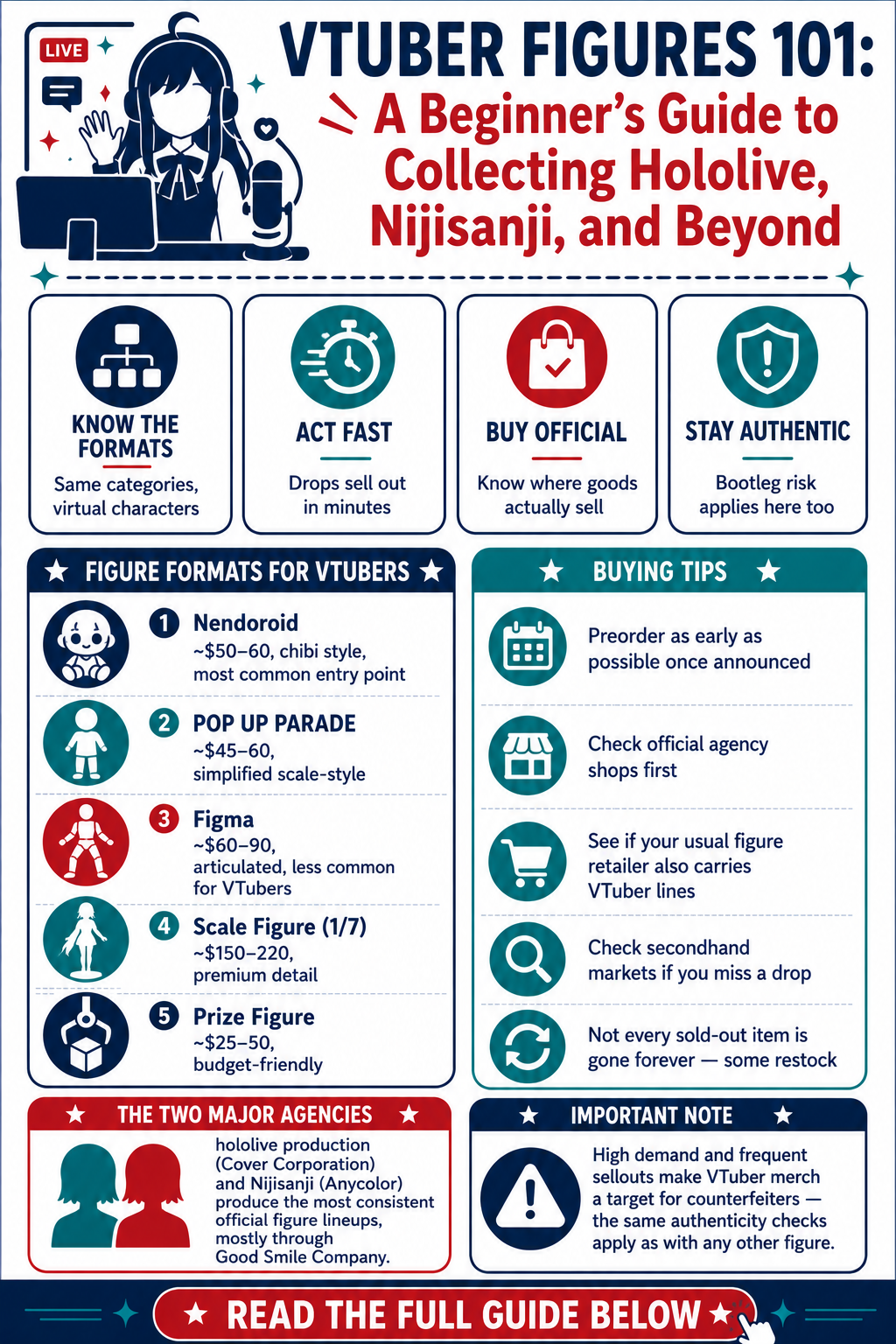
  • VTuber Figures 101: A Beginner’s Guide to Collecting Hololive, Nijisanji, and Beyond

    VTuber Figures 101: A Beginner’s Guide to Collecting Hololive, Nijisanji, and Beyond

    Affiliate Disclosure: This post contains affiliate links. If you buy through one of them, I may earn a small commission at no extra cost to you. I only recommend stores I’ve actually ordered from or researched thoroughly — my opinions are my own.

    The Problem: VTuber Merch Follows Different Rules Than Standard Anime Figures

    If you’ve made the jump from anime figures into VTuber collecting, you’ve probably noticed the buying process feels a bit different — drops that sell out in minutes, region-restricted official shops, and event-exclusive goods that only ever get sold at a single physical pop-up in Japan. None of this means VTuber figures are riskier or harder to collect well, but it does mean the playbook that works for standard anime figures needs a few adjustments.

    In my experience, most of the frustration collectors run into here comes from not knowing the category exists separately from general anime merch, rather than the buying process itself being genuinely difficult. This guide covers the basics: who the major players are, what figure types you’ll actually encounter, and how to buy without getting caught out by a sold-out drop.

    Who This Article Is NOT For

    • If you’re not familiar with VTubers at all, this guide assumes some basic familiarity with the concept — a VTuber is a virtual, animated on-screen persona used by a streamer/performer for content, backed by an agency that produces official merchandise for that persona.
    • If you already collect VTuber merch regularly, most of this will be familiar — feel free to skip to the “Dealing with Sold-Out Drops” section for the parts most likely to still be useful.
    • If you haven’t read my Nendoroid vs Figma vs Scale Figure guide yet, it’s worth reading first — VTuber figures use the exact same format categories, just applied to a different kind of character.

    The Two Major Agencies You’ll Run Into Most

    hololive production, operated by Cover Corporation, is one of the largest VTuber agencies, and its talents get consistent figure support across Nendoroid, Figma, POP UP PARADE, and scale figure lines, mostly through Good Smile Company.

    Nijisanji, operated by Anycolor, is the other major name you’ll encounter constantly, with its own steady stream of scale figures and merchandise, including collaborations with figure retailers running region-specific preorders.

    There are smaller and independent VTuber talents and agencies as well, though official figure support tends to concentrate most heavily around these two larger agencies simply due to scale and demand.

    Figure Categories for VTubers (Same Formats, Different Characters)

    VTuber figures use the same category system as standard anime figures — the format decision is the same, just applied to a virtual streamer persona instead of an anime character:

    FormatWhat to ExpectTypical Price
    NendoroidChibi-style, interchangeable face plates, the most common entry point~$50–60
    POP UP PARADEGood Smile Company’s mid-tier, simplified scale-style line — less detailed than a full scale figure but more affordable~$45–60
    FigmaArticulated, posable — less common for VTubers than Nendoroid, but does exist for some popular talents~$60–90
    Scale Figures (typically 1/7)Full detail, static pose, the premium option~$150–220
    Prize FiguresBudget-friendly, licensed but more variable quality — same category I’ve covered for general anime figures~$25–50

    If you’ve already read my guides on figure types and prize figures, you already understand the tradeoffs here — VTuber collecting doesn’t introduce new format logic, just a new category of character.

    Where Official VTuber Goods Actually Sell

    • Official agency shops (hololive’s official shop, for example) sell merchandise directly, though a meaningful portion of drops and campaigns are structured primarily for Japan-based buyers, which can limit direct access for overseas fans on certain items
    • General figure retailers increasingly carry VTuber figures alongside their standard anime catalog — it’s worth checking whether your preferred retailer stocks this category, since several mainstream import-friendly shops do carry Good Smile Company’s VTuber lines
    • Event-exclusive goods are sometimes only available at physical conventions or pop-up stores in Japan, similar in spirit to the convention-exclusive garage kits I’ve covered elsewhere — these are the hardest category to access without being in Japan in person

    Dealing With Sold-Out Drops

    This is genuinely the biggest adjustment coming from standard anime figure collecting — VTuber merch, especially limited or event-tied goods, can sell out dramatically faster than a typical figure preorder, sometimes within minutes of going live.

    • Preorder as early as possible once an item is announced, rather than waiting to see if you’re still interested — popular talent merchandise in particular can disappear from official stock quickly
    • Check secondhand marketplaces if you miss a drop. Sold-out VTuber goods do turn up on Japanese secondhand platforms afterward, though usually at a premium over the original price
    • Apply the same scarcity-checking logic I’ve covered for limited editions here — not every sold-out item stays permanently unavailable, and some do get restocked or reprinted, so it’s worth checking back rather than assuming a missed drop is gone forever

    Authenticity Still Matters Here Too

    Don’t assume the bootleg risk that applies to standard anime figures somehow doesn’t apply to VTuber merchandise — if anything, the combination of high demand and frequent sold-out drops makes VTuber figures an attractive target for counterfeiters for exactly the same reasons limited editions attract more bootlegging in general. The same checks — official packaging, authentication stickers, seller reputation — apply just as much here as with any other figure purchase.

    Frequently Asked Questions

    Do VTuber figures use different formats than regular anime figures? No — they use the same category system (Nendoroid, Figma, POP UP PARADE, scale figures, prize figures). The only real difference is the character being represented, not the format logic itself.

    Why do some VTuber goods sell out so much faster than typical anime figures? A combination of large, highly engaged fanbases and genuinely limited production runs on certain items, particularly event-exclusive or campaign-tied merchandise, creates faster sellouts than you’d typically see with standard figure preorders.

    Can I buy VTuber figures from the same stores I already use for anime figures? Often yes — it’s worth checking whether your regular retailer carries this category, since several mainstream import-friendly shops now stock official VTuber merchandise from Good Smile Company alongside their standard catalog.

    Is it worth buying VTuber merch secondhand if I miss a drop? It can be a reasonable option, with the same caution that applies to any secondhand figure purchase — check my guide to buying secondhand safely and stay alert for bootleg risk on especially hyped, sold-out items.

    Final Thoughts

    VTuber figure collecting isn’t a fundamentally different hobby from standard anime figure collecting — it’s the same format categories and the same authenticity concerns, layered with a faster-moving, higher-demand buying environment. The biggest adjustment is speed: preorder early, know where official and secondhand markets exist for a specific talent, and don’t assume a sold-out item is gone forever without checking back.

    If you’re new to this side of the hobby entirely, it’s worth starting with my breakdown of figure types and comparison of trusted retailers before diving into VTuber-specific drops — the fundamentals carry over directly.

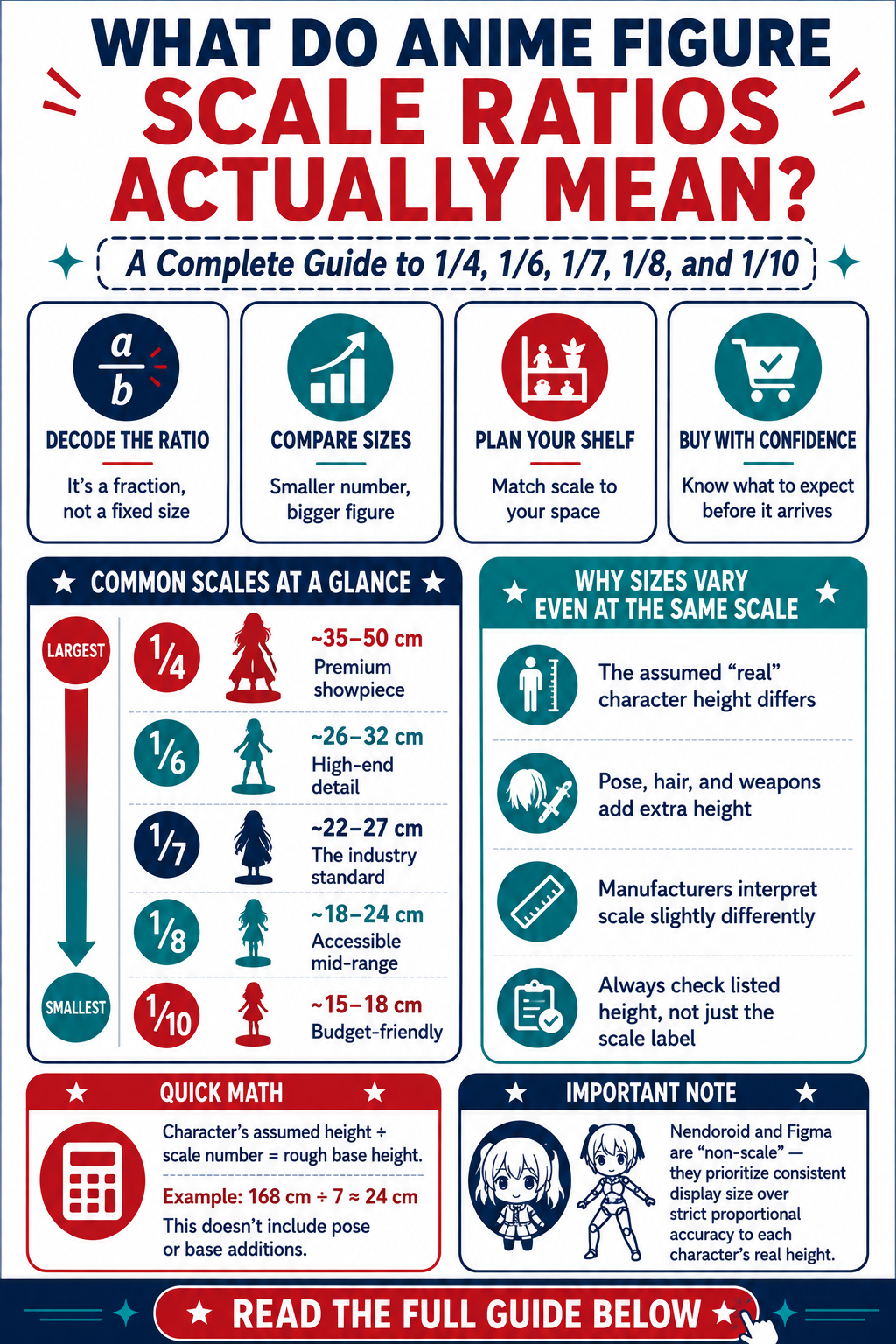
  • What Do Anime Figure Scale Ratios Actually Mean? A Complete Guide to 1/4, 1/6, 1/7, 1/8, and 1/10

    What Do Anime Figure Scale Ratios Actually Mean? A Complete Guide to 1/4, 1/6, 1/7, 1/8, and 1/10

    Affiliate Disclosure: This post contains affiliate links. If you buy through one of them, I may earn a small commission at no extra cost to you. I only recommend stores I’ve actually ordered from or researched thoroughly — my opinions are my own.

    The Problem: “1/7 Scale” Doesn’t Actually Tell You the Height

    If you’ve shopped for scale figures for more than a few minutes, you’ve run into a genuinely confusing piece of terminology: the scale ratio. A “1/7 scale” figure and a “1/8 scale” figure sound like they should have an obvious, predictable size difference — but then you look at two different 1/7 scale figures and they’re noticeably different heights, and the whole system starts to feel less useful than it should be.

    In my experience, the confusion usually comes from treating scale as if it directly tells you a figure’s height, when it actually tells you something slightly different: how much the character has been shrunk down from their assumed real-life height. Once that distinction clicks, the rest of this makes a lot more sense.

    Who This Article Is NOT For

    • If you only collect Nendoroids or Figma, scale ratios largely don’t apply to you — those are “non-scale” lines that prioritize a consistent display size over strict proportional accuracy.
    • If you’ve already got a solid handle on scale ratios, this is probably too introductory to be useful — this is written for collectors who are newer to the scale figure side of the hobby specifically.
    • If display space genuinely isn’t a constraint for you, some of the space-planning advice here matters less — buy whatever scale suits the figure best.

    How Scale Ratios Actually Work

    1. Scale is a ratio applied to an assumed real-life character height, not a fixed figure size. Manufacturers estimate what the character would stand at “in real life” (often somewhere in the 150–180 cm range depending on the character) and divide by the scale number.

    2. The same scale label can still produce different heights, because the underlying assumed character height varies, and because things like hair, weapons, wings, or a dramatic pose add to the figure’s actual footprint beyond the “base” scaled height.

    3. Smaller number after the slash means a bigger figure. This trips people up constantly — 1/6 is larger than 1/8, because you’re dividing by a smaller number.

    Quick Reference: Common Scales

    ScaleTypical Height RangeGeneral Price TierBest For
    1/4Roughly 35–50 cmPremium ($300+)A single showpiece centerpiece; requires serious dedicated display space
    1/6Roughly 26–32 cmHigh-end ($150–400+)Maximum detail at a size still manageable for a well-planned shelf
    1/7Roughly 22–27 cmMid-to-premium ($100–300+)The modern industry standard — the sweet spot most collectors default to
    1/8Roughly 18–24 cmAccessible mid-range ($80–200+)Great detail-to-footprint ratio without demanding too much shelf space
    1/10Roughly 15–18 cmMore budget-friendlySmaller collections, tighter shelf space, still with real sculpted detail

    Prices above are rough general ranges, not fixed numbers — manufacturer, character complexity, and how recently a figure was released all shift where a specific piece lands.

    Why Two Figures of the Same Scale Can Look Different Sizes

    This is the part that catches new collectors off guard most: scale describes a ratio, not a guaranteed final height, and several things push the actual size around:

    • The assumed “real” height of the character varies. A character assumed to be 180 cm tall will produce a noticeably bigger 1/7 scale figure than a character assumed to be 155 cm tall, even though both are labeled the same scale.
    • Pose and accessories add height beyond the base figure. A dynamic jumping pose, flowing hair, a raised weapon, or an elaborate display base can all push a figure’s total measured height well past what the “pure” scale math would suggest.
    • Manufacturers don’t interpret scale with perfect consistency. Most companies follow similar general standards, but it’s genuinely common for one manufacturer’s 1/7 to read slightly larger or smaller in person than another’s — this isn’t necessarily an error, just a difference in sculpting interpretation.

    Because of this, treat the scale number as a useful starting filter, not a precise measurement — always check the actual listed height (and ideally, the height including the base) before assuming exactly how a figure will fit your shelf.

    Choosing a Scale Based on Space and Budget

    • Tight or limited shelf space: Lean toward 1/8 or 1/10. You still get real sculpted detail without needing a dedicated display case or wide shelf run.
    • Standard bookshelf or display cabinet: 1/7 is genuinely the industry default for a reason — it balances presence and detail against a manageable footprint, which is part of why it’s so common.
    • A single character you want as a true centerpiece: 1/6 or 1/4, if your budget and space both allow for it. These sizes are meant to command attention, not blend into a lineup.
    • Building a matched, uniform-looking shelf across multiple characters: Try to stick to one scale (commonly 1/7 or 1/8) across your collection, since mixing scales — while still visually fine — creates a more varied, less uniform display hierarchy.

    A Quick Way to Estimate Height Yourself

    If you know (or can find) the manufacturer’s assumed character height, you can roughly estimate a figure’s base height yourself: divide the character’s assumed height by the scale’s denominator. A character assumed to be 168 cm tall at 1/7 scale would come out to roughly 24 cm as a baseline — though remember this doesn’t account for pose, hair, or base additions, so treat it as a rough starting estimate rather than a guarantee.

    Frequently Asked Questions

    Is a bigger scale number always a bigger figure? No — it’s the opposite. Since scale is expressed as a fraction, a smaller denominator (like 1/6) means a larger figure than a bigger denominator (like 1/10), because you’re dividing the assumed real height by a smaller number.

    Why do Nendoroid and Figma not use scale ratios? These are considered “non-scale” lines specifically because they prioritize a consistent, comparable display size across different characters rather than strict proportional accuracy to each character’s actual height — a very tall character and a very short character end up roughly similar sizes in these lines, which breaks true scale logic on purpose.

    Which scale is the best value for a new collector? 1/8 scale is often recommended as a strong starting point — it delivers real sculpted detail without the price or space demands of 1/6 or 1/4, making it a practical entry point before committing to larger, pricier pieces.

    Does a listed height include the display base? This varies by manufacturer and listing, so it’s worth checking the specific product description — a figure’s “true” height and its height including a tall or elaborate base can differ meaningfully, which matters if you’re planning shelf clearance carefully.

    Final Thoughts

    Scale ratios are genuinely useful once you know what they’re actually measuring — a fraction applied to an assumed real-life height, not a fixed, guaranteed figure size. Use scale as your first filter when comparing figures, but always check the actual listed height (base included, if you’re tight on shelf space) before finalizing a purchase, since pose, accessories, and manufacturer interpretation can shift the real-world size more than the scale label alone would suggest.

    If you’re still deciding between scale figures and other formats entirely, my Nendoroid vs Figma vs Scale Figure guide is the right place to start, and my manufacturer comparison can help you understand how different companies approach scale and detail differently once you’ve settled on a size.