Affiliate Disclosure: This post contains affiliate links. If you buy through one of them, I may earn a small commission at no extra cost to you. I only recommend stores I’ve actually ordered from or researched thoroughly — my opinions are my own.
The Problem: The Sticker Price Is Never the Real Price
Here’s what catches almost every new collector off guard: you find a figure listed at, say, $65, add it to your cart, and by the time shipping and customs are factored in, you’ve actually paid closer to $110. Nobody tells you this upfront, and the rules are different depending on which country you’re ordering into — which makes it even more confusing if you’ve seen a friend in a different country pay something completely different for what looks like the same order.
In my experience, the collectors who get frustrated with importing from Japan aren’t usually upset about the shipping cost itself — they’re upset about being surprised by it. This guide breaks down exactly what you’re actually paying for, country by country, so nothing shows up as a surprise at your door.
One important note before we start: import duty rules, especially in the US, have been changing rapidly through 2025 and into 2026. I’ve done my best to reflect the current situation as of writing this, but treat the specific numbers below as a guide to the shape of the costs rather than an exact quote — always check current rates before you order, especially for larger purchases.
Who This Article Is NOT For
- If you’re buying from a domestic retailer that already holds pre-imported stock in your country, none of this applies to you — customs costs are baked into the sticker price you already saw.
- If you’re only interested in the shipping speed, not the cost breakdown, most of the stores I recommend list estimated delivery windows directly on their shipping pages.
- If you’re ordering something valued well under any of the thresholds below (a single small accessory, for example), you can probably skip straight to checkout without worrying about any of this.
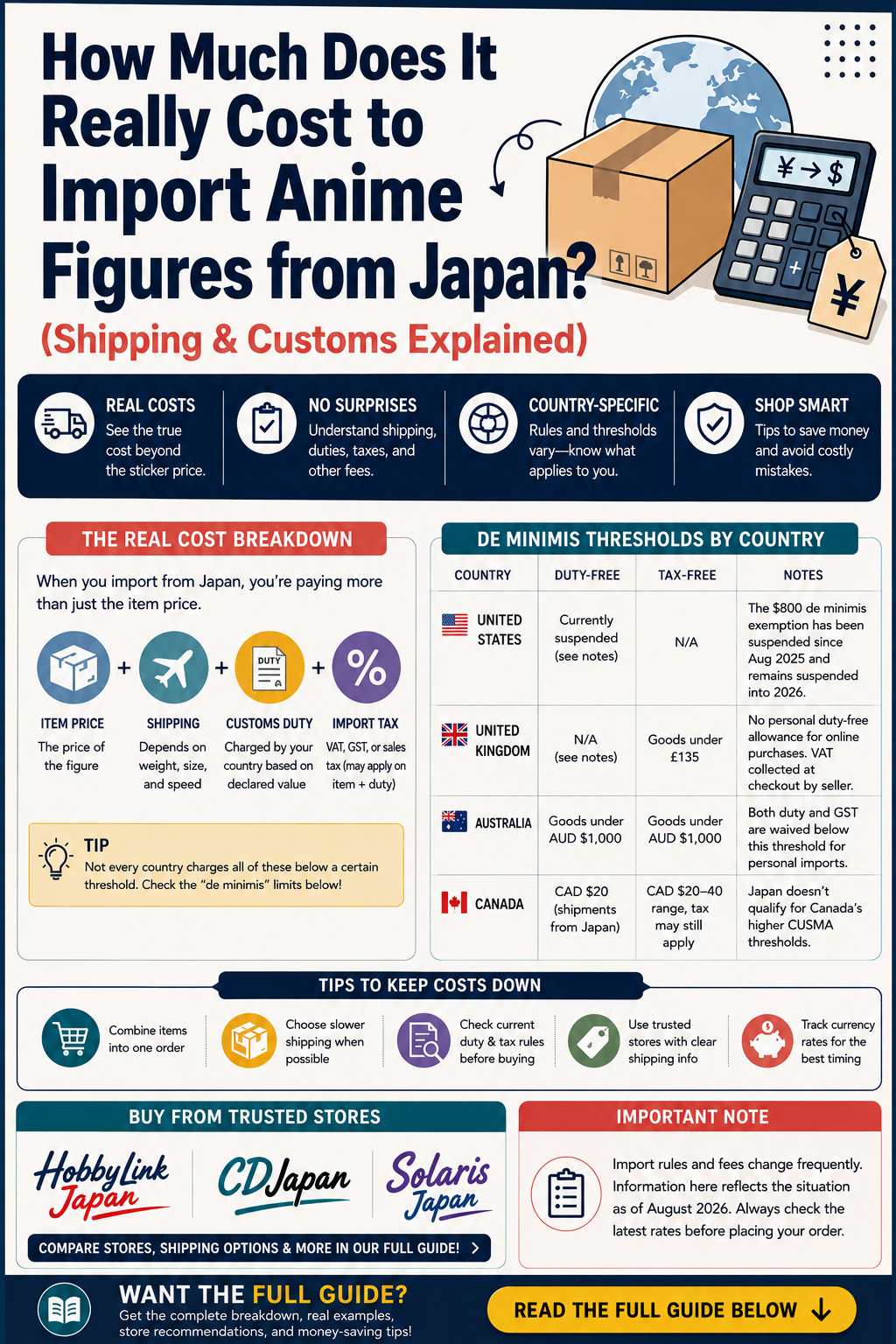
How These Costs Actually Break Down
1. Shipping cost, which depends on the carrier, the weight/size of the package, and how fast you want it to arrive.
2. Customs duty, a percentage-based (or sometimes flat) fee charged by your country’s border agency, based on the declared value of the goods.
3. Import tax (VAT, GST, or sales tax depending on your country), charged on top of the goods’ value — and sometimes on top of the duty as well.
Not every country charges all three below a certain value — that’s what the “de minimis threshold” tables below actually represent.
Quick Comparison: De Minimis Thresholds by Country
| Country | Duty-free threshold | Tax-free threshold | Notes |
|---|---|---|---|
| United States | Currently suspended (see below) | N/A | As of writing, the long-standing $800 exemption has been suspended since August 2025 and remains suspended into 2026 |
| United Kingdom | N/A (see below) | Goods under £135: VAT collected at checkout by the seller | No personal duty-free allowance for online purchases; gifts under £39 are the exception, not standard purchases |
| Australia | Goods under AUD $1,000 | Goods under AUD $1,000 | Both duty and GST are waived below this threshold for personal imports |
| Canada | CAD $20 (shipments from Japan) | CAD $20–40 range, tax may still apply | Japan doesn’t qualify for Canada’s higher CUSMA thresholds, which only apply to shipments from the US/Mexico |
Country-by-Country Breakdown
United States: The Situation Has Genuinely Changed
If you’ve imported figures from Japan before and remember it being duty-free, that’s because it used to be — packages valued under $800 fell under what’s called the “de minimis” exemption. As of late August 2025, that exemption was suspended by executive order, and as of this writing it remains suspended, with the policy continuing to shift through early-to-mid 2026 amid legal challenges.
Practically speaking, this means:
- Most packages shipped from Japan to the US now have some form of duty applied, regardless of value
- Depending on how the carrier or postal service processes the shipment, this can show up as either a percentage-based tariff (roughly 10–15% in many cases as of writing) or a flat per-item fee
- This is genuinely one of the more fluid parts of US trade policy right now, and specific rates have continued to shift — I’d strongly recommend checking your carrier’s current customs page or the CBP website before placing a large order, rather than relying on older blog posts (including this one, if enough time has passed since I wrote it)
What this means practically: budget for your figure to cost noticeably more than the listed price once it clears customs, and don’t assume a $70 figure will land at $70. If you’re ordering multiple figures at once, some collectors have found that splitting orders doesn’t help — duty is now generally applied regardless of per-package value, not avoided by keeping individual packages small.
United Kingdom: VAT Is Collected Upfront, Duty Is a Separate Question
The UK doesn’t have a duty-free personal allowance for standard online purchases the way some other countries do — that only applies to genuine gifts between individuals, not retail purchases, and only under £39.
For a normal figure order:
- Under £135: The seller typically collects UK VAT (20%) directly at checkout, so what you see at checkout is closer to the real final price
- Over £135: Import duty may also apply on top of VAT, and this is usually handled by the courier, who may charge a handling fee alongside the duty itself
The practical upshot is that UK buyers often see the tax baked into the price at checkout for smaller orders, but should expect a separate bill from the courier for larger ones (a premium scale figure, for example, or a multi-item order).
Australia: The Most Straightforward of the Four
Australia has one of the cleanest systems here: if the total value of your order is under AUD $1,000, you generally won’t pay GST or duty at all. This covers the vast majority of individual figure purchases — a single Nendoroid, Figma, or even most scale figures will fall comfortably under this threshold.
Where it gets relevant is if you’re placing a large combined order (several scale figures at once, for example) that pushes the total value over AUD $1,000 — at that point, the standard 10% GST plus applicable duty would apply to the full order.
Canada: The Lowest Threshold of the Group
This is the one that catches Canadian collectors off guard most often. Canada’s higher duty-free thresholds under CUSMA only apply to shipments coming from the US or Mexico — since figures are shipped from Japan, none of those higher thresholds apply. Instead, the general CAD $20 threshold applies, and orders between roughly $20–40 may still be tax-liable even if duty-free.
In practice, this means almost every figure order into Canada will attract some combination of duty and GST/HST (or provincial equivalent), and Canada Post typically adds a flat handling fee on top for processing the dutiable package.
What Shipping Itself Actually Costs
Separate from duty and tax, the shipping fee itself varies by carrier speed:
- Express/EMS-style shipping is faster (often 1–2 weeks) but costs more — expect this to add a meaningful chunk to a single figure’s total cost, more if the box is large or heavy (scale figures in particular)
- Economy/surface shipping is slower (sometimes a month or more) but noticeably cheaper, and is worth considering if you’re not in a hurry
- Consolidation services, like HLJ’s Private Warehouse, let you combine multiple items into a single shipment — this is one of the most effective ways to reduce your per-item shipping cost if you’re ordering more than one figure
Exact shipping costs vary by store, carrier, and current fuel surcharges, so I’d always recommend checking the live shipping calculator on the store’s site with your actual address rather than relying on a fixed number here.
Practical Ways to Reduce Your Total Cost
- Consolidate orders. If a store offers warehouse consolidation (HLJ does this well), combine multiple preorders into a single shipment instead of paying shipping repeatedly.
- Choose economy shipping when you’re not in a hurry. The savings can be substantial, especially on heavier items.
- Know your threshold before you order. If you’re in Australia and close to the AUD $1,000 line, splitting a large order across two separate purchases (with two separate shipments) may keep both under the threshold — just be aware this doesn’t work the same way in the US given the current suspended exemption.
- Double-check current rates before a large purchase. This applies especially to US buyers right now, given how much the situation has shifted over the past year.
Frequently Asked Questions
Do I have to pay customs on every anime figure I import? It depends entirely on your country and the order’s value. Australian and UK buyers under the relevant thresholds may pay little to nothing extra; US buyers should currently expect some duty on nearly all orders given the suspended exemption; Canadian buyers have the lowest threshold of the four and should expect duty/tax on most orders.
Will splitting my order into smaller packages help avoid customs charges? It can help in countries with a clear per-shipment threshold (like Australia’s AUD $1,000 line), but in the current US situation, this generally doesn’t help, since duty is being applied more broadly regardless of individual package value.
Why did my figure cost more at delivery than what I paid at checkout? This is usually import duty and/or tax collected by the courier at the point of delivery, rather than by the seller at checkout. Whether this happens — and how much — depends on your country’s threshold rules covered above.
Is it cheaper to buy from a store with a US warehouse, like Solaris Japan’s dual-warehouse option? For US buyers specifically, yes — often meaningfully so, since goods already inside the US avoid the international customs process on that leg of the journey. It’s one of the reasons I recommend Solaris Japan for anyone in North America who’s especially worried about unpredictable customs costs.
Final Thoughts
The honest takeaway here is that “how much will this actually cost me” doesn’t have one universal answer — it depends heavily on your country, your order size, and (particularly for US buyers right now) a policy landscape that’s still shifting. What doesn’t change is the value of ordering from retailers who are upfront about shipping costs and, where possible, offer consolidation or local-warehouse options to soften the impact.
If you haven’t already, it’s worth reading my comparison of trusted Japan-based figure stores — I break down which of HobbyLink Japan, CDJapan, and Solaris Japan fits best depending on exactly this kind of cost and shipping consideration.
コメントを残す