タグ: Solaris Japan

  • How to Track Anime Figure Preorders and Release Dates (So You Never Miss One)

    How to Track Anime Figure Preorders and Release Dates (So You Never Miss One)

    Affiliate Disclosure: This post contains affiliate links. If you buy through one of them, I may earn a small commission at no extra cost to you. I only recommend stores I’ve actually ordered from or researched thoroughly — my opinions are my own.

    The Problem: Preorder Windows Close Fast, and Nobody Sends You a Personal Reminder

    Here’s the frustrating part about figure preorders that nobody warns you about until you’ve missed one: the popular ones don’t stay open for long, announcements don’t always happen where you’re looking, and once a limited preorder window closes, your options usually shrink to paying a steep markup on the secondary market or waiting for a re-release that might never come.

    In my experience, the collectors who never seem to miss a preorder aren’t just lucky or more plugged in socially — they’ve built a small, repeatable system for catching announcements before the window closes. That’s really all this comes down to: a system, not luck. This guide walks through how to build one.

    Who This Article Is NOT For

    • If you’re not interested in preordering and only buy in-stock figures, most of this doesn’t apply to you directly — though the tracking habits here still help if a specific character or series you love tends to get preordered out quickly once it does become available.
    • If you haven’t picked a store yet, start with my comparison of trusted Japan-based figure stores — the tracking system below assumes you already know where you’re likely to place your order.
    • If you’re brand new to ordering from Japan generally, my first-time buyer’s guide covers the checkout and preorder payment process itself, which is a useful companion to this article.

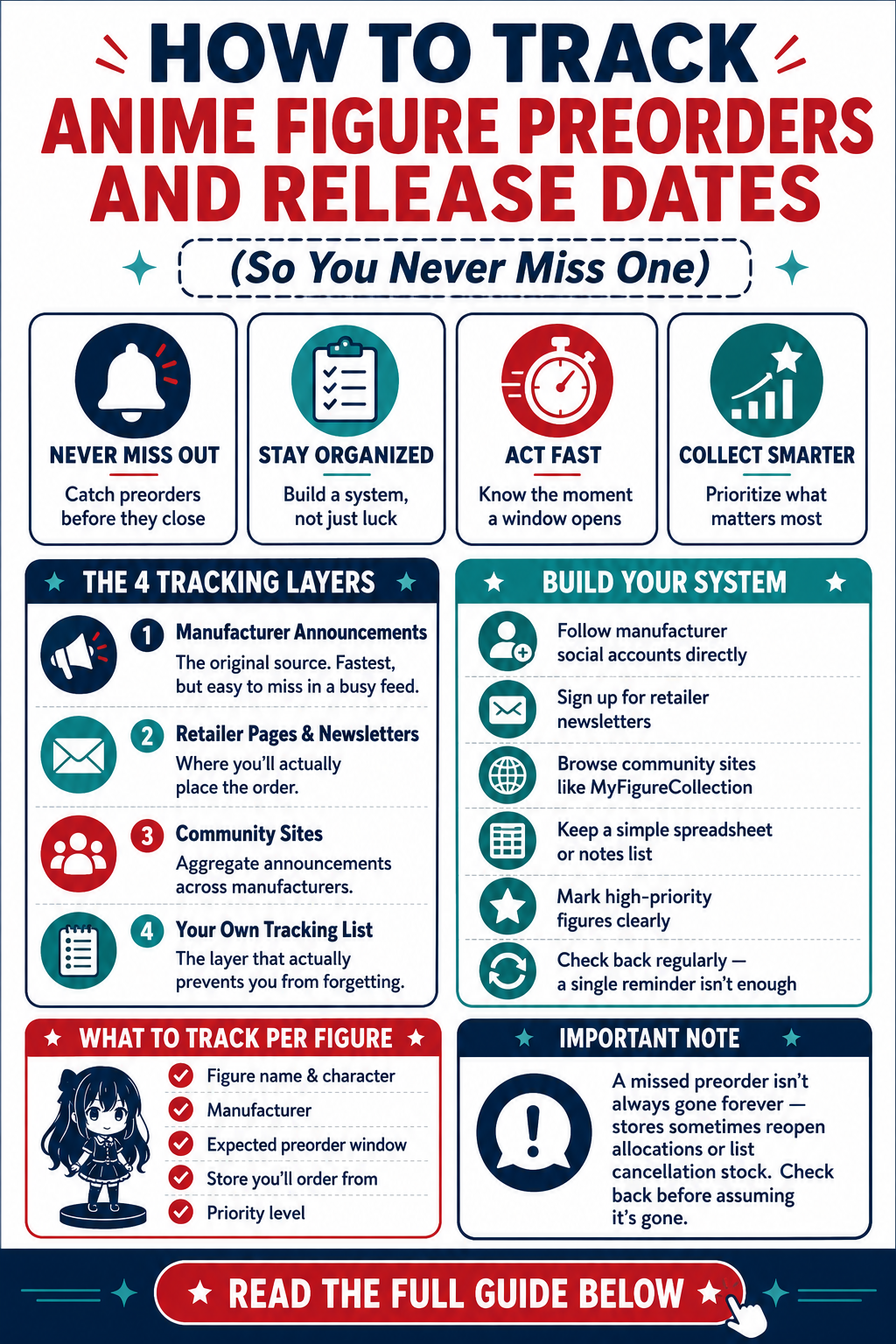
    The Four Layers of a Good Tracking System

    No single source catches everything reliably, which is exactly why relying on just one tends to fail eventually. A solid system layers a few different sources together:

    1. Manufacturer and brand announcements — the original source of “this figure exists,” usually the fastest to know but not always the most convenient to monitor constantly.

    2. Retailer preorder pages — where you’ll actually place the order, and where preorder windows, bonuses, and availability changes show up first from a purchasing standpoint.

    3. Community tracking sites — collector-run databases that aggregate announcements across manufacturers, often faster to browse than checking each manufacturer individually.

    4. Your own tracking list — the layer that actually prevents you from forgetting, regardless of how good the first three are at surfacing information.

    Quick Comparison: Tracking Methods

    MethodBest ForLimitation
    Manufacturer social media (X/Twitter, official sites)Earliest announcements, straight from the sourceEasy to miss in a busy feed; some manufacturers post primarily in Japanese
    Retailer preorder pages & newslettersKnowing exactly when you can actually buyOnly shows what that specific retailer carries
    Community database sites (e.g., MyFigureCollection)Browsing broadly, following specific characters/series across all manufacturersRequires actively checking or setting up notifications yourself
    Personal tracking list (spreadsheet, notes app, calendar)Never forgetting something you’ve already decided you wantOnly useful for things you already know about — doesn’t surface new announcements

    Building Each Layer

    Follow Manufacturers Directly

    Good Smile Company, Max Factory, Kotobukiya, Alter, and similar manufacturers post new figure announcements on their official social accounts and websites, often before retailers even open preorders. Following these directly is the fastest way to hear about something the moment it’s revealed — the tradeoff is that it takes active attention, since a single announcement can easily scroll past in a busy feed.

    Practical tip: if a manufacturer’s official account posts in both Japanese and English, following both can occasionally give you a small heads-up, since the two don’t always post at exactly the same time.

    Use Retailer Preorder Pages and Newsletters

    This is where your tracking actually turns into a purchase. Once you know a figure exists, check whether your preferred store has opened preorders for it, and sign up for that store’s newsletter if you haven’t already — this is genuinely one of the more reliable ways to catch preorder openings and reopenings without manually checking every day.

    If you’re deciding between HLJ, CDJapan, and Solaris Japan, my full store comparison covers how each handles preorders specifically, including HLJ’s no-upfront-payment model, which is worth knowing about if you’re planning to track and preorder regularly.

    Use a Community Tracking Site

    Collector-run community sites — MyFigureCollection (MFC) being the most established example — let you follow specific characters, series, or manufacturers, and often surface community discussion the moment a new figure is announced or a preorder window opens. These sites work well as a broader net, since they aggregate across manufacturers rather than requiring you to check each one individually.

    Keep Your Own List

    This is the step people skip, and it’s the one that actually prevents missed preorders. Even a simple spreadsheet, notes app list, or calendar with reminders works — the goal is just to have somewhere you write down “this exists, I want it, here’s the expected preorder window” the moment you learn about a figure, rather than trusting yourself to remember it later.

    A simple format that works well:

    • Figure name / character
    • Manufacturer
    • Expected preorder open date (if known)
    • Which store you plan to order from
    • Priority level (so your top-priority figures don’t get lost among “would be nice” ones)

    Tips for Not Missing the Ones That Matter Most

    • Mark your genuinely high-priority figures clearly, separate from ones you’re only mildly interested in. If everything gets equal attention in your tracking system, the ones you actually care about are more likely to slip through.
    • Check back periodically, not just once. A single reminder for an estimated release window isn’t enough — preorder dates shift, and windows sometimes open earlier or later than originally announced.
    • Don’t assume a missed preorder is gone forever. Retailers occasionally reopen allocations, list cancellation stock, or get additional inventory after the original window closes — it’s always worth checking back rather than assuming your only remaining option is the secondary market.
    • Be cautious about secondary market pricing if you do miss a window. A missed preorder showing up at a steep markup on a resale site is also exactly the kind of listing where bootleg risk increases — my guide to spotting fakes is worth a look if you end up going this route.

    Frequently Asked Questions

    Where do most preorder announcements happen first? Usually the manufacturer’s own social media or website, slightly ahead of when individual retailers open preorders for that item. Retailer newsletters tend to be the fastest way to know exactly when you can place an order, even if they’re not always the very first announcement.

    Is it worth using more than one tracking method at once? Yes — this is really the core idea of this guide. No single source catches everything reliably, so combining a couple of sources (a retailer newsletter plus a personal tracking list, for example) meaningfully reduces the chance of missing something you actually wanted.

    What should I do if I miss a preorder window? Check back periodically, since reopened allocations and cancellation stock do happen. If you do end up buying secondhand or from a resale listing at a markup, apply extra scrutiny for authenticity, since marked-up secondary listings carry more bootleg risk than a direct retailer preorder.

    Do I need to follow Japanese-language accounts to catch announcements early? Not necessarily, but it can occasionally help, since some manufacturers post in Japanese slightly ahead of their English content. It’s optional rather than essential — a well-built system using English-language retailer and community sources will still catch the vast majority of what you’re looking for.

    Final Thoughts

    Missing a preorder almost never comes down to bad luck — it usually comes down to relying on a single source that didn’t happen to catch that particular announcement in time. Layering a few tracking habits together (following manufacturers, signing up for retailer newsletters, browsing a community site occasionally, and keeping your own simple list) turns “hoping you don’t miss it” into an actual system.

    If you’re building out your preorder habits, it’s worth revisiting my first-time buyer’s guide for how the actual preorder payment process works once you’ve found what you’re looking for.
  • When Are Anime Figures Actually on Sale? A Collector’s Guide to Timing Your Purchases

    When Are Anime Figures Actually on Sale? A Collector’s Guide to Timing Your Purchases

    Affiliate Disclosure: This post contains affiliate links. If you buy through one of them, I may earn a small commission at no extra cost to you. I only recommend stores I’ve actually ordered from or researched thoroughly — my opinions are my own.

    The Problem: Most Figures Sell at MSRP Most of the Time, and Nobody Tells You When That Changes

    Here’s something that surprises a lot of new collectors: unlike a lot of retail categories, anime figures don’t go on sale constantly. Most of the major Japan-based retailers sell new releases at or very close to MSRP the majority of the year — the deep discounts everyone talks about tend to cluster around a handful of specific windows, and if you don’t know when those are, you’ll end up paying full price for everything by default.

    In my experience, the collectors who consistently save money aren’t hunting for secret coupon codes — they’re just aware of the handful of predictable moments each year when prices actually move, and they plan bigger purchases around those windows instead of buying on impulse the moment something catches their eye.

    Who This Article Is NOT For

    • If you’re chasing a specific figure that’s about to sell out or go out of print, don’t wait for a sale — availability matters more than a discount you might not get anyway. Buy it now.
    • If you’re new to importing and haven’t picked a store yet, start with my comparison of trusted Japan-based figure stores — the sales strategies below only matter once you know where you’re shopping.
    • If you’re expecting steep, frequent discounts like you’d see on general retail sites, it’s worth resetting expectations here — figure discounts tend to be smaller and less frequent than, say, clothing or electronics sales.

    How I’m Breaking This Down

    1. Predictable annual sale windows, the times of year when major retailers reliably run promotions.

    2. Store-specific pricing patterns, since some stores discount more often than others by design.

    3. Ongoing ways to save that aren’t tied to a specific date, like rewards programs and shipping consolidation.

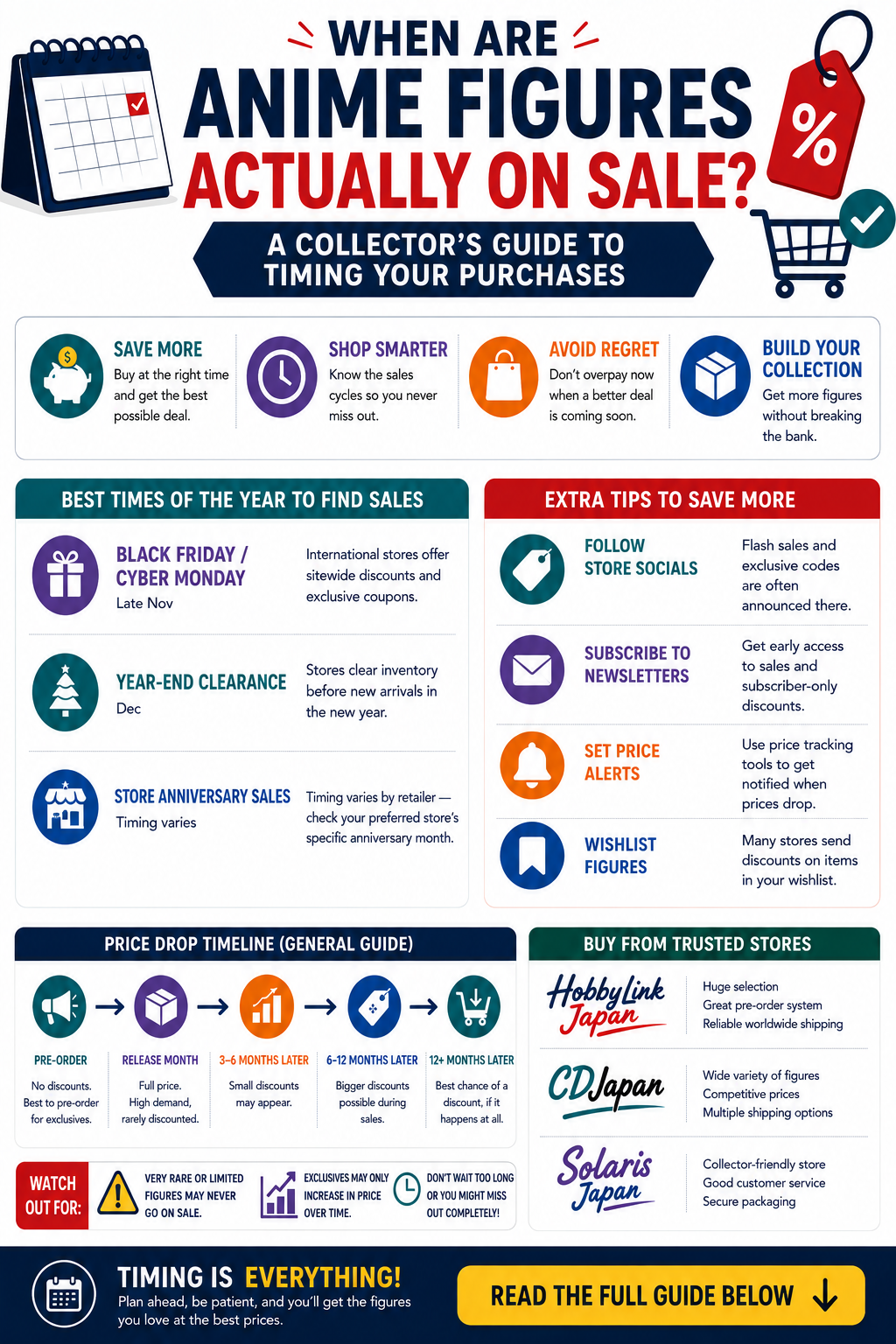
    The Predictable Sale Windows

    Time of YearWhat Tends to Happen
    Black Friday / Late NovemberThe most reliable major sale window across the industry — HobbyLink Japan in particular has run Black Friday promotions in past years, often including shipping discounts alongside product discounts
    Store anniversary salesSeveral retailers run their own anniversary promotions at different points in the year — timing varies by store, so it’s worth knowing your preferred store’s specific anniversary month
    Seasonal clearance (summer/winter)Older stock and previous-run figures occasionally get marked down to clear inventory, particularly on items that have been sitting for a while
    Site-wide “super sales”Some retailers periodically run broader promotional events outside the usual calendar — these aren’t always predictable in advance, which is where an email newsletter (below) becomes useful

    A caution worth repeating: exact dates and discount depths shift year to year and I’m not going to pretend I can predict this year’s specifics with certainty — treat the calendar above as “these are the seasons to watch,” not a guaranteed schedule.

    How Each Store’s Pricing Actually Works

    HobbyLink Japan (HLJ)

    HLJ tends to price close to MSRP for most of the year, but has a track record of running a genuine Black Friday sale, sometimes paired with temporary shipping discounts. Since HLJ doesn’t require upfront payment on preorders, a practical strategy is to place preorders as usual, then keep an eye out for shipping promotions to time your Private Warehouse consolidation around.

    CDJapan

    CDJapan generally sells at MSRP without frequent deep discounts on individual figures — its value proposition leans more on the rewards points system (a small percentage back on every purchase) and preorder-exclusive bonus items rather than direct price cuts. If you’re a frequent CDJapan shopper, the points add up more as an ongoing discount than a single big sale event.

    Solaris Japan

    Because Solaris Japan’s value proposition is centered on convenience (US warehouse, lower customs risk) rather than rock-bottom pricing, don’t expect this to be your go-to for deep discounts — it’s a better fit for prioritizing certainty over squeezing out the lowest possible price.

    AmiAmi (mentioned for context)

    Worth knowing about even though it’s not part of my main affiliate recommendations: AmiAmi is generally considered one of the more competitively priced retailers for both new and pre-owned figures, and its rewards points system functions similarly to CDJapan’s.

    Ongoing Ways to Save (Not Tied to a Specific Date)

    • Sign up for the store’s official newsletter. This is genuinely the most reliable way to hear about promotions as they happen, rather than hoping to catch a sale by chance. I’d specifically recommend the official newsletter over third-party “coupon code” sites — a lot of those sites list expired or non-functional codes, and you’re better off going straight to the source.
    • Use shipping consolidation. This isn’t a “sale” in the traditional sense, but combining multiple preorders into a single shipment (HLJ’s Private Warehouse is the standout example here) meaningfully reduces your total cost, especially if you’re a regular buyer rather than a one-off shopper.
    • Take advantage of rewards points programs. CDJapan and AmiAmi both offer points back on purchases, which function as a slow-building discount for anyone who orders from the same store repeatedly.
    • Don’t discount timing against exchange rates. The price you pay is ultimately converted from Japanese yen, so favorable currency movement can sometimes save you more than an actual sale would — worth a quick check if you’re planning a larger purchase and have some flexibility on timing.

    Which Strategy Fits You? (By Use Case)

    “I buy a lot of figures throughout the year and want ongoing savings.” Lean into rewards points (CDJapan, AmiAmi) and shipping consolidation (HLJ’s Private Warehouse) rather than waiting for sale events — the savings compound more reliably over time.

    “I only buy a few figures a year and want to time it right.” Sign up for newsletters from your preferred stores and plan bigger purchases around the Black Friday window specifically, since it’s the most consistently reliable discount period across the industry.

    “I’m chasing a specific in-demand figure.” Don’t wait for a sale — buy it when you find it in stock or open for preorder. Popular figures selling out is a bigger financial risk than missing a modest discount.

    “I want the simplest possible approach with the least monitoring effort.” Just sign up for one or two newsletters and otherwise buy when you’re ready. You’ll still catch the major sale windows without actively hunting for deals.

    Frequently Asked Questions

    Do anime figure stores have coupon codes? Some do, distributed primarily through their own newsletters or social media accounts. Be cautious of third-party “coupon aggregator” websites — a large percentage of the codes listed on these sites are expired or never worked in the first place, and they’re not an official source.

    Is it worth waiting for a sale before preordering? Generally no — preorder discounts are uncommon at most major retailers, and popular preorders can sell out entirely regardless of price. It’s usually better to preorder when you find something you want and save sale-timing strategies for in-stock or already-released figures instead.

    Which store has the best ongoing prices, not just sale prices? Of the stores I recommend, pricing philosophy varies: HLJ and CDJapan generally sit closer to MSRP with occasional sale windows, while Solaris Japan’s value is more about shipping convenience than baseline price. If rock-bottom everyday pricing is your top priority, it’s worth comparing against AmiAmi as well.

    Final Thoughts

    The honest reality is that anime figures aren’t a category where you can count on frequent, steep discounts — most of your savings will come from a combination of a handful of predictable seasonal windows, ongoing rewards programs, and smart shipping consolidation, rather than chasing coupon codes.

    If you’re still building your shopping foundation, it’s worth revisiting my comparison of trusted Japan-based figure stores and my breakdown of shipping and customs costs by country — between timing your purchases well and minimizing shipping and customs costs, that combination will save you far more over a year of collecting than any single sale event.

  • First-Time Buyer’s Guide: How to Order Anime Figures from Japan (Step by Step)

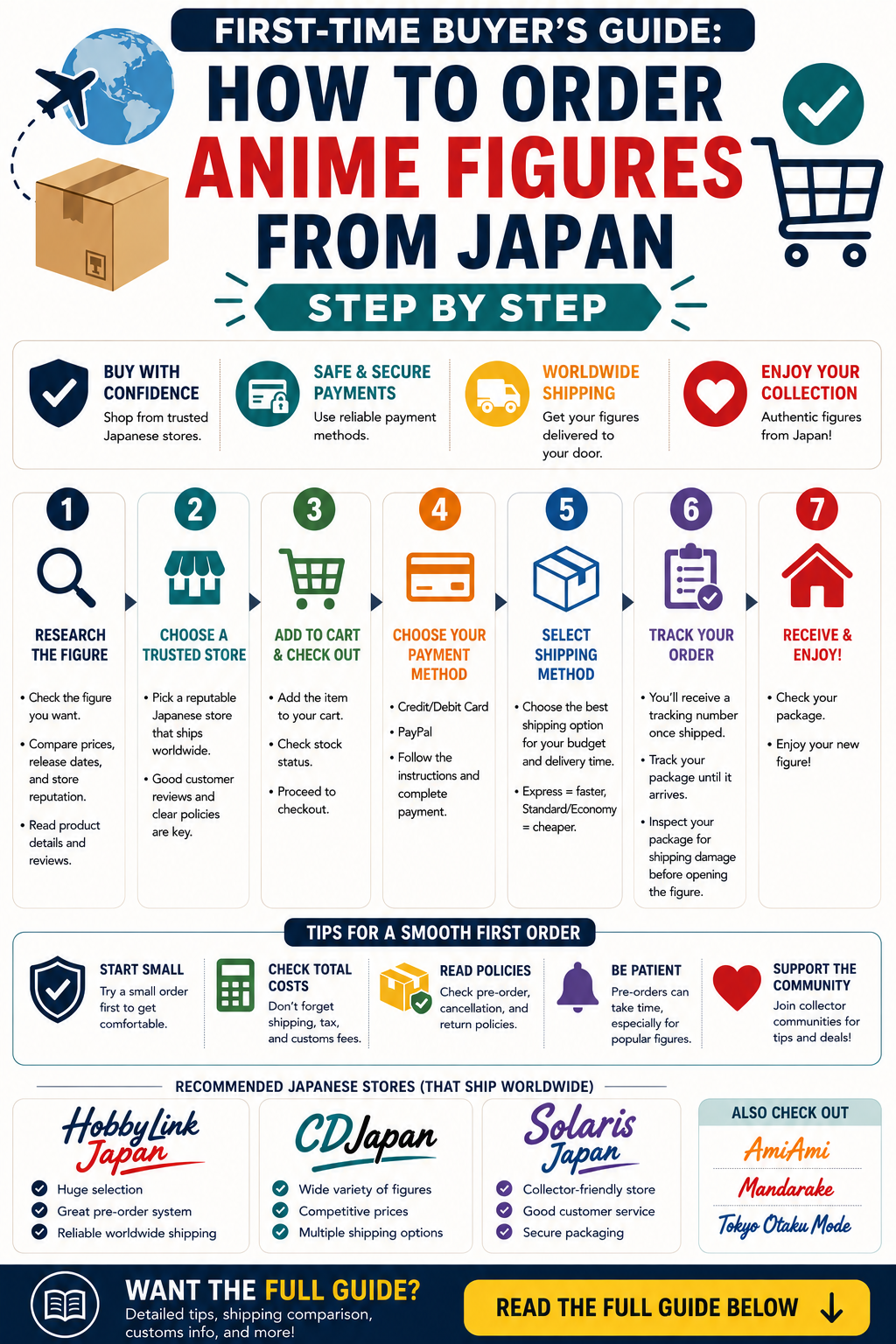
    First-Time Buyer’s Guide: How to Order Anime Figures from Japan (Step by Step)

    Affiliate Disclosure: This post contains affiliate links. If you buy through one of them, I may earn a small commission at no extra cost to you. I only recommend stores I’ve actually ordered from or researched thoroughly — my opinions are my own.

    The Problem: You’ve Picked a Store, But the Checkout Process Still Feels Unfamiliar

    You’ve done the homework — maybe you’ve already read through which stores are actually trustworthy, you know which type of figure you want, and you’ve got a rough idea of what customs and shipping will actually cost. But there’s still a gap between “I know what I want to buy” and actually clicking through checkout with confidence.

    In my experience, this is the point where a lot of first-time buyers hesitate the longest — not because the process is actually hard, but because it’s unfamiliar, and nobody wants to mess up an order for something they’ve been looking forward to. This guide walks through the entire process from start to finish, so you know exactly what to expect at each step.

    Who This Article Is NOT For

    • If you’ve already ordered from Japan before, most of this will be familiar — you might still find the preorder payment timing section useful, since that trips up even some experienced collectors.
    • If you haven’t picked a store yet, back up to my store comparison guide first — the checkout process below assumes you’ve already landed on somewhere like HLJ, CDJapan, or Solaris Japan.
    • If you’re specifically worried about receiving a fake, that’s covered separately in my guide to spotting bootleg figures — this article assumes you’re ordering from a legitimate retailer, where that risk is minimal to begin with.

    How This Walkthrough Is Organized

    I’m splitting this into the two paths your first order will actually take: buying something already in stock, and preordering something that hasn’t released yet. They work differently enough that it’s worth understanding both before you start clicking around a store’s website.

    Part 1: Creating Your Account and Setting Up Your Details

    Most Japan-based figure retailers require an account before checkout, even for a one-time order. This is normal and usually takes under five minutes.

    1. Sign up with your email, or in some cases through a social login option
    2. Enter your shipping address in the Latin alphabet. International retailers are built to handle this — don’t worry about needing to know any Japanese
    3. Set your currency and language preferences, if the store offers them (most of the retailers I recommend default to English automatically for overseas visitors)
    4. Add a payment method. Credit and debit cards are almost universally accepted; some stores also support PayPal

    One small tip: double-check your address formatting matches what the store expects (some ask for postal code before city, others after) — a mismatched address is one of the more common reasons for a delayed shipment.

    Part 2: Buying an In-Stock Item

    This is the simpler of the two paths, and a good way to get comfortable with a new store before committing to a preorder.

    1. Search for the item by name, or browse by category if you’re not sure exactly what you want yet
    2. Check the product page carefully — confirm it’s the actual release version you want (re-releases and variant colorways are common, and it’s easy to grab the wrong one if you’re skimming)
    3. Add it to your cart, and check the shipping cost estimate at this stage rather than waiting until final checkout — most stores let you preview this before you commit
    4. Choose your shipping method. This is usually where you’ll pick between faster/more expensive and slower/cheaper options
    5. Complete payment. For in-stock items, you’re typically charged immediately
    6. Wait for processing and dispatch. Most retailers process in-stock orders within a few business days before it actually ships

    Part 3: Placing a Preorder (Where Most Confusion Happens)

    Preorders work differently from in-stock purchases, and the details vary meaningfully by store — this is genuinely the part I’d recommend reading closest before your first preorder.

    1. Find the preorder listing and confirm the estimated release month (these are estimates, not guarantees — delays of a month or more aren’t unusual, and can happen for reasons entirely outside the retailer’s control)
    2. Check the payment timing policy before you commit. This is the detail that catches people off guard: some stores charge your card in full the moment you place the preorder, others only charge once the item is ready to ship, and some take a deposit upfront with the balance due later. HobbyLink Japan’s “pay when it ships” model, for example, means your money isn’t tied up for months before the figure even exists — worth knowing if you’re preordering something releasing far in the future
    3. Confirm what’s included. Check whether bonus parts, first-run extras, or store-exclusive accessories are part of the listing, since these are sometimes tied to ordering before a specific date
    4. Place the order and note the estimated ship date, but hold that date loosely — treat it as a rough guide rather than a fixed promise
    5. Watch for a payment reminder if your store takes payment closer to release rather than at order time — missing this can result in your preorder being cancelled

    Part 4: Waiting, Tracking, and Delivery

    Once your order (in-stock or preorder) has shipped, here’s what typically happens:

    • You’ll receive tracking information, usually by email, once the package leaves the warehouse
    • Delivery timing depends on the shipping method you chose — express options are faster but pricier, economy options take longer but cost less
    • Customs may add extra time and cost at this stage, depending on your country. If you haven’t already, it’s worth reading my breakdown of shipping and customs costs by country so nothing at delivery catches you off guard
    • Inspect the package before opening the figure fully, especially for your first order — check for shipping damage on the outer box before assuming any issue is with the figure itself

    Tips for a Smoother First Order

    • Start smaller. Your very first order doesn’t need to be an expensive preorder — a small in-stock item is a low-risk way to learn how a specific store’s process works before committing to something bigger
    • Keep your confirmation emails. If anything goes missing from a multi-item order, having the original confirmation makes resolving it much faster
    • Don’t mix preorders and in-stock items in one order unless you’re prepared to wait. Many stores ship combined orders together, which means your in-stock item could sit waiting for months until the preorder is ready
    • Know your figure type before you shop. If you’re still deciding between styles, my Nendoroid vs Figma vs Scale Figure guide covers the tradeoffs
    • Budget for the real total, not just the sticker price. Between shipping and potential customs charges, your actual cost is often meaningfully higher than the listed price — plan for that ahead of time rather than being surprised at checkout or delivery

    Frequently Asked Questions

    Do I need to speak Japanese to order from these stores? No. HobbyLink Japan, CDJapan, and Solaris Japan are all built for English-speaking overseas customers, with English product pages, checkout, and customer support.

    When am I actually charged for a preorder? It depends entirely on the store — some charge at order time, others when the item ships, and some take a partial deposit. Always check the specific store’s policy before placing a preorder, since this varies more than most first-time buyers expect.

    What happens if a preorder gets delayed? Delays of a month or so are common in the industry and usually stem from manufacturing, licensing, or shipping logistics outside the retailer’s control. Legitimate stores will typically update the estimated ship date on your order rather than leaving you in the dark — if a store goes silent on a significant delay, that’s worth following up on directly.

    Can I cancel a preorder if I change my mind? This depends on the store’s policy and how close you are to the release date. Some stores, like HLJ, explicitly allow preorder cancellations before release — this is one of the reasons I recommend them for first-time buyers specifically.

    Final Thoughts

    The actual mechanics of ordering from Japan aren’t complicated once you’ve done it once — the friction is almost entirely in not knowing what to expect the first time. Start with something small and in-stock, get comfortable with how your chosen store handles shipping and confirmation emails, and the rest tends to click into place quickly.

    If you haven’t already picked a store, my full comparison of HobbyLink Japan, CDJapan, and Solaris Japan is the natural next step before placing your first order.

  • How Much Does It Really Cost to Import Anime Figures from Japan? (Shipping & Customs Explained)

    How Much Does It Really Cost to Import Anime Figures from Japan? (Shipping & Customs Explained)

    Affiliate Disclosure: This post contains affiliate links. If you buy through one of them, I may earn a small commission at no extra cost to you. I only recommend stores I’ve actually ordered from or researched thoroughly — my opinions are my own.

    The Problem: The Sticker Price Is Never the Real Price

    Here’s what catches almost every new collector off guard: you find a figure listed at, say, $65, add it to your cart, and by the time shipping and customs are factored in, you’ve actually paid closer to $110. Nobody tells you this upfront, and the rules are different depending on which country you’re ordering into — which makes it even more confusing if you’ve seen a friend in a different country pay something completely different for what looks like the same order.

    In my experience, the collectors who get frustrated with importing from Japan aren’t usually upset about the shipping cost itself — they’re upset about being surprised by it. This guide breaks down exactly what you’re actually paying for, country by country, so nothing shows up as a surprise at your door.

    One important note before we start: import duty rules, especially in the US, have been changing rapidly through 2025 and into 2026. I’ve done my best to reflect the current situation as of writing this, but treat the specific numbers below as a guide to the shape of the costs rather than an exact quote — always check current rates before you order, especially for larger purchases.

    Who This Article Is NOT For

    • If you’re buying from a domestic retailer that already holds pre-imported stock in your country, none of this applies to you — customs costs are baked into the sticker price you already saw.
    • If you’re only interested in the shipping speed, not the cost breakdown, most of the stores I recommend list estimated delivery windows directly on their shipping pages.
    • If you’re ordering something valued well under any of the thresholds below (a single small accessory, for example), you can probably skip straight to checkout without worrying about any of this.

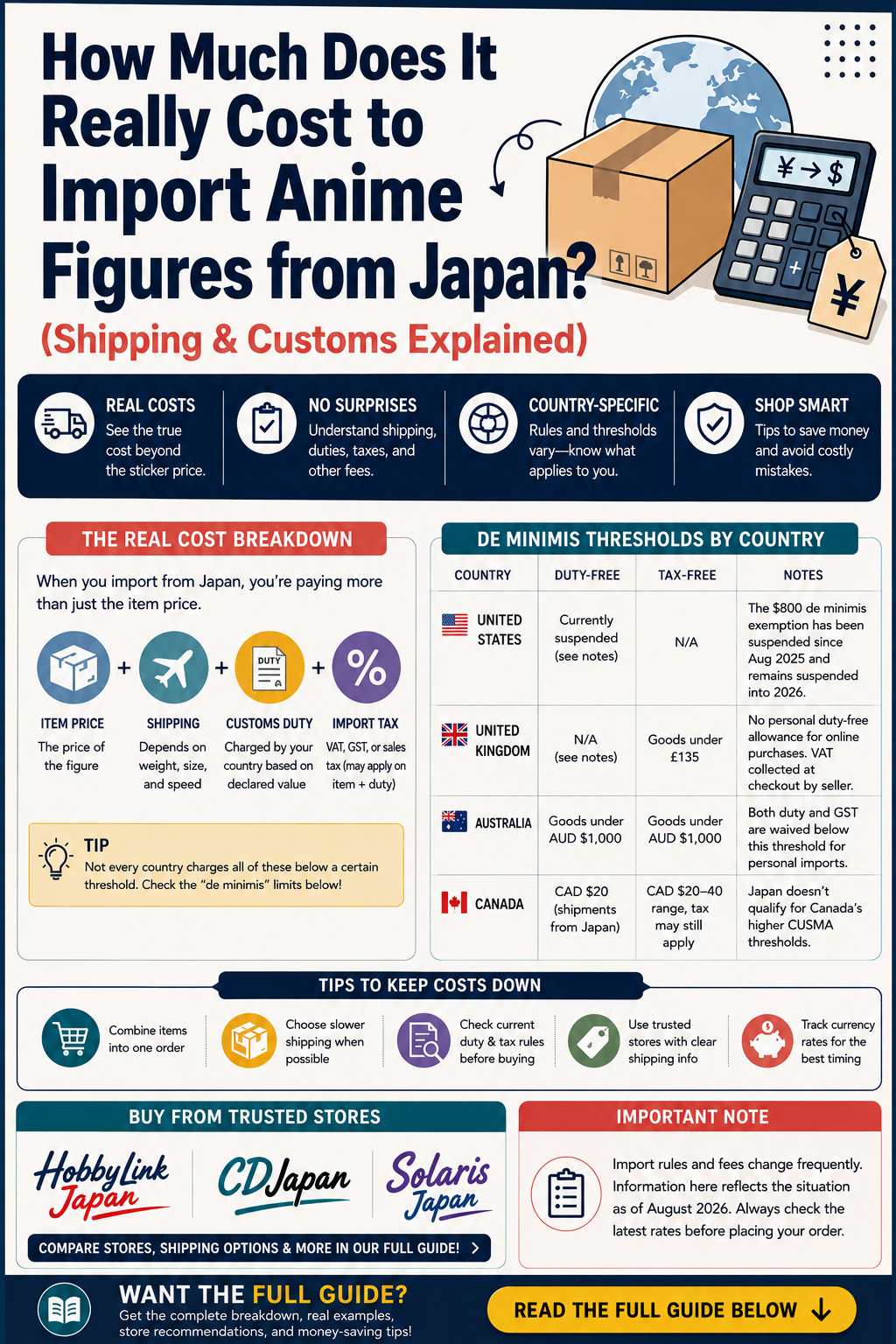
    How These Costs Actually Break Down

    1. Shipping cost, which depends on the carrier, the weight/size of the package, and how fast you want it to arrive.

    2. Customs duty, a percentage-based (or sometimes flat) fee charged by your country’s border agency, based on the declared value of the goods.

    3. Import tax (VAT, GST, or sales tax depending on your country), charged on top of the goods’ value — and sometimes on top of the duty as well.

    Not every country charges all three below a certain value — that’s what the “de minimis threshold” tables below actually represent.

    Quick Comparison: De Minimis Thresholds by Country

    CountryDuty-free thresholdTax-free thresholdNotes
    United StatesCurrently suspended (see below)N/AAs of writing, the long-standing $800 exemption has been suspended since August 2025 and remains suspended into 2026
    United KingdomN/A (see below)Goods under £135: VAT collected at checkout by the sellerNo personal duty-free allowance for online purchases; gifts under £39 are the exception, not standard purchases
    AustraliaGoods under AUD $1,000Goods under AUD $1,000Both duty and GST are waived below this threshold for personal imports
    CanadaCAD $20 (shipments from Japan)CAD $20–40 range, tax may still applyJapan doesn’t qualify for Canada’s higher CUSMA thresholds, which only apply to shipments from the US/Mexico

    Country-by-Country Breakdown

    United States: The Situation Has Genuinely Changed

    If you’ve imported figures from Japan before and remember it being duty-free, that’s because it used to be — packages valued under $800 fell under what’s called the “de minimis” exemption. As of late August 2025, that exemption was suspended by executive order, and as of this writing it remains suspended, with the policy continuing to shift through early-to-mid 2026 amid legal challenges.

    Practically speaking, this means:

    • Most packages shipped from Japan to the US now have some form of duty applied, regardless of value
    • Depending on how the carrier or postal service processes the shipment, this can show up as either a percentage-based tariff (roughly 10–15% in many cases as of writing) or a flat per-item fee
    • This is genuinely one of the more fluid parts of US trade policy right now, and specific rates have continued to shift — I’d strongly recommend checking your carrier’s current customs page or the CBP website before placing a large order, rather than relying on older blog posts (including this one, if enough time has passed since I wrote it)

    What this means practically: budget for your figure to cost noticeably more than the listed price once it clears customs, and don’t assume a $70 figure will land at $70. If you’re ordering multiple figures at once, some collectors have found that splitting orders doesn’t help — duty is now generally applied regardless of per-package value, not avoided by keeping individual packages small.

    United Kingdom: VAT Is Collected Upfront, Duty Is a Separate Question

    The UK doesn’t have a duty-free personal allowance for standard online purchases the way some other countries do — that only applies to genuine gifts between individuals, not retail purchases, and only under £39.

    For a normal figure order:

    • Under £135: The seller typically collects UK VAT (20%) directly at checkout, so what you see at checkout is closer to the real final price
    • Over £135: Import duty may also apply on top of VAT, and this is usually handled by the courier, who may charge a handling fee alongside the duty itself

    The practical upshot is that UK buyers often see the tax baked into the price at checkout for smaller orders, but should expect a separate bill from the courier for larger ones (a premium scale figure, for example, or a multi-item order).

    Australia: The Most Straightforward of the Four

    Australia has one of the cleanest systems here: if the total value of your order is under AUD $1,000, you generally won’t pay GST or duty at all. This covers the vast majority of individual figure purchases — a single Nendoroid, Figma, or even most scale figures will fall comfortably under this threshold.

    Where it gets relevant is if you’re placing a large combined order (several scale figures at once, for example) that pushes the total value over AUD $1,000 — at that point, the standard 10% GST plus applicable duty would apply to the full order.

    Canada: The Lowest Threshold of the Group

    This is the one that catches Canadian collectors off guard most often. Canada’s higher duty-free thresholds under CUSMA only apply to shipments coming from the US or Mexico — since figures are shipped from Japan, none of those higher thresholds apply. Instead, the general CAD $20 threshold applies, and orders between roughly $20–40 may still be tax-liable even if duty-free.

    In practice, this means almost every figure order into Canada will attract some combination of duty and GST/HST (or provincial equivalent), and Canada Post typically adds a flat handling fee on top for processing the dutiable package.

    What Shipping Itself Actually Costs

    Separate from duty and tax, the shipping fee itself varies by carrier speed:

    • Express/EMS-style shipping is faster (often 1–2 weeks) but costs more — expect this to add a meaningful chunk to a single figure’s total cost, more if the box is large or heavy (scale figures in particular)
    • Economy/surface shipping is slower (sometimes a month or more) but noticeably cheaper, and is worth considering if you’re not in a hurry
    • Consolidation services, like HLJ’s Private Warehouse, let you combine multiple items into a single shipment — this is one of the most effective ways to reduce your per-item shipping cost if you’re ordering more than one figure

    Exact shipping costs vary by store, carrier, and current fuel surcharges, so I’d always recommend checking the live shipping calculator on the store’s site with your actual address rather than relying on a fixed number here.

    Practical Ways to Reduce Your Total Cost

    • Consolidate orders. If a store offers warehouse consolidation (HLJ does this well), combine multiple preorders into a single shipment instead of paying shipping repeatedly.
    • Choose economy shipping when you’re not in a hurry. The savings can be substantial, especially on heavier items.
    • Know your threshold before you order. If you’re in Australia and close to the AUD $1,000 line, splitting a large order across two separate purchases (with two separate shipments) may keep both under the threshold — just be aware this doesn’t work the same way in the US given the current suspended exemption.
    • Double-check current rates before a large purchase. This applies especially to US buyers right now, given how much the situation has shifted over the past year.

    Frequently Asked Questions

    Do I have to pay customs on every anime figure I import? It depends entirely on your country and the order’s value. Australian and UK buyers under the relevant thresholds may pay little to nothing extra; US buyers should currently expect some duty on nearly all orders given the suspended exemption; Canadian buyers have the lowest threshold of the four and should expect duty/tax on most orders.

    Will splitting my order into smaller packages help avoid customs charges? It can help in countries with a clear per-shipment threshold (like Australia’s AUD $1,000 line), but in the current US situation, this generally doesn’t help, since duty is being applied more broadly regardless of individual package value.

    Why did my figure cost more at delivery than what I paid at checkout? This is usually import duty and/or tax collected by the courier at the point of delivery, rather than by the seller at checkout. Whether this happens — and how much — depends on your country’s threshold rules covered above.

    Is it cheaper to buy from a store with a US warehouse, like Solaris Japan’s dual-warehouse option? For US buyers specifically, yes — often meaningfully so, since goods already inside the US avoid the international customs process on that leg of the journey. It’s one of the reasons I recommend Solaris Japan for anyone in North America who’s especially worried about unpredictable customs costs.

    Final Thoughts

    The honest takeaway here is that “how much will this actually cost me” doesn’t have one universal answer — it depends heavily on your country, your order size, and (particularly for US buyers right now) a policy landscape that’s still shifting. What doesn’t change is the value of ordering from retailers who are upfront about shipping costs and, where possible, offer consolidation or local-warehouse options to soften the impact.

    If you haven’t already, it’s worth reading my comparison of trusted Japan-based figure stores — I break down which of HobbyLink Japan, CDJapan, and Solaris Japan fits best depending on exactly this kind of cost and shipping consideration.

  • The Best Site to Buy Anime Figures Online (2026 Comparison)

    The Best Site to Buy Anime Figures Online (2026 Comparison)

    Affiliate Disclosure: This post contains affiliate links. If you buy through one of them, I may earn a small commission at no extra cost to you. I only recommend stores I’ve actually ordered from or researched thoroughly — my opinions are my own.

    The Problem: You Just Want a Figure That Isn’t Fake, Overpriced, or Stuck in Customs Hell

    Here’s the thing nobody tells you when you first start collecting anime figures: buying one is easy. Buying one safely, at a fair price, without getting bootlegged or hit with a surprise customs bill three weeks later — that’s the actual challenge.

    In my experience, most new collectors make their first purchase from whatever site pops up first on Google, get a decent figure, feel confident, and then order their second one from a site that turns out to be selling recasts (unlicensed resin knockoffs dressed up as the real thing). It happens more than people admit online.

    The anime figure market has exploded over the past few years, and with that growth came a flood of sketchy resellers, price-gouging Amazon third-party sellers, and “too good to be true” listings that are, in fact, too good to be true. At the same time, the legitimate options all work slightly differently, and picking the wrong one for your situation can mean paying more than you need to, waiting months longer than expected, or dealing with a return policy that basically doesn’t exist.

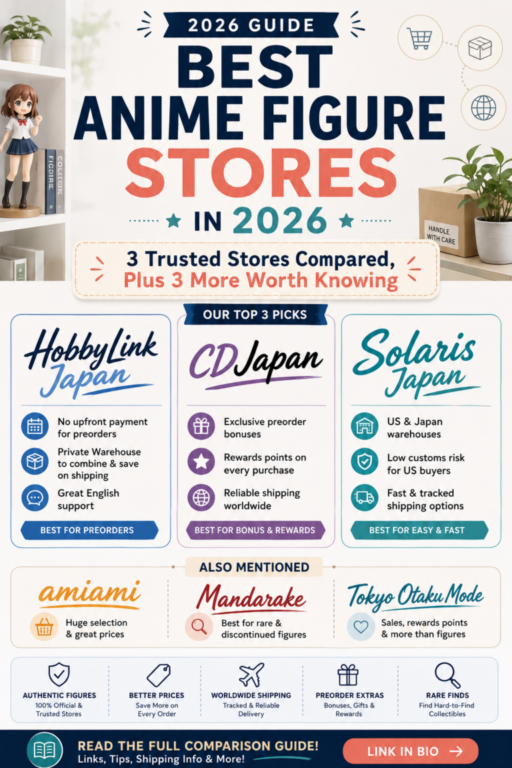
    This guide focuses on the three stores I trust and buy from personally — HobbyLink Japan, CDJapan, and Solaris Japan — with a quick look at a few other well-known names so you have the full picture.

    Who This Article Is NOT For

    Before we get into it, let’s save you some time if you’re not the right reader for this:

    • If you only want figures from your local comic shop or a US-based retailer with fast domestic shipping, this isn’t the guide for you — you’ll want a US-stocked retailer instead, which carries pre-imported inventory at a markup for speed.
    • If you’re chasing ultra-rare vintage garage kits from the 90s, that’s a different rabbit hole entirely (Yahoo Auctions Japan and proxy services), and none of the stores below specialize in that.
    • If price is truly no object and you just want zero hassle, an official brand store might suit you better than the Japan-based retailers I’m covering here, since they handle everything domestically.

    If none of those apply and you’re looking for the best balance of price, authenticity, and shipping reliability from Japan, keep reading.

    How I Picked These Stores (Selection Criteria)

    I didn’t just rank stores by name recognition. Every store on this list had to clear three bars:

    1. Verified authenticity track record. Every figure sold needs to be officially licensed stock, not recasts or bootlegs. I looked at how each store sources inventory, whether they work directly with manufacturers like Good Smile Company and Kotobukiya, and what collectors on forums and Reddit actually say about what showed up at their door.

    2. Genuine international shipping support. A lot of Japanese retail sites technically “have” an English version but fall apart the moment you try to check out with a non-Japanese address or card. I only included stores with a real, functioning international ordering process — tracked shipping, customs paperwork handled properly, and support staff who respond in English.

    3. Value for what you’re actually trying to do. “Cheapest” isn’t the same as “best value.” A store that’s dirt cheap but takes four months to ship, or charges you a fortune in unexpected fees, isn’t actually saving you money. I weighed price against reliability, return policy, and how painless the whole process is.

    Quick Comparison Table

    StoreBest ForNew or Pre-OwnedShipping ConsolidationTypical Price vs MSRPBeginner Friendly
    HobbyLink Japan (HLJ)Flexible preorders, no upfront paymentMostly newYes (Private Warehouse)At/near MSRPYes
    CDJapanPreorder bonuses, media + figures togetherNewYesAt MSRPYes
    Solaris JapanAvoiding customs surprises, US-side stockNewYes (dual warehouse)Slightly above MSRPYes

    In-Depth Reviews

    1. HobbyLink Japan (HLJ) — Best for Peace of Mind on Preorders

    HLJ’s standout feature is something called the Private Warehouse, which lets you hold multiple items for up to 60 days and ship them all together in one box. That alone can save a meaningful amount on international shipping if you’re ordering more than one figure at a time.

    Pros:

    • No upfront payment required for preorders — you’re only charged once the item actually arrives and ships
    • Preorders can be cancelled if you change your mind before release, which almost no other store allows
    • Private Warehouse consolidation cuts shipping costs on multi-item orders
    • Excellent English-language support, and a genuinely long operating history (since 1997)

    Cons:

    • Prices tend to sit closer to MSRP rather than offering steep discounts
    • Focused almost entirely on new stock, so it’s not the place to hunt for older or discontinued figures
    • The site’s search and filtering feels a bit dated compared to newer competitors

    In my experience, HLJ is the store I recommend most often to first-time buyers specifically because of the “pay when it ships” preorder model. There’s something reassuring about not having your money tied up for six months before a figure even exists.

    2. CDJapan — The Underrated Pick for Bonus Hunters

    CDJapan started as a music and media import shop and expanded into figures later, and that history still shows in the best possible way — it’s polished, professional, and reliable. What makes it worth a look is that figures here often come bundled with preorder bonuses (posters, extra accessories) that don’t show up anywhere else.

    Pros:

    • Preorder-exclusive bonuses add real value if you’re a completionist
    • Reliable, professional shipping and packaging
    • A point rewards system gives a small percentage back on every purchase, which stacks over time
    • Useful if you’re also buying CDs, Blu-rays, or artbooks, since it’s all in one cart
    • One of the longest-running international affiliate-friendly stores in this space, which speaks to how consistently they’ve treated overseas customers over the years

    Cons:

    • Prices are usually right at MSRP, with few discounts
    • Selection isn’t quite as deep as HLJ if figures are your only interest
    • Payment is charged at order time, not at shipping

    In my experience, CDJapan is the store I point completionist collectors toward — the bonus items they include aren’t gimmicks, they’re genuinely exclusive to ordering through them.

    3. Solaris Japan — Best If Customs Fees Give You Anxiety

    Solaris Japan operates a dual-warehouse model, with stock in both Japan and the US, and it’s built specifically around minimizing the customs headaches that come with importing collectibles.

    Pros:

    • US-based warehouse option means faster delivery and fewer customs surprises for North American buyers
    • Buy-direct-from-Japan option still available when you want the lower price and don’t mind the longer wait
    • Good customer service reputation, with real people answering questions promptly

    Cons:

    • Prices tend to run a bit higher than ordering directly from Japan-only stores, since you’re partly paying for the convenience
    • Catalog is smaller than HLJ
    • The dual-pricing system (Japan vs US stock) can be confusing the first time you use it

    In my experience, Solaris Japan is the one I recommend to anyone who’s been burned by a surprise customs bill before. Paying a little more upfront to know exactly what you owe is worth it for a lot of collectors, even if it’s not the cheapest option on paper.

    A Few Other Stores Worth Knowing About

    These didn’t make the main comparison because they either don’t run an accessible affiliate program or their process has some quirks worth flagging, but they’re still legitimate options worth knowing about as a collector:

    • AmiAmi — Frequently the first stop for long-time collectors thanks to below-MSRP pricing and a huge catalog covering both new and pre-owned figures.
    • Mandarake — The best source for rare, discontinued, or out-of-print figures, though the dated website interface takes some getting used to.
    • Tokyo Otaku Mode — A broader “otaku lifestyle” catalog beyond figures, with periodic sales worth watching for casual collectors.

    Which One Should You Actually Use? (By Use Case)

    “I’m buying my first figure and just want it to be safe and easy.” Go with HLJ. Excellent track record, English support, and a beginner-friendly “pay when it ships” checkout. In my experience, new collectors rarely regret starting here.

    “I hate surprise customs fees and just want it to show up without drama.” Solaris Japan’s US warehouse option is worth the small price premium. It’s the closest thing to a “set it and forget it” experience on this list. One heads-up if you’re comparison shopping right before a release: their promotional windows can move fast, so don’t sit on a decision too long once you’ve found what you want.

    “I want bonus items and a rewards program that actually pays off over time.” CDJapan’s preorder bonuses and point system reward loyalty in a way most competitors don’t bother with.

    “I order more than one figure at a time and want to save on shipping.” HLJ’s Private Warehouse consolidation is purpose-built for exactly this. Hold your items, ship once, pay less.

    “I want the absolute lowest price and don’t mind extra research.” Worth cross-checking AmiAmi’s pricing before you commit — it’s often the cheapest of the bunch, though it’s not part of the direct comparison above.

    Final Thoughts

    There isn’t one single “best” site here — that’s the honest answer, even though it’s not the satisfying one. What there is, though, is a right answer for you, depending on whether you care more about price, safety, or peace of mind on shipping.

    If you’re reading this and still not sure where to start, my honest recommendation is to make your first order through HLJ or CDJapan. Both are safe, well-reviewed, and forgiving for beginners — and if customs fees are your biggest worry, Solaris Japan is worth the small premium for the peace of mind.

    Ready to start your collection the right way? Check out https://www.hlj.com/, browse https://www.cdjapan.co.jp/, or see what https://solarisjapan.com/ has in stock this month.