Affiliate Disclosure: This post contains affiliate links. If you buy through one of them, I may earn a small commission at no extra cost to you. I only recommend stores I’ve actually ordered from or researched thoroughly — my opinions are my own.
The Problem: Figure Collecting Rarely Blows Your Budget All at Once
Nobody accidentally spends $2,000 on figures in a single afternoon. What actually happens is smaller and sneakier: a $65 Nendoroid here, a preorder there, shipping and customs tacked onto each one, and by the end of the year the total is a genuine surprise when you actually add it up.
In my experience, the collectors who feel good about their spending aren’t the ones who spend the least — they’re the ones who set an actual number ahead of time and have a system for tracking against it. This guide walks through how to build a collecting budget that’s realistic rather than aspirational, so it’s something you’ll actually stick to.
Who This Article Is NOT For
- If you already track your spending closely and feel good about it, you probably don’t need this — keep doing what’s working.
- If you’re buying your first figure and just want to get started, budgeting can wait until you have a better sense of your actual habits — start with my first-time buyer’s guide instead, and come back here once you’ve made a few purchases.
- If money genuinely isn’t a constraint for you, this article’s core value (help you avoid overspending) doesn’t really apply — buy what you love.
How to Build a Budget That Actually Works
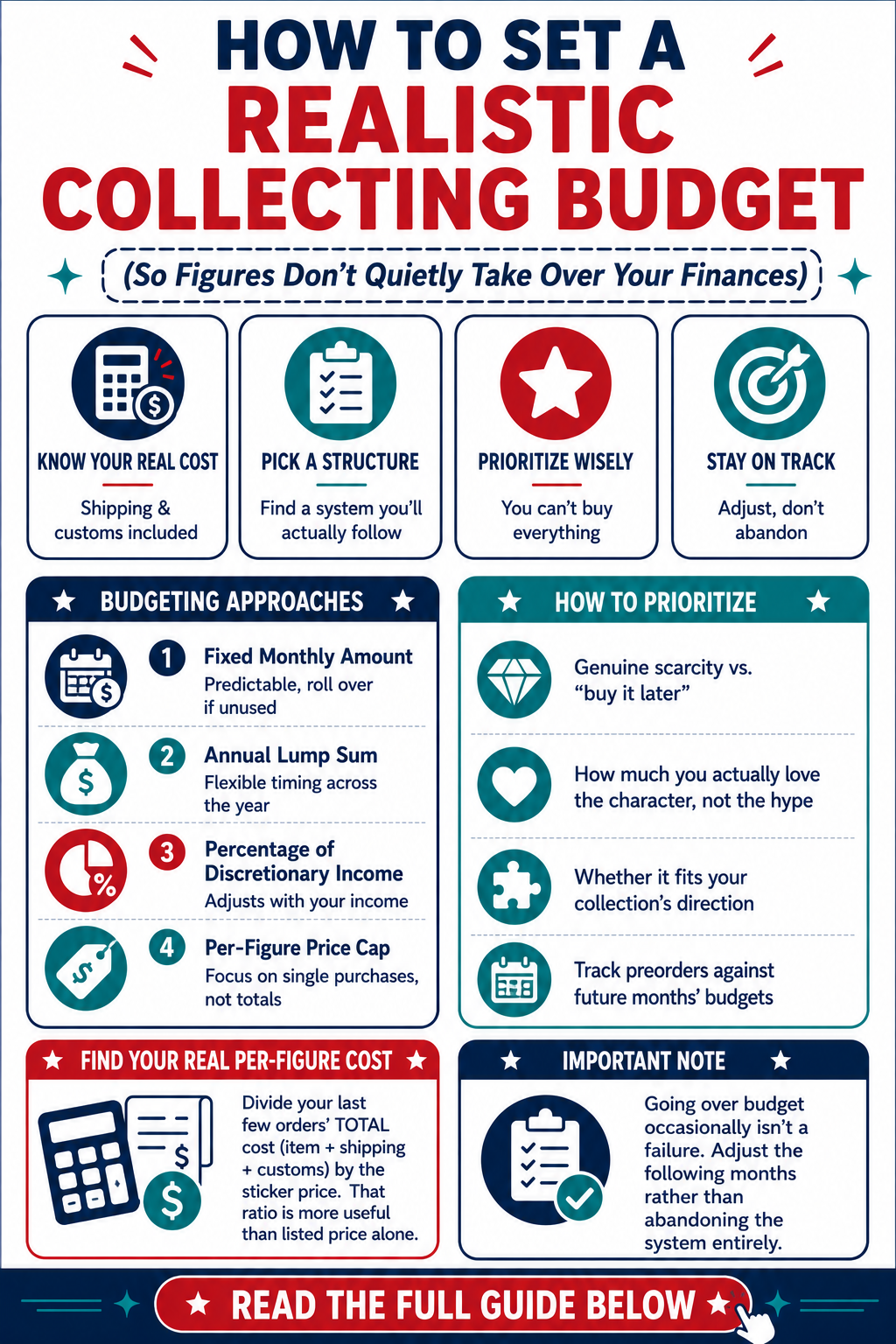
1. Calculate your true per-figure cost, not just the sticker price. Shipping and customs meaningfully change the real number, and skipping this step is the most common reason budgets fail.
2. Set a number before you start browsing, not after. Deciding what you can spend while looking at something you already want to buy rarely results in a realistic number.
3. Build in a system for prioritizing, since a fixed budget means you can’t buy everything — deciding in advance how you’ll choose matters more than the exact dollar figure.
Step 1: Know Your Real Per-Figure Cost
The sticker price is only part of what you’ll actually pay. Depending on your country, shipping and customs can add a meaningful percentage on top — and this varies significantly by country, so use your own actual recent orders as a baseline rather than assuming a flat percentage.
A simple way to find your real number: look back at your last few completed orders and calculate the actual total (item + shipping + any customs charged at delivery) divided by the sticker price. That ratio is a much more useful budgeting tool than the listed price alone, since it reflects what things really cost for you specifically.
Step 2: Pick a Budgeting Structure That Fits Your Habits
| Approach | How It Works | Best For |
|---|---|---|
| Fixed monthly amount | Set a consistent dollar amount each month, roll over unused amounts if you want | Collectors with steady income and a preference for predictability |
| Annual lump sum, allocated as you go | Decide a yearly total upfront, track spending against it as purchases happen | Collectors who prefer flexibility around when big purchases happen |
| Percentage of discretionary income | A fixed percentage of what’s left after essentials, adjusted naturally as income changes | Collectors whose income fluctuates |
| Per-figure cap with unlimited quantity | No overall budget, but a maximum price per individual figure | Collectors more concerned about single big purchases than total spending |
None of these is objectively correct — the right structure is whichever one you’ll actually follow. A perfectly designed budget you abandon after two months is less useful than a simpler one you stick with all year.
Step 3: Build a Prioritization System
A budget only works if you also have a way to decide what to buy when you can’t buy everything. A few practical filters:
- Genuine scarcity vs. “buy it later.” If something is genuinely limited and won’t come back, prioritize it over something you could reasonably order in a few months. My preorder tracking system is useful here — knowing well in advance what’s coming lets you plan your budget around genuinely time-sensitive purchases rather than reacting to everything as urgent.
- How much you actually love the character, rather than how much hype something has. Chasing every popular release is a much faster way to blow a budget than being selective about what you personally care about most.
- Whether it fits your existing collection’s direction. If you’ve settled into collecting mostly from certain genres or a specific type, an impulse purchase far outside that pattern is worth a second look before committing.
Dealing With Preorders in a Budget
Preorders complicate budgeting because the payment timing varies by store, and money committed months in advance is easy to lose track of. A few practical habits:
- Track preorders against future months’ budgets, not just the current one, especially with stores that charge at order time rather than at shipping
- Know your store’s payment timing before committing — HLJ’s pay-when-it-ships model, for example, doesn’t tie up your budget the same way an upfront-payment preorder does
- Keep a running list of committed-but-unshipped preorders and their expected cost, so you have visibility into money that’s already spoken for even though it hasn’t left your account yet
When You’ve Gone Over Budget
It happens. A few realistic options rather than just feeling bad about it:
- Adjust future months rather than abandoning the budget entirely. One over-budget month doesn’t mean the system failed — spend less over the following months to balance it out.
- Consider selling something to offset the cost. If your collecting priorities have shifted, my guide to selling figures safely covers how to do this without getting scammed or badly underpaid.
- Revisit whether your budget number was realistic in the first place. If you’re consistently going over, the number itself might need adjusting rather than your habits.
Frequently Asked Questions
How much do most collectors actually spend per year? This varies enormously based on figure type, frequency, and country — a collector buying mostly Nendoroids a few times a year spends very differently than someone buying premium scale figures monthly. Rather than benchmarking against a stranger’s number, your own realistic budget matters more than any average.
Should shipping and customs be part of my budget, or just the figure price? Definitely part of it — this is the single biggest reason budgets fail. Use your actual completed order totals (not just sticker prices) to set a realistic number.
Is it bad to go over budget occasionally? Not inherently — the goal of a budget is general financial awareness and control, not perfect adherence every single month. Adjusting the following months to compensate is a completely reasonable response to an occasional overspend.
What’s the best way to avoid impulse preorders wrecking my budget? A combination of tracking upcoming releases in advance (so nothing feels like a surprise you have to react to immediately) and giving yourself a short waiting period before committing to anything not already on your radar.
Final Thoughts
A collecting budget isn’t about spending less for its own sake — it’s about making sure your spending reflects an actual decision rather than a series of small purchases that add up before you notice. Know your real per-figure cost including shipping, pick a budgeting structure you’ll actually stick with, and build in a way to prioritize when you can’t buy everything you want.
If you’re just getting your collecting habits established, it’s worth revisiting my comparison of trusted Japan-based retailers and shipping and customs cost breakdown — together, they’re the foundation for actually knowing what your collecting habit costs.