Affiliate Disclosure: This post contains affiliate links. If you buy through one of them, I may earn a small commission at no extra cost to you. I only recommend stores I’ve actually ordered from or researched thoroughly — my opinions are my own.
The Problem: A Great Collection Can Still Look Underwhelming in a Bad Setup
I’ve written before about protecting your figures from sunlight, dust, and humidity — but there’s a separate question that matters just as much for how much you actually enjoy your collection: does the setup actually look good? A genuinely impressive figure lineup can still feel underwhelming crammed onto a cluttered shelf with bad lighting, while a more modest collection can look like a dedicated exhibit with the right setup.
In my experience, the gap between “figures on a shelf” and “a display that makes people stop and look” usually comes down to three things: the case or shelving itself, lighting, and a bit of intentional organization — none of which require a huge budget to get right.
Who This Article Is NOT For
- If you already have a display setup you’re happy with, this is more useful for someone actively planning or upgrading their setup.
- If you haven’t read my storage and display care guide yet, read that first — it covers the preservation side (UV, dust, humidity) that should inform any setup you build.
- If your collection is small enough that a single shelf handles it comfortably, most of this scales up for larger collections — feel free to take just the lighting section and leave the rest for later.
What Actually Makes a Display Setup Look Good
1. Consistent, flattering lighting. This single factor probably has the biggest visual impact for the least effort and cost.
2. A case or shelving system that fits your budget and space, from fully open shelving to a dedicated glass cabinet.
3. Intentional organization, rather than figures placed wherever there happened to be room.
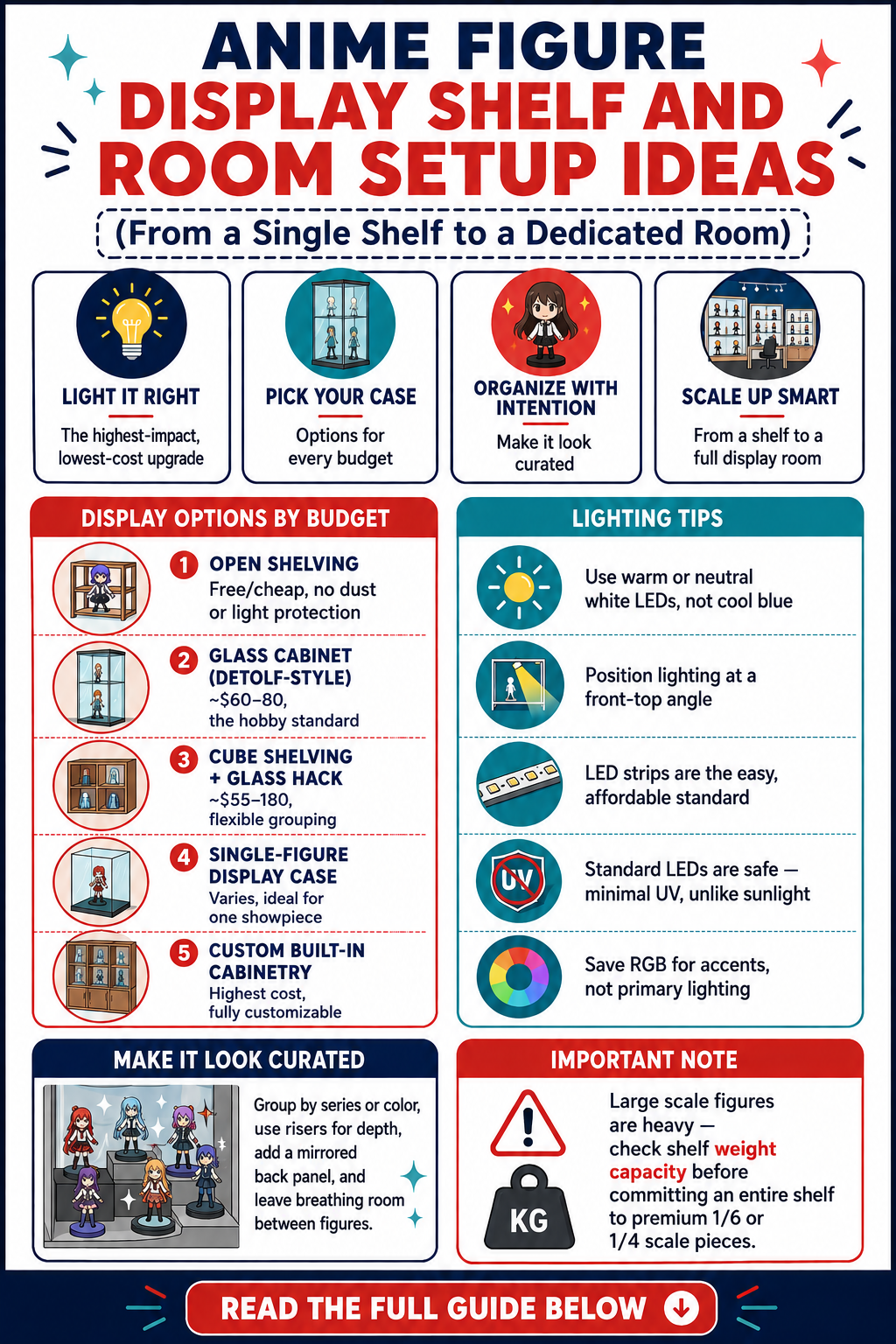
Display Options by Budget
| Option | Approximate Cost | Pros | Cons |
|---|---|---|---|
| Open shelving (bookshelf, floating shelves) | Whatever shelving you already have | Free or cheap, easy to access and rearrange | No dust or light protection on its own |
| IKEA Detolf-style glass cabinet | Roughly $60–80 | The most popular dedicated option in the hobby for good reason — glass panels, real dust protection, widely available | Fixed shelf spacing; the door magnet on some versions isn’t very strong |
| Cube/cubby shelving (e.g., Kallax-style) with a glass-front hack | Roughly $55–180 depending on size and configuration | Flexible grouping by cube, good for larger collections, popular DIY modification target | Requires more setup effort if you’re adding glass fronts yourself |
| Dedicated single-figure display case | Varies, often sold specifically for premium figures | Ideal for a single showpiece scale figure; often comes with built-in lighting | Not cost-effective for a large collection |
| Built-in or custom cabinetry | Highest cost, highly variable | The most polished, “museum” look; fully customizable | Requires real budget and often professional installation |
For most collectors starting a dedicated display for the first time, a glass cabinet in the IKEA Detolf style is genuinely the standard recommendation across the hobby — it’s affordable, provides real dust protection, and looks clean without requiring any DIY skill.
Lighting: The Highest-Impact Upgrade for the Lowest Cost
If you upgrade only one thing, make it lighting. A well-lit display with basic figures consistently looks better than an unlit one with premium figures.
- Use warm or neutral white LEDs, not cool blue. Cool-toned lighting tends to make skin tones and paint finishes look artificial and washed out; warm or neutral white (roughly in the 2700–4000K range) is generally considered the most flattering for figure display.
- Position lighting at a front-top angle, angled slightly downward and inward. This avoids the harsh shadows that come from lighting figures straight-on or from directly above.
- LED strip lighting is the standard, affordable solution. Adhesive LED strips along the interior top edge of a case or shelf are inexpensive, easy to install without any wiring experience, and dramatically improve how a collection looks.
- Standard household LEDs are safe for long-term use. Unlike natural sunlight, quality LED lighting emits minimal UV and produces very little heat, which matters given how permanent UV damage is — this is genuinely one of the safer lighting choices for long-term figure display, as opposed to leaving a case near a window.
- Avoid relying on RGB lighting as your primary light source. It looks flashy in photos but tends to render fine paint and sculpt detail less accurately than warm or neutral white — reserve colored lighting for accent effects rather than your main illumination.
Organizing Your Collection So It Actually Looks Curated
- Group by series, color palette, or figure line rather than placing figures in the order you acquired them — a shelf that flows logically reads as intentional, while a random arrangement reads as cluttered even with great individual pieces.
- Use risers or small stands to add depth. Placing every figure at the same flat level makes even a great collection look one-dimensional; small clear acrylic risers (the kind sold for cupcake displays or spice racks work fine) let you stagger height and create visual layers.
- Consider a mirrored back panel for glass cabinets. This is a common upgrade for Detolf-style cases specifically, and it makes a shelf look fuller and adds visibility to details on the back of figures you’d otherwise never see.
- Leave some breathing room. Packing figures edge-to-edge undersells detail work on figures that deserve room to be seen individually — a slightly sparser, well-spaced shelf often looks more premium than a tightly packed one.
- Mind weight capacity if you collect larger scale figures. Larger scale pieces can weigh considerably more than Nendoroids or Figma figures, and cheaper particle-board shelving can bow under sustained heavy loads over time — this is worth checking before committing an entire shelf to premium 1/6 or 1/4 scale pieces.
Scaling Up: From a Shelf to a Room
If your collection has genuinely outgrown a single case, a few practical approaches for scaling up:
- Add cases incrementally rather than all at once. Multiple matching glass cabinets (several Detolf-style units side by side, for example) create a cohesive “wall of figures” look without needing a single large custom build.
- Dedicate a specific wall or corner rather than spreading figures throughout a room. A concentrated display area reads as much more intentional than figures scattered across multiple pieces of furniture in different parts of a room.
- Plan lighting at the room level, not just per case. Ambient room lighting affects how your case lighting reads — a dim room with well-lit cases tends to make the display pop more than a brightly lit room competing with your case lighting.
- Think of the space progressively, like a small museum. As a collection grows, treating the display space as something to plan intentionally — sightlines, groupings, focal pieces — pays off more than continuing to add figures to whatever shelf has room left.
Frequently Asked Questions
Is the IKEA Detolf actually the best option, or just the most popular? It’s popular because it hits a genuinely strong balance of price, availability, and function — real glass panels, decent dust protection, and a size that works for most rooms. It’s not the only good option, but it’s a reliable, low-risk starting point if you’re not sure what to get.
Does lighting actually make that much difference? Yes, more than most new collectors expect. The same figures under flat ambient room light versus a well-angled warm-white LED setup can look like a completely different display — it’s consistently the highest-impact, lowest-cost upgrade available.
Will LED lighting damage my figures the way sunlight does? Standard household LED lighting is a safe long-term choice, since it produces minimal UV output compared to natural sunlight, which is where the real risk of yellowing and fading comes from. It’s a meaningfully safer choice than displaying figures anywhere near a window.
How do I keep a large collection from looking cluttered? Grouping by series or color, using risers for visual depth, and leaving some breathing room between pieces all help a large collection read as curated rather than crowded — it’s more about organization than simply having more shelf space.
Final Thoughts
A great display setup doesn’t require a huge budget — it requires a bit of intention about lighting, a case that fits your space and collection size, and organization that lets individual figures actually stand out rather than competing for attention. Start with lighting if you do nothing else; it’s the single change most likely to make your existing collection look noticeably better.
Once your display setup is sorted, it’s worth revisiting my guide to protecting figures long-term to make sure your new setup is working with your figures’ longevity, not against it — and if you’re still growing the collection itself, my comparison of trusted Japan-based retailers is the place to start for what goes on those new shelves.