Affiliate Disclosure: This post contains affiliate links. If you buy through one of them, I may earn a small commission at no extra cost to you. I only recommend stores I’ve actually ordered from or researched thoroughly — my opinions are my own.
The Problem: Everyone Says “Go to Akihabara,” But That’s Only Half the Story
If you’re planning a trip to Japan and figure shopping is on your list, Akihabara is probably the only name you’ve heard so far — and it’s a completely legitimate recommendation. But after living in Japan for 24 years, I can tell you it’s not the only place worth your time, and depending on what you’re actually hunting for, it might not even be the best one.
In my experience, most first-time visitors end up doing Akihabara exactly the way every travel blog describes, then leaving without ever hearing about Nakano Broadway — which, for serious collectors specifically, is often the better trip. This guide covers both, honestly, so you can plan around what you’re actually looking for rather than just following the crowd.
Who This Article Is NOT For
- If you’re not planning to visit Japan in person, this doesn’t apply to you directly — stick with my comparison of trusted online retailers instead.
- If you want a full otaku-culture day out (arcades, maid cafes, gachapon) rather than focused figure shopping, Akihabara covers that broader experience much better than Nakano Broadway does — this guide focuses specifically on figure buying.
- If you’re chasing only brand-new releases and don’t care about secondhand or rare finds, Akihabara’s newer-focused stores will serve you better than Nakano Broadway’s secondhand-heavy ecosystem.
How These Two Districts Actually Differ
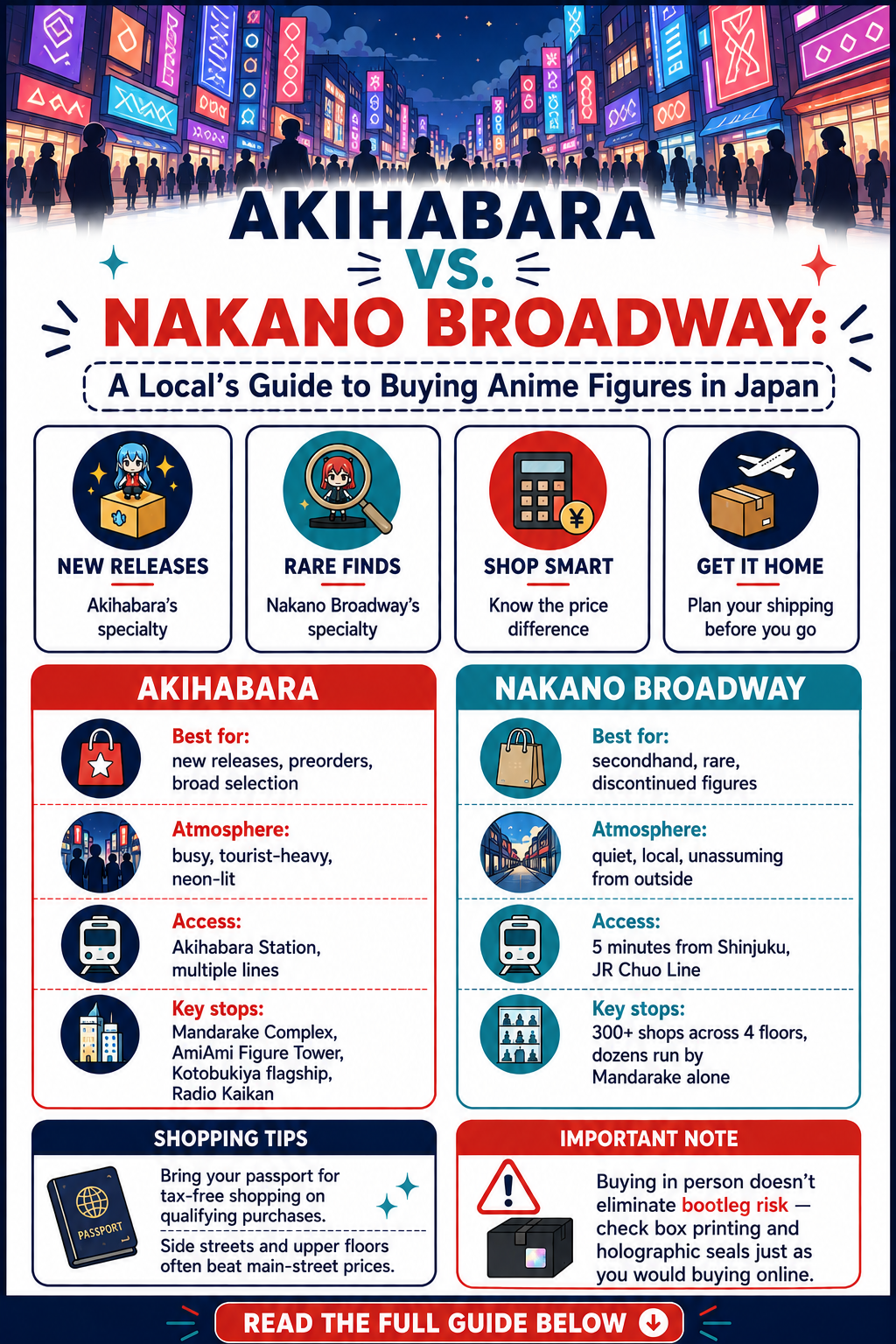
1. New vs. secondhand emphasis. Akihabara leans toward new releases and current stock; Nakano Broadway leans heavily toward secondhand, rare, and out-of-production figures.
2. Atmosphere and crowd level. Akihabara is loud, tourist-heavy, and can carry a bit of a markup because of it; Nakano Broadway is quieter, more locally-oriented, and often better value as a result.
3. Store density and specialization. Akihabara has large individual stores with broad selection; Nakano Broadway has dozens of small, hyper-specialized shops under one roof.
Quick Comparison: Akihabara vs. Nakano Broadway
| Akihabara | Nakano Broadway | |
|---|---|---|
| Best for | New releases, preorders, broad selection | Secondhand, rare, discontinued figures |
| Atmosphere | Busy, tourist-heavy, neon-lit | Quiet, local, unassuming from outside |
| Access | Akihabara Station, multiple lines | 5 minutes from Shinjuku on the JR Chuo Line |
| Pricing | Can run higher on the main street, especially for tourist-facing shops | Often noticeably better value, particularly for secondhand |
| Store structure | Fewer, larger stores | 300+ shops across four floors, dozens run by Mandarake alone |
Akihabara: Your Best Bet for New Releases and Broad Selection
Akihabara is genuinely worth the trip, and it earns its reputation. A few stores worth prioritizing:
- Mandarake Complex — an eight-floor building dedicated to secondhand figures, manga, and collectibles, organized by category per floor. Even though Mandarake is more associated with Nakano Broadway, this Akihabara location is a serious destination in its own right.
- AmiAmi’s Akihabara figure tower — a multi-floor store from the well-known online retailer, stocked with new scale figures, prize figures, and preorders.
- Kotobukiya’s flagship Akihabara store — their own scale figures, plastic model kits, and store-exclusive goods, all under one roof.
- Akihabara Radio Kaikan — a landmark hobby building near the station with roughly ten floors of figure, model, and collectible shops.
A practical tip: the main street draws heavy tourist traffic, and pricing on that strip can reflect it. Side streets and upper floors of the larger buildings tend to hold better value than the ground-floor, main-street storefronts.
Nakano Broadway: The Serious Collector’s Trip
Nakano Broadway doesn’t look like much from the outside — it reads as a fairly ordinary neighborhood shopping building. Inside, it’s genuinely one of the densest concentrations of rare anime and figure merchandise anywhere in Tokyo, and it’s where Mandarake itself was founded back in 1980.
Mandarake alone operates dozens of individual specialty shops here, each focused on a specific category rather than one general store:
- Mandarake Main Store — general manga, artbooks, and anime goods; a reasonable starting point if you’re not sure exactly what you’re hunting for
- Mandarake Special — dedicated to figures and model kits, including a genuinely enormous selection of out-of-production pieces you won’t easily find anywhere else
- Additional specialty shops covering doujinshi, vintage toys, cosplay items, and more, each run independently under the same umbrella
If you’ve read my guide to buying secondhand figures, the condition grading concepts there apply directly here — Japanese secondhand shops are generally meticulous about condition assessment, and Nakano Broadway’s Mandarake locations are a great place to actually practice reading those grades in person before you buy.
Practical Tips for Shopping in Person
- Tax-free shopping is genuinely worth using. As a visiting tourist, you can generally get purchases exempted from Japan’s consumption tax on qualifying totals at participating stores — bring your passport, since it’s required for the tax-free process.
- Check authenticity the same way you would buying online. My guide to spotting bootlegs still applies in person — look for crisp box printing, manufacturer holographic seals, and buy from reputable, established shops rather than unfamiliar sellers.
- Plan for how you’ll get everything home. Figures are fragile and often bulky — decide before you go whether you’re checking a bag with extra padding, or looking into international shipping services from Japan for a larger haul, since carrying multiple scale figures home in a carry-on isn’t always realistic.
- Budget more time for Nakano Broadway than you’d expect. The sheer number of small specialty shops means a thorough visit takes longer than the compact footprint suggests — don’t try to squeeze it into a rushed hour between other plans.
- Compare in-person prices against what you’d pay importing. Figures are often somewhat cheaper bought directly in Japan than imported, since you’re skipping international shipping and, depending on your country, potential customs charges — worth keeping in mind if you’re deciding between buying now in person or preordering something for later delivery.
Which Should You Visit? (By Priority)
“I want new releases, preorders, and a big otaku-culture day out.” Akihabara. It’s the more complete experience if figure shopping is one part of a broader visit.
“I’m hunting something discontinued or rare that I can’t find anywhere else.” Nakano Broadway, specifically Mandarake’s figure-focused shops. This is genuinely one of the best places in the world for exactly this kind of hunt.
“I only have time for one district.” If your main goal is buying figures rather than the broader Akihabara experience, Nakano Broadway often delivers better value and a calmer shopping pace — but if you want the full sensory experience of Japan’s otaku culture (arcades, themed cafes, the neon and crowds), Akihabara is worth prioritizing instead.
“I want both, but I’m short on time.” They’re genuinely doable in one trip if you plan for it — Nakano Broadway is about 25 minutes from Akihabara via Shinjuku, so a determined collector can realistically hit both in a single day with early planning.
Frequently Asked Questions
Is Nakano Broadway harder to get to than Akihabara? Not really — it’s about five minutes from Shinjuku Station on the JR Chuo Line, making it genuinely accessible from most parts of central Tokyo.
Are prices actually better at Nakano Broadway? Generally yes, particularly for secondhand goods, since it draws a more local, less tourist-driven crowd than Akihabara’s main strip. New releases are priced similarly across both areas.
Do I need to worry about bootlegs shopping in person the same way I would online? Yes — buying in person doesn’t eliminate authenticity risk, though established shops like Mandarake, AmiAmi, and Kotobukiya are reliable choices either way. The same checks that apply to online purchases are worth keeping in mind in person too.
Can I ship my purchases home instead of carrying them? Many larger stores can arrange this, and dedicated shipping/forwarding services exist specifically for this purpose if you’ve bought more than you can reasonably carry. Worth asking about at the point of purchase if you’re planning a larger haul.
Final Thoughts
Akihabara earns its reputation, but it’s genuinely only half the picture for serious figure collectors visiting Japan. If your trip allows for it, seeing both districts gives you the best of new-release excitement and rare secondhand hunting — but if you have to choose, let what you’re actually looking for (new vs. rare, browsing vs. hunting) make the decision rather than just following whichever place gets mentioned first online.
If a trip to Japan isn’t in your near future, the good news is you don’t need one to collect well — my comparison of trusted online retailers covers how to buy safely and confidently from anywhere in the US, UK, Australia, or Canada.