タグ: Good Smile Company

  • My Figure Has a Manufacturing Defect — Now What? (It’s Not a Bootleg)

    My Figure Has a Manufacturing Defect — Now What? (It’s Not a Bootleg)

    Affiliate Disclosure: This post contains affiliate links. If you buy through one of them, I may earn a small commission at no extra cost to you. I only recommend stores I’ve actually ordered from or researched thoroughly — my opinions are my own.

    The Problem: Something’s Wrong, But It’s Genuinely Authentic

    You’ve bought from a trusted retailer, checked the authentication details, and you’re confident it’s real — but something is genuinely wrong. A bow that’s supposed to be sewn onto the skirt is missing. The paint on a bare-skin part looks discolored in a way it shouldn’t. A joint doesn’t hold its pose at all right out of the box. This isn’t a bootleg problem — it’s a manufacturing defect, and it happens even to major, reputable manufacturers.

    The good news is that legitimate manufacturers generally do have a real process for this — it’s just a different process than a shipping damage claim or a bootleg situation, and knowing which one applies matters for actually getting it resolved.

    Who This Article Is NOT For

    • If you suspect the figure itself might not be authentic, this isn’t the right guide — check my bootleg-spotting guide first, since manufacturer defect support only applies to genuine products.
    • If the box arrived visibly crushed or the figure was clearly damaged in transit, that’s a shipping damage situation, not a manufacturing defect — see my shipping insurance and damage claims guide instead.
    • If you dropped, broke, or lost a part yourself after opening the figure, manufacturers generally don’t cover this — see the eligibility section below for why.

    How to Tell the Difference: Defect vs. Damage vs. Bootleg

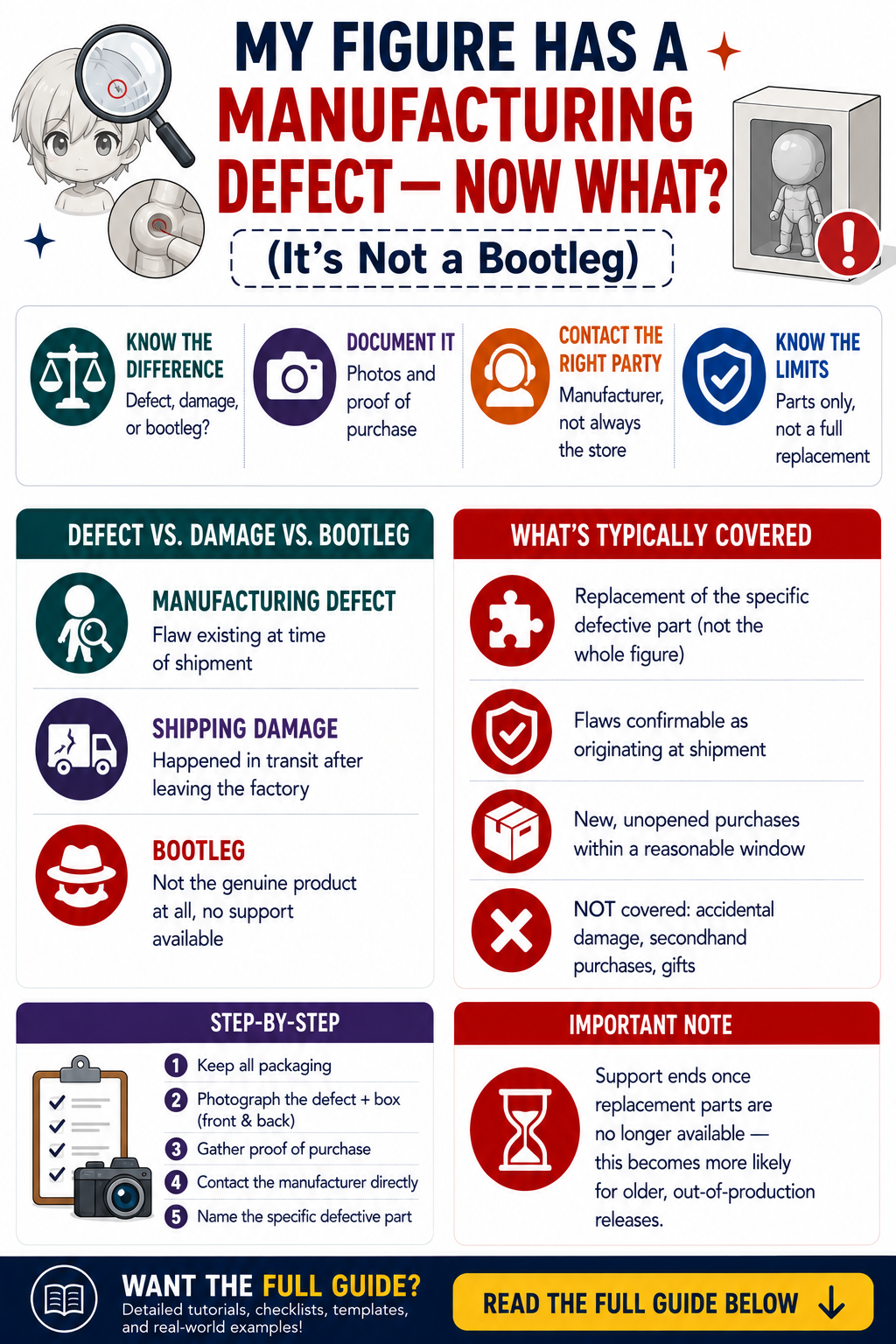
    1. A manufacturing defect is a flaw that existed at the time the product left the factory — discoloration, a missing accessory that should have been included, paint that never adhered correctly, or a joint that was assembled incorrectly.

    2. Shipping damage happens after the figure left the factory in good condition, during transit — a cracked box, a snapped part from rough handling, or damage clearly caused by impact.

    3. A bootleg isn’t the genuine product at all — it’s an unauthorized copy, and no legitimate manufacturer will offer support for it, regardless of how convincing the fake is.

    Manufacturers generally require you to sort out which category applies before contacting them, since defect support and damage claims go through different processes entirely.

    What Manufacturers Will Actually Cover

    Based on how major manufacturers like Good Smile Company structure their support policies, a few consistent patterns show up:

    • They typically replace or exchange only the defective part, not the entire figure — don’t expect a full replacement unit in most cases
    • The defect generally needs to be something confirmable as originating at the time of shipment, not something that could plausibly have happened after you received it
    • Cosmetic flaws in areas that don’t affect visible appearance (a scuff on the underside of a base, for example) are often explicitly excluded from support, even if technically a manufacturing imperfection
    • Support typically doesn’t extend to opened, secondhand, or long-held items. A common cutoff is products already transferred to a third party, or held for several months past delivery — check the specific manufacturer’s policy, since exact windows vary
    • Gifts and items bought through private/secondhand marketplaces are frequently excluded, since the manufacturer generally can’t verify the original purchase chain
    • Support ends once replacement parts are no longer available, which becomes more likely for older releases — a manufacturer may simply not be able to help with a defect on a figure that’s been out of production for years

    What to Do, Step by Step

    1. Don’t discard any packaging or accessories, even ones that seem unrelated to the defect — you may be asked to document the full contents
    2. Photograph the defect clearly, along with the figure as a whole and both the front and back of the box
    3. Gather your proof of purchase — order confirmation, receipt, or account order history showing when and where you bought it
    4. Contact the manufacturer directly, not just the retailer, for defect-specific issues — major manufacturers typically handle this through their own dedicated support channels rather than through the store you purchased from
    5. Describe the specific defective part clearly, using the part name or code from the instruction manual if one was included, since manufacturers generally process requests part-by-part rather than as a general complaint
    6. Be patient with the review process. Each case is typically reviewed individually, and response times vary — this isn’t usually an instant resolution

    A Note on Known, Larger-Scale Defect Issues

    Occasionally, a manufacturer identifies a defect affecting an entire product line rather than isolated units — for example, a paint finish issue that causes gradual discoloration on bare-skin parts across a specific run of figures. When this happens, reputable manufacturers have issued public notices, extended replacement request windows (sometimes even for units not yet showing symptoms), and proactively supported affected customers. If you own a figure from a release that’s had public attention for a known issue, it’s worth checking the manufacturer’s official announcements page directly, since these situations sometimes come with specific deadlines to request support.

    Frequently Asked Questions

    Will the manufacturer replace my entire figure if a small part is defective? Generally no — expect a replacement of the specific defective part rather than the whole figure, based on how major manufacturers structure this kind of support.

    Can I get defect support if I bought the figure secondhand? Usually not — most manufacturer defect policies explicitly exclude secondhand purchases and gifts, since they can’t verify the original purchase chain. This is one more reason buying new from a trusted retailer has real advantages beyond just authenticity.

    What if I accidentally broke a part myself — will they still help? Typically not. Manufacturer defect support is generally limited to flaws that existed at the time of shipment, not damage that occurred afterward, even if it was accidental on your part.

    Should I contact the retailer or the manufacturer for a defect? For manufacturing defects specifically, major manufacturers generally prefer to handle this directly through their own support channels, rather than through the retailer. Retailers are usually your first stop for shipping damage or order issues instead.

    Final Thoughts

    A manufacturing defect on a genuine figure isn’t the same problem as a bootleg or a shipping accident, and treating it as the right category matters for actually getting it resolved. Document everything, contact the manufacturer directly with clear photos and proof of purchase, and understand upfront that support typically covers replacement parts rather than a whole new figure — and generally only for items bought new, held for a reasonable window, and not already transferred to someone else.

    If you’re not sure whether what you’re looking at is a defect, shipping damage, or something more concerning, my guide to spotting bootlegs and shipping insurance guide cover the other two situations in more depth.
  • Good Smile Company vs. Kotobukiya vs. Alter: Anime Figure Manufacturers, Explained

    Good Smile Company vs. Kotobukiya vs. Alter: Anime Figure Manufacturers, Explained

    Affiliate Disclosure: This post contains affiliate links. If you buy through one of them, I may earn a small commission at no extra cost to you. I only recommend stores I’ve actually ordered from or researched thoroughly — my opinions are my own.

    The Problem: The Same Character, Made By Five Different Companies, Looking Five Different Ways

    Once you’ve been collecting for a little while, you’ll run into this: a character you love has been sculpted by Good Smile Company, Kotobukiya, Alter, and a couple of smaller manufacturers, and each version looks and costs noticeably different. Without knowing what each company is actually known for, it’s hard to tell whether you’re choosing based on real quality differences or just whichever product photo happened to look best.

    In my experience, once you learn a handful of manufacturers’ general reputations and specialties, this decision gets a lot easier — not because one company is universally “best,” but because each has a genuinely distinct style and focus that suits different priorities.

    Who This Article Is NOT For

    • If you only buy from one manufacturer already and you’re happy with that, there’s no need to overhaul your approach — this is most useful when you’re actively deciding between multiple versions of the same character.
    • If you haven’t read my Nendoroid vs Figma vs Scale Figure guide yet, that’s the more fundamental decision — this article assumes you already know roughly which type you want and are now choosing between manufacturers within that type.
    • If brand doesn’t matter to you at all and you buy purely on character and price, that’s a completely reasonable approach — this article is for the specific moment when you’re comparing multiple versions of the same figure.

    How These Manufacturers Actually Differ

    1. Style and sculpting approach. Some companies lean toward softer, cuter proportions; others aim for lifelike realism; still others specialize in dynamic, action-oriented poses.

    2. Price positioning. Manufacturers occupy genuinely different price tiers, and that’s tied to their production philosophy, not just brand markup.

    3. What they’re specifically known for. Most of these companies have a specialty — chibi figures, premium scale statues, highly articulated action figures — that’s worth knowing before comparing two versions of the same character.

    Quick Comparison: Major Manufacturers

    ManufacturerKnown ForTypical Price RangeStyle Signature
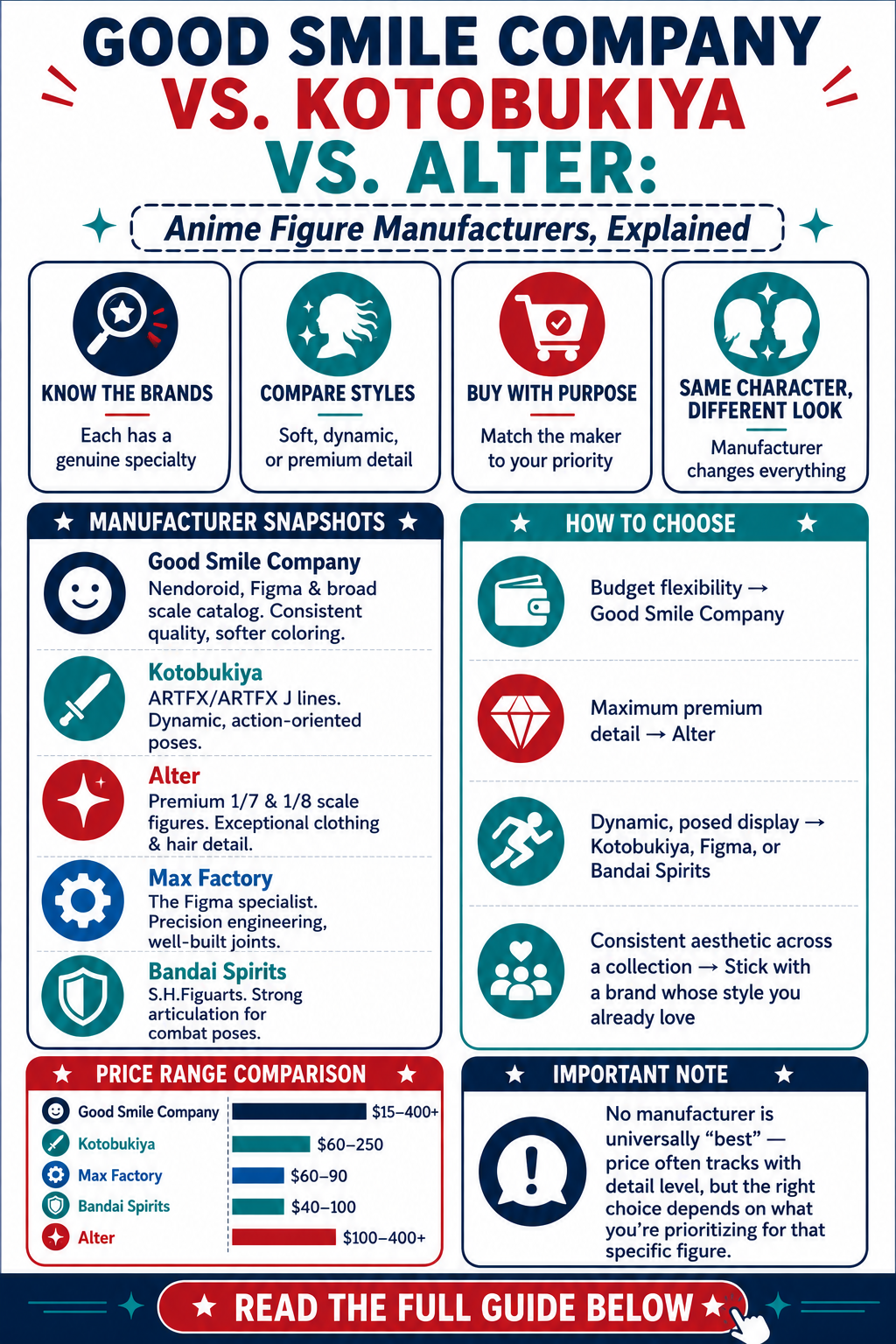
    Good Smile Company (GSC)Nendoroid, Figma (via Max Factory), and a broad scale figure catalog$15–400+ depending on lineConsistent quality, softer color palettes, distinctive illustrated box art
    KotobukiyaARTFX/ARTFX J lines, Bishoujo statues, plastic model kits$60–250Dynamic poses, strong presence in both anime and game character figures
    AlterPremium 1/7 and 1/8 scale figures$100–400+Exceptionally detailed sculpting, especially clothing and hair; among the most premium-positioned manufacturers
    Max FactoryFigma line specifically, plus some scale work$60–90 for FigmaEngineered articulation, often described as combining Alter-level precision with GSC’s softer coloring
    Bandai SpiritsS.H.Figuarts and other highly articulated action-figure-style lines$40–100Strong articulation aimed at dynamic action poses, particularly for battle-heavy series

    Good Smile Company: The Broad, Reliable Generalist

    Good Smile Company is probably the name you’ll encounter most often, and for good reason — their catalog spans budget-friendly chibi figures all the way up to premium scale pieces, and their quality is generally consistent across that whole range. They’re the company behind Nendoroid and, through their relationship with Max Factory, Figma, which alone makes them a company most collectors end up owning something from.

    Collectors often describe GSC’s scale figures as having a slightly softer color palette compared to Alter’s more true-to-source coloring, and their packaging is genuinely notable in its own right — GSC scale figure boxes typically include original illustration artwork on the side, which some collectors display or keep specifically for that reason.

    Kotobukiya: Dynamic Poses and Broad Franchise Coverage

    Kotobukiya has been producing figures since the 1980s, and their ARTFX and ARTFX J lines are known for dynamic, action-oriented poses across both anime and video game franchises. They also have a significant presence in plastic model kits, which sets them apart from manufacturers focused purely on pre-painted figures.

    If you’re comparing a Kotobukiya version of a character against a more static competitor, the pose itself is often the differentiator — Kotobukiya tends to favor capturing a character mid-action rather than a calm, neutral stance.

    Alter: The Premium Specialist

    Alter has built its entire reputation around one thing: exceptionally detailed 1/7 and 1/8 scale figures, generally positioned at the premium end of the price range. Collectors consistently point to their clothing and hair detail work as a standout, along with expressive, lifelike facial sculpting. This isn’t the manufacturer to look at if you’re working with a tight budget, but if you’re choosing a single showpiece figure for a character you love most, Alter is frequently the answer serious collectors reach for.

    Max Factory: The Figma Specialist

    Max Factory is closely associated with Good Smile Company and is specifically responsible for the Figma line. Collectors often describe their work as combining Alter-level sculpting precision with Good Smile’s softer color approach — a reasonable way to think about them is as the company behind the articulated, posable side of the hobby specifically, with a reputation for genuinely well-engineered joints that hold up to repeated posing.

    Bandai Spirits: Built for Action

    Bandai Spirits’ S.H.Figuarts line (and similar offerings) leans heavily into strong articulation aimed at recreating dynamic combat and action poses, which pairs naturally with battle-heavy series. If Figma is your reference point for posable figures, Bandai Spirits’ lines are worth comparing directly against it — both prioritize dynamic posing, but with different engineering approaches and slightly different aesthetic sensibilities.

    How to Actually Choose Between Manufacturers for the Same Character

    • If budget is your main constraint, Good Smile Company’s broader price range generally offers the most flexibility, from budget-friendly to premium within the same brand.
    • If you want the most premium, detailed version available, Alter is usually the name to check first, accepting the higher price tag that comes with it.
    • If you want the figure posed dynamically rather than standing still, compare Kotobukiya, Figma (Max Factory), and Bandai Spirits’ offerings for that character rather than a static scale figure.
    • If you already know you love a specific line’s overall aesthetic (GSC’s softer coloring, Alter’s lifelike detail, Kotobukiya’s dynamic energy), that consistency across their catalog is often a more reliable guide than judging any single product photo in isolation.

    Frequently Asked Questions

    Is one manufacturer objectively “the best”? No — each has a genuine specialty and price positioning, and “best” depends entirely on what you’re prioritizing: budget flexibility (Good Smile Company), premium detail (Alter), dynamic posing (Kotobukiya, Figma, Bandai Spirits), or a specific aesthetic style.

    Why do two figures of the same character look so different depending on manufacturer? Each company interprets the source material through its own sculpting and coloring approach — this is a real, consistent stylistic difference, not just random variation between individual products.

    Are more expensive manufacturers always higher quality? Generally, price does track with detail level and production care in this hobby, but “higher quality” doesn’t automatically mean “better for you” — a Nendoroid from Good Smile Company and a premium Alter scale figure are both well-made, just built for completely different purposes and budgets.

    Does the manufacturer affect authenticity risk? Not directly, but well-known manufacturers and their popular lines are more frequently targeted by bootleggers simply due to higher demand — buying from a trusted retailer matters regardless of which manufacturer made the figure.

    Final Thoughts

    Once you know a handful of manufacturers’ general reputations, choosing between multiple versions of the same character stops being a guessing game based on product photos alone. Good Smile Company offers breadth and reliability, Alter specializes in premium detail, Kotobukiya and Bandai Spirits lean into dynamic posing, and Max Factory anchors the articulated Figma line specifically — knowing which of those priorities matters most to you makes the decision genuinely straightforward.

    If you’re still working out which figure type suits you best before worrying about manufacturer, my Nendoroid vs Figma vs Scale Figure guide is the right place to start, followed by my comparison of trusted Japan-based retailers for where to actually buy.