タグ: First-Time Buyers

  • Best Anime Figures for Beginners: Where to Actually Start Your Collection

    Best Anime Figures for Beginners: Where to Actually Start Your Collection

    Affiliate Disclosure: This post contains affiliate links. If you buy through one of them, I may earn a small commission at no extra cost to you. I only recommend stores I’ve actually ordered from or researched thoroughly — my opinions are my own.

    The Problem: Too Many Options Makes It Hard to Just Start

    If you’ve decided you want to start collecting anime figures, the sheer number of options can be genuinely paralyzing — Nendoroid or Figma or scale figure, which manufacturer, which character, how much to spend, where to even buy it from. It’s a lot to figure out before you’ve even made your first purchase.

    In my experience, the collectors who get stuck the longest aren’t the ones who don’t know what they like — they’re the ones trying to make the “perfect” first decision instead of just making a reasonable one. This guide is meant to cut through that: a straightforward starting point based on what actually works well for a first purchase, without needing to have every preference figured out in advance.

    Who This Article Is NOT For

    • If you’ve already made your first purchase and are past this stage, this is more useful to share with someone else just getting started than for yourself at this point.
    • If you already know exactly what you want, there’s no need to overthink it with a “beginner framework” — go buy it.
    • If budget genuinely isn’t a factor for your first purchase, some of the cost-based reasoning here matters less — buy whatever excites you most.

    What Actually Makes a Good First Figure

    1. Low financial risk. Your first purchase is also your first chance to learn how a store’s shipping, packaging, and process actually works — you want that learning experience to come from something affordable, not your most expensive purchase.

    2. Broad appeal and availability. A figure type with a huge catalog gives you the best chance of finding a character you already love, rather than compromising on your first purchase.

    3. Manageable commitment. Something that doesn’t require special display considerations, extensive posing skill, or a big shelf investment right away.

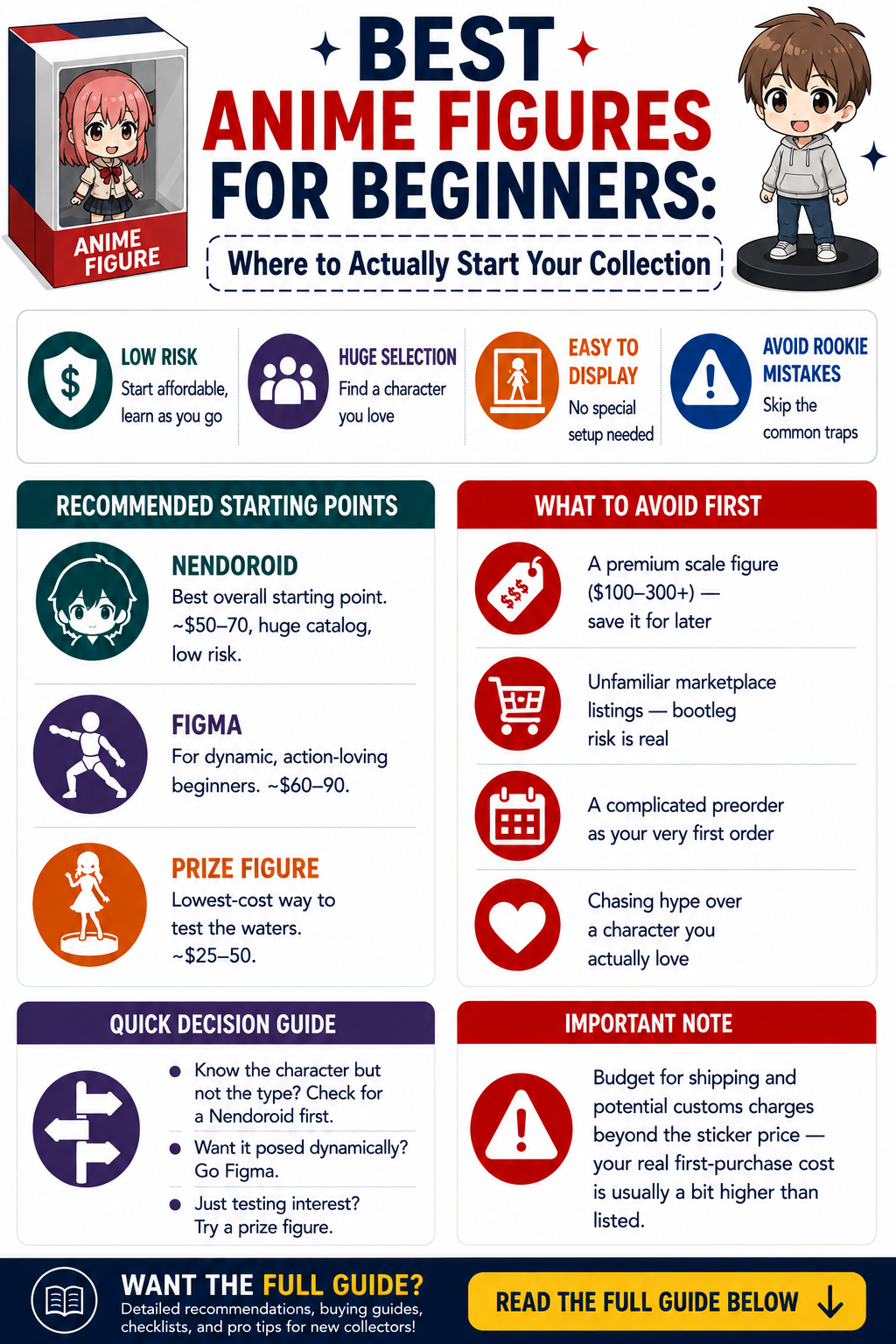
    The Recommended Starting Point: Nendoroid

    If you only take one piece of advice from this article, it’s this: for almost every new collector, a Nendoroid is the right first purchase.

    • Price is low-risk. Generally in the $50–70 range, which means a purchase that doesn’t go perfectly (wrong character choice, wanting something different next time) doesn’t sting financially.
    • The catalog is enormous. If a character has merchandise at all, there’s a strong chance a Nendoroid exists for them, which means you’re very likely to find one of a character you already love rather than settling.
    • They’re genuinely fun, not just a “starter” compromise. Interchangeable face plates and small accessories make them engaging to own, not just a stepping stone to something else.
    • They’re forgiving to display. Small footprint, no special lighting or case requirements to get started, and durable enough for a first-time buyer still learning how to handle and store figures carefully.

    If You Want Something More Dynamic: Figma

    If you already know you’re drawn to action-heavy series and want your first figure posed dynamically rather than sitting still, Figma is a reasonable alternative starting point — slightly pricier than a Nendoroid (roughly $60–90), but still well within low-risk territory for a first purchase.

    If You Want to Test the Waters Before Spending Much at All

    Prize figures are a genuinely reasonable way to dip a toe in before committing to a full-price figure — officially licensed, generally in the $25–50 range, with the tradeoff of more variable quality between manufacturers and sub-lines. This is a fine way to see whether collecting appeals to you at all before spending more.

    What to Avoid for Your First Purchase

    • A premium scale figure, however tempting. The price (often $100–300+) and lack of forgiveness if you’re not sure about display space or long-term interest make this a riskier first move — save it for once you know you’re genuinely committed to the hobby.
    • Buying from an unfamiliar marketplace listing to save a few dollars. Your first purchase is the worst time to accidentally receive a bootleg — stick with a trusted retailer for your first order, even if it costs slightly more.
    • A complicated preorder as your very first order. Preorders involve payment timing quirks and release delays that are easier to navigate once you already understand how a store’s process works — an in-stock item is a gentler introduction. My first-time buyer’s guide covers both paths in detail once you’re ready.
    • Chasing hype over genuine interest. A popular figure you don’t actually care about tends to be a less satisfying first purchase than a less-hyped figure of a character you genuinely love.

    A Simple Decision Framework

    “I know exactly which character I want, but not which figure type.” Check whether a Nendoroid exists for that character first — it’s the lowest-risk way to start, and you can always add a Figma or scale figure of the same character later once you know you’re committed.

    “I’m not sure which character I even want yet.” Take some time browsing a trusted retailer’s Nendoroid catalog specifically — the format’s broad coverage makes it a good way to browse without narrowing yourself to one figure type’s limited selection first.

    “I want to spend as little as possible to see if I even like collecting.” Start with a prize figure rather than a full-price Nendoroid — lower stakes, though expect more variability in quality.

    “I already know I want something dynamic and posed.” Go with Figma over a static scale figure for your first purchase — you get the posability you’re after without the price and space commitment of a premium scale piece.

    Frequently Asked Questions

    Is a Nendoroid really the best choice for every beginner? It’s the best choice for most beginners specifically because of the combination of low price, huge catalog, and low display commitment — but if you already know you want something more dynamic or detailed, that’s a completely valid reason to start elsewhere.

    Should my first figure be a character I already love, or whatever looks good? A character you already love, if possible. First purchases you’re genuinely attached to tend to hold up better as a positive first experience than ones chosen purely because they were available or discounted.

    Is it a mistake to start with a scale figure if that’s genuinely what I want most? Not necessarily a mistake, but it does raise the stakes on your first purchase before you’ve learned how shipping, condition, and display actually work in practice. If you’re confident and prepared for that, it’s a personal choice rather than an objective error.

    How much should I expect to spend on my first figure, all in? Beyond the figure’s sticker price, factor in shipping and potential customs charges, which vary by country — budgeting for a total somewhat above the listed price avoids an unpleasant surprise at checkout or delivery.

    Final Thoughts

    The “right” first figure isn’t a single universal answer, but a Nendoroid of a character you genuinely love is the starting point that works well for the vast majority of new collectors — affordable enough that a less-than-perfect first choice doesn’t sting, broad enough in catalog that you’re likely to find exactly what you want, and forgiving enough to display without any special setup.

    Once you’ve made that first purchase and have a feel for the process, my Nendoroid vs Figma vs Scale Figure guide and comparison of trusted retailers are the natural next steps for figuring out where your collection goes from here.
  • First-Time Buyer’s Guide: How to Order Anime Figures from Japan (Step by Step)

    First-Time Buyer’s Guide: How to Order Anime Figures from Japan (Step by Step)

    Affiliate Disclosure: This post contains affiliate links. If you buy through one of them, I may earn a small commission at no extra cost to you. I only recommend stores I’ve actually ordered from or researched thoroughly — my opinions are my own.

    The Problem: You’ve Picked a Store, But the Checkout Process Still Feels Unfamiliar

    You’ve done the homework — maybe you’ve already read through which stores are actually trustworthy, you know which type of figure you want, and you’ve got a rough idea of what customs and shipping will actually cost. But there’s still a gap between “I know what I want to buy” and actually clicking through checkout with confidence.

    In my experience, this is the point where a lot of first-time buyers hesitate the longest — not because the process is actually hard, but because it’s unfamiliar, and nobody wants to mess up an order for something they’ve been looking forward to. This guide walks through the entire process from start to finish, so you know exactly what to expect at each step.

    Who This Article Is NOT For

    • If you’ve already ordered from Japan before, most of this will be familiar — you might still find the preorder payment timing section useful, since that trips up even some experienced collectors.
    • If you haven’t picked a store yet, back up to my store comparison guide first — the checkout process below assumes you’ve already landed on somewhere like HLJ, CDJapan, or Solaris Japan.
    • If you’re specifically worried about receiving a fake, that’s covered separately in my guide to spotting bootleg figures — this article assumes you’re ordering from a legitimate retailer, where that risk is minimal to begin with.

    How This Walkthrough Is Organized

    I’m splitting this into the two paths your first order will actually take: buying something already in stock, and preordering something that hasn’t released yet. They work differently enough that it’s worth understanding both before you start clicking around a store’s website.

    Part 1: Creating Your Account and Setting Up Your Details

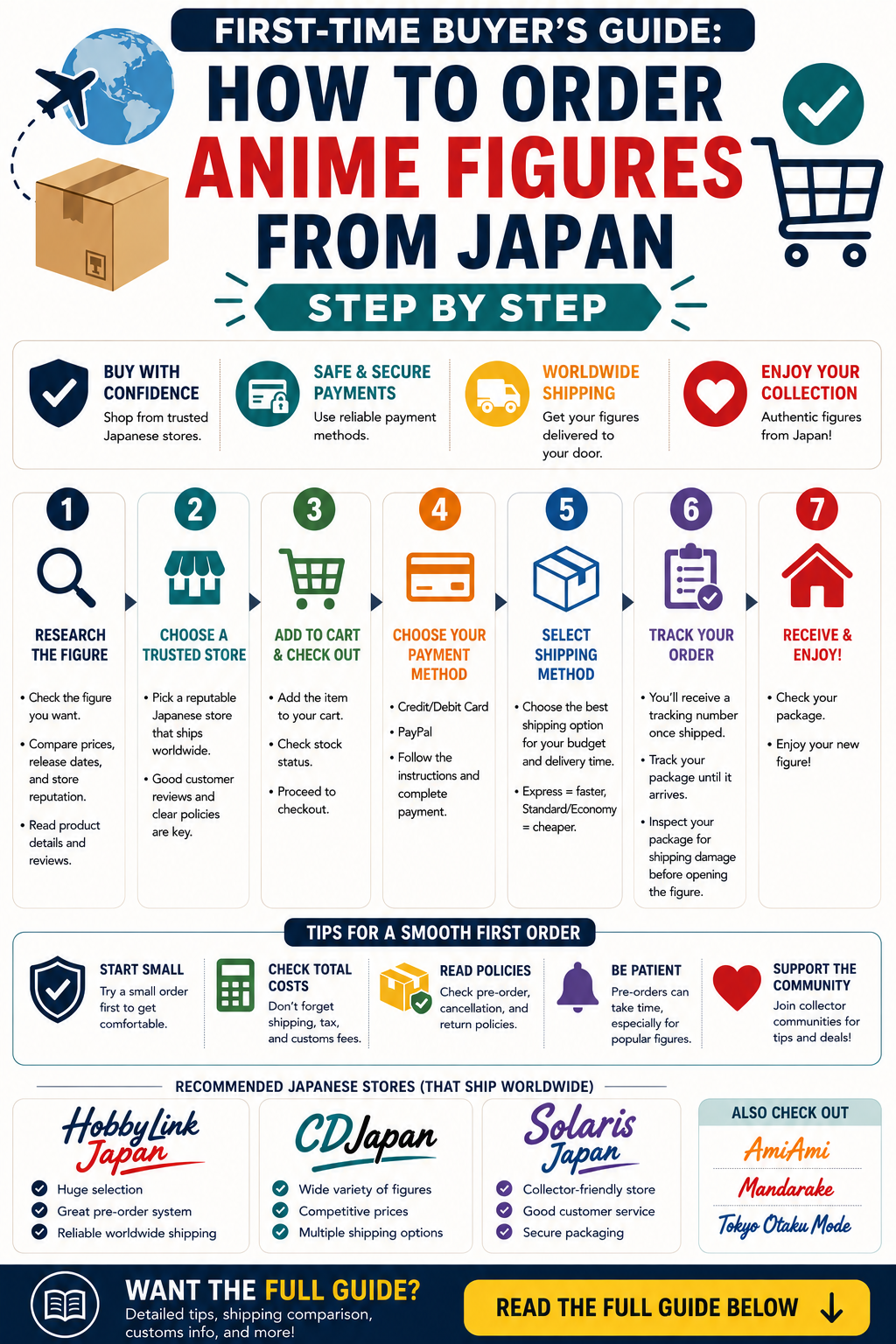
    Most Japan-based figure retailers require an account before checkout, even for a one-time order. This is normal and usually takes under five minutes.

    1. Sign up with your email, or in some cases through a social login option
    2. Enter your shipping address in the Latin alphabet. International retailers are built to handle this — don’t worry about needing to know any Japanese
    3. Set your currency and language preferences, if the store offers them (most of the retailers I recommend default to English automatically for overseas visitors)
    4. Add a payment method. Credit and debit cards are almost universally accepted; some stores also support PayPal

    One small tip: double-check your address formatting matches what the store expects (some ask for postal code before city, others after) — a mismatched address is one of the more common reasons for a delayed shipment.

    Part 2: Buying an In-Stock Item

    This is the simpler of the two paths, and a good way to get comfortable with a new store before committing to a preorder.

    1. Search for the item by name, or browse by category if you’re not sure exactly what you want yet
    2. Check the product page carefully — confirm it’s the actual release version you want (re-releases and variant colorways are common, and it’s easy to grab the wrong one if you’re skimming)
    3. Add it to your cart, and check the shipping cost estimate at this stage rather than waiting until final checkout — most stores let you preview this before you commit
    4. Choose your shipping method. This is usually where you’ll pick between faster/more expensive and slower/cheaper options
    5. Complete payment. For in-stock items, you’re typically charged immediately
    6. Wait for processing and dispatch. Most retailers process in-stock orders within a few business days before it actually ships

    Part 3: Placing a Preorder (Where Most Confusion Happens)

    Preorders work differently from in-stock purchases, and the details vary meaningfully by store — this is genuinely the part I’d recommend reading closest before your first preorder.

    1. Find the preorder listing and confirm the estimated release month (these are estimates, not guarantees — delays of a month or more aren’t unusual, and can happen for reasons entirely outside the retailer’s control)
    2. Check the payment timing policy before you commit. This is the detail that catches people off guard: some stores charge your card in full the moment you place the preorder, others only charge once the item is ready to ship, and some take a deposit upfront with the balance due later. HobbyLink Japan’s “pay when it ships” model, for example, means your money isn’t tied up for months before the figure even exists — worth knowing if you’re preordering something releasing far in the future
    3. Confirm what’s included. Check whether bonus parts, first-run extras, or store-exclusive accessories are part of the listing, since these are sometimes tied to ordering before a specific date
    4. Place the order and note the estimated ship date, but hold that date loosely — treat it as a rough guide rather than a fixed promise
    5. Watch for a payment reminder if your store takes payment closer to release rather than at order time — missing this can result in your preorder being cancelled

    Part 4: Waiting, Tracking, and Delivery

    Once your order (in-stock or preorder) has shipped, here’s what typically happens:

    • You’ll receive tracking information, usually by email, once the package leaves the warehouse
    • Delivery timing depends on the shipping method you chose — express options are faster but pricier, economy options take longer but cost less
    • Customs may add extra time and cost at this stage, depending on your country. If you haven’t already, it’s worth reading my breakdown of shipping and customs costs by country so nothing at delivery catches you off guard
    • Inspect the package before opening the figure fully, especially for your first order — check for shipping damage on the outer box before assuming any issue is with the figure itself

    Tips for a Smoother First Order

    • Start smaller. Your very first order doesn’t need to be an expensive preorder — a small in-stock item is a low-risk way to learn how a specific store’s process works before committing to something bigger
    • Keep your confirmation emails. If anything goes missing from a multi-item order, having the original confirmation makes resolving it much faster
    • Don’t mix preorders and in-stock items in one order unless you’re prepared to wait. Many stores ship combined orders together, which means your in-stock item could sit waiting for months until the preorder is ready
    • Know your figure type before you shop. If you’re still deciding between styles, my Nendoroid vs Figma vs Scale Figure guide covers the tradeoffs
    • Budget for the real total, not just the sticker price. Between shipping and potential customs charges, your actual cost is often meaningfully higher than the listed price — plan for that ahead of time rather than being surprised at checkout or delivery

    Frequently Asked Questions

    Do I need to speak Japanese to order from these stores? No. HobbyLink Japan, CDJapan, and Solaris Japan are all built for English-speaking overseas customers, with English product pages, checkout, and customer support.

    When am I actually charged for a preorder? It depends entirely on the store — some charge at order time, others when the item ships, and some take a partial deposit. Always check the specific store’s policy before placing a preorder, since this varies more than most first-time buyers expect.

    What happens if a preorder gets delayed? Delays of a month or so are common in the industry and usually stem from manufacturing, licensing, or shipping logistics outside the retailer’s control. Legitimate stores will typically update the estimated ship date on your order rather than leaving you in the dark — if a store goes silent on a significant delay, that’s worth following up on directly.

    Can I cancel a preorder if I change my mind? This depends on the store’s policy and how close you are to the release date. Some stores, like HLJ, explicitly allow preorder cancellations before release — this is one of the reasons I recommend them for first-time buyers specifically.

    Final Thoughts

    The actual mechanics of ordering from Japan aren’t complicated once you’ve done it once — the friction is almost entirely in not knowing what to expect the first time. Start with something small and in-stock, get comfortable with how your chosen store handles shipping and confirmation emails, and the rest tends to click into place quickly.

    If you haven’t already picked a store, my full comparison of HobbyLink Japan, CDJapan, and Solaris Japan is the natural next step before placing your first order.