Affiliate Disclosure: This post contains affiliate links. If you buy through one of them, I may earn a small commission at no extra cost to you. I only recommend stores I’ve actually ordered from or researched thoroughly — my opinions are my own.
The Problem: “1/7 Scale” Doesn’t Actually Tell You the Height
If you’ve shopped for scale figures for more than a few minutes, you’ve run into a genuinely confusing piece of terminology: the scale ratio. A “1/7 scale” figure and a “1/8 scale” figure sound like they should have an obvious, predictable size difference — but then you look at two different 1/7 scale figures and they’re noticeably different heights, and the whole system starts to feel less useful than it should be.
In my experience, the confusion usually comes from treating scale as if it directly tells you a figure’s height, when it actually tells you something slightly different: how much the character has been shrunk down from their assumed real-life height. Once that distinction clicks, the rest of this makes a lot more sense.
Who This Article Is NOT For
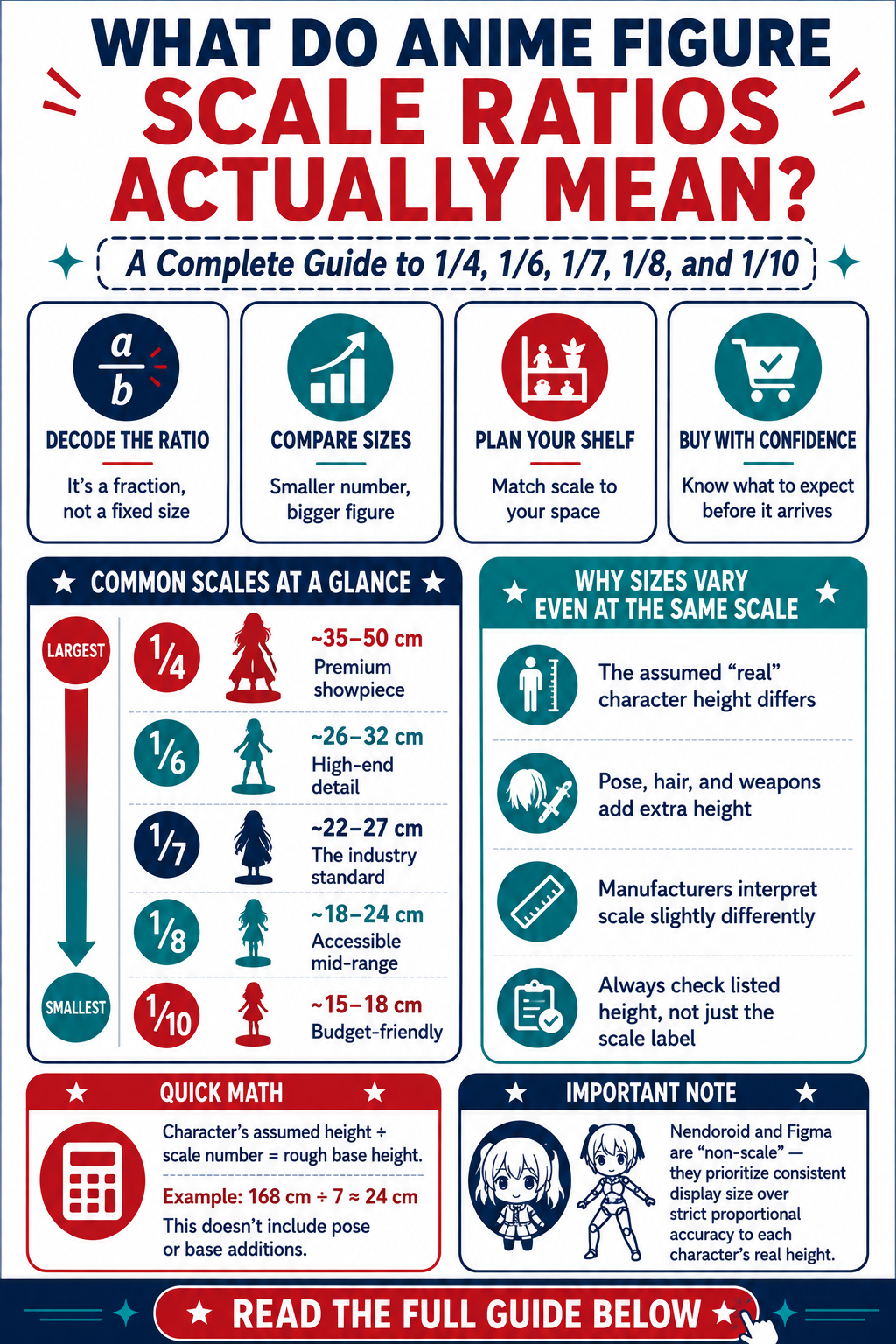
- If you only collect Nendoroids or Figma, scale ratios largely don’t apply to you — those are “non-scale” lines that prioritize a consistent display size over strict proportional accuracy.
- If you’ve already got a solid handle on scale ratios, this is probably too introductory to be useful — this is written for collectors who are newer to the scale figure side of the hobby specifically.
- If display space genuinely isn’t a constraint for you, some of the space-planning advice here matters less — buy whatever scale suits the figure best.
How Scale Ratios Actually Work
1. Scale is a ratio applied to an assumed real-life character height, not a fixed figure size. Manufacturers estimate what the character would stand at “in real life” (often somewhere in the 150–180 cm range depending on the character) and divide by the scale number.
2. The same scale label can still produce different heights, because the underlying assumed character height varies, and because things like hair, weapons, wings, or a dramatic pose add to the figure’s actual footprint beyond the “base” scaled height.
3. Smaller number after the slash means a bigger figure. This trips people up constantly — 1/6 is larger than 1/8, because you’re dividing by a smaller number.
Quick Reference: Common Scales
| Scale | Typical Height Range | General Price Tier | Best For |
|---|---|---|---|
| 1/4 | Roughly 35–50 cm | Premium ($300+) | A single showpiece centerpiece; requires serious dedicated display space |
| 1/6 | Roughly 26–32 cm | High-end ($150–400+) | Maximum detail at a size still manageable for a well-planned shelf |
| 1/7 | Roughly 22–27 cm | Mid-to-premium ($100–300+) | The modern industry standard — the sweet spot most collectors default to |
| 1/8 | Roughly 18–24 cm | Accessible mid-range ($80–200+) | Great detail-to-footprint ratio without demanding too much shelf space |
| 1/10 | Roughly 15–18 cm | More budget-friendly | Smaller collections, tighter shelf space, still with real sculpted detail |
Prices above are rough general ranges, not fixed numbers — manufacturer, character complexity, and how recently a figure was released all shift where a specific piece lands.
Why Two Figures of the Same Scale Can Look Different Sizes
This is the part that catches new collectors off guard most: scale describes a ratio, not a guaranteed final height, and several things push the actual size around:
- The assumed “real” height of the character varies. A character assumed to be 180 cm tall will produce a noticeably bigger 1/7 scale figure than a character assumed to be 155 cm tall, even though both are labeled the same scale.
- Pose and accessories add height beyond the base figure. A dynamic jumping pose, flowing hair, a raised weapon, or an elaborate display base can all push a figure’s total measured height well past what the “pure” scale math would suggest.
- Manufacturers don’t interpret scale with perfect consistency. Most companies follow similar general standards, but it’s genuinely common for one manufacturer’s 1/7 to read slightly larger or smaller in person than another’s — this isn’t necessarily an error, just a difference in sculpting interpretation.
Because of this, treat the scale number as a useful starting filter, not a precise measurement — always check the actual listed height (and ideally, the height including the base) before assuming exactly how a figure will fit your shelf.
Choosing a Scale Based on Space and Budget
- Tight or limited shelf space: Lean toward 1/8 or 1/10. You still get real sculpted detail without needing a dedicated display case or wide shelf run.
- Standard bookshelf or display cabinet: 1/7 is genuinely the industry default for a reason — it balances presence and detail against a manageable footprint, which is part of why it’s so common.
- A single character you want as a true centerpiece: 1/6 or 1/4, if your budget and space both allow for it. These sizes are meant to command attention, not blend into a lineup.
- Building a matched, uniform-looking shelf across multiple characters: Try to stick to one scale (commonly 1/7 or 1/8) across your collection, since mixing scales — while still visually fine — creates a more varied, less uniform display hierarchy.
A Quick Way to Estimate Height Yourself
If you know (or can find) the manufacturer’s assumed character height, you can roughly estimate a figure’s base height yourself: divide the character’s assumed height by the scale’s denominator. A character assumed to be 168 cm tall at 1/7 scale would come out to roughly 24 cm as a baseline — though remember this doesn’t account for pose, hair, or base additions, so treat it as a rough starting estimate rather than a guarantee.
Frequently Asked Questions
Is a bigger scale number always a bigger figure? No — it’s the opposite. Since scale is expressed as a fraction, a smaller denominator (like 1/6) means a larger figure than a bigger denominator (like 1/10), because you’re dividing the assumed real height by a smaller number.
Why do Nendoroid and Figma not use scale ratios? These are considered “non-scale” lines specifically because they prioritize a consistent, comparable display size across different characters rather than strict proportional accuracy to each character’s actual height — a very tall character and a very short character end up roughly similar sizes in these lines, which breaks true scale logic on purpose.
Which scale is the best value for a new collector? 1/8 scale is often recommended as a strong starting point — it delivers real sculpted detail without the price or space demands of 1/6 or 1/4, making it a practical entry point before committing to larger, pricier pieces.
Does a listed height include the display base? This varies by manufacturer and listing, so it’s worth checking the specific product description — a figure’s “true” height and its height including a tall or elaborate base can differ meaningfully, which matters if you’re planning shelf clearance carefully.
Final Thoughts
Scale ratios are genuinely useful once you know what they’re actually measuring — a fraction applied to an assumed real-life height, not a fixed, guaranteed figure size. Use scale as your first filter when comparing figures, but always check the actual listed height (base included, if you’re tight on shelf space) before finalizing a purchase, since pose, accessories, and manufacturer interpretation can shift the real-world size more than the scale label alone would suggest.
If you’re still deciding between scale figures and other formats entirely, my Nendoroid vs Figma vs Scale Figure guide is the right place to start, and my manufacturer comparison can help you understand how different companies approach scale and detail differently once you’ve settled on a size.