Affiliate Disclosure: This post contains affiliate links. If you buy through one of them, I may earn a small commission at no extra cost to you. I only recommend stores I’ve actually ordered from or researched thoroughly — my opinions are my own.
The Problem: You Found a Character You Love, and Now There Are Five Different Figures of Them
Here’s the moment that trips up almost every new collector: you finally decide to buy your first figure, you search the character’s name, and suddenly you’re staring at a Nendoroid, a Figma, and two or three scale figures — all of the same character, all wildly different prices, and nothing on the product page actually explains why.
In my experience, this is where a lot of people either panic-buy the cheapest option and end up disappointed, or overspend on something way more detailed than they actually wanted for their first purchase. Neither outcome feels great.
The truth is, “Nendoroid,” “Figma,” and “scale figure” aren’t just brand names — they’re entirely different categories of product, built for different purposes, at different price points, with different tradeoffs. Once you understand what separates them, picking the right one becomes obvious. That’s what this guide is for.
Who This Article Is NOT For
- If you already know exactly what you want and just need to know where to buy it safely, skip ahead to my comparison of trusted Japan-based figure stores instead.
- If you’re specifically hunting for prize figures (the cheaper figures you’d win from a claw machine or crane game in Japan, or their retail equivalents), that’s a different category entirely with its own quality expectations — this guide focuses on the three main collector-grade categories.
- If budget isn’t a concern and you just want “the best one, whatever it costs”, the short answer is a premium scale figure from a manufacturer like Alter — but keep reading anyway, because “best” really does depend on what you’re going to do with it.
How I’m Comparing These (Selection Criteria)
1. What the figure is actually built for. Some figures are designed to be posed and played with. Others are designed to sit still and look as detailed as possible. That single distinction drives almost every other difference between the three categories.
2. Realistic price-to-value expectations. I’m not just listing sticker prices — I’m looking at what you’re actually getting for that money, so you can judge whether a category fits your budget before you fall in love with a specific figure.
3. Practical collecting factors. Display space, durability, assembly requirements, and how forgiving each type is for a first-time buyer.
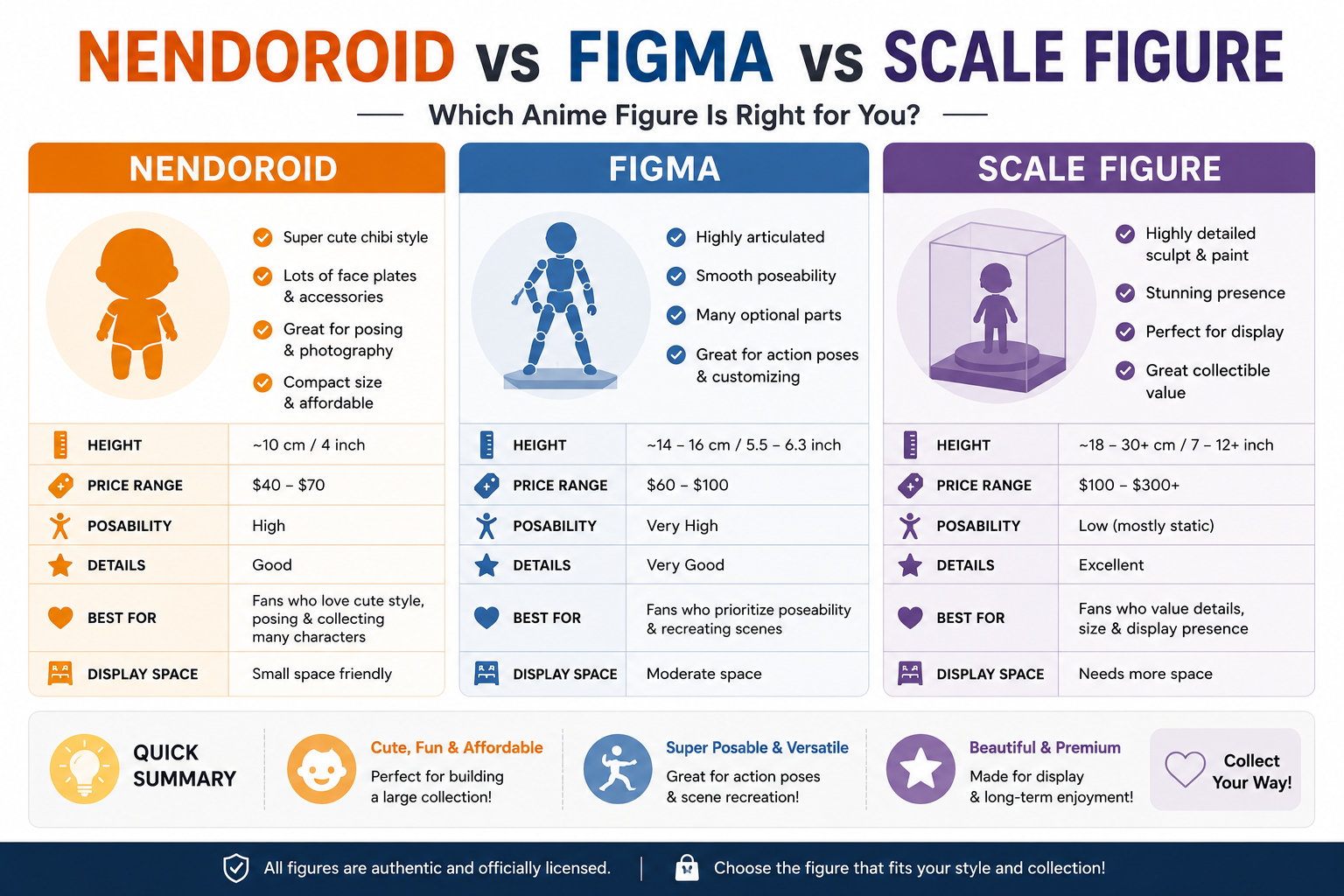
Quick Comparison Table
| Nendoroid | Figma | Scale Figure | |
|---|---|---|---|
| Made by | Good Smile Company | Max Factory (distributed by Good Smile Company) | Alter, Kotobukiya, Freeing, Yamato, Good Smile Company, and others |
| Style | Chibi / super-deformed, exaggerated proportions | Realistic proportions, action-figure-like | Realistic proportions, often dynamic sculpted poses |
| Typical height | Around 10cm | Around 12–15cm | Varies by scale (1/7, 1/8 common), often 20cm+ |
| Posable? | Some articulation, limited by chibi design | Highly articulated, built for posing | No — sculpted in a fixed pose |
| Typical price range | Roughly $50–70 | Roughly $60–90 | Roughly $80–300+ |
| Best for | Cute displays, photography, casual collecting | Dynamic scenes, action poses, versatility | Serious detail, showpiece collecting |
The Three Categories, Explained
Nendoroid — The Cute, Customizable Desk Companion
Nendoroids are Good Smile Company’s chibi-style line — big heads, small bodies, and an emphasis on charm over realism. What makes them special isn’t just the look, though; it’s the sheer number of interchangeable parts. Most Nendoroids ship with multiple face plates for different expressions, swappable hands, and small props that let you recreate specific scenes or just give the figure some personality.
Pros:
- Generally the most affordable of the three main categories
- Interchangeable face plates make them genuinely fun to photograph and display differently over time
- Small footprint, so you can fit a lot of them on one shelf
- Huge catalog — if a character has any figure at all, there’s a good chance it’s a Nendoroid
Cons:
- Articulation is real but limited compared to a Figma — the chibi proportions restrict how dynamic a pose can look
- Some collectors find the exaggerated style doesn’t suit “serious” characters from darker or more mature series
- Small accessories are easy to lose, and swapping parts too often can loosen the joints over time
In my experience, Nendoroids are the best entry point for someone who isn’t sure yet how deep into collecting they want to go. They’re cheap enough that a bad purchase doesn’t sting, and versatile enough to stay fun long after the first unboxing.
Figma — Built for Motion
Figma is Max Factory’s line (distributed through Good Smile Company), and the entire design philosophy is different from Nendoroid: realistic proportions, engineered joints, and a level of articulation that lets you recreate almost any pose from the source material. Where a Nendoroid is meant to sit cutely on a shelf, a Figma is meant to look like it’s mid-action.
Pros:
- The articulation is genuinely impressive — shoulders, hips, ankles, and more all move in ways that keep the sculpt looking natural even mid-pose
- Comes with multiple hands, face plates, and often weapons or props for recreating specific scenes
- Scale is close to other popular collectible lines, so they display well alongside similar-sized figures
- Excellent for anyone who wants to actually photograph their collection, not just display it statically
Cons:
- More expensive than Nendoroids for a similar-sized figure
- Visible joints can bother collectors who prefer a completely seamless, statue-like look
- Posing takes a bit of practice — badly positioned joints can look awkward until you get a feel for the range of motion
In my experience, Figma is the category I recommend to anyone who’s into battle or action-heavy series specifically because static poses just don’t do those characters justice. A Figma of a character mid-attack looks completely different — and better — than the same character sitting still.
Scale Figures — The Showpiece
Scale figures are where the “statue” mentality takes over. These aren’t designed to be posed or played with at all — they’re sculpted in one fixed position, usually to a specific scale ratio (1/7 and 1/8 are the most common), and the entire focus is on sculpt quality, paint detail, and presentation. Brands like Alter, Kotobukiya, Freeing, and Yamato specialize in this category, and even Good Smile Company produces premium scale lines alongside their Nendoroid and Figma work.
Pros:
- The detail level is simply on another tier — paint work, fabric texture, hair strands, and dynamic sculpted poses that no articulated figure could replicate
- Larger size makes them genuine centerpiece pieces for a shelf or display case
- No loose joints, no missing parts to lose — what you unbox is the finished piece
Cons:
- Significantly more expensive, and prices climb fast for premium manufacturers or complex sculpts
- Takes up real shelf space — a few scale figures can fill a shelf that would hold a dozen Nendoroids
- Zero posability — you’re committing to whatever pose the sculptor chose
- More fragile in some cases, particularly figures with thin extended parts (weapons, hair, flowing fabric)
In my experience, scale figures are worth the jump once you already know which characters mean the most to you. They’re not a great “let’s see if I like collecting” purchase — they’re a “this character deserves the best version I can find” purchase.
Which One Should You Actually Buy? (By Use Case)
“I’m buying my very first figure and don’t want to overspend before I know if I’ll like collecting.” Start with a Nendoroid. Low financial risk, small footprint, and genuinely charming even as a one-off purchase.
“I love battle/action anime and want my figures to look dynamic, not just standing there.” Go Figma. The articulation exists specifically for this — a static figure of a character known for combat scenes tends to feel like it’s missing the point.
“I have one character I’m truly devoted to and want the best possible version.” This is scale figure territory. Save up, pick a reputable manufacturer, and treat it as a centerpiece purchase rather than a casual one.
“I want variety without running out of shelf space.” Mix Nendoroids in with a couple of Figma or scale pieces. A lot of experienced collectors end up doing exactly this — Nendoroids fill out the collection, while one or two larger pieces anchor the display.
“I’m worried about getting a bootleg.” This applies to all three categories, but it’s worth saying clearly: authentic Nendoroid, Figma, and scale figures from Good Smile Company, Max Factory, Alter, and similar manufacturers are not cheap. If you see one priced dramatically below typical retail — especially on a marketplace listing rather than a proper retailer — treat it as a red flag. Sticking to trusted retailers who specialize in Japanese imports is the simplest way to avoid this entirely.
Frequently Asked Questions
What is a Nendoroid? A Nendoroid is a chibi-style collectible figure made by Good Smile Company, recognizable by its oversized head, small body, and interchangeable face plates and accessories. They’re typically around 10cm tall and priced in the $50–70 range.
What is a Figma figure? Figma is a line of highly articulated, realistically proportioned figures made by Max Factory and distributed by Good Smile Company. Unlike Nendoroids, Figma figures are built specifically for dynamic posing, with engineered joints and interchangeable parts for recreating action scenes.
Are Nendoroids worth it? For most new collectors, yes. They’re the most affordable of the three main categories, take up relatively little shelf space, and the interchangeable parts keep them fun to display in different ways long after your first unboxing.
Is a Figma or a Nendoroid better? Neither is objectively “better” — they’re built for different things. Nendoroids lean into cute, static display and affordability. Figma figures lean into realistic proportions and posability, at a somewhat higher price. The right choice depends on whether you want charm or dynamic action.
Do scale figures come with a stand? Most scale figures include a base or stand as part of the sculpt itself, since they’re designed as a single fixed-pose piece rather than an assembled figure. Always check the individual product listing, as this can vary by manufacturer.
Final Thoughts
There’s no universally “better” category here — a Nendoroid isn’t a cheaper, worse version of a Figma, and a Figma isn’t a “budget” scale figure. They’re built for genuinely different purposes, and the right one depends on what you actually want out of your collection: charm and affordability, posability and action, or maximum detail as a showpiece.
If you’re still not sure, my honest advice for a first purchase is to start small with a Nendoroid of a character you already love, see how the collecting bug hits you, and go from there.
Once you’ve picked your category, the next question is where to actually buy it safely. I’ve put together a full breakdown of the Japan-based stores I trust for importing figures overseas — covering pricing, shipping, and which one fits different priorities. HobbyLink Japan is a great starting point if you want a low-risk preorder process, CDJapan is worth checking for preorder bonuses, and Solaris Japan is the easiest option if customs fees make you nervous.