Affiliate Disclosure: This post contains affiliate links. If you buy through one of them, I may earn a small commission at no extra cost to you. I only recommend stores I’ve actually ordered from or researched thoroughly — my opinions are my own.
The Problem: That “Great Deal” Might Not Be a Figure At All — It Might Be a Recast
Here’s an uncomfortable truth about figure collecting: bootlegs (often called “recasts” in the hobby, because they’re literally cast from a mold copied off an official figure) have gotten a lot better at looking real. A few years ago, spotting a fake was almost trivial — bad paint, obviously wrong packaging, a price that was suspiciously low. Today, some of these knockoffs are convincing enough to fool collectors who’ve been in the hobby for years, let alone someone buying their first figure.
In my experience, the moment this actually stings isn’t when you first suspect something’s off — it’s weeks later, when you finally compare your figure side-by-side against official photos and realize the hair is subtly wrong, the paint has bled slightly outside the lines, or the box just feels cheap in a way you can’t quite explain until you’ve held a real one.
This guide walks through exactly what to check, in the order I’d actually check it, so you can catch a fake before you buy — or at least before your return window closes.
Who This Article Is NOT For
- If you’re only buying from stores I’ve already vetted — HobbyLink Japan, CDJapan, and Solaris Japan all source directly from official distributors, so bootlegs essentially aren’t a risk there. This guide matters most if you’re buying from marketplaces, resellers, or anywhere outside a trusted specialist retailer.
- If you’re deliberately buying garage kits (GKs) or fan-made resin kits that are openly sold as unofficial, unlicensed pieces — that’s a different (and legal, as long as it’s disclosed) category from a bootleg being passed off as authentic.
- If you haven’t picked a figure type yet, back up to my Nendoroid vs Figma vs Scale Figure guide first — it’s easier to spot something wrong once you know what the real thing is supposed to look like.
How This Checklist Is Built
1. Check the packaging before the figure itself. Bootleggers often nail the sculpt reasonably well but cut corners hard on the box, since that’s the part original manufacturers actually spend real money protecting.
2. Check the details real manufacturers can’t afford to get wrong. Paint bleed, seam lines, and material quality are expensive to get right — legitimate companies invest in it, and copies almost always show the strain somewhere.
3. Check the context of the sale. Price, seller reputation, and where the listing lives tell you a lot before the figure even arrives.
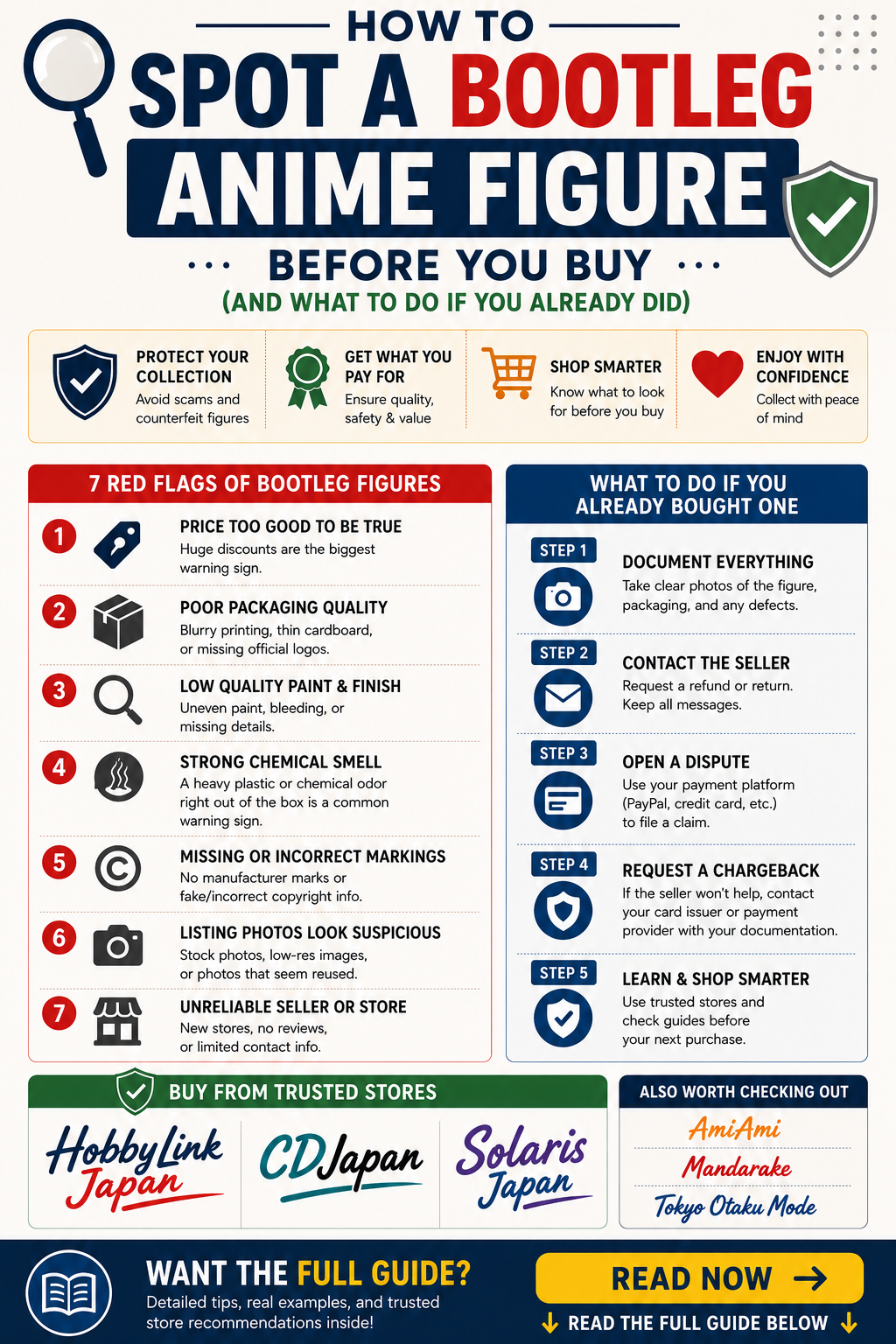
Quick Red-Flag Checklist
| Category | Authentic Figure | Bootleg / Recast |
|---|---|---|
| Price | Matches typical retail or preorder pricing | Noticeably below market price, “too good to be true” |
| Box printing | Crisp, high-resolution art and text | Blurry, pixelated, or slightly off-color printing |
| Authentication sticker | Holographic or metallic manufacturer seal present | Missing, or a flat sticker with no holographic effect |
| Hair/sculpt tips | Sharp, pointed detail matching official renders | Rounded, softened, or slightly misshapen edges |
| Paint application | Clean lines, no bleed between colors | Smearing, bleeding outside lines, uneven coverage |
| Smell (fresh from box) | Little to no odor, or mild plastic smell | Strong chemical or “heavy plastic” smell |
| Seller/listing | Authorized retailer or manufacturer-recognized shop | Marketplace listing using stolen official photos, vague seller history |
What to Actually Check, Step by Step
1. Start With the Box, Not the Figure
Before you even touch the figure itself, the box tells you most of what you need to know. Legitimate manufacturers like Good Smile Company, Bandai, and Kotobukiya spend real money on packaging because it’s part of protecting a premium product — bootleggers are usually working from scanned images of the original box art, which shows up as blurry or slightly pixelated printing once you look closely.
The single most reliable box-level check is the authentication sticker. Most major manufacturers place a holographic or metallic seal somewhere on the box — tilt it under a light and you should see a multi-layered, shifting logo effect. If that sticker is missing entirely, or present but completely flat with no holographic shimmer, that’s one of the strongest single signals you’re looking at a fake.
Watch out for sellers who explain away a missing sticker or box with phrases like “factory reject” or “unboxed unofficial stock.” Manufacturers don’t sell damaged or rejected stock through unofficial channels — that explanation is a workaround bootleg sellers use, not a real category of product.
2. Look at the Fine Detail Work
Once you’re looking at the actual figure, focus on the parts that are genuinely expensive to get right: hair tips, fabric texture, and small painted details like eyes or emblem work.
Hair and sculpted edges are a surprisingly reliable tell. Authentic figures tend to have sharp, defined tips wherever the sculpt calls for it. Recasts are made from a mold taken off an existing figure, and that process tends to soften and round out fine points — so hair that should end in a crisp tip often looks slightly melted or blunt on a bootleg.
Paint application is another strong indicator. Look at the most visually complex areas of the figure — eyes, patterned clothing, small emblems — since that’s where a rushed paint job shows the most. Bleeding between colors, visible smearing, or paint that looks either too thin or oddly caked on are all signs of a lower-quality reproduction rather than an official production run.
3. Trust Your Nose (Seriously)
This sounds strange, but it’s a genuinely useful check: authentic figures typically have little to no smell straight out of the box, or at most a very mild plastic scent. Bootlegs are frequently made with cheaper, non-regulated materials, and a strong chemical or “heavy plastic” odor right after unboxing is a real warning sign — not proof on its own, but worth combining with the other checks above.
One caveat: older figures, or ones that have sat in a hot or sun-exposed environment, can develop an odor or slightly degraded paint from age rather than being fake. Use smell as one data point among several, not a standalone verdict.
4. Investigate the Listing Itself, Before You Even Buy
A lot of this can be checked before the figure ever ships:
- Price that’s dramatically below typical retail is the single biggest predictor of a bootleg. Authentic figures cost what they cost because of material quality and licensing — a steep discount almost always means something’s off.
- Stock photos vs. seller photos. If a listing only uses official promotional images and never shows an actual photo of the item the seller has in hand, be cautious — this is a common tactic for disguising a bootleg.
- Seller history and reviews. Check whether other buyers have specifically mentioned receiving a bootleg from that seller. On larger marketplaces, this is often searchable directly in the reviews.
- Where the listing lives. Marketplace listings (eBay, general marketplace apps, social media shops) carry meaningfully more bootleg risk than a dedicated, specialist retailer that sources directly from manufacturers or authorized distributors.
If You Think You Already Bought a Bootleg
- Compare against official reference photos from the manufacturer’s own product page, focusing on the checkpoints above (hair tips, paint bleed, box printing).
- If you bought through a major marketplace (eBay, Amazon, similar platforms), most have explicit buyer protection policies for counterfeit or “significantly not as described” items — file a claim through the platform rather than trying to negotiate directly with the seller.
- If you bought from a private seller or an unfamiliar site, a chargeback through your card issuer or payment provider is usually your strongest option once you have comparison photos ready.
The Simplest Long-Term Fix
Realistically, the checklist above is useful for marketplace purchases, secondhand buys, or anywhere you’re not 100% sure of the source. But the easiest way to avoid ever needing it is to buy from retailers that source directly from official distributors in the first place. That’s the whole reason I put together my comparison of trusted Japan-based figure stores — HobbyLink Japan, CDJapan, and Solaris Japan all source through legitimate channels, so this entire checklist becomes unnecessary if you’re ordering from them.
Frequently Asked Questions
What does “recast” mean in figure collecting? A recast is a bootleg figure made by taking a mold directly off an existing official figure, then producing unauthorized copies from that mold. The term is used somewhat interchangeably with “bootleg” in the collecting community, though recast specifically refers to this mold-copying process.
Are bootleg figures illegal? Yes — bootlegs are unlicensed reproductions that infringe on the original manufacturer’s and copyright holder’s rights. Beyond the legal issue, they’re also frequently made with lower-quality, non-regulated materials.
Can a bootleg figure look identical to the real thing in photos? Increasingly, yes. Some high-quality bootlegs are convincing enough in online listing photos that the differences only become clear once you inspect the packaging, paint, and sculpt details in person — which is why checking seller reputation and price before buying matters as much as inspecting the item after it arrives.
Is it safe to buy secondhand anime figures? It can be, but the bootleg risk is higher than buying new from an authorized retailer, since you’re relying entirely on the seller’s honesty and your own inspection. Apply the checklist above, and be especially cautious of secondhand listings priced well below typical resale value.