Affiliate Disclosure: This post contains affiliate links. If you buy through one of them, I may earn a small commission at no extra cost to you. I only recommend stores I’ve actually ordered from or researched thoroughly — my opinions are my own.
The Problem: A Hobby You Loved Starts Feeling Like an Obligation
Every collector eventually hits some version of this: a preorder shows up and instead of excitement, you feel something closer to obligation. A shelf that used to bring you joy starts to feel like clutter you have to manage. You keep buying because it’s what you do, not because you’re actually excited anymore.
In my experience, this is a genuinely normal part of long-term collecting, not a sign that something’s wrong with you or that you need to quit entirely. Hobbies ebb and flow, interests shift, and a collection built up over years doesn’t always keep pace with who you are now. This guide is about recognizing that shift honestly and figuring out what to actually do about it — whether that’s a small reset, a partial downsize, or just permission to slow down for a while.
Who This Article Is NOT For
- If you’re just going through a temporarily quiet period and still genuinely enjoy your collection, that’s not burnout — that’s just a normal ebb in any hobby. No need to overhaul anything.
- If you’re dealing with something that feels bigger than “my hobby isn’t fun right now” — a broader pattern affecting how you feel day to day — that’s worth talking through with a professional or someone you trust, not something a blog post about figure collecting can meaningfully address.
- If you’re just looking for practical selling logistics, skip ahead to my guide to selling figures safely instead.
Recognizing the Signs (Without Overreacting to Normal Ups and Downs)
A few patterns worth paying attention to, without treating any single one as a crisis:
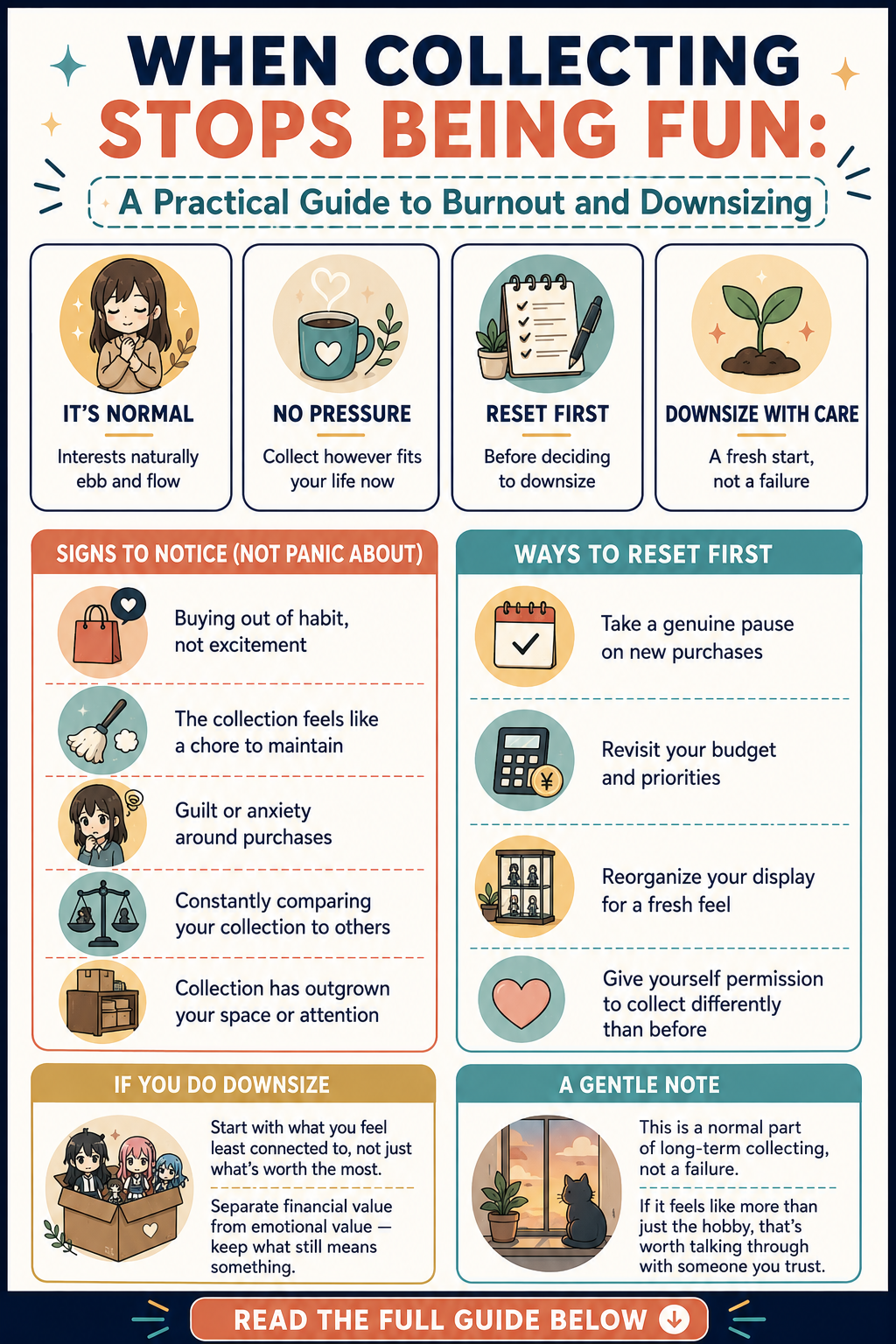
- Buying out of habit rather than genuine excitement — preordering something mostly because you always preorder from that series, not because you’re actually looking forward to it
- The collection feeling like a chore to maintain — dusting, organizing, or even just looking at your shelf starts to feel like a task rather than something you enjoy
- Guilt or anxiety around purchases, rather than the anticipation that used to come with them
- Comparing your collection to others’ constantly, in a way that makes your own feel inadequate rather than something to enjoy on its own terms
- A growing gap between the size of your collection and the space or attention you can actually give it
None of these individually mean you need to make a big change — they’re worth noticing as a pattern over time, not reacting to after one slow month.
Why This Happens
Interests genuinely shift. The characters, shows, and figure styles that excited you five years ago might not reflect who you are now — that’s not a failure of commitment, it’s just normal change.
Completionism can quietly become pressure. If you’ve built a habit of “collecting everything from a series,” that habit can outlast the actual enjoyment, turning into an obligation rather than a choice.
Social comparison changes how a hobby feels. Constantly seeing other collectors’ hauls and displays can shift collecting from something personal into something performative, which tends to drain the actual enjoyment out of it over time.
A collection can simply outgrow your actual life. Space, budget, and time are all finite, and a collection that made sense at one size can start to feel unmanageable as it grows past what you can realistically maintain or enjoy.
Practical Ways to Reset Without Necessarily Downsizing
- Take a genuine pause on new purchases, even a short one, without treating it as “quitting.” A month or two without buying anything can clarify whether you actually miss it or were just on autopilot.
- Revisit your collecting budget and priorities. Sometimes burnout is really about spending on things you don’t care about that much, rather than the hobby itself — tightening your priorities can restore some of the excitement.
- Reorganize your display. Sometimes a stale-feeling collection just needs a genuinely fresh arrangement — my display and shelf setup guide has practical ideas if it’s been a while since you’ve changed anything.
- Give yourself explicit permission to collect less, or differently, than you used to. Nothing says a hobby has to stay the same shape forever — moving from “everything from this series” to “only the pieces I genuinely love” is a completely valid shift, not a lesser way to collect.
When Downsizing Makes Sense
If a genuine reset doesn’t bring the enjoyment back, or if your collection has simply outgrown your space or budget in a way that’s causing real stress, downsizing is a completely reasonable next step — not a failure or an admission that you wasted money.
- Start with what you feel least connected to, not necessarily what’s worth the most. A figure you barely look at is a better candidate for selling than a lower-value piece you still genuinely love.
- Separate “financial value” from “emotional value” honestly. It’s okay to keep a lower-value figure because it still means something to you, and sell a higher-value one that doesn’t — the goal is a collection that fits your current life, not maximizing resale value.
- Sell in batches rather than all at once, if the idea of downsizing feels overwhelming. You don’t need to decide on your entire collection’s fate in one sitting.
- When you’re ready, my guide to selling figures safely covers pricing, platforms, and avoiding scams so the practical side doesn’t add extra stress to what’s already a bit of an emotional process.
Frequently Asked Questions
Does feeling burned out on collecting mean I should quit entirely? Not necessarily — for a lot of collectors, it’s a signal to pause, reset priorities, or downsize rather than a sign the hobby itself was a mistake. Interests naturally ebb and flow over years of collecting.
Is it normal to feel guilty about downsizing a collection I spent a lot on? Yes, this is a common feeling, but it’s worth separating the money already spent from the decision in front of you now — a figure sitting unused isn’t giving you anything back just because you paid for it, and selling it doesn’t erase the enjoyment you got from it originally.
How do I know if I’m burned out versus just going through a quiet period? A quiet period usually resolves on its own with time; burnout tends to persist as a pattern — buying out of habit rather than excitement, or the collection feeling like a chore — over a longer stretch. If you’re not sure, a genuine pause on new purchases is a low-risk way to find out.
Should I sell figures I still love just because I haven’t looked at them recently? Not necessarily — “haven’t looked at it recently” and “don’t care about it anymore” aren’t the same thing. This is where separating emotional and financial value matters; keep what genuinely still means something to you, regardless of how often you’ve displayed it lately.
Final Thoughts
Collecting is supposed to bring you something — enjoyment, connection to characters and shows you love, a creative outlet, whatever it is for you personally. When it stops doing that, it’s worth taking seriously without treating it as a crisis. Sometimes the fix is a short break, a tighter budget, or a fresh shelf arrangement. Sometimes it’s genuinely time to let some of the collection go. Either way, there’s no obligation to keep collecting exactly the way you always have if it’s not serving you the way it used to.
If you do decide it’s time to downsize, my guide to selling figures safely is the practical next step — and if you’re staying in the hobby but want to reset how you approach it going forward, my budgeting guide is a good place to rebuild from.
コメントを残す